IN THIS ISSUE
- A sage for the ages
- When fieldwork gets wild
- The search for frosted elfin
- Young raptors you need to see
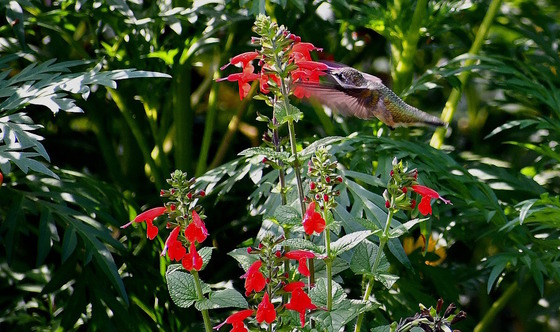 A ruby-throated hummingbird feeding at red salvia blooms (Terry W. Johnson)
By TERRY W. JOHNSON
For the past several years, the native version of the plant called red salvia has become one of my favorite garden flowers.
While a number of plants sold in nurseries and big box stores are called red salvia, don’t confuse them with the true red salvia (Salvia coccinea) – also commonly known as scarlet sage.
My wife deserves the credit for bringing red salvia to our yard. A fan of butterflies and hummingbirds, she is constantly searching for plants that attract these colorful backyard residents. A few years ago, that search led her to red salvia.
The seeds she planted near our deck have since sold us on this plant’s virtues. …
Read Terry’s column and you’ll be sold, too!
Terry W. Johnson is a retired DNR program manager and executive director of TERN, friends group of the Wildlife Conservation Section. Check out past columns and his blog. Permission is required to reprint a column.
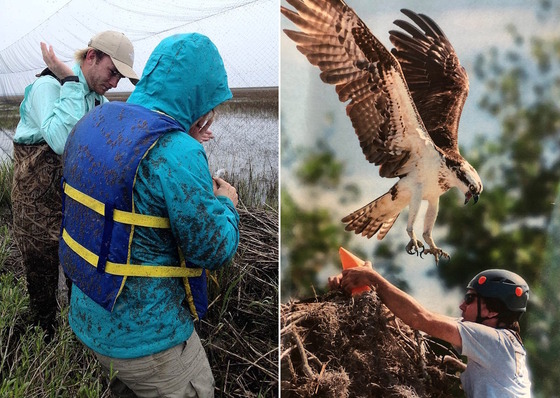 All in a day's work: swarms of sand gnats and an overprotective osprey (Tim Keyes/GaDNR; Michael Levine)
Every job has its challenges. But wildlife fieldwork has some truly wild ones.
From a biblical-grade plague of biting bugs to an unnerving encounter with cave vultures, here are a few examples from the When Bad Things Happen to Good Biologists department.
SAND GNAT HELL
In spring 2015, sand gnats on the Georgia coast reached what locals called a new high – or low – for misery. Which was unfortunate for DNR Program Manager Tim Keyes, U.S. Fish and Wildlife Service biologist Billy Brooks and Elizabeth Hunter, now an assistant professor at Virginia Tech. The three were banding saltmarsh sparrows that March on the Medway River near Richmond Hill.
The work involves flushing sparrows into nets, carefully untangling them, recording data and adding leg bands. Translation: stuff that takes time and patience. At one point, Keyes photographed Brooks and Hunter gamely trying to "extract the birds when you couldn’t really breathe or see very well due to the bugs.”
Those gray patches on Hunter’s blue coat and vest? They’re mats of hungry gnats.
Keyes said the crew “processed the birds in a boat cruising at about 10 knots to avoid the bugs," returning to land only "quickly" to release them.
ONE ANGRY OSPREY
Andy Day never saw the osprey coming. The National Park Service biologist watching from the ground did, but she didn’t sound a warning, Day recalls with a wry chuckle.
One minute, Day, now a DNR wildlife technician, was reaching into an osprey nest 10 feet up in the Everglades to pluck feathers from a chick for a genetics study. The next, he’s shaking his head after a whack to the helmet.
In a picture snapped by a private photographer just before impact, the osprey appears to hover over Day. “It wasn’t hovering,” he said. “That was just a fast shutter speed. It was coming at full force.”
The osprey attacked again but he escaped unhurt. And to be fair, Day said the Park Service staffer did caution him at the start.
“She said, ‘This one is known to be a little aggressive. You might want to wear a helmet.’”
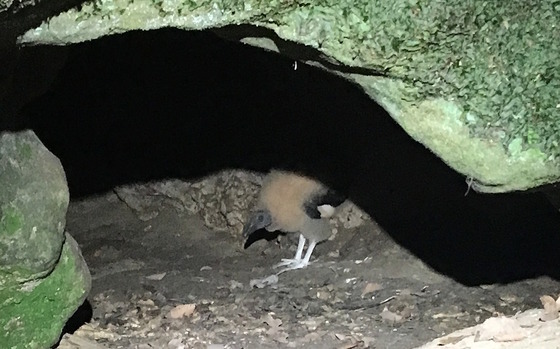 Small vulture, loud noise, big scare (Emily Souder)
AS IF CAVES WEREN'T SPOOKY ENOUGH
DNR Wildlife Conservation Section staff were counting tricolored bats emerging from a southwest Georgia cave in summer 2019 when they heard something, well, unexpected. Emily Souder and Laci Pattavina, now a Fish and Wildlife Service biologist, were greeted by this (listen) as they neared the cave entrance.
“We were sure it was a bobcat or some other large mammal that would soon attack!” said Souder, who has since become a wildlife consultant.
When the noise stopped, she and Pattavina gathered their courage and curiosity and moved closer. Which is when they discovered the source: a black vulture chick hissing from its nest in the cave.
A few weeks later, Souder visited the cave again and found a second vulture chick.
“It must be a great spot for them. They clearly they don’t mind the bats.”
Got a wild story about your work or recreation involving Georgia wildlife? Email it to rick.lavender@dnr.ga.gov.
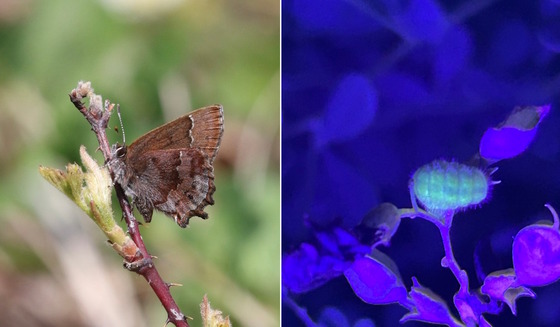 Frosted elfin: inconspicuous butterfly by day; glowing caterpillar by night (Michael Newton/ www.inaturalist.org/observations/357641885; Charlotte Brennan/ www.inaturalist.org/observations/297819704)
By JOSIE ELLIOTT and ANDREW CARROLL
Frosted elfin butterflies haven’t been seen in Georgia since 1967. That lack of documented sightings led in 2018 to the U.S. Fish and Wildlife Service categorizing Callophrys irus as extirpated in the state.
Yet DNR and others haven’t given up hope for these small, dull-colored butterflies. The agency’s Wildlife Conservation Section is in the first year of working with four other Southeastern states, conservation organizations and the public to search for frosted elfins.
The presence of frosted elfin is connected to the availability of host plants – those species required for reproduction and larval development. In Georgia, the lone known host is sundial lupine (Lupinus perennis), which grows in the Coastal Plain. But in more northern counties, frosted elfin caterpillars are also suspected of feeding on yellow wild indigo (Baptisia tinctoria).
Both species are commonly found in regularly disturbed areas, such as along railroads and roadsides, in airport approach zones, and under power lines. Open pine forests that are regularly burned may also support the plants.
With guidance from land managers, biologists and others, plus observations posted on iNaturalist, the Wildlife Conservation’s terrestrial invertebrate team has found promising sites in Georgia that might host frosted elfin. Ongoing projects to plant sundial lupine also could provide habitat, including for reintroducing the butterflies on protected lands.
The hunt for frosted elfin focuses on daytime surveys of sites where host plants are found. But night surveys are also planned because the larva actually glows under UV light! In other states, finding the butterflies has proven significantly easier when looking at night with UV flashlights.
Frosted elfin is in decline and will be considered for listing under the federal Endangered Species Act next year. Ongoing surveys for populations will be important for that determination.
HOW TO HELP
If you know of any large patches of host plants – sundial lupine or yellow wild indigo – in Georgia, please email details and photos to DNR at gabiodata@dnr.ga.gov.
PARTNER POWER
The multistate search for frosted elfin and its host plants includes Georgia, Florida, North Carolina, Virginia and Louisiana. DNR is also working with the McGuire Center for Lepidoptera and Biodiversity in Gainesville, Fla.; Tall Timbers in Tallahassee, Fla.; and The Jones Center at Ichauway in southwest Georgia.
Josie Elliott and Andrew Carroll are wildlife technicians with the DNR Wildlife Conservation Section’s terrestrial invertebrate team.
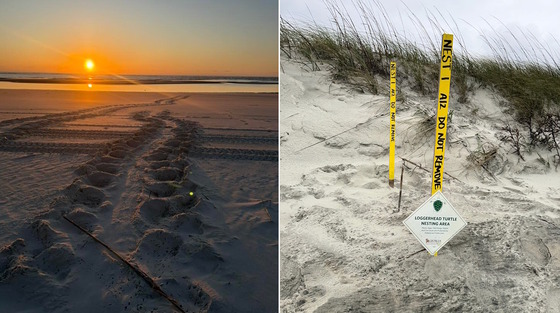 Tracks to St. Catherines' first nest (left) and Sea Island's first screened and marked (Sarah Krieger/SCI; Sea Island)
After starting on schedule this month, loggerhead sea turtle nesting in Georgia is surging, with nests reported on almost all barrier island beaches. The season’s first two nests were found May 6 on St. Catherines Island and Cumberland Island National Seashore. More than 200 have been documented since. Coastwide surveys by the Georgia Sea Turtle Cooperative began mid-month, with members expecting a busy summer monitoring the state’s primary nesting sea turtle.
An April surge in sea turtle strandings along the state’s coast – 27 the first two weeks of the month – may be connected to winter cold snaps that left the turtles in poor health and more susceptible to washing up on beaches and other shorelines, researchers say. Two-thirds of the strandings were plate-sized green sea turtles, a species and size more cold-tolerant and more abundant in shallow water in winter, and more at risk of cold-stunning when water temperatures drop below 50 degrees.
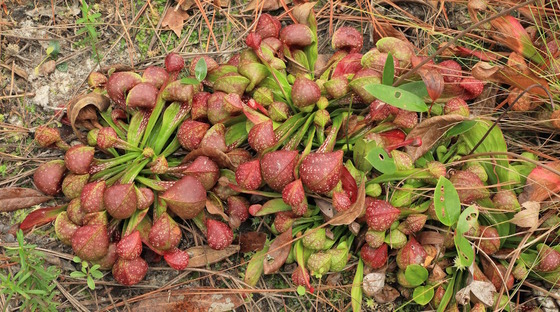 Parrot pitcherplants at Ohoopee Dunes (Alan Cressler)
Pitcherplants at Ohoopee Dunes Wildlife Management Area are benefiting from work by DNR’s Wildlife Conservation Section, Atlanta Botanical Garden, Chattahoochee Nature Center and others to boost populations at the WMA near Swainsboro. Site prep and outplantings from conservation collections this year included sweet (Sarracenia rubra), parrot (S. psittacina) and yellow (S. flava) pitcherplants, while there are also plans to sow purple pitcherplants (S. purpurea) using locally sourced seed.
About 115 young birders took part in Georgia’s annual Youth Birding Competition, which turned 20 this year. During the April 18 awards banquet at Charlie Elliott Wildlife Center, Cobb County’s Awesome Anhingas were crowned grand champions and High School Division winners after seeing or hearing 128 species in a 24-hour search ranging from the coast to Kennesaw Mountain in Atlanta. Plus: Who led our poll for best YBC team name? Lord of the Wings.
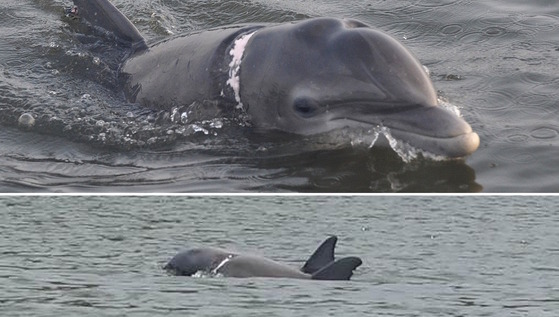 Waldo with scar in 2009 (top) and a calf this spring (Robin Perrtree/NOAA permit 14219; Chris Hintz/permit 27902)
An "entangled" dolphin seen near Isle of Hope in Chatham County thankfully turned out to be just another sighting of Waldo. Almost 20 years ago, the then-young bottlenose dolphin had a rubber ring stuck around its neck and cutting into its flesh. A multi-agency rescue removed the ring. But the white scars remain and Savannah State University’s dolphin science lab has monitored the dolphin since, nearly 90 sightings that include Waldo’s first known calf in 2020 and her latest last year. Report hurt or dead marine mammals: (800) 2-SAVE-ME (800-272-8363).
This calving season for North Atlantic right whales included the most mom-and-calf pairs since 2009 – 23 (three of them first-time moms) – plus sightings in the Southeast overall of 45 reproductive females and 54 males for a total (with the calves) of 122 whales. Other footnotes: 19 of the mom-calf pairs have been seen in the Northeast, meaning they migrated safely; 13 moms had calved in 2021 or 2022, a more normal interval than recent calving averages of seven to 10 years; the entangling fishing rope that killed the male named Division (catalog no. 5217) was snow crab ghost gear from Canadian waters; and comments on NOAA’s possible “deregulatory-focused modernization” of vessel speed limits and call for alternative ways to reduce vessel strikes – a leading cause of whale deaths and injuries – are due June 2. Watch: DNR’s Jessica Thompson joins a Georgia Conservancy “State of the Science” panel on right whales.
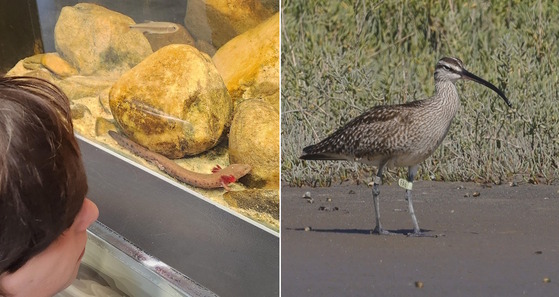 Mudpuppy at Joe Tanner Discovery Center; whimbrel on Jekyll Causeway (Berkeley Boone, Tim Keyes/GaDNR)
Quick hits:
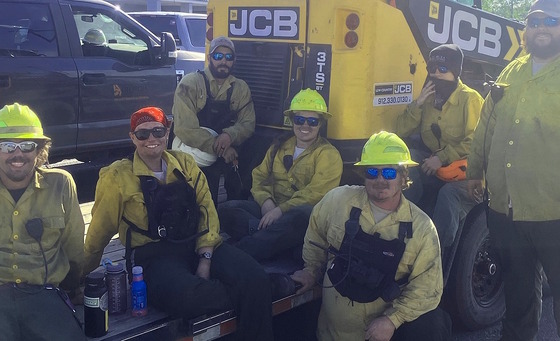 DNR staff answering the call to help fight wildfires in south Georgia (GaDNR)
Names in the news: As wildfires raged across parts of south Georgia last month, DNR Wildlife Resources Division staff were supporting partner agencies, working alongside Georgia Forestry Commission teams and using dozers, chainsaws, skid steers and type 6 engines to suppress the fires and protect communities. Tasha Messer of DeKalb County Recreation, Parks and Cultural Affairs was chosen the top mentor in DNR’s Youth Birding Competition for the second straight year. The award itself was renamed the David Hedeen Mentor Award this year in memory of the well-known Georgia birder who died in January. Hedeen’s 2004 invitation for DNR’s Tim Keyes to join the World Series of Birding in Cape May, New Jersey, led to Keyes starting the Georgia competition in 2006. Chris Hodge has been named the new colonel and director of the DNR Law Enforcement Division. Hodge began work with the agency as a game warden in 2001 and most recently served as captain of a 20-county region based in Brunswick. His promotion follows the retirement of Col. Mike England, a 35-year-plus employee of the division. DNR State Wildlife Action Plan Coordinator Dr. Brett Albanese and Wildlife Resources Division GIS analyst Liz Morata and specialist Dylan Severens discussed using ESRI to support conservation efforts in a May 12 webinar held by the Natural Areas Association. The presentation focused on DNR’s Wild Georgia Hub, which explores and explains Georgia’s latest State Wildlife Action Plan.
WHAT YOU MISSED ...
In the previous Georgia Wild:
- Click to help wildlife
- Why wrens like you
- Big turtles, big problems
- Blomquist blitz? We'll explain
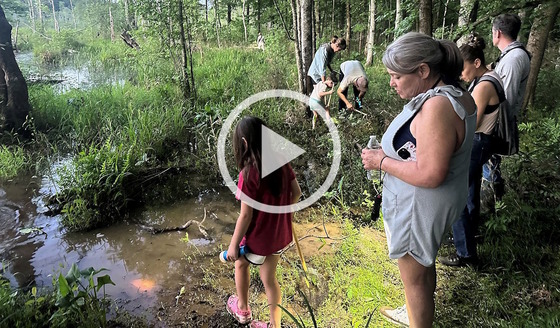 Looking and listening during an Oconee River Land Trust frog walk in Jackson County (Erin Cork/GaDNR)
(audio) "Local land trust hosts frog walk in wetland," WUGA-FM (91.7, 94.5, Athens)
Old utility poles, new life for oystercatchers in DNR project, Georgia Power
(audio) "Numbers of endangered right whale calves rebound, but threats remain," WUSF-FM (89.7, Tampa, Fla.)
"Sunbird uses tongue to suck up nectar," UC Berkeley
(audio) "Frown and Fabulous Fat Sleeper," Fish of the Week! podcast, U.S. Fish and Wildlife Service
"Ga. rolls out unwelcome mat for non-native species," (Thomasville) Times-Georgian. Related: (+video) "Hydrilla spreading across Lake Sinclair," WMAZ-TV (ch. 13, Macon); "Officials ask for help combating aquatic invasives," The Augusta Chronicle; "These crabs are racing up U.S. coast," BBC Discover Wildlife (study in Journal of Crustacean Biology).
"Wildfires threatened endangered species found only in two Ga. counties," The Current. Related: "Largest wildfire in Ga. history?" Savannah Morning News; "Drought, wildfires could impact wildlife for years," The Atlanta Journal-Constitution; "Why the Southeast is burning," The Conversation; "Drought shrinks wetlands, disrupts wildlife," WTOC-TV (ch. 11, Savannah).
"Right whale calving season produces most births since 2009," New England Aquarium. Also: CBS News, The Current, Canadian Broadcasting Corp.
"DNR youth birdathon still going strong," Grice Connect. Also: Lanier County News and others.
(+video) "Plastic landscape netting putting wildlife at risk," WRDW-TV (ch. 12, Augusta)
(+audio) "Snakes more active around Atlanta as temps rise," WSB-FM (95.5, Atlanta). Related: "What to do if you stumble across a snake," WSAV-TV (ch. 3, Savannah); Georgia snakes adapting to climate change," The Augusta Chronicle.
(+video) "DNR tips on how to handle Canada geese," WAGA-TV (ch. 5, Atlanta)
"Why Atlanta homeowners should add bat boxes," Axios Atlanta
"Want a pet raccoon in Georgia? Here's the law," Savannah Morning News
"GCSU tracking gorgeous bird vanishing from Ga. wetlands," Georgia Public Broadcasting, via The (Macon) Telegraph
"Birding is booming as Birds Georgia celebrates 100 years," Atlanta magazine
(+video) "Where have fireflies been, and why are they coming back to Camden?" WTLV-TV (ch. 12, Jacksonville, Fla.)
"Climate change, urbanization increasing wildlife encounters," The Augusta Chronicle
"New study: How bad for humans is wildlife trade?" Georgia Public Broadcasting
"Southern Conservation Trust, Fayetteville preserve native orchids," The (Fayetteville) Citizen
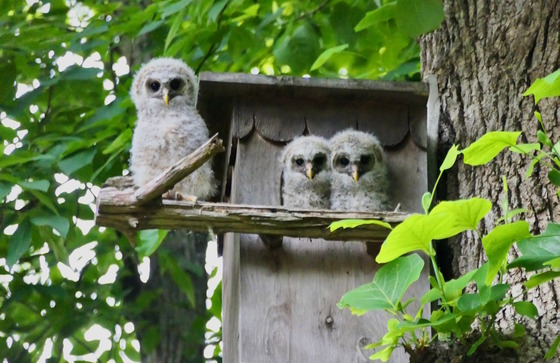 Three barred owl "floofs" peer from their nest box in Griffin (Linda May/GaDNR)
It was a good year for barred owls in the middle Georgia yard of Chris and Linda May. A nest box the couple put up five years ago in a large tulip poplar outside their Griffin home has seen a number of barred owl broods come and go. Yet this year the adult pair raised three owlets. (Linda, outreach coordinator of DNR’s Wildlife Conservation Section, calls the fluff-and-stuff young “floofs.”) The last of the owlets fledged May 2. But the family will stay together for several more months, Linda said, with the young honing their flying skills and begging food from their parents.
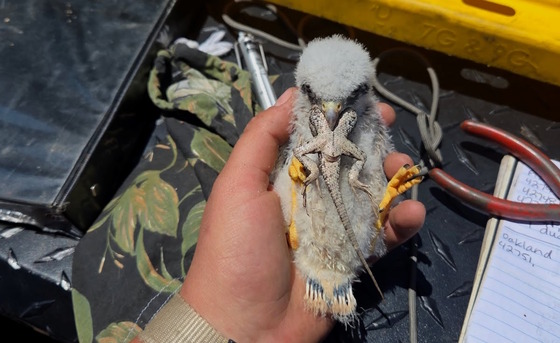 Kestrel banding with a fence lizard bonus (Aydreyel Schuh/GaDNR)
This American kestrel chick wasn't about to let a little leg banding interfere with lunch. Although the banding DNR does to help monitor these native falcons in middle and south Georgia is temporarily unsettling for young kestrels, senior wildlife biologist Nathan Klaus said a chunky chick banded last week by wildlife technician Aydreyel Schuh “absolutely refused to drop” an eastern fence lizard one of the parent birds had delivered to the nest box.
CREDIT: Georgia Wild masthead/osprey diving (Adobe Stock)
Top
|