IN THIS ISSUE
- When giving is easy
- Why wrens like you
- Big turtles, big problems
- Blomquist blitz (we'll explain)
(Editor's note: We're resending this issue in case you missed it the first time.)
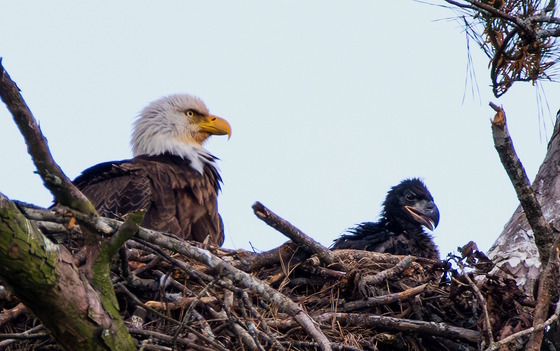 Georgia's Wildlife Fund conserves nongame such as this bald eagle and eaglet in north Georgia (Ron Goldfarb)
Help conserve Georgia wildlife with a few keystrokes?
It’s possible in the GoOutdoorsGeorgia Shop, which offers five options to support the Georgia Wildlife Conservation Fund in click-and-give amounts of $5 to $100.
Or, when buying a hunting or fishing license at GoOutdoorsGeorgia, simply choose to round up your payment when you check out. The extra goes to the fund.
All donations to what’s officially the Nongame Wildlife Conservation and Wildlife Habitats Acquisition Fund are dedicated by state law to conserving Georgia's nongame – native wildlife not legally fished for or hunted – native plants, wildlife habitat and related education and outreach. DNR’s Wildlife Conservation Section depends on the fund, which also includes revenue from other fundraisers such as the sale and renewal of Georgia's bald eagle license plates, to restore, monitor and protect nongame and the wild places these species need.
The Wildlife Conservation Section receives almost no state appropriations. Instead, the agency's work depends largely on the fund, grants and direct donations.
Want to help? Just click GoOutdoorsGeorgia.com/Shop or scan the code below.
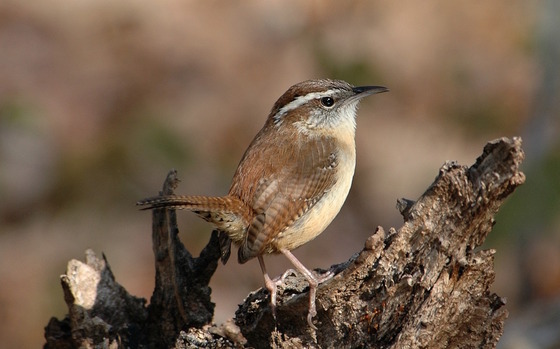 Carolina wrens are often one of your closest wild neighbors (Todd Schneider/GaDNR)
By TERRY W. JOHNSON
Although most species of wildlife try to stay as far away from us as possible, a precious few have adapted to life nearby. This is particularly true of birds, which not only regularly visit our yards in search of water and food, but some of which also nest in the shadow of our homes.
These species include Carolina chickadees, eastern bluebirds, house wrens, brown-headed nuthatches, great crested flycatchers, purple martins and Carolina wrens.
Carolina wrens, however, take nesting close to humans to another level. …
Read Terry’s column for more on these spunky birds that nest nearby.
Terry W. Johnson is a retired DNR program manager and executive director of TERN, friends group of the Wildlife Conservation Section. Check out past columns and his blog. Permission is required to reprint a column.
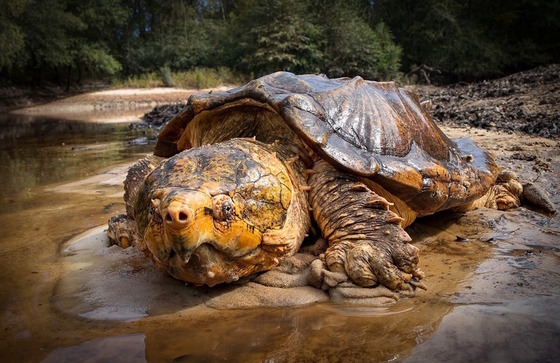 A large male Suwannee alligator snapping turtle (Greg Brashear)
By DIRK J. STEVENSON
Georgians are fascinated by turtles. And they should be. The southeastern U.S. is noted for its turtle diversity, and the Peach State is home to over 25 species. Most of our native turtles are denizens of freshwater wetlands, from swampy ponds to mountain bogs. Yet our streams and rivers also host turtles specific to flowing waterways. Among these are the singular alligator snapping turtles.
Two species of alligator snapping turtles occur in Georgia. The Suwannee alligator snapper (Macrochelys suwanniensis) is endemic to the Suwannee River drainage and found in the Okefenokee Swamp and major tributaries of the Suwannee watershed – the Withlacoochee, Little and Alapaha River systems. Farther west, the alligator snapping turtle (Macrochelys temminckii) inhabits the Ochlockonee, Flint and Chattahoochee River drainages and their sizeable tributaries.
These prehistoric-appearing reptiles are among the largest freshwater turtles on Earth, with males reaching 80 to more than 120 pounds. Alligator snappers also are the only turtles in the world that have an oral predatory lure – a red, wiggler-like structure on the floor of the mouth that they can wiggle to entice fish close to their open jaws (watch).
And, yes, those massive muscular heads pack a punch. A lab test recorded one Florida turtle with a bite force of 1,150 pounds per square inch. That's on par with a polar bear. The bite can pulverize fish, smaller turtles, snakes and amphibians.
Snappers love carrion, too, and, paradoxically for such ferocious-looking beasts, they commonly consume small mussels and fruits and nuts such as persimmons, wild grapes, acorns and water tupelo drupes that drop from floodplain forest trees. Thus, the nickname “river bear.”
Video: Difference between alligator and common snapping turtles.
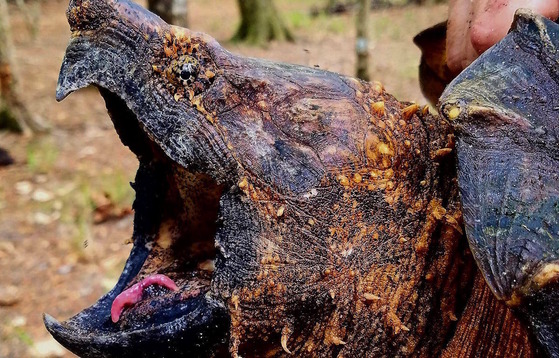 The gaping mouth provides a glimpse of this Suwannee snapper's oral predatory lure (Daniel Sollenberger/GaDNR)
PROTECTED BUT SLOW TO RECOVER
Both alligator snapper species are imperiled and protected in Georgia. The Suwannee snapper was listed as threatened under the federal Endangered Species Act in 2024, and a recent status review of its relative, the alligator snapping turtle, determined that listing for that species is also warranted. Each is also state-listed by Georgia and categorized as species of greatest conservation need in Georgia’s State Wildlife Action Plan.
During the 1960s and '70s, adult alligator snapping turtles in the Flint River were commercially trapped by the tens of thousands for the turtle soup market. The overharvest caused dramatic population declines. Surveys on the Flint in 2014 and 2015 – some 22 years after trapping was outlawed – showed that the population still hadn’t recovered.
Despite living for decades, turtles have a relatively low chance of surviving to sexual maturity. As is the case for many imperiled turtles, and as shown on the Flint, an unnatural death rate of adult female alligator snappers carries severe consequences for the long-term survival of local populations.
WHEN FISHING IN SOUTH GEORGIA
If you have cast many hooks into slow-moving south Georgia waters, you know that strange creatures sometimes bite your bait. Everything from American eels to primeval bowfin and gar (and don’t forget those long-necked flapjack impersonators, the softshell turtles) may investigate your offering, especially if its live or fresh dead bait. Rod and reel anglers who target catfish after dark sometimes hook alligator snapping turtles. Although less common, daytime anglers also encounter them.
Sometimes, fishing activities can pose a threat to alligator snappers. Turtles can swallow hooks or drown when hooked or entangled by trot and limb lines, as well as jugs. (Trot lines are multiple hooks strung across a stream; limb lines – also called set hooks – and jugs have single hooks and are either hung from branches over the water or attached to floating jugs.) Alligator snappers have also died when clumps of monofilament line clogged their intestinal tracts.
If you hook a gator snapper, you may be able to safely remove the hook using extra-long fishing pliers. If not, carefully cut the line as close to the hook as possible. Also follow all regulations and ethical practices when using trotlines, limb lines and jugs.
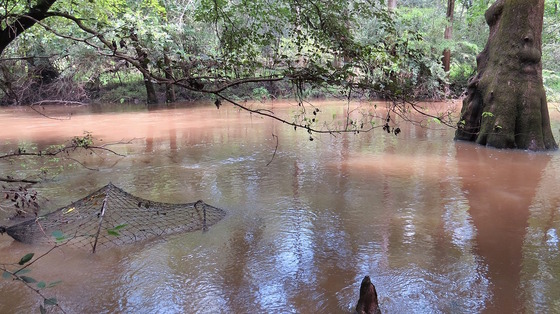 A hoop-net trap set by researchers in a Suwannee River tributary (Dirk J. Stevenson)
GOOD NEWS FOR SUWANNEES
A recently completed study of Suwannee alligator snapping turtles in a south Georgia tributary of the Suwannee River yielded some fantastic news.
Using baited hoop-net traps, researchers captured and marked over 100 snappers during the three-year project, even recapturing 29 during one subsequent survey (“Where monster snappers dwell,” September 2018). A capture-recapture model estimated a population density of about 13 turtles per kilometer (or .6 mile) of river and high survival rates for adult males and females. As significant, large numbers of subadult turtles were documented.
The large number of juvenile and subadult Suwannee gator snappers points to successful recruitment over the last 20 years in these waters. But continued vigilance and monitoring is needed.
Of course, you should count yourself very fortunate if you ever encounter an alligator snapper in the wild. You can spend a lot of time on a section of river where they are common and never see one. These impressive and interesting turtles, the primary predators of Southeastern river ecosystems, are extremely secretive. And essentially harmless to humans.
Dirk J. Stevenson is a naturalist and owner of Altamaha Environmental Consulting.
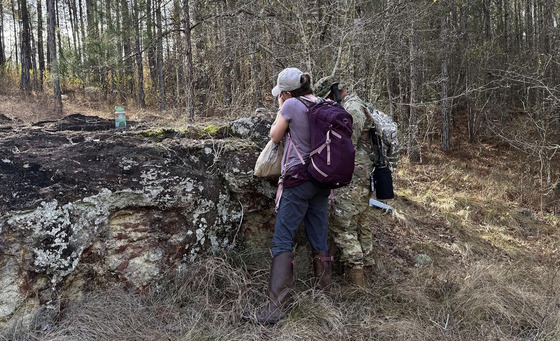 Bryologists at work during the Blomquist Foray at Ohoopee Dunes (Csilla Czako/Special to GaDNR)
The 2026 Blomquist Foray hosted by DNR Wildlife Conservation Section biologists last month drew over 50 bryologists and lichenologists from across the Southeast to survey for bryophytes and lichens at Ohoopee Dunes Wildlife Management Area. (Translation for the non-botanists among us: The two-and-a-half day biannual blitz involved scientists interested in bryophytes – simple land plants such as mosses – and lichens – fungi are an example – searching for and learning more about under-documented species.) Foray findings from the WMA near Swainsboro added state records, distribution data and species updates, while also underscoring the region’s ecological uniqueness.
This year’s Conserve Georgia grants include 14 projects varying from new DNR lands for recreation and conservation near the Okefenokee National Wildlife Refuge and on the Satilla River to expanding Augusta Canal National Heritage Area trails and turning a 26-acre forest into an Atlanta park. Meanwhile, state lawmakers passed a bill to extend the Georgia Outdoor Stewardship Act – the law behind the grants – to the year 2039 and up the percentage of sales tax revenue from outdoor recreation equipment going to the grant fund, a boost of about $15 million a year without raising taxes, the Camo Coalition reports.
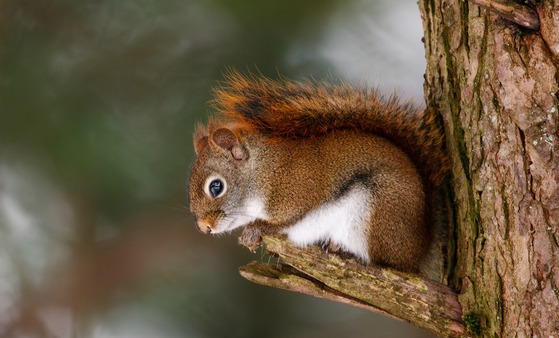 Wanted: sightings of red squirrels in northeast Georgia (Adobe Stock)
When in northeast Georgia, if you spot a red squirrel, report it via iNaturalist or by email. The University of West Georgia’s Dr. Andrew Edelman, the U.S. Forest Service and DNR want to know more about this State Wildlife Action Plan priority species in Georgia, such as which habitats the smaller, rust-colored cousins of gray squirrels are using and what threats they face. (Note: Gray squirrels with a reddish hue or even a red tail are not uncommon; but they're not the species sought.)
DNR’s annual Youth Birding Competition is rich in creativity when it comes to team names, whether it’s Vomiting Vultures or Lord of the Wings. With the 2026 competition already underway, take this fun survey to vote for a top-5 list of names.
Train to help monitor monarch butterflies at in-person sessions of the Monarch Joint Venture’s Integrated Monarch Monitoring Program. Susan Meyers of Monarchs Across Georgia will lead training May 2 at Reed Bingham State Park near Adel and May 17 at Hard Labor Creek State Park near Rutledge. Email DNR’s Anna Yellin to register.
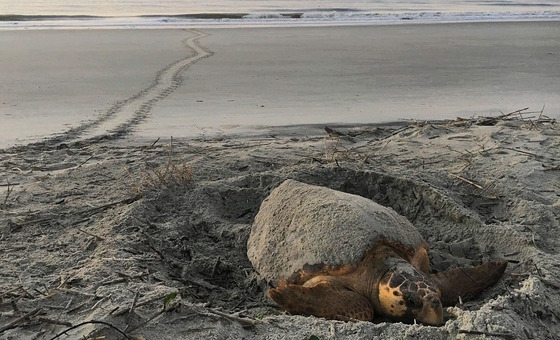 Coming soon to a Georgia beach near you: nesting sea turtles (GaDNR)
With sea turtle nesting season looming, coastal boaters are encouraged to watch for sea turtles (and manatees) in near-shore waters and report any they hit or see hurt or dead to 800-2-SAVE-ME (800-272-8363). The Georgia Sea Turtle Cooperative’s pre-season meeting, prep for a summer of marking, protecting and monitoring nests, is April 23 at DNR Coastal Regional Headquarters in Brunswick.
At a Screven County bridge scheduled for maintenance, Wildlife Conservation Section biologists helped Georgia Department of Transportation staff install bat boxes nearby to house a colony of Brazilian free-tailed bats roosting under the bridge. The coordination between DNR and DOT helps ensure safe homes for bats and safe roadways for drivers. (Related: "Bat crossing" DNR blog post.)
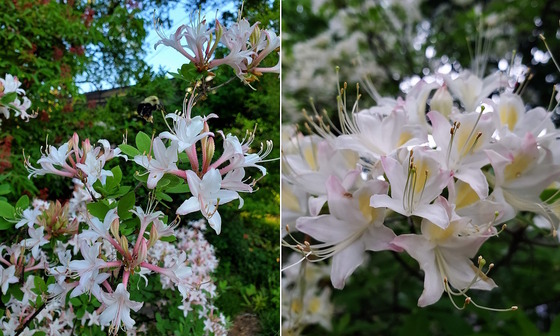 Native azaleas in bloom: coastal (left) and Alabama species (Lisa Kruse/GaDNR)
Quick hits:
- The azaleas coloring the Masters last week have nothing on Georgia’s native species, such as these coastal and Alabama azaleas blooming at the home of DNR senior botanist Lisa Kruse. Learn more.
- Explore this year’s DNR Wildlife Viewing Grant recipients, from native fish signs on the Flint River in Albany to community bat programs in Clarkston and a native plant “waystation” for monarchs in Toccoa.
- A March survey for Georgia dwarf trillium (Trillium georgianum), possibly the state’s rarest plant, found that a once-poached population on private land now has more than 1,000 plants, spurring plans for long-term monitoring.
- A bear’s sense of smell is seven times better than a bloodhound’s, so be BearWise and secure foods, garbage and recyclables to avoid attracting them.
-
Check out the winning art in the Give Wildlife a Chance Poster Contest, Georgia’s top Wildlife Forever Fish Art Contest entries and students’ blue-ribbon submissions celebrating Sapelo Island National Estuarine Research Reserve’s 50th anniversary (on display at Darien's Old Jail Art Center and Museum in August).
- Tis the season for hunting (turkey season is open statewide till May 15), birding (spring migration is full on) and fishing (find forecasts, get trout stocking reports, land a Georgia Angler Award and avoid spreading invasives).
-
Registration is open for the June 6 North Georgia Prescribed Fire Council meeting in Jasper, and landowners can sign up by May 13 for only $15.
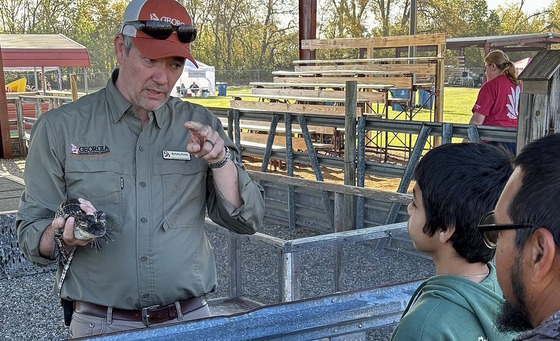 DNR's Berkeley Boone shows a juvenile alligator to Claxton Wildlife Festival visitors (Linda May/GaDNR)
Names in the news: DNR Wildlife Conservation Section staff have been busy with outreach statewide, helping with the Whigham Rattlesnake Roundup and Claxton’s Rattlesnake and Wildlife Festival, the Etowah Wildlife Expo in Canton, CoastFest in Brunswick, programs such as “Snakes in the Garden” for Brookhaven’s Pine Tree Garden Club, and a Master Birder class on the coast with Coastal Audubon, Manomet and One Hundred Miles. The Georgia Senate recognized DNR Commissioner Walter Rabon as recipient of the Dallas Safari Club’s 2026 Conservation Trailblazer Award. According to a resolution sponsored by Sen. Lee Anderson, Rabon’s leadership “strengthened access to the outdoors, empowered youth and advanced meaningful initiatives such as the DNR Career Academy and Outdoors Beyond Barriers.” Erin Cork is the new program manager at the Wildlife Conservation Section’s Forsyth office. Cork, previously the agency’s private lands biologist, had served as interim manager following Dr. Bob Sargent’s retirement.
WHAT YOU MISSED ...
In the previous Georgia Wild:
- Bird Island Rule: What's new
- Teamwork gives darter a fin up
- Concern over salamander pathogen
- How sapsuckers help hummingbirds
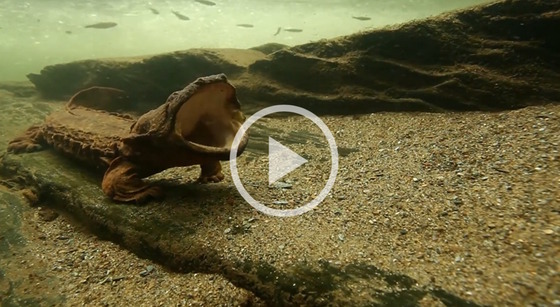 "The Last Dragons: Protecting Appalachia's Hellbenders," Freshwaters Illustrated
Female Florida panther calling for a mate, U.S. Fish and Wildlife Service
(audio) "The Forgotten Bird Artist (Rex Brasher)," Our Wild Lives podcast (The Wildlife Society)
(audio) "Emerald Bowfin: Honey Badger of a Fish!" Fish of the Week podcast (U.S. Fish and Wildlife Service)
"Rare Footage of Endangered Bornean Clouded Leopard Family," Orangutan Foundation
(audio) "Building a Better Backyard for Wildlife," Our Wild Lives podcast (The Wildlife Society)
"Georgia biologists study small fish with big impacts," WABE-FM (90.1, Atlanta)
"State to spend $33 million for 14 conservation projects," WSB-TV (ch. 2, Atlanta)
(+video) "Plans for wildlife management area by Okefenokee Swamp," WALB-TV (ch. 10, Albany). Also: Atlanta Journal-Constitution.
"New Bird Island sites, safeguards in place on coast," EIN Presswire
"Boaters, anglers urged to help stop aquatic invaders," The Augusta Chronicle
"DNR announces New Wildlife Viewing Grant projects," WNEG-FM (93.1, Toccoa)
"Resolution declares Year of Georgia Birding Trail," Savannah Business Journal
"Rush to understand deadly new salamander disease," The Wildlife Society
"T-shirt art winners announced in Youth Birding Competition," Grice Connect
"Right whales off Nantucket: highest count in 15 years," Cape Cod Times (Mass.)
(+video) "Right whale Ghost had 9th calf at 50; why is she so rare?" Garden & Gun
"Developments may threaten historic canal trail," Savannah Morning News
"Vacant lots buzz with bees," The Wildlife Society (study: Ecological Entomology)
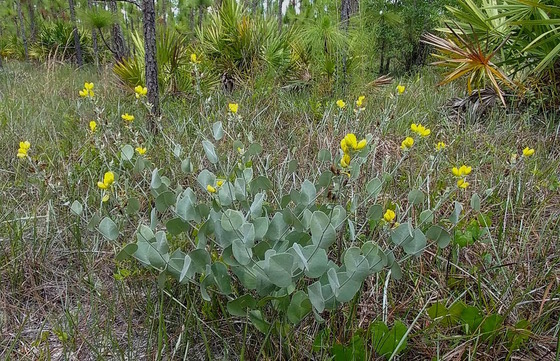 Hairy rattleweed in bloom (GaDNR)
Life may be looking up for hairy rattleweed, a federally endangered plant known only from southeast Georgia’s Brantley and Wayne counties. Although about 95 percent of its longleaf pine-saw palmetto flatwoods habitat has been converted to pine plantations, the scraggly looking legume more elegantly named Baptisia arachnifera is benefiting from efforts to restore habitat – through prescribed fire, timber thins and removing competing sand pines – along with propagating seeds and protecting key sites. A survey of Wire Road Tract, part of the state's Sansavilla Wildlife Management Area near Hortense, counted 4,454 plants, the world’s largest population, said DNR wildlife biologist Marylou Horan. And in an example of full-circle conservation, hairy rattleweed seed gathered at Sansavilla in 2023 were then grown at the Altama Plantation WMA native plant nursery near Brunswick and outplanted in 2024 near where the original seed were collected. For more: “Strangely named rare plant makes a comeback.”
Top
|