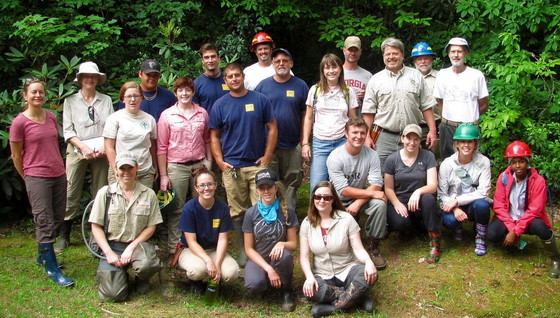
 GPCA reps gather for a mountain bog work day (Rebecca Byrd)
As we start on a new fiscal year, I want to take a moment to thank you for your hard work, dedication and contributions managing our state’s wildlife resources. Your work and customer service are second to none. And your contributions are noticed: by me, by your chiefs and by the Commissioner’s Office.
Occasionally, those contributions are even noticed nationally by others.
Our own Dr. Mincy Moffett Jr. will be representing the Georgia Plant Conservation Alliance (GPCA) when he is handed the 2019 Federal Highway Environmental Excellence Award for Ecosystems, Habitat and Wildlife this month. Given only every two years, Federal Highway Environmental awards recognize transportation leaders across the country who make outstanding contributions to environmental stewardship and partnerships that reach beyond traditional project outcomes.
The Georgia Department of Transportation submitted the application, citing that agency’s unique partnership with the GPCA. The alliance is a network committed to conserving Georgia’s rare plants and their habitats. DOT is a key member. So is WRD, which helped charter the group in 1995.
On another front, our Public Affairs team co-hosted the annual Association of Conservation Information conference in Savannah last month. Not only did they host the conference, they were awarded for their exceptional work, as well. Rick Lavender, Heidi Ferguson, Amanda Hrubesh and Aubrey Pawlikowski brought home a combined eight awards recognizing promotional video content, graphic design, social media campaigns and outreach.
Also last month, Mitch East and Chris Semerjian, members of WRD’s GIS team, represented us well at the Esri International User Conference in San Diego. They, along with fellow team member Dylan Severens, were recognized with a Special Achievement in GIS award. WRD was one of only 175 organizations chosen from more than 100,000 clients worldwide.
Finally, thank you to our staff who worked so hard during the mass stranding of pilot whales on St. Simon’s. It was a tireless effort that produced great teamwork across divisions, including WRD, Coastal Resources and Law Enforcement. You maintained composure in an extremely high stress and public situation. The majority of the pod was successfully pushed back out to sea – with timely help from the public – necropsies of the three deceased whales were quick and informative, and communication with the media was nationally covered and distributed.
Join me in congratulating these fellow WRD staffers and kudos to all of you on another outstanding year. Keep up the great work!
Read about others in the WRD family who are doing well in Names in the News.
CHANGES AT HQ
As noted in an earlier email, I recently reorganized WRD Headquarters, promoting Ted Will to Game Management Section chief and making John Bowers special projects manager in the Director's Office.
Ted's extensive experience in the field with Fisheries Management, where he previously served as assistant chief, and his work with both Fisheries and Game Management at the headquarters level uniquely qualify him for his new role.
I look forward to seeing the benefits from these organizational changes, and I'm confident they will further WRD’s mission and our delivery of services.
Top
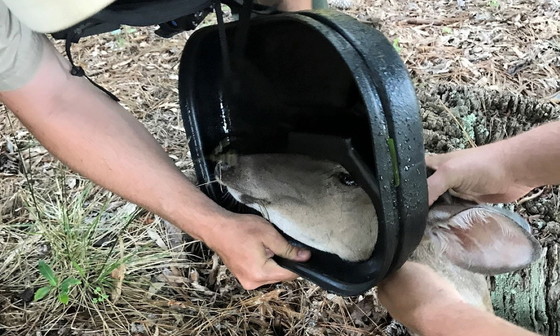 Staff carefully remove the trash can lid from the doe (DNR)
Persistence and professionalism were key to freeing a doe wandering a Woodstock neighborhood with a plastic trash can lid around its neck.
Game Management learned about the deer in Eagle Watch in late June. Staff assessed the situation and began monitoring the doe, which was not in immediate danger. That focus shifted to more visits and talks with residents (and WSB-TV/Channel 2) as it became clear the deer wouldn’t be able to free itself.
Region 1 staff, with help of WRD's Urban Wildlife Program, got within range and darted the deer in early July. Unfortunately, the dart didn’t fully inject the tranquilizer, leaving the deer too active to free.
Yet later that month, WRD again darted the deer – this time the dart worked – and removed the lid, placing the doe in a deer box and taking it to a quiet place to minimize stress. Staff stayed with the deer until midnight, when the drugs wore off and it was released in a wooded area.
Staff discussed the release with residents and let them know the doe was in good condition. Homeowners appreciated WRD’s perseverance in resolving the situation.
Top
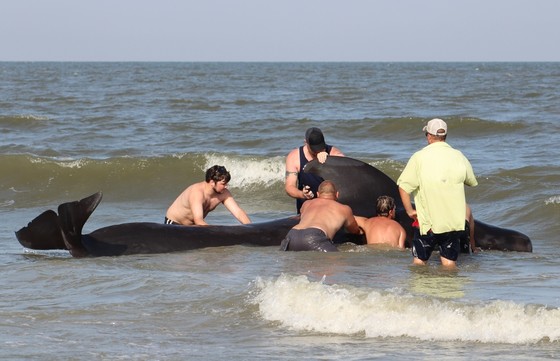 Beachgoers help a stranded pilot whale on St. Simons. (Jordan Chriqui/Coastal Blackwater Adventures)
Scores of St. Simons Island beachgoers, lifeguards, officials and DNR staff will not soon forget July 16.
Thanks to their work and a rising tide, a mass stranding of short-finned pilot whales that began about 6 p.m. on East Beach ended with most of the pod of about 50 whales swimming back to sea. At least 20 stranded. Only three died.
Senior wildlife biologist Clay George, marine mammal researcher with Wildlife Conservation, helped lead the response that long, chaotic evening. Here’s how he explained the mass stranding – one of only three in Georgia involving pilot whales since 1962 – to Jacksonville, Fla., stations and CBS News.
Glynn County beach manager Shawn Lentini said lifeguards first spotted the pod just after 5 p.m. near Gould’s Inlet, at the north end of East Beach. They thought they were heading out to sea. But less than 45 minutes later, the lifeguards saw people gathered in the surf near the Coast Guard Station.
The whales were swimming into shore.
Lentini phoned DNR game warden 1st Class Jay Bright, a friend. Bright’s advice: Try to keep the whales in the water, but don’t let people put themselves in danger.
Lifeguards and beachgoers began trying to push the whales that were stranding into deeper water and keep others from the shallows. Lentini said the incoming tide was key, providing more water to work in.
Staff from WRD, Coastal Resources and Law Enforcement arrived within minutes and began managing the rescue. Adam and Jan Mackinnon were among the scores from DNR who responded. They spent hours in the water with the whales. “It was one of those all hands on deck kind of things,” Adam said.
And one that attracted attention worldwide.
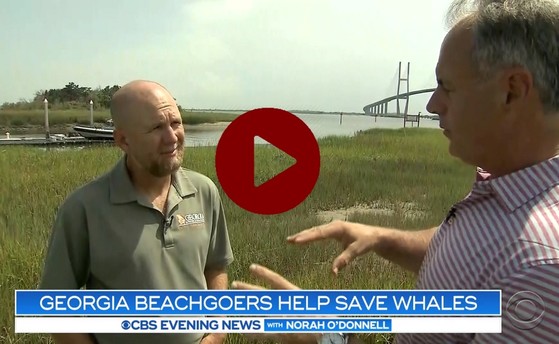 WRD's Clay George updates CBS News
Initial findings from WRD necropsies of the three adult males that died – one was euthanized – revealed no obvious signs of human interaction that might have caused or contributed to their stranding. Further analysis is pending.
On July 21, a pod of pilot whales was seen offshore of Florida, 140 miles south from St. Simons. A video of that group shows a dorsal fin that looks similar to the fin of one of the St. Simons whales’. But the ID has not been confirmed.
Five pilot whales stranded but were rescued July 29 on Florida’s Redington Beach in the Gulf of Mexico. George said the dorsal fins of those whales did not match any from the Georgia stranding.
Top
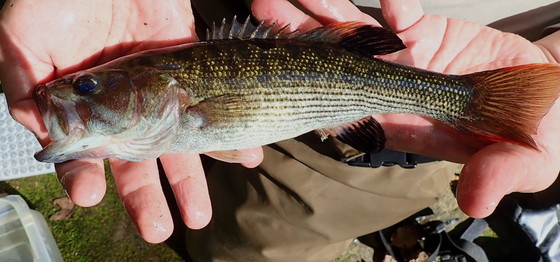 Chattahoochee bass: slight but spunky (DNR)
Black bass are the nation’s most popular freshwater sportfish. Thankfully, Georgia is home to more black bass species than any place on Earth. But Chattahoochee bass, one of our more photogenic bass, is threatened by habitat degradation, hybridization and invasive species.
Fisheries Management’s Stream Survey Team is conducting a range-wide survey to better understand the distribution and population status of Chattahoochee bass, which are found only in the Chattahoochee River basin. Goals include identifying land-use and habitat variables that correlate with strong populations and effectively using molecular analysis to document the extent of the threat posed by hybridization with non-native black bass.
Understanding how introgression (the transfer of genetic information among species) and habitat degradation affect conservation of endemic species such as the Chattahoochee bass is vital to protecting and improving conditions for them.
BIG FIGHT IN BEAUTIFUL PLACES
Though small, Chattahoochee bass are hard-fighting. They also inhabit scenic stretches of river and count as a species toward Georgia’s Bass Slam. All of which make catching one an adventure.
P.S.: When fishing the coast, check out DNR's Saltwater Slam.
Top
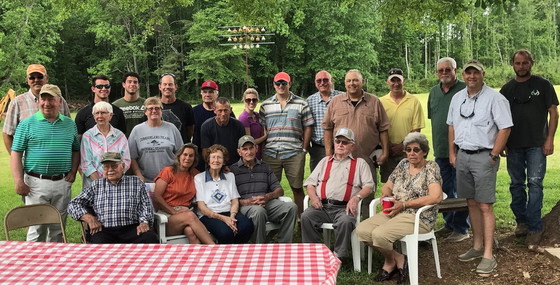 The Region 4 reunion drew a crowd (Special from Wanda Granitz)
REGION 4 REUNION
A recent reunion gathered Region 4 retirees and friends at Fred and Wanda Granitz’ farm in Meansville. The group, not all of whom are pictured above, included Dick and Barbara Whittington; Jack and Shirley Scott; Coley and Sharon Cooper; Ken Grahl; Terry Johnson; Oscar and Bobbie Dewberry; Les and Jaydee Ager; Coley and Debra Pascal; Mike, Rachael, Matt and Jacob Crumbley; Linda Guy and Rita Hutcherson; Lee and Bob Reardon-Zittle; Ben and Kate Granitz; Rusty Garrison; Tommy Shover; Rob and Stacey Bartlett; Doug Hoffman; and, Fred and Wanda Granitz.
Wrote Wanda of the get-together May 15, “It was a great time to see the people who were such an important part of our lives for so many years!”
The reunion was also dubbed the "first annual," meaning there are more to come.
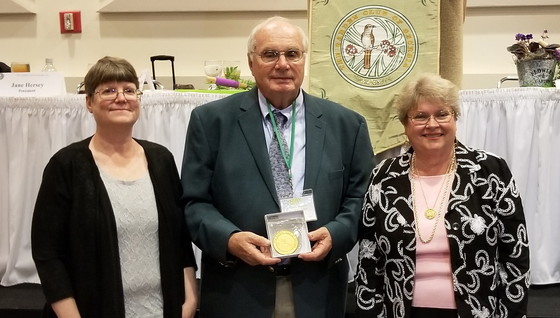 Terry Johnson with WRD's Melissa Hayes, left, and the Garden Club's Jane Hersey (Garden Club of Georgia)
GARDEN CLUB HONORS JOHNSON
This spring, retired Nongame Program Manager Terry Johnson received The Garden Club of Georgia’s highest award for a non-member. Then-club President Jane Hersey presented the Award of Merit to Johnson for his work in helping start and continuing to lead the Community Wildlife Program. The 20-year-old Garden Club/WRD program is focused on enhancing native wildlife and habitats statewide through the club’s some 9,000 members.
The Nongame Program is the predecessor of WRD’s Wildlife Conservation Section.
Got news of WRD retirees or know of any who would like to receive this newsletter? Please email us.
Top
What makes for a good post on WRD’s blog?
Public Affairs’ Heidi Ferguson, who is coordinating the blog, said the recent post about how plucky volunteers pulled and hacked pigweed at Di-Lane’s youth dove field “was a great submission from region staff and fantastically easy to edit!”
“It had a thesis statement, outlined the problem clearly (what, where, when and why), reported the actions taken by an individual to solve a problem (who – wildlife tech Ryan Meckel in this case) and had plenty of excellent photos that told a story.”
Contact Heidi to submit a post or discuss ideas for one.
Top
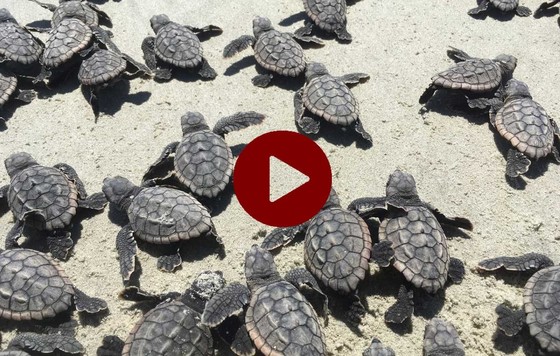 Loggerhead hatchlings on Ossabaw (Ashley Raybould/DNR)
Georgia has shattered its nesting record for loggerhead sea turtles. Members of the Georgia Sea Turtle Cooperative have recorded more than 3,820 nests, easily topping the previous high of 3,289 in 2016. Check out this NPR story from Ossabaw Island and a deeper take on WABE-FM (90.1, Atlanta).
Thanks to hard work and top-notch programming, the Go Fish Center had its busiest month ever this June. More than 3,900 visited the Perry center, learning about Georgia’s aquatic resources, WRD conservation and management efforts, and – for some – how to fish and even land their first catch.
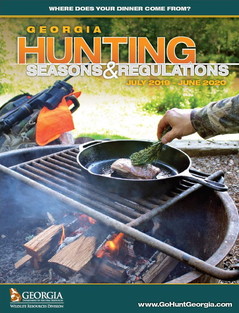
Got regs? The state’s 2019-2020 hunting seasons and regulations guide is available online and in print at WRD offices and license vendors. Here’s a look at some of the significant changes, including new wildlife management areas.
One of the new sites is the Hilliard Plantation Tract at Chattahoochee Fall Line WMA. Purchased through a combination of partners, this tract of nearly 8,100 acres has prime potential for ecological restoration, including expansion of a longleaf pine ecosystem for rare species such as red-cockaded woodpeckers, and provides for public recreation including hunting, angling, hiking, birding and camping.
A red-cockaded woodpecker fledged this spring at River Creek, the Rolf and Alexandra Kauka WMA, the first documented at the site in some 30 years. After translocating the endangered birds to River Creek in 2017, WRD found and monitored three nests this year, one of which had the successful fledging.
Two boat ramp closures of note: Uvalda Landing in Montgomery County is scheduled to close Aug. 15 for a DOT project to realign the road and bridge (the re-opening date is not known yet). Also, Rocky Hammock Landing boat ramp on Flat Tub WMA is closed for construction (alternate access sites include Flat Tub Landing, Scuffle Bluff Landing on Horse Creek WMA and Barr’s Bluff). Stay in the know about WRD site closings.
Spread the word: Georgia teachers can find what they need to instruct their students in the outdoors at WRD’s new education web portal. Resources range from species profiles and educational videos to camps and events.
This WRD issue of WeRDNR should have landed in your inbox on Outlook, not a clutter or junk folder. DNR IT has made changes to route emails from GovDelivery/Granicus, used for agency e-newsletters like this one and related communications, directly to your inbox. Still receiving this enews in clutter or junk? Email Sarah Hanson, WRD marketing and communications assistant manager.
WRD’s 2020 statewide meeting is set for Jan. 15 at the Idlewilde Event Center at Indian Springs State Park in Flovilla. Headquarters will work with each region to get a list of employees who will be attending.
Top
|
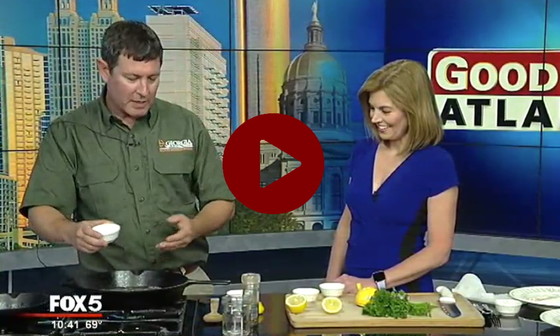 Charlie Killmaster with Good Day Atlanta's Joanne Feldman
State deer biologist Charlie Killmaster showcased his gourmet cooking skills and even provided some fishing tips during this National Fishing Day “hook to table” segment on WAGA-TV’s Good Day Atlanta (Fox 5).
The Georgia Plant Conservation Alliance honored botanist Tom Patrick by naming its highest award for him and presenting the first one to him. Patrick was the first botanist for the Georgia Natural Heritage Inventory Program – later folded into what is now the Wildlife Conservation Section – and helped start the GPCA in 1995.
On the personnel front, Brad Alexander has been promoted to new manager of Game Management’s Private Lands Program. A biologist in the program since 2013, Alexander has worked in south Georgia and most recently in Clarkesville, which is where he will be based. Mary Nieminen, formerly of Florida State Parks and the Joseph W. Jones Ecological Research Center, has joined Private Lands as a biologist. Nieminen’s role centers on working with southwest Georgia landowners. Matt Rowe will be leading WRD’s conservation of freshwater mussels in central and south Georgia. Rowe's background includes developing a mussel monitoring program for Florida’s wildlife agency and recently hiking the Appalachian Trail.
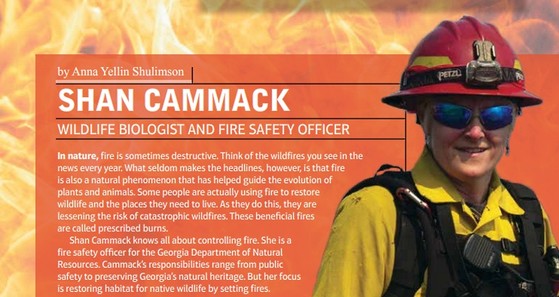 A copy of the Shan Cammack Q&A is provided with permission from Muse Magazine, © 2019 by Cricket Media.
The July/August issue of the children’s science magazine Muse features a Q&A with DNR fire management officer Shan Cammack. Fellow WRD wildlife biologist Anna Yellin wrote the article.
Competing at the International Shooting Sport Federation World Cup in Munich, Rosemary Kramer, daughter of WRD’s Kevin Kramer, became one of only 11 American women eligible for qualification in the 2020 Olympics. Rosemary, who attends Georgia Southern University, scored a 618.3 in Germany (590 was the threshold), putting her on track for the Summer Games in Tokyo.
Destrie Vescuso, daughter of WRD’s John Vescuso, added to her archery titles this month, winning the middle school division’s female open class at the S3DA Outdoor Target National Championship. The tournament at Mermet Lake State Conservation Area in Illinois fielded more than 300 archers from 15 states.
Parker and Evan Dowd, sons of WRD's Jamie Dowd, are members of the Lake Oconee Shotgun Team that repeated as National HOA (High Over All) Team Champions during the 2019 Scholastic Clay Target Program National Championships last month in Marengo, Ohio. In 2018, the Lake Oconee team – LOST, for short – was the top HOA squad for all three shotgun disciplines: singles trap, singles skeet and sporting clays.
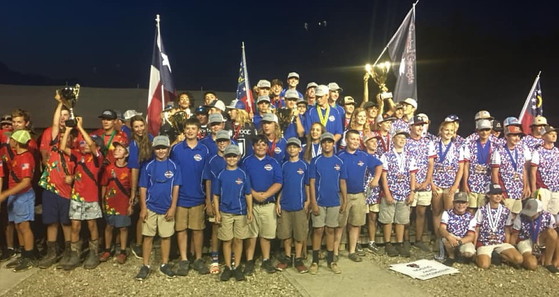 The Lake Oconee team (center, in blue) with two other top-four Georgia shotgun teams at the national tourney.
Top
WRD We Are DNR recipients include the following, plus some of the comments from those nominating them:
Lisa Bohannon, Game Management Region 1 (Armuchee) – Lisa is a champion office manager, the foundational pillar of region operations. Every aspect of the region is affected by how she fulfills her job responsibilities, from budgets to retirements and turnover, and even playing a key role in the seamless transition to a new building. In many senses, she serves as boss, friend, confidant, disciplinarian and tree (yes, a tree because when she needs to be stern about something her phrase “well talk to the tree” is sometimes used). But even as a “tree,” Lisa is appreciated and respected by all employees.
Charlie Killmaster, Game Management state deer biologist – Charlie is always an exemplary employee, but his most recent endeavor exceeded even his usual commitment to customer service. Already heavily involved in the regulations process and development of the hunting guide, he volunteered to create a database of regulatory information for WMA hunts for Game Management and Public Affairs. The end result: a more useful database and a more readable regulations format. Charlie did this while successfully juggling his already overflowing plate of job duties. He is a leader and a team builder.
Colt Martin, Go Fish Education Center – Although he recently transferred to Go Fish, Colt has already gone above and beyond. He has volunteered to help with education programs and hatchery tours, freeing others to handle behind-the-scenes issues and prepare for upcoming activities. When a visitor found she had flat tire, Colt did not hesitate in helping replace the tire, work done during record-setting heat and requiring him to find an adequate jack. He even filled the flat tire to show the customer where the hole was. You can't place a value on the assistance he provided to this visitor in a time of need.
Jason Mitchell, Fisheries Region 4 (Waycross) –Jason has been the lead technician on the Satilla River flathead catfish removal project for more than 10 years. During his months in the field, he provides excellent customer service, answering questions from the public about the project’s purpose and status. He even takes that message about non-native species to schools and other outlets to reach different audiences. Jason is also creative. Low water limits the use of large shocking boats. But Jason designed and built a shocking system for a single-person craft useful at almost any water level. Such innovation is key for this project.
Michael Sellers, WRD Volunteer Coordinator – Michael has shown an exemplary work ethic and produced exemplary results in providing outstanding customer service. Not only has he built relationships with those outside of WRD – including other states looking to create a successful volunteer program – he has strengthened his relationship with WRD regions through regular contact and training. This year, WRD set a record with more than 60,000 volunteer hours. Michael also has seen his work come full circle, with some volunteers hired as staff in part from the experience they gained through volunteering.
Eric Wittig, Summerville Fish Hatchery/Region 1 – In his year-and-a-half at the hatchery, Eric’s work ethic, drive and demeanor have been above and beyond. He arrives early and prepared. He is quick to volunteer for the labor-intensive and less glamourous jobs, and even quicker to help others. In his first year as a tech 2, he was asked to temporarily fill the role of tech 3. He handled both jobs and trained hourlies without missing a step. He lives 20-25 minutes from the hatchery, but when the low-water alarm went off at 3 a.m., he was there in 25 minutes. He always seems to be smiling and ready to work.
We Are DNR awards allow all WRD employees to recognize associates for exemplary work. Just click the button above and answer the brief questions.
Top
The WRD champions chosen by section chiefs for the previous quarter are:
Fisheries Management
Jeff Durniak, Northeast Office (Gainesville) – During Jeff’s 34-year career he made significant contributions in all facets of fisheries management, including population management, habitat conservation and angler involvement. As a biologist in north Georgia, his early research provided insight into key fisheries issues and helped provide for several long-standing management practices. Jeff has worked diligently to establish and nourish partnerships within the conservation community. His tireless efforts to engage and inspire anglers and his advocacy of anglers and conservation are legendary.
Chris Semerjian, Dylan Severens and Mitch East – As noted in the Director's Message in this issue, the work of WRD's GIS team was recognized with a Special Achievement in GIS Award at the ESRI User Conference in San Diego in July. In less than two years, the GIS team has overcome significant challenges and transformed statewide information management through the development of cross-agency, innovative data collection, and reporting and internal/customer-facing map applications that drive recruitment, retention and reactivation efforts using ArcGIS.
Game Management
Kathy Church, Region 2 (Gainesville) – This fiscal year at Smithgall Woods Regional Education Center, Kathy managed 806 programs, averaging more than two a day, with a reduced workforce. Smithgall also had a record 22,224 program participants, exceeding 20,000 for the first time. Kathy directly marketed to schools and identified better ways to deliver information to teachers. She used her Trout Unlimited sponsorship on school programs, reaching schools where fees posed a barrier to programming. Kathy also promoted the center in local media and worked with area hunts and research at Blue Ridge WMA.
Wildlife Conservation
Jamie Calloway, Forsyth office – Hired as the maintenance worker after Ken VanHoy retired, Jamie had big shoes to fill. But he did. Jamie welcomed challenges, finishing monthly task lists in one to two weeks. So his tasks multiplied. He rebuilt the well house, repaired the damaged drive, rebuilt decks and oversaw re-roofing buildings. He deployed with DNR for cleanup after Hurricane Michael. He became certified in chainsaw and ATV operations. He helped on prescribed burns. After working with biologists, Jamie even enrolled in Southeastern Technical College’s wildlife and fisheries program, attending class on his off days.
Congratulations to all of these employees. Thanks to each for helping WRD excel at customer service and continue to pursue its mission.
Top
Changes from mid-April through mid-July (hourly positions not included).
HIRED
- Emily Harvin Belser, Game Management (Administration), wildlife biologist 2
- Allison Gordy Colter, Bobwhite Quail Initiative, wildlife biologist 2
- Bradford Allen DeShields, Game (Calhoun), wildlife technician 2
- Lori Ann Downs, BQI, admin assistant 3
- Jenna Michelle Haag, Fisheries Management (Statewide Programs), fisheries tech 3
- Kellen Edward Jones, Game (Thomson), wildlife tech 2
- Rachael Katlyn Luse, Game (Gainesville), admin support 1
- Diana Jean McGrath, BQI, wildlife biologist 2
- Michael Alvin Moore, Waterfowl Habitat, wildlife tech 1
- Mary Frances Nieminen, BQI, wildlife biologist 2
- Joseph Benjamin Otto, Fisheries (North Region 1), fisheries tech 2
- Jeremy Brian Ray, Fisheries (Central Region II), fisheries tech 2
- Matthew Thomas Rowe, Wildlife Conservation, wildlife biologist 2
- Calvin Tyler Wakefield, Game (Administration), wildlife biologist 2
- Jacob Parks Wilson, Waterfowl Habitat, wildlife tech 2
PROMOTED
- Joshua B. Aldridge, Game (Calhoun), wildlife tech supervisor
- Bradley Wayne Alexander, BQI, manager 2 natural resources
- Marissa G. Peebles, Fisheries (Central Region II), admin assistant 3
- Stanley B. Walker, Waterfowl Habitat, wildlife tech 1
RESIGNED
- Zacheus Mark Henshaw, Wildlife, wildlife tech 1
- David Ross Morgan, Game (Sapelo Island), wildlife tech supervisor
- Graham Scott Rhone, Game (Albany), wildlife tech 2
RETIRED
- Christopher B. Bailey, Game (Sapelo), mechanic 2
- Daniel O. Booke, Game (Calhoun), wildlife tech supervisor
- John B. Jensen, Wildlife, wildlife biologist 3
- James H. Miller, Fisheries (South Central Region IV), fisheries tech 3
- Charles V. Waters III, Game (Calhoun), manager 2 natural resources
- Andrew D. Wentworth, Fisheries (North Region 1), fisheries tech 2
- Denise Wiatrek, Fisheries (Central Region II), admin assistant 3
Top
|