|
'Remember what R3 stands for? Who has embraced our R3 Initiative in their everyday work? How are you doing it?
I want to hear from you!
 There are certainly some great success stories out there. For example, did you see the Georgia Farm Monitor interview with trout stocking coordinator John Lee Thomson? This is how you work R3 and license sales into your everyday conversations, folks.
Also, we’ve taken your feedback and developed this toolbox of R3 resources. Along with other things, it includes a business card you can print locally and keep in your pocket for easy reference. If you want to see something else added to the toolbox, let Marketing and Communications Manager Jenifer Wisniewski or others on her team know.
We are almost on pace to meet our license sales goal for the year (97 percent, to be exact). I know if we focus on recruitment, retention and reactivation, we can do it.
Don’t forget about the youth license, the one-day license and the recent addition of donations online!
|
On another note ... Family is one of our agency’s values. It is also high on my list of priorities. Our immediate family and our DNR family are both very important.
As you know, I talk a lot about the WRD and DNR family, and in the last few weeks I have been on the receiving end of their care. Because of the sacrifice of this larger family, I was able to take off and spend the last days with my dad. The outpouring of kindness, notes and cards expressing your heartfelt sympathy meant the world to me after his passing. I cannot thank you all enough.
DNR is many things to many people; however, to me DNR is family.
Back to top
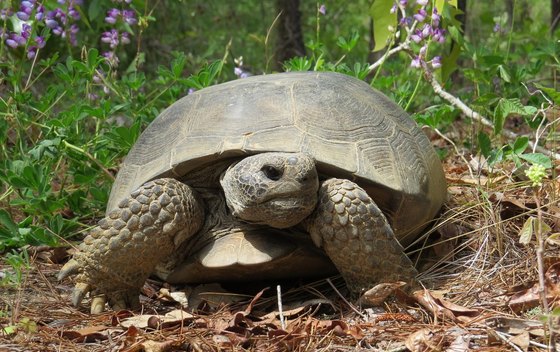 The online donation option will help WRD conserve species such as the gopher tortoise. (Dirk J. Stevenson)
If you haven’t heard, supporters of wildlife conservation in Georgia can now donate online to the Nongame Wildlife Conservation Fund.
This addition to WRD’s license and permit system offers options to make a set donation or round up a purchase or renewal, with the extra going to conservation.
There’s even a Keep Georgia Wild package! The promotion bundles a $10 donation to the Wildlife Conservation Fund with a $5 one-day combo license.
Buying a license helps on all fronts. It provides sporting privileges and lands access, and increases Georgia's share of federal excise taxes paid by hunters and anglers. A $5 one-day license represents about $45 for wildlife work in our state.
Of course, contributions are critical to restoring and protecting Georgia animals not legally fished for or hunted, plus rare plant species and the habitats these animals and plants need. This effort led by WRD's Nongame Conservation Section depends mainly on grants, fundraisers and donations to the fund.
Help spread the word about the new online donation option.
TALKING POINTS
Back to top
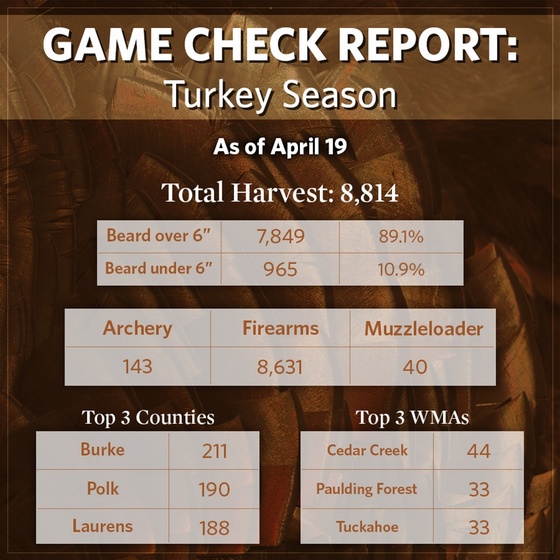 Just over halfway through the season, this chart shows how turkey hunting is shaping up statewide. For updates, follow the harvest via Game Check. Also check out WRD’s Facebook photo albums of turkeys taken on private lands and public lands, plus those taken by youth hunters.
Back to top
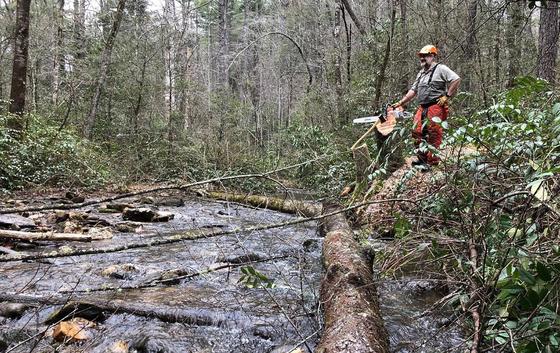 Fisheries' Tony Anderson dropped these two hemlocks in Walnut Fork (DNR)
The Fisheries Section is boosting habitat for brook trout through a project dubbed “chop and drop.”
Last month, biologist Anthony Rabern and his staff cut down 40 trees, mostly dying hemlocks infested with invasive wooly adelgids, and placed the trees in a half-mile section of Walnut Fork Creek in Rabun County. Adding large, woody debris to trout streams is a long-term project for Fisheries’ Region 1 and the U.S. Forest Service.
Walnut Fork is just one of many brook trout streams targeted for chop and drop in the coming years.
The phrase fits the work: Basically, trees are cut to fall into streams. The dead trees provide brookies and other aquatic organisms with needed cover from predators and a slow-water shelter from flooding.
Back to top
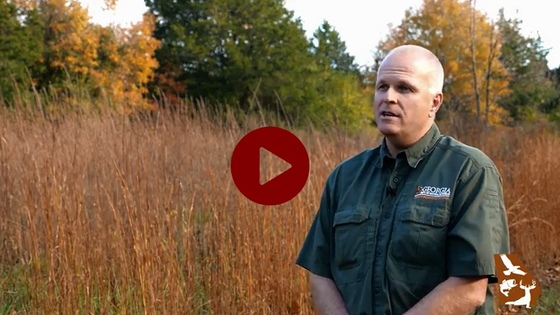 WRD reaches our customers in a variety of ways. One we’re using more and more these days is video. Below are some of the latest.
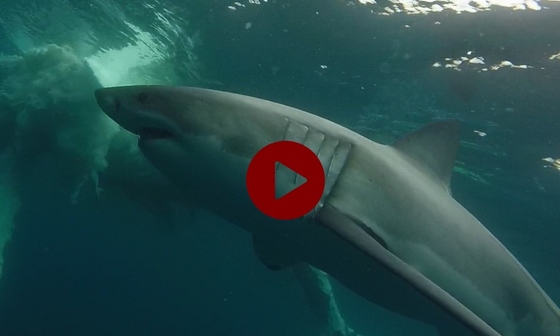 Stay tuned to WRD’s YouTube channel, our Facebook page and Instagram for more.
Back to top
New to WRD? This video of Director Rusty Garrison is helping guide new employees through the division. Next up: training software. Got questions about resources referenced in the video? Contact Training Specialist Lindsey Brown.
DNR and area leaders celebrated the opening of Sutton’s Landing in Lee County April 18 and recently announced a 6,000-acre addition to Ohoopee Dunes WMA in Emanuel County. Buying or renewing hunting and fishing licenses returns more federal excise taxes paid by hunters and anglers to Georgia, supporting wildlife lands and management. Use our app to explore public lands and boat ramps near you.
Georgia freshwater turtles are better protected through new regulations that limit export to permitted turtle farms. The amended regulations do away with permits for commercial collectors and hard-to-enforce annual harvest limits.
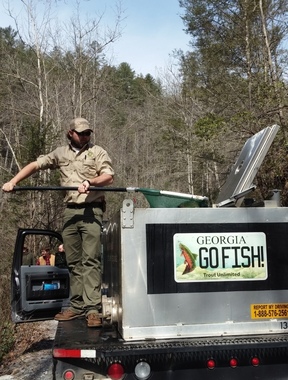 Did you know that more than 1 million trout will be stocked in Georgia this year? Thanks to abundant rainfall, increased funding (credit hunting and fishing license fee changes approved in the passage of House Bill 208) and prime growing conditions, the size of stockers has stretched from 9 to 10 inches long. Weekly stocking emails. Top trout streams and tips, plus WRD’s weekly fishing blog.
For North Atlantic right whales, it was a bleak winter. Surveys conducted in part by WRD counted only 11 adult right whales and zero calves in the Southeast, the first winter since surveys began in the 1980s that no calf has been seen off Georgia and Florida, the imperiled species’ only known calving grounds.
Doraville’s David Hampton landed the year’s first Georgia Bass Slam, catching a Bartram’s, Chattahoochee, smallmouth, largemouth and spotted bass between February and April. Catch five of the state’s 10 eligible black bass species and add your name to the list of slam anglers!
Codey Elrod and his unique job – helping control feral hogs on Ossabaw Island – are the focus of this profile by the U.S. Fish and Wildlife Service’s Dan Chapman. It’s a good read about the good work that Elrod, a Game Management technician, is doing.
With lights newly installed at piers and parking lots, nine Public Fishing Areas will open for night fishing from May 1-Sept. 30. Fisheries Chief Matt Thomas called the addition “a great example of fishing license dollars at work” and part of WRD’s ongoing efforts to enhance angler access and opportunities.
A prescribed fire covering more than 1,300 acres on Tallulah Gorge State Park and adjacent Chattahoochee National Forest and Georgia Power lands went off without a hitch this month, despite the large scale of the fire and the high-profile site. Partners included DNR, the U.S. Forest Service, Georgia Forestry Commission, Georgia Power and others. Watch: Before-the-burn interview with WRD’s Nathan Klaus. Also see Forest Service photos.
|
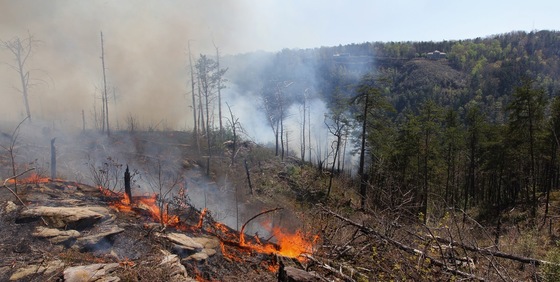 Prescribed fire at Tallulah Gorge (Philip Juras)
Back to top
WRD’s recent We Are DNR recipients include the following, plus some of the comments from those nominating them:
Robert Horan, Game Management (Region 7, Brunswick) – Robert strives to provide the department with the best habitat management using proven techniques. He put together our burn team and the team's trailer, complete with supplies and equipment needed to ensure safe burns. He also has been our front-line person for disaster response, including multiple hurricanes. Recently he showed his excellence in customer service, offering without hesitation to take an elderly, mobility-limited woman from the Atlanta area and her friend to see a ruff – a northern Eurasian sandpiper – that showed up at Butler Island Refuge. Robert even arranged to have an expert birder positively identify the bird. He did this on a Friday after front-loading his week with the prep and installation of a water-control structure.
David Dodge, range safety officer, Clybel Shooting Range – When a customer’s son celebrated his birthday by shooting at the range, David helped turn what could have been a disappointing end to the day into a positive experience. After using the ranges, the two moved to the skeet and trap field for the son’s first try at that sport. But one of their shotguns malfunctioned and they didn’t have the right-sized shot for the other. David, who was walking them through use of the field, offered his 12-gauge, saying he didn’t want the youth not to have a chance to shoot. David was as excited as them when the son busted the first clay! From start to finish, his customer service was excellent.
We Are DNR awards allow all WRD employees to recognize associates for exemplary work. Just click the button and answer the brief questions.
WRD CHAMPIONS
WRD champions – as chosen by section chiefs – for January-March are:
Fisheries Management
-
Jody Swearingen has kept both Dodge and Ocmulgee public fishing areas running in the absence of an area manager on Dodge. Although that position was recently filled, it will be another month before that person comes on board. In addition to keeping the PFAs going – including general maintenance, water systems/chlorination/water monitoring, lake management, etc. – Jody monitored the filling of Ocmulgee PFA. There, he recently discovered a potential problem and notified everyone so it could be evaluated. He has also helped in conducting spring standardized sampling on the areas.
Game Management
- January champion David Gregory, a Region 1 biologist, was assigned an impromptu statewide task to review and update the section’s personnel/manpower model. This required re-establishing a diverse ad hoc committee, coordinating data updates and analysis, revising and testing the model, and providing a product, all within a short time. This information is key for staffing decisions in discussions with the Commissioner’s Office, the Office of Planning and Budget, and legislators.
- A critical challenge with the Georgia Coyote Challenge is securing sponsors for each session’s prize. After hearing we didn’t have a sponsor for March-April, Hunter Development Program secretary Jeannine Lee reached out to a contact she had and made the pitch. Jeannine, our February champion, secured the donation needed to cover that session’s drawing for a lifetime license. This level of commitment and action is exemplary, and much appreciated.
- March champion Forrest Buckner, a Forest Management Unit forester, has been a huge asset in his area. He has installed firebreaks and helped clean up old ones at Yuchi WMA, work contributing to prescribed burns on the WMA, including in stands that haven’t been burned for 10-15 years. Forrest helped, as well, with other prescribed fire activities on more than 1,000 acres, including operating the aerial ignition machine. He also maintained oversight on timber thinning at Di-Lane and Oconee WMAs, transported and placed logging bridges to help DOT and the Georgia Forestry Commission with timber thinning in the I-16 median, and oversaw weekend reforestation activities at Big Lazer WMA.
Nongame Conservation
-
Sue Cahill, administrative support 2 at Charlie Elliott Wildlife Center, has a champion-sized impact on visitors. Sue consistently provides accurate information to customers inquiring about the area and other WMAs, answering questions about hunting, fishing and other outdoor activities. She also keeps maintenance staff updated on events at Charlie Elliott, a task she took on to keep communication open between maintenance and event staff. Sue even developed a system and partnership with Clybel WMA range safety officers to manage and collect revenue from Sunday range operations.
-
Eamonn Leonard, wildlife biologist 2 at the Brunswick office, has been a key asset in coastal conservation. Through participation in the Coastal Habitat Mapping project he has become an expert in Coastal Plain flora. He contributed to the conservation of more than 37,500 acres through 12 land acquisition grants totaling $12 million, as well as numerous surveys, inventories and mapping projects. His botanical knowledge and research have been crucial for understanding and implementing land management policy on state lands. Eamonn also focuses on assessing and managing invasive species on state lands on the coast and promoting the use of native species. He serves with many groups, including as conservation task force member for Cannons Point Preserve and chair of Coastal WildScapes and the Coastal Georgia Cooperative Invasive Species Management Area.
- With his compassion, warmth and knowledge, Ashley Harrington, an hourly associate at Nongame’s Forsyth office, has been an effective ambassador for conservation. More than a decade ago, he retired from Robins Air Force Base and began volunteering with DNR. He quickly became indispensable, conducting bird surveys, helping with fires, taking ownership of the nest box program for southeastern American kestrels (which he effectively doubled in size). He turned 70 this year and his responsibilities continue to grow, from harvesting native grass seed at Panola Mountain State Park to putting in firebreaks on sandhills in west-central Georgia. Those who work with him say it’s a rare day when Ashley complains!
Congratulations to all of these employees. Thanks to each for helping WRD excel at customer service and continue to pursue its mission.
Back to top
Changes from late February through March (hourly positions not included).
PROMOTED
- Michael L. Crumbley, Game Management (Fort Valley), wildlife technician supervisor
- Margie Annette Dent, Nongame (Social Circle), administrative assistant 1
- Stanley Plato Kirby IV, Game Management (Fort Valley), wildlife technician supervisor
- Major Walter Lane II, Game Management (Social Circle), manager 2
- Kenneth Stacy Palmer, Game Management (Gainesville), wildlife technician 3
RESIGNED
- Patrick Lee Snellings, Fisheries Management (North Region 1 Operations), fisheries biologist 2
RETIRED
- Willis Joel Hillery, Game Management (Sapelo Island operations), vessel captain 3
Back to top
|