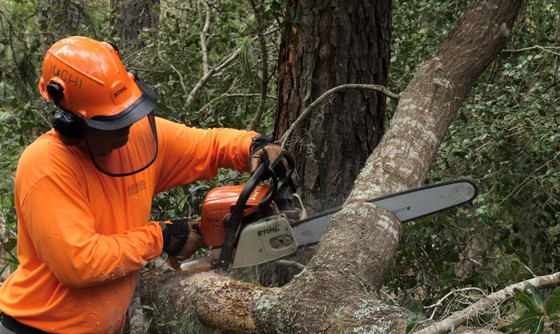
 Clearing roads on Ossabaw (Heidi Ferguson/DNR)
First, I want to thank you again for your tremendous work in responding to Hurricane Irma. As you’ve done before, you showed how capable you are – whether it’s clearing roads, repairing waterfowl impoundments or covering the office for those called to the field – and how willing you are to contribute when disaster strikes.
Irma won’t be our last test, of course. Our division will be called on again, joining the rest of DNR in shouldering new responsibilities and making sacrifices to help our state and fellow citizens. When that test comes, we will respond. Your track record shows that. And I couldn’t be more thankful for you.
(Here's a quick look at our response on Ossabaw Island.)
On an unrelated note, I hope you’ve heard about the updated uniform policy and our online catalog.
The range of items, styles and colors available from multiple brands in the one-stop-shop represents a significant upgrade. Please note that section chiefs have set spending limits, and orders must be approved by region or program administrative staff. Also make sure to follow the dress code.
Questions about uniforms? Check first with your Headquarters staff. Marketing and Communications Manager Jenifer Wisniewski can provide answers, as well.
Thank you for all you do to make our division great!
Back to top.
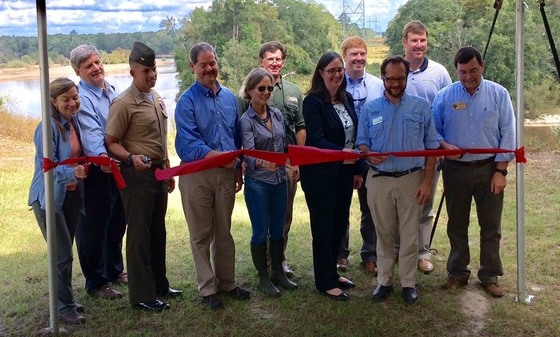 Sansavilla partners mark the final acquisition (Rick Lavender/DNR)
DNR and some of its key conservation partners announced the closing of the final land acquisition phase for Sansavilla Wildlife Management Area on Oct. 16. The 19,500-acre area along the Altamaha River in Wayne and Glynn counties is:
- Home to scores of wildlife species, at least 17 federally or state-listed or species of concern.
- A priority site for conserving gopher tortoises, Georgia’s state reptile and a candidate for listing.
- Popular for hunting, fishing, wildlife viewing and boating, and part of the WMA system (before as leased land) for more than 40 years.
- Rich in habitats, such as 2,600 acres of priority longleaf ecosystem restoration areas and more than 12 miles of Altamaha frontage.
DNR acquired Sansavilla in phases from The Conservation Fund, with assistance from The Nature Conservancy. The $36 million purchase was funded by donations from the Robert W. Woodruff and Knobloch Family foundations, U.S. Fish and Wildlife Service and U.S. Forest Service Forest Legacy program grants, and state bond dollars. Further, using funds from the Defense Department's Readiness and Environmental Protection Integration Program, the Marine Corps purchased a restricted use easement to buffer its Townsend Bombing Range.
The Sansavilla ribbon-cutting, held on a river bluff near Hortense, featured speakers representing many of the project’s partners.
Watch this Marine Corps Combat Camera video by Lance Cpl. Christian Moreno marking the event.
Back to top.
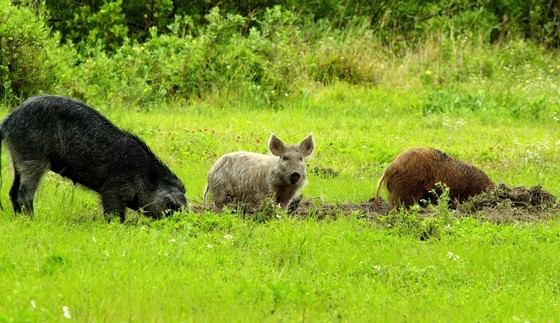 Feral swine (USDA)
WRD is joining with other agencies, UGA and the Georgia Farm Bureau to hold five workshops this fall on combating feral hogs.
Farmers and landowners know well the threats these invasive pigs pose to crops, native wildlife and natural habitats. Georgia took an economic hit estimated at $150 million last year from swine-spawned damages.
At the workshops, experts will discuss disease and transportation issues, swine biology, economics, effective control techniques, and regulations. Each session also will include a hog trapping demonstration.
The workshops are free, although space is limited and pre-registration is required. Each is set for 8:30 a.m.-noon at:
- Nov. 3, Chicopee Woods Agricultural Center, Gainesville.
- Nov. 8, Gordon County Agricultural Center, Calhoun.
- Nov. 13, Bulloch County Agricultural Center, Statesboro.
- Nov. 30, Albany (site to be announced).
- Dec. 15, Berrien County (site to be announced).
Along with WRD and the Farm Bureau, partners include the U.S. Department of Agriculture’s Natural Resources Conservation Service, USDA Wildlife Services, Georgia Association of Conservation Districts, Georgia Department of Agriculture and UGA’s Warnell School of Forestry and Natural Resources.
Back to top.
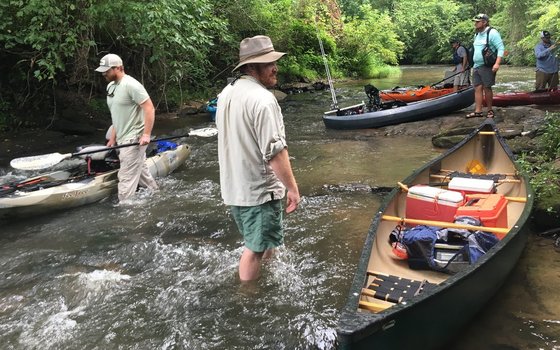 Preparing to fish ... er, sample (DNR)
Paddle-powered volunteer anglers are propelling a bass study in the upper Chattahoochee River.
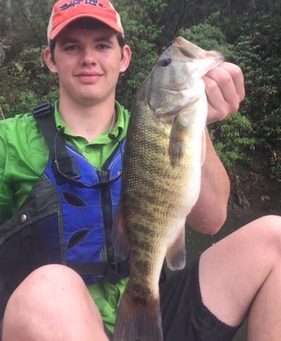 WRD Fisheries Management in north Georgia has teamed with the Southeast Aquatic Resource Partnership and UGA’s Cooperative Extension Service to identify the ranges, genetics, species compositions and movements of shoal, Chattahoochee and other black bass species in the Chattahoochee and its tributaries above Lake Lanier. But these streams are too small to boat and too large to wade, meaning conventional fisheries sampling gear can’t be used.
Instead, project leaders have turned to volunteer anglers in kayaks and canoes. When a volunteer catches a bass -- such as the hefty shoal bass above -- WRD staff identify the species and measure, weigh, photograph and take a fin clip for genetic analysis. Each bass also is tagged so recaptures can be identified.
More than 200 bass have been caught, processed and released, contributing valuable data to the conservation and management of north Georgia’s native basses and engaging anglers in WRD’s work.
Back to top.
|
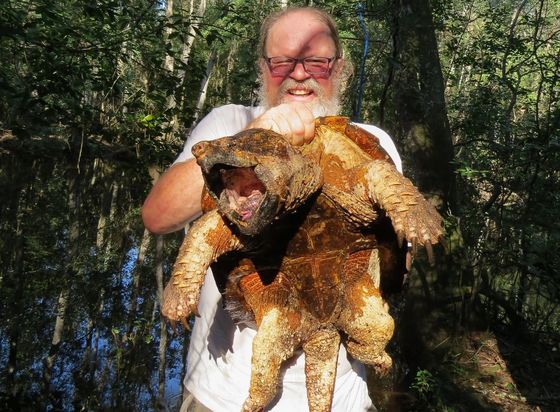 George Heinrich with Suwannee gator snapper (Dirk J. Stevenson)
George Heinrich will go to great depths to draw attention to North America’s native turtles. Even into an over-your-head blackwater bend in the Alapaha River.
Not that herp scientists like Heinrich, of St. Petersburg, Fla., need much coaxing to explore the lair of any species they’re seeking. In late September, he and Georgia naturalist Dirk J. Stevenson tread tea-colored water in a deep slough of the south Georgia river, testing the sluggish current, temporarily avoiding the swarming mosquitoes and probably toe-checking any available river bottom for a jagged shell that might reveal their targeted turtle species: the Suwannee alligator snapper.
It was all part of the Florida Turtle Conservation Trust’s Big Turtle Year. Heinrich and Tim Walsh of the Bruce Museum are trying to see as many of the United States’ 59 turtle species as possible in 2017.
WRD senior wildlife biologist John Jensen and Public Affairs staff joined the search on the Alapaha, an adventure covered in detail in this division blog post.
Update: As of Oct. 27. Heinrich and Walsh had seen 53 species.
Back to top.
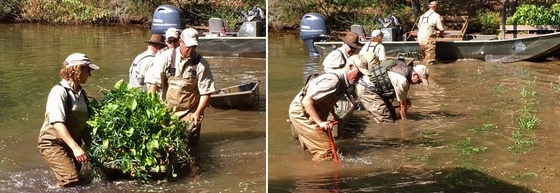 Aquatic planting at work (Melissa Cummings/DNR)
An aquatic vegetation planting demonstration at Lake Sinclair promoted the local project and the potential of WRD’s new aquatic vegetation greenhouse.
Reporters from WGXA-TV in Macon, The (Macon) Telegraph and The Eatonton Messenger showed up Sept. 22 to see Fort Valley Region fisheries staff plug native plant species in Sinclair and tour shorelines where plantings had already established aquatic vegetation. (Check out the news coverage.)
The plants came from a greenhouse built at Walton Fish Hatchery in Social Circle through a donation from Yamaha Motor Corp. The demo showcased the benefits of aquatic vegetation, including improved fish habitat and erosion control. It also pointed out how the greenhouse can provide for plantings statewide.
WRD Headquarters staff and a Yamaha Motor representative took part in the event.
Back to top.
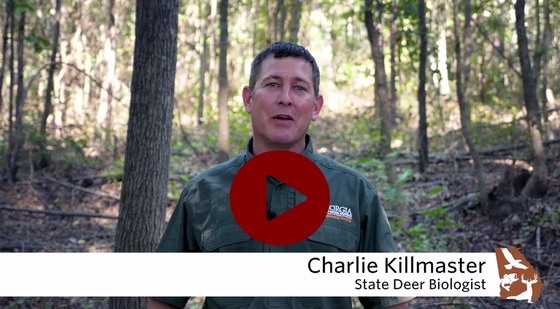 Firearms season for deer started with a bang, and the soon-coming rut will only boost hunting and the harvest. State deer biologist Charlie Killmaster previewed the season on Facebook, while hunters can explore the rut timing in their areas with this rut map based on UGA Deer Lab and WRD research.
Including Wildlife Action Plan coordinators and staff from federal and other organizations, 38 states were represented at the 2017 State Wildlife Action Plan National Meeting at Callaway Gardens Oct. 23-26. WRD’s Nongame Conservation Section helped organize the Association of Fish & Wildlife Agencies-coordinated meeting, with Division Director Rusty Garrison welcoming the group and staff giving presentations and leading a field trip to Sprewell Bluff WMA.
Public Affairs wants photos and video from the field and the closest camera is your phone? Here are some secrets for success:
- Get close, and walk to zoom (don’t use your phone’s zoom).
- Before you shoot turn the phone sideways, so the image is horizontal.
- Take a fresh perspective such as getting level with your subject.
- Photograph high-priority subjects -- staff in uniform in the field, hunting harvests, live wildlife and people fishing, hunting or wildlife viewing.
More from the Association for Conservation Information, plus reminders on what not to do from the Quality Deer Management Association.
Back to top.
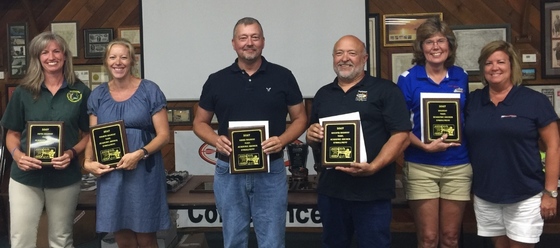 WRD's Jennifer Pittman, National Archery in the Schools Program coordinator for Georgia, was recognized with other state NASP coordinators who have more than 10 years of service during the organization's administrators conference in August. Pittman, second from left above, also was honored for leading one of the top five Academic Archer Programs in the nation.
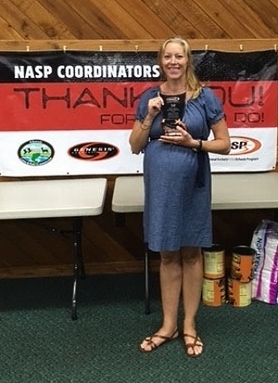 The Academic Archer Program is designed to promote and recognize academic excellence among NASP archers. Academic Archers should maintain a grade point average that establishes them well within school GPA criteria for high academic scholarship.
Under Pittman’s leadership, Georgia’s NASP has grown from a few schools and students to more than 130 schools and 17,000 students. Fewer than 100 students attended the first state tournament. Now Georgia holds district tournaments, three regional tournaments and a state tournament with more than 1,000 archers competing for $10,000 in college scholarships. The state also has the fourth-most Academic Archer students in the nation.
Small wonder that the program is considered one of the country’s best.
Pittman, above right with the Academic Archers honor, also was recognized in August as a WRD We Are DNR employee.
Back to top.
|
We Are DNR
awards allow all WRD employees to recognize associates for exemplary
work. Just click the button below and answer the brief questions.
Back to top.
WE ARE DNR RECOGNITION
Other WRD recipients for August and September include the following, plus some of the comments from those nominating them:
Adam Mackinnon, education coordinator, Sapelo Island National Estuarine Research Reserve – A large part of Adam’s job is providing service to customers of all ages – from students and teachers to special groups – and he excels at it in content and delivery. Adam also excels at working effectively with others: His commitment is to the mission and the group, project or program objectives.
Ross Martinez, senior range safety officer, Cedar Creek Shooting Range, Hunter Development Program – In addition to providing excellent customer service to range patrons, Ross’ attention to detail is evident in all aspects of his management of the range. He also recently developed a beginner’s handgun class, including writing curriculum designed in part for females who hadn't fired or owned a handgun.
Aubrey Pawlikowski, Game Management secretary, Headquarters – Aubrey has been a valuable asset, helping proof the draft regulations guide, sort out time sheets and proving a quick study in other tasks. But she really shines in customer service, professionally handling calls and taking ownership of issues, such as helping gator hunters who didn’t receive tags by opening day get them in time for their hunts.
Mike Queen, range safety officer, Wilson Shoals Shooting Range, Hunter Development Program – Mike, who teaches handgun safety for the University of North Georgia, suggested providing training for beginning shooters, especially women, to introduce them to the range and teach them firearms safety basics. The resulting handgun instruction at Wilson Shoals' Ladies’ Day at the Range has received outstanding reviews.
WRD CHAMPIONS
WRD champions – as chosen by section chiefs – for July through September are:
Fisheries Management
-
Robert Dills, part-time associate at Paradise PFA: After the PFA manager and assistant manager were assigned to Irma debris removal, Robert – the only associate available to tackle significant hurricane debris at Paradise – used equipment to move dozens of trees blocking roadways and lake access, quickly restoring public access to the PFA.
-
Zack Brock, tech in Fort Valley region: Zack proved key in securing donations for the Cast and Blast event at Flat Creek PFA, identified and resolved an issue that saved the state money in its contract with a paint retailer, and quickly provided aid to a motorcyclist injured in an accident near the Fort Valley office.
-
Chris Semerjian, GIS specialist at Headquarters: Chris worked at the Irma Incident Command post in Metter, spending long days piloting and evaluating GIS components and spatial applications to help manage the response – tools that show great promise for responding to future incidents
Game Management
-
Caleb Eubanks, wildlife tech 3, Fitzgerald (Region 6): Not counting his work on other WMAs, at Bullard Creek Caleb has conducted camera surveys, developed a two-year burn rotation plan and six miles of access trails, established wildlife plantings, posted boundaries, and completed roadside herbicide applications.
-
David Reed, wildlife tech 3, Gainesville (Region 2): As lead on the team covering Warwoman, Swallow Creek, Chattahoochee and Buck Shoals, David’s systematic approach to wildlife openings on these WMAs has resulted in exceptional wildlife openings of clover and chicory. He has also overseen renovations at Buck Shoals.
-
Brian Vickery, wildlife tech supervisor, Albany (Region 5): Although short-staffed by four positions, Vickery has efficiently got the job done, organizing and prepping 300-plus acres of dove fields, mowing hunter trails, and making repairs to the region’s more than 400 miles of roads.
Nongame Conservation
-
Lisa Boone, administrative assistant 3, Charlie Elliott Wildlife Center: Lisa is the heart and soul of Charlie Elliott, a team player who keeps the place running, tackling challenges and providing excellent service to external and internal customers – including her lunch and learn programs.
-
Steve Raper, business support analyst 3, Forsyth: A leader in bringing nongame conservation to private lands, Steve has developed expertise in key areas such as the Farm Bill, helped create a conservation easement template for the Gopher Tortoise Conservation Initiative and led an effort exploring how best to protect relatively small but biologically diverse sites.
-
Lisa Kruse, wildlife biologist 2, Social Circle: Lisa is a dedicated botanist who in the past year has received competitive grants critical to conservation efforts for federally endangered Canby’s dropwort, while also working on a team ensuring permanent protection of the Canoochee Bogs site.
Special recognition also goes to Shirley Hall, business support analyst 1 for nongame at Headquarters. Shirley’s upcoming retirement will be a significant event in the section’s history. She is an outstanding employee who oversees 60-plus grants and multiple contracts, manages a complicated section budget, and mentors other administrative support staff.
Congratulations to these employees! Thanks to each for helping WRD excel at customer service and continue to pursue its mission.
Back to top.
Changes for July through September (hourly positions not included).
HIRED
- Matthew J. Stoddard, Nongame Conservation (Brunswick), wildlife technician 2
- Eric Benjamin Wittig, Fisheries Management, fisheries tech 2
- Jonathan Martin Savarese, Fisheries Management (Go Fish Education Center), fisheries tech 2
- Jonathan Cade Helton, Game Management (Calhoun), wildlife tech 2
- Mitchell B. East, Game Management (administration), GIS specialist 3
- Marylou N. Moore, Nongame Conservation, wildlife tech 2
PROMOTED
- Kevin Von Seggern, Game Management (Thomson), wildlife tech supervisor
- Heidi Marie Ferguson, Public Affairs (Headquarters), communications specialist 3
- Jason M. Wisniewski, Nongame Conservation (Social Circle), wildlife biologist 3
- Nicholas A. Crosby, Game Management (Sapelo Island), wildlife tech 3
RESIGNED
- William Seton Michael Goldman, Fisheries Management, administrative support 1
- Christopher W. Peck, Fisheries Management (Region 1), fisheries tech 2
- Rickey Dean Lockhart, Game Management, heavy equipment operator 2
RETIRED
- Joseph B. Murphy, Game Management (Albany), wildlife tech 3
- Jim Brady Hargrove, Fisheries Management, fisheries tech 2
Back to top.
|