Withlacoochee River System Update - 1/3/2020
Southwest Florida Water Management District sent this bulletin at 01/03/2020 05:59 PM EST
 |
2019 - Another Wet Year for the Withlacoochee
I hope everyone had a very Merry Christmas and Happy New Year!
Rainfall:
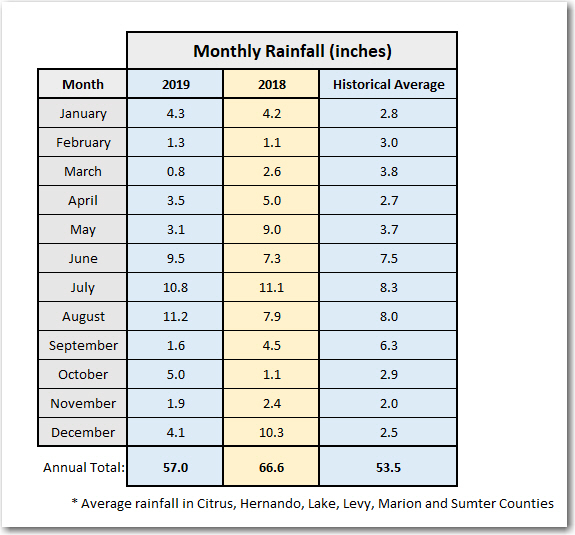
- In 2019, our region received 57 inches of rainfall. That’s 3.5 inches more than the historical average (53.5 inches/year).
- Above average rainfall in 2019 was more impactful than normal, because it came on the heels of a very wet 2018 (67 inches).
- This recent rainfall trend has impacted our region’s water resources, keeping lake levels and river flows relatively high over the past couple years.
- In fact, you’d have to go back to early summer of 2017 to find a time when water levels were on the low end.
- High rainfall has also kept aquifer (groundwater) levels higher than the normal range for most of 2019, which has kept our springs flowing strong.
- The figure below shows monthly rainfall in 2019, as compared to 2018 and the historical average.
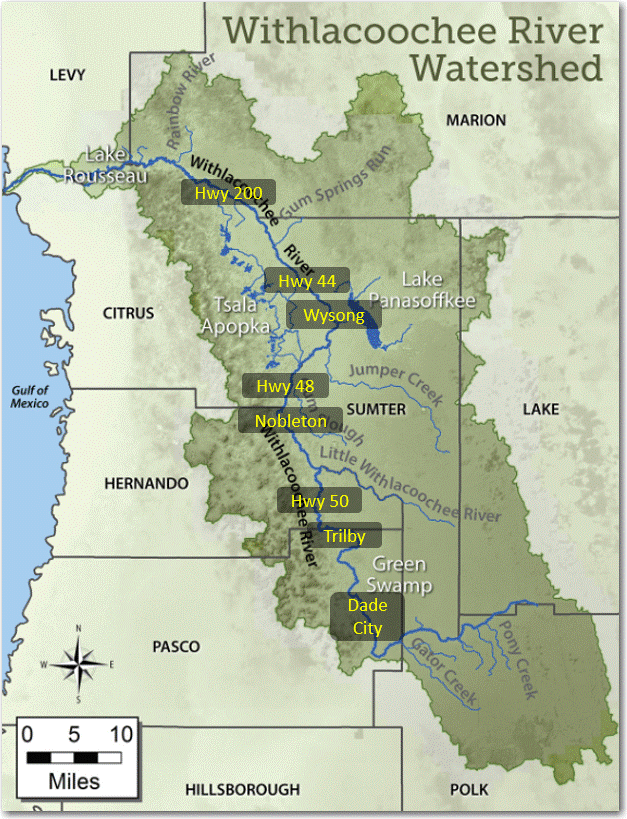
Withlacoochee River (from the Green Swamp downstream past Hwy 200):
- It’s normal for water levels and river flows along the Withlacoochee River to fluctuate, because of rainfall events that occur throughout the year.
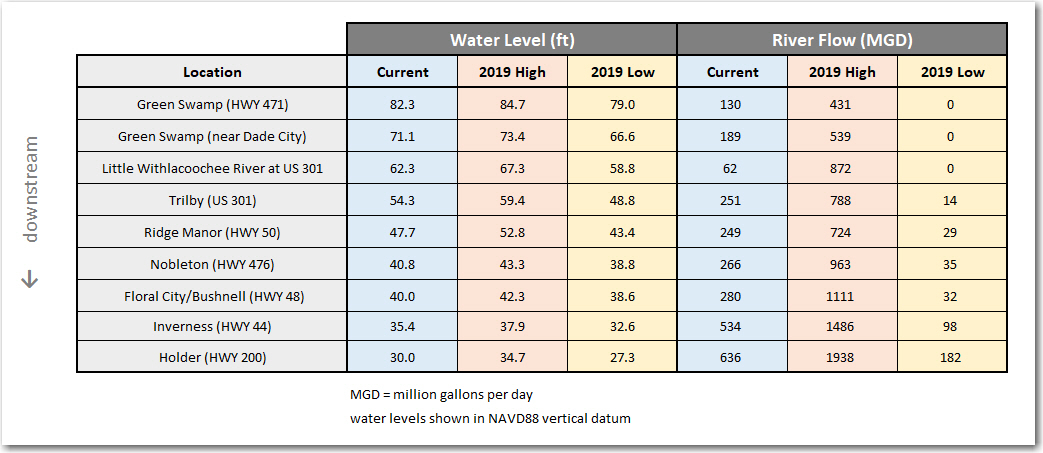
- Our lowest recorded levels of 2019 occurred in early June, while summer rainfall caused levels/flows to peak in August this past year.
- The table below compares current river levels and flows to what they were at their highest and lowest in 2019.
- Currently, water levels along the river are several feet lower than they were at their peak in August.
- River flows are currently about 1/3 as high as they were at the end of this past summer.
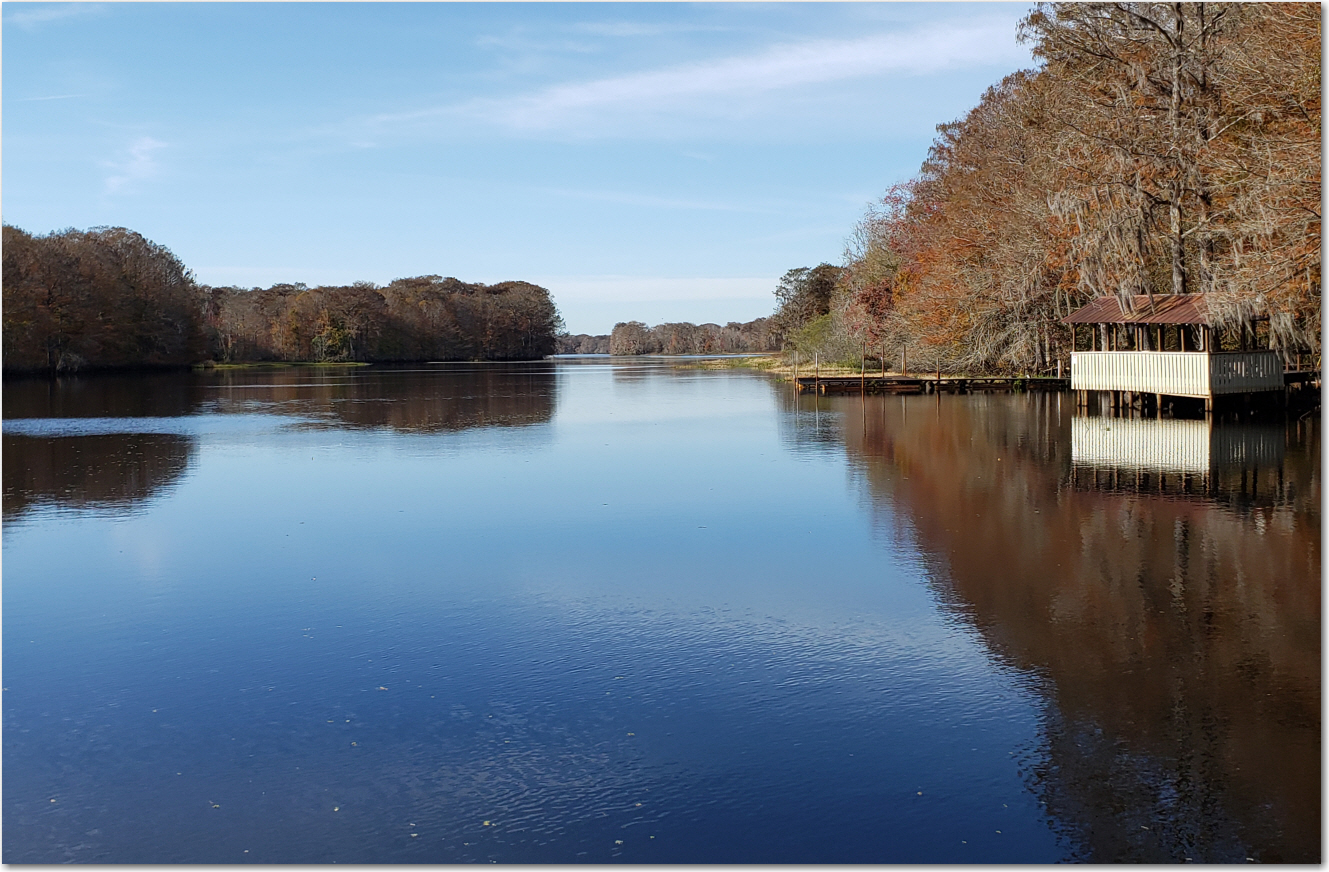
Withlacoochee River at Trails End (December 2019)
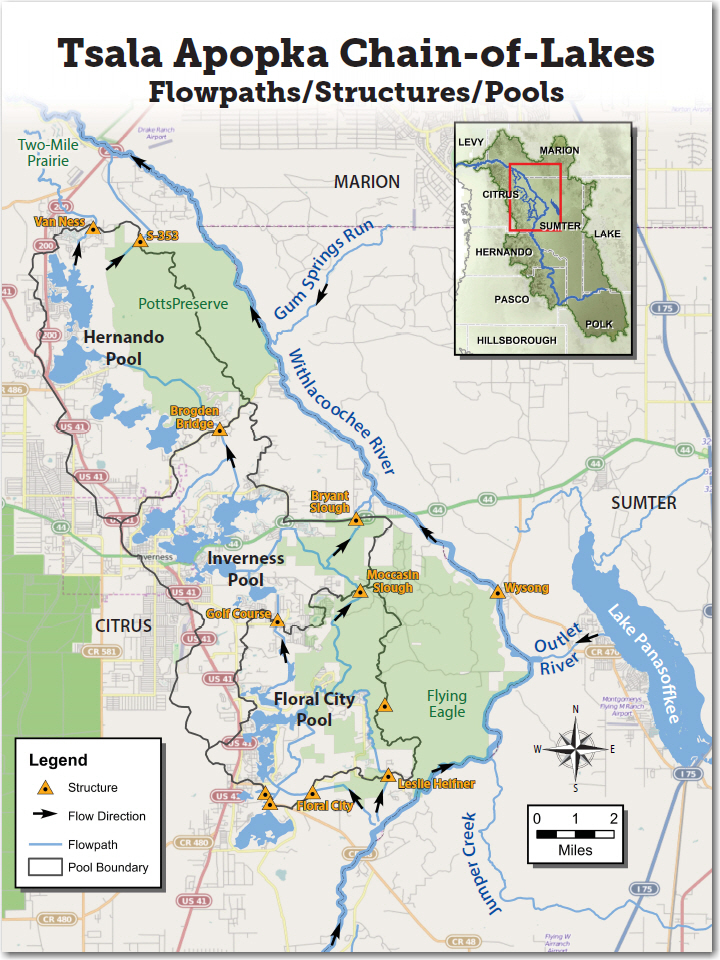
Tsala Apopka Chain of Lakes:
- The Tsala Apopka chain of lakes includes more than a dozen “deep” water lakes adjoined by expansive wetland/marsh areas that make up three distinct “pools” of water (see map below).
- During wet times, these wetlands/marshes will stay inundated with about 1-2 feet of water, resulting in more than 20,000 acres of water surface throughout the lake chain.
- During times of drought, the wetland/marsh areas will naturally dry up, leaving less than 6000 acres of water surface, limited to the “deep” water lake areas.
- Over the past couple years, higher than average rainfall has kept these wetland/marsh areas inundated, and water levels in the Tsala Apopka chain of lakes have remained relatively stable.
- Lake levels are currently about a foot lower than they peaked in 2019.
- All the water control structures (aka “locks”) are currently closed, helping to conserve water in the lakes.
- The table below compares current pool levels to what they were at their highest and lowest in 2019.

Moccasin Slough Wetland (December 2019)

Lake Panasoffkee and Wysong:
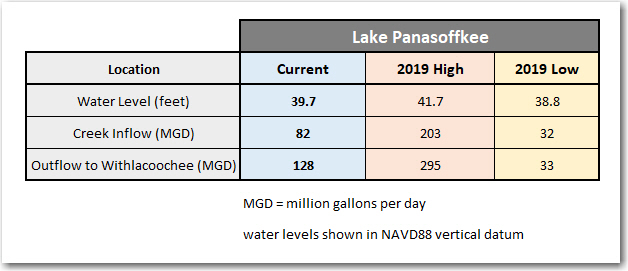
- Fluctuating water levels on Lake Panasoffkee are the result of changing flows into and out of the lake.
- In 2019, summer rainfall caused high inflows, while invasive vegetation growth in the outlet river limited outflows from the lake.
- The result was Lake Panasoffkee this year reaching its highest recorded level since 2004.
- Lake levels are currently 2 feet lower than they peaked in August of 2019.
- Inflows and outflows remain strong from high winter rainfall over the past few months.
- At times, the Wysong Structure on the Withlacoochee River has a limited ability to affect lake and river levels upstream.
- Currently, the Wysong Structure is partially raised, helping to conserve water levels upstream.
- The table below compares current lake levels and flows to what they were at their highest and lowest in 2019.
Lake Rousseau and the Lower Withlacoochee River (from Dunnellon to the Gulf of Mexico):
- Downstream of Dunnellon, combined flows from the Withlacoochee and Rainbow Rivers enter Lake Rousseau, upstream of Inglis.
- Rainbow River flows, which have remained relatively strong over the past couple years, have been steadily declining since their peak in early September.
- Withlacoochee River flows, which dropped sharply in September, have been relatively steady over the past couple months.
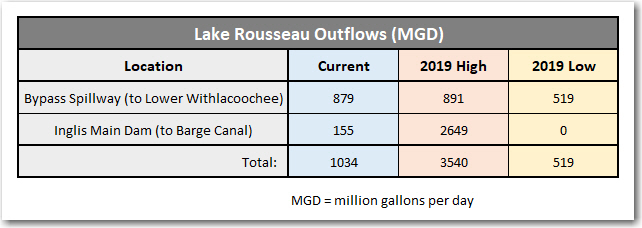
- Overall, about a billion gallons of water per day is currently entering and leaving Lake Rousseau.
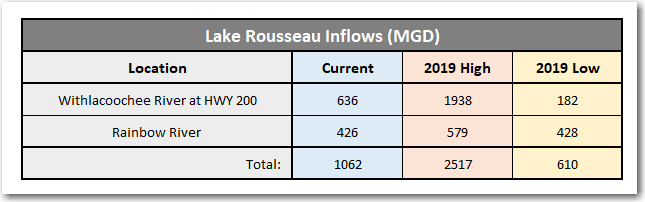
- Outflows from the lake are currently twice as high as they were in early June of 2019.
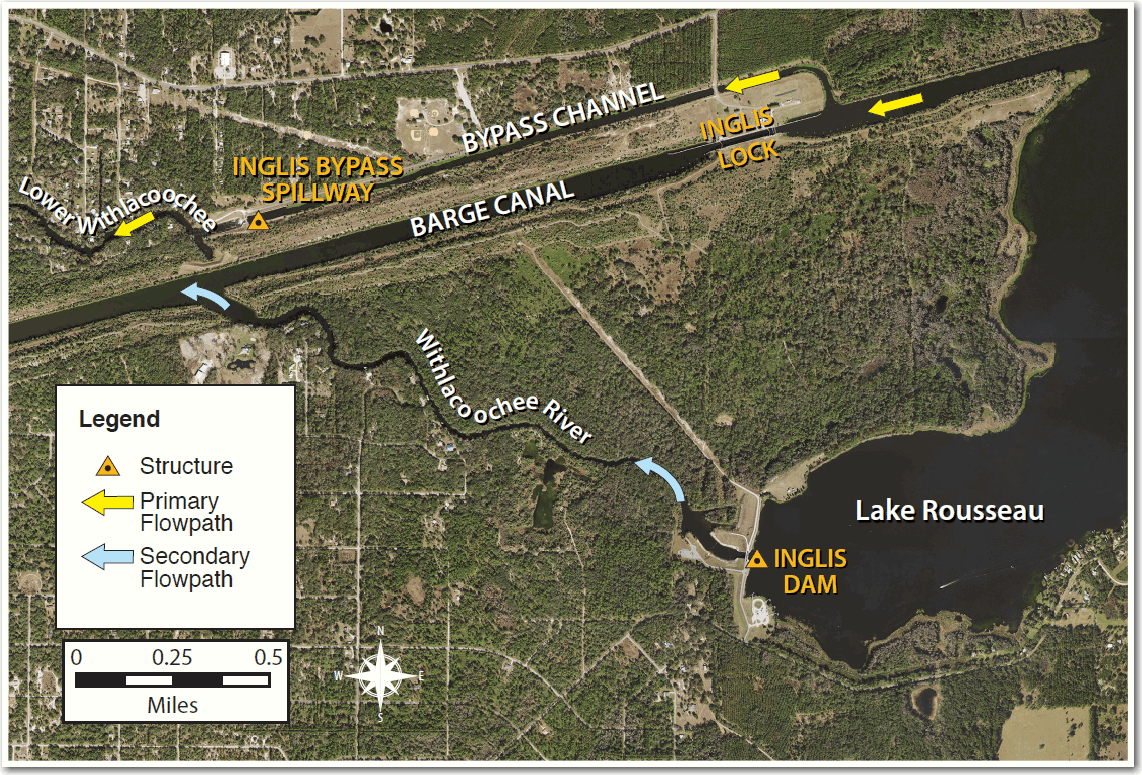
- The Inglis Bypass Spillway remains fully open, passing maximum flow to the Lower Withlacoochee River.
- In fact, the Bypass Spillway has passed max flow for nearly three quarters of the time in 2019. Typically, it only flows that high less than half the year.
- Excess flows are still passing through the Inglis Main Dam to the Barge Canal and into the Gulf of Mexico, although at a much lower rate than it did this past summer.
Have a great weekend!
Mark
Mark Fulkerson, Ph.D., P.E.
Chief Professional Engineer
Water Resources Bureau
Southwest Florida Water Management District
(352) 796-7211, ext. 4410
(800) 423-1476 (FL only)
(352) 279-4493 (cell)
|
|
|
|
|
|
|
|


|
Southwest Florida Water Management District | 2379 Broad Street, Brooksville, FL 34604-6899 |
|
If you do not want to continue receiving emails about these projects, click Unsubscribe. To manage your Southwest Florida Water Management District subscriptions, click Manage Preferences. |