
Withlacoochee River System Update - 10/1/2019
Southwest Florida Water Management District sent this bulletin at 10/01/2019 04:49 PM EDT
 |
Lack of Rainfall Causes Water Levels to Decline
(This update contains information for the entire system including the Withlacoochee River, Tsala Apopka Chain-of-Lakes, Lake Panasoffkee, Lake Rousseau and the Lower Withlacoochee River.)
Rainfall and Springflow:
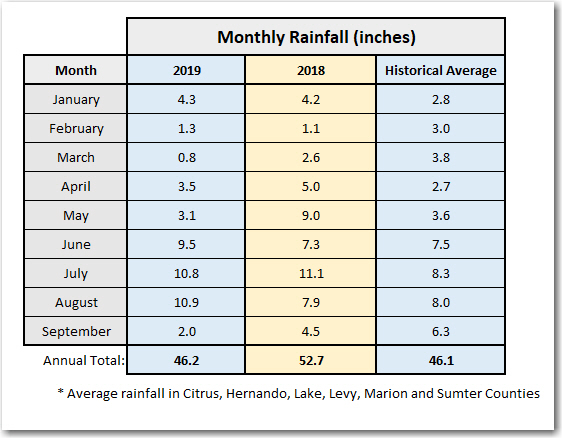
- More than two-thirds of our total rainfall so far in 2019 fell during a three-month span (June - August).
- Then the wet season came to an abrupt halt.
- In September, our region only received about 2 inches of rain, much lower the historical average (6.3 inches).
- This brings our total rainfall for the year to 46 inches, matching the historical average for the first 9 months of the year (January through September).
- High rainfall over the past several months has kept our aquifer (groundwater) levels high. Currently aquifer levels are in the 78th percentile for this time of year.
- As a result, flow in our region’s springs remain above normal for this time of year.
- The figure below shows monthly rainfall so far this year, as compared to last year and the historical average.
Withlacoochee River (from the Green Swamp downstream past Hwy 200):
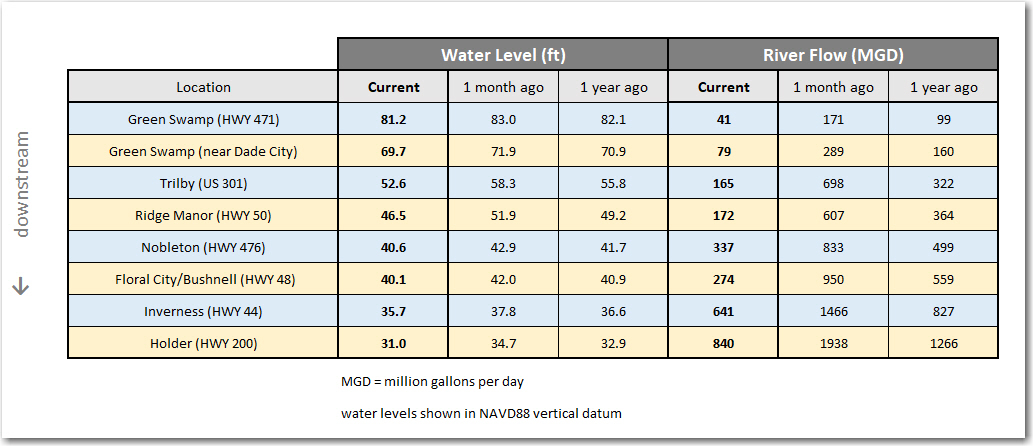
- Lack of recent rainfall has caused water levels and flows in the Withlacoochee River to decline sharply in recent weeks.
- This decline is a welcome sight to some, who feared or experienced flooding from high rainfall this summer.
- Over the past month, water levels have dropped several feet and river flows have decreased by about 30%.
- This decline is natural for a flowing stream and we can expect these trends to continue until our region receives high rainfall again.
- River levels and flows are also currently lower than they were this time last year, a direct result of how quickly the rainfall ended this year.
- The table below compares current river levels and flows to their peaks both this year (2019) and last year (2018).
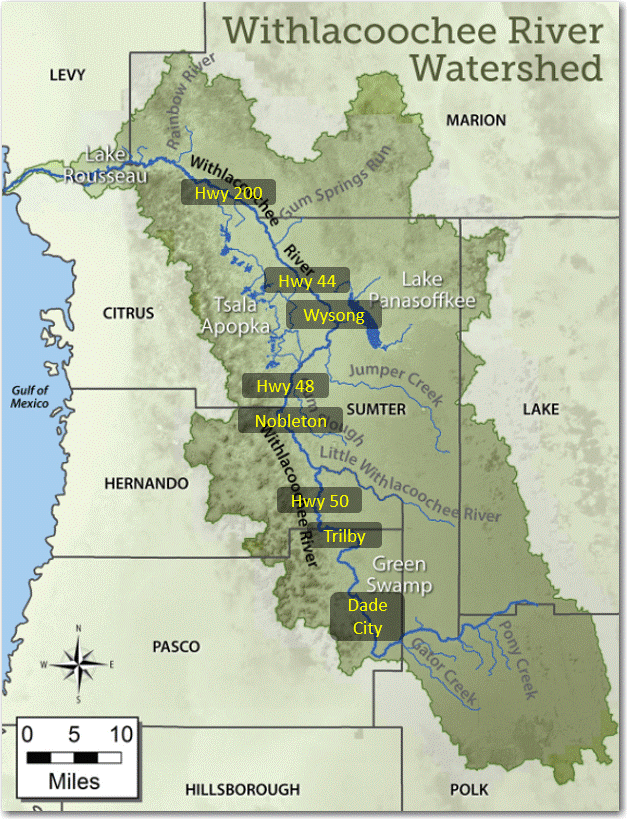
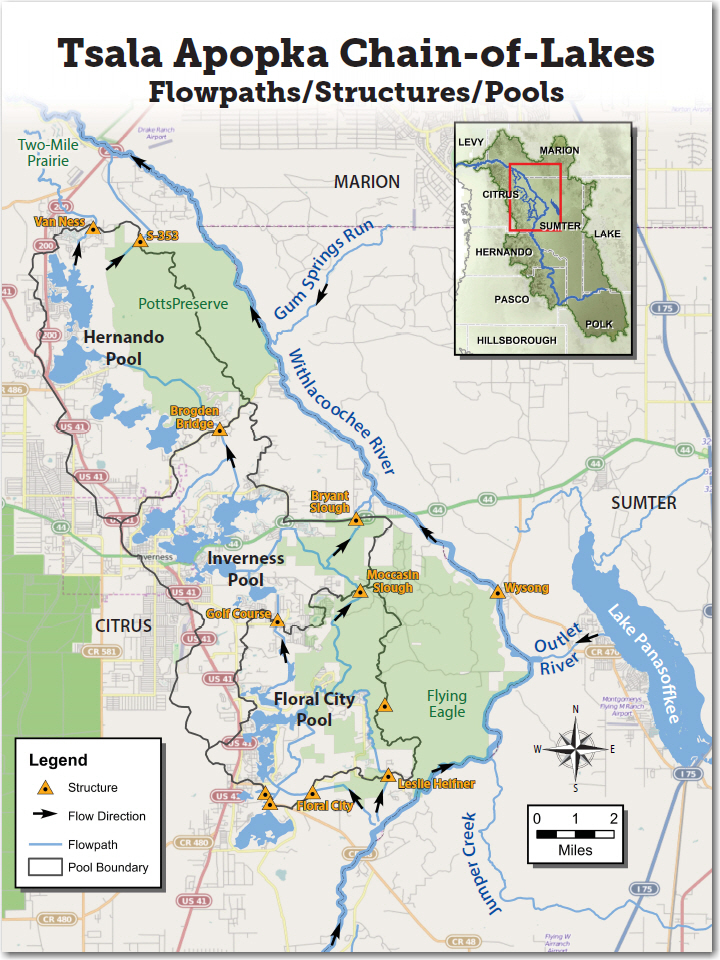
Tsala Apopka Chain of Lakes:
- Lake levels in all three pools of the Tsala Apopka chain have been relatively high all year long.
- For the second year in a row, rainfall filled the lakes during the summer and very little river water was needed.
- In fact, structures were opened several times this summer to release excess water from the lakes.
- In September, lake levels fell a couple inches due to low rainfall.
- For a couple weeks this past month, structures were opened to allow river water in, which limited the rate at which the lakes would have naturally dropped.
- These structures were closed last week, however, as the Withlacoochee River naturally fell below the level of the lakes.
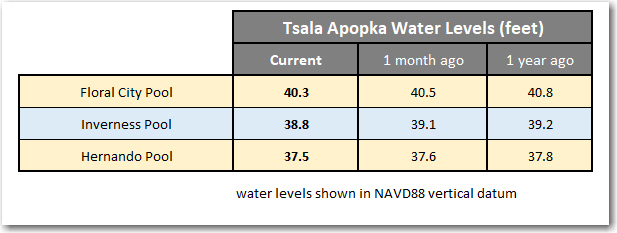
- The table below compares current pool levels to what they were this time last month and last year. All three pools are currently 7-8 inches below their high guidance levels.
Lake Panasoffkee and Wysong:
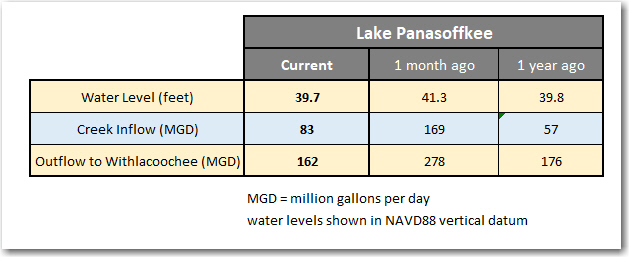
- After experiencing its 3rd highest water level since 1960, Lake Panasoffkee has steadily dropped over the past several weeks.
- The water level in Lake Panasoffkee is now 2 feet lower than it was in mid-August, and surprisingly 2 inches lower than it was this time last year.
- Lower lake levels are a combination of less inflow and better outflow (ie. hydrilla removal).
- As flows and water levels on the Withlacoochee River have declined, the Wysong Structure has been slowly raised.
- Currently, the main gate at Wysong is raised about halfway up from the river bottom, while the independent gate remains fully lowered.
- The table below compares current lake levels and flows to last month and last year at this time.
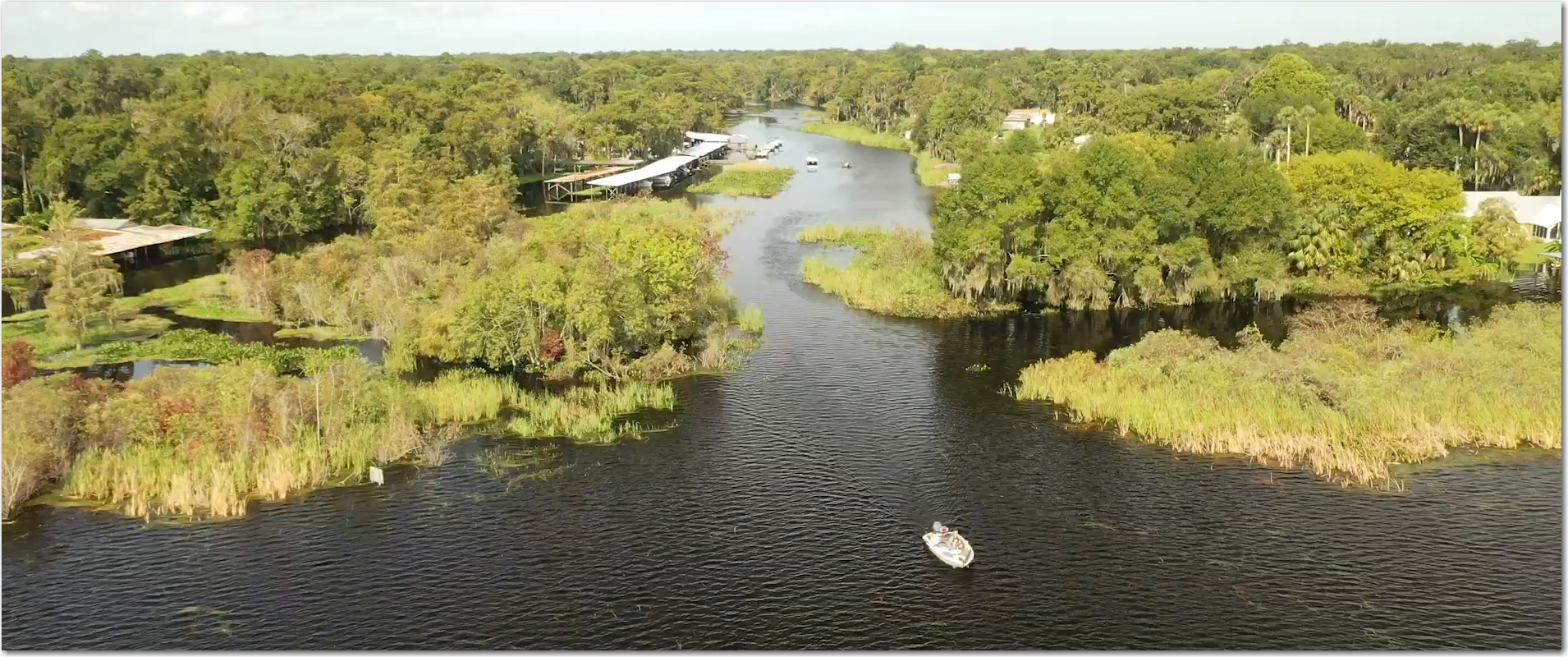
Start of the Outlet River from Lake Panasoffkee – August 2019 (image courtesy of the University of Florida)
Lake Rousseau and the Lower Withlacoochee River (from Dunnellon to the Gulf of Mexico):
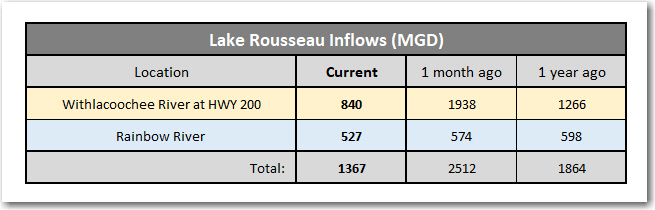
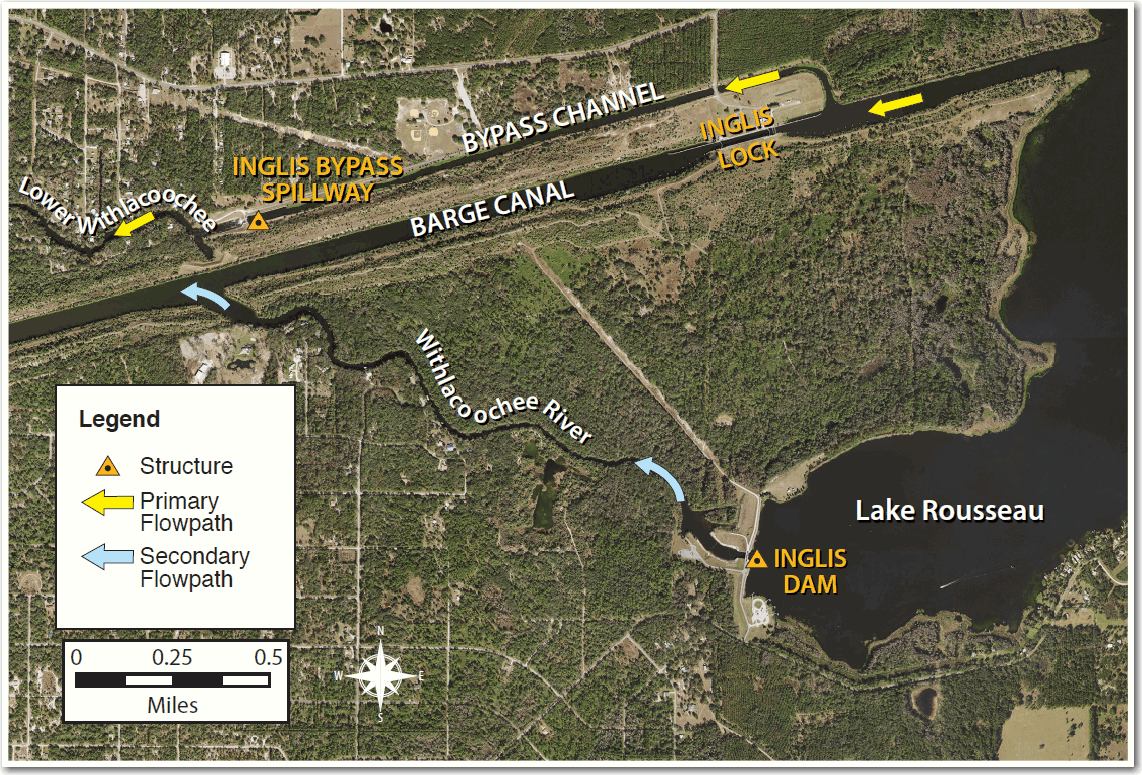
- Downstream of Dunnellon, combined flows from the Withlacoochee and Rainbow Rivers enter Lake Rousseau, upstream of Inglis.
- Flow in the Rainbow River (which reflects changes in aquifer levels) dropped 8% in September.
- Withlacoochee River flows (which depend on rainfall and runoff from adjacent lands), declined by nearly 60% over the past month.
- Overall, only about half as much flow is entering Lake Rousseau, compared to last month.
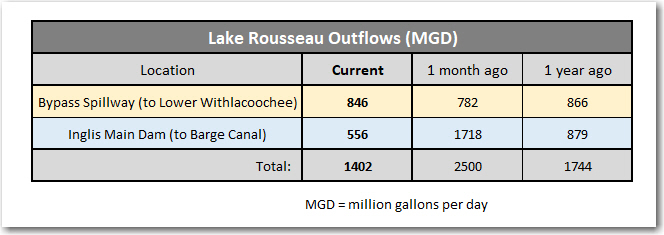
- Outflows from Lake Rousseau have also declined by about 50% over the past month.
- After being lowered several inches due to high upstream conditions, Lake Rousseau has now returned to its normal level.
- The Inglis Bypass Spillway, which conveys flow to the Lower Withlacoochee River remains fully open.
- Excess flows are still passing through the Inglis Main Dam to the Barge Canal and into the Gulf of Mexico, although at a much lower rate compared to last month.
If you have any questions or concerns, please let me know.
Take care,
Mark
Mark Fulkerson, Ph.D., P.E.
Southwest Florida Water Management District
(352) 796-7211, ext. 4410
(800) 423-1476 (FL only)
(352) 279-4493 (cell)
|
|
|
|
|
|
|
|


|
Southwest Florida Water Management District | 2379 Broad Street, Brooksville, FL 34604-6899 |
|
If you do not want to continue receiving emails about these projects, click Unsubscribe. To manage your Southwest Florida Water Management District subscriptions, click Manage Preferences. |