FOR IMMEDIATE RELEASE: Oct. 18, 2013
DEP SECRETARY TOURS NORTHEAST FLORIDA FACILITIES WORKING TO IMPROVE ST. JOHNS
~Secretary Herschel T. Vinyard Jr. visits facilities making strides as part of river's restoration plan~
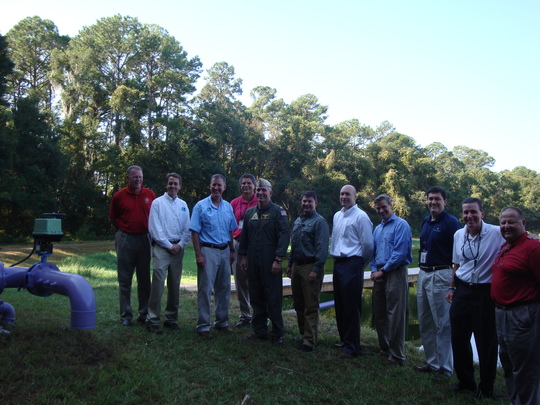 Secretary Herschel T. Vinyard Jr. (third from left) and DEP staff meet with Naval Air Station Jacksonville staff on Friday.
JACKSONVILLE – Florida Department of Environmental Protection Secretary Herschel T. Vinyard Jr. conducted a tour of four Northeast Florida facilities on Friday for updates on continued progress in helping restore the St. Johns River. These projects and investments are part of the ongoing commitments made by these facilities and other state and local governments to improve the health of the river by reducing the amount of nutrients entering the river.
“Northeast Florida is fortunate to have such an important water resource in the St. Johns River. I have seen first-hand that these facilities have made major strides towards improvement,” said Vinyard. “However, we must continue to monitor progress to ensure that the goal of restoration is achieved. We are fully committed to enforcing the adopted restoration plan until the health of the river is restored."
Vinyard, DEP Northeast District and Division of Environmental Assessment and Restoration staff visited Clay County Utility Authority’s Fleming Island Wastewater Treatment Plant, Naval Air Station Jacksonville, the JEA Buckman Facility and the Atlantic Beach Wastewater Treatment Facility on Friday to witness projects that have been implemented or are under construction to improve wastewater treatment, reduce wastewater discharges and reduce groundwater consumption.
-
Due to significant upgrades, the Clay County Utility Authority's Fleming Island wastewater treatment plant now provides advanced wastewater treatment. The Miller Street wastewater treatment plant also has undergone upgrades to improve its system. In addition, the implementation of an extensive water reuse system, allows discharge from these facilities to be used for irrigation. Clay County Utility Authority has achieved more than 100 percent of
reduction requirements with these improvements
-
Naval Air
Station Jacksonville recently completed a reuse project that
beneficially uses treated wastewater to irrigate its golf course rather than
being discharged into the river. The new system also has the benefit of
reducing ground water consumption by providing irrigation for the NAS-Jax
golf course and ball fields. With the completion of the project and other
wastewater improvements, 54 percent of the reductions are complete for the two naval
facilities in the basin—Naval Air Station Jax and Naval Station Mayport. Construction on another NAS Jax project will
begin in 2014 that will reduce total nitrogen by an additional 9 percent by building a two-mile pipeline
and a zero-discharge spray field in the South Antenna Farm area. This project
will provide more than 660,000 gallons per day of reuse water and will result in
zero discharge of all treated wastewater from NAS Jax to the St. Johns
River.
-
Since 1999,
JEA has invested $246 million on three main nutrient removal techniques:
upgrading larger regional wastewater treatment plants to advanced nutrient
removal technology, phasing out smaller older technology plants and building
and expanding the community’s reuse system. JEA is
completing the final major capital project in that nutrient initiative now:
nutrient removal upgrades at the Buckman Wastewater Treatment Plant. When this $22 million construction project is
complete this fall, JEA
will have reduced the discharge of nitrogen to the river by more than 50
percent from all of its facilities, an achievement of more than 100 percent of
the required reductions.
-
The
Atlantic Beach Wastewater Treatment Facility has completed construction of the city’s main wastewater treatment plant that
included wastewater treatment upgrades along with sludge and odor control
improvements. The construction of this facility allowed the flow from the
aged Buccaneer Wastewater Treatment plant to be transferred to this new
facility with better treatment capabilities. These combined efforts have
achieved more than 100 percent of the city’s total nitrogen reductions for
its wastewater facilities and also assisted with meeting 45 percent of its stormwater reductions. In addition, this
week the City Commission approved a project to extend reuse from the Main
Wastewater Treatment Plant to a nearby private golf course, which will reduce the amount of water discharged to the Lower St. Johns River and require a permanent green space easement that will prevent
additional development being built on the golf course
property.
The Department adopted reduction goals for the main stem of the Lower St. Johns River Basin in June of 2008 from Buffalo Bluff just south of Palatka to the mouth of the river. The restoration goals established total phosphorus and total nitrogen reductions in the freshwater reach needed to achieve chlorophyll-a levels in this portion of the river. These were the basis for restoration plan to achieve these target reductions, which was adopted in October 2008.
“Restoring
the St Johns River is a top priority for the Department and a complex challenge
involving a diverse group of stakeholders working together, said DEP Northeast District Director Greg Strong. "Today’s visit helps
us to recognize some of the considerable progress that’s already happening to
achieve our water quality goals, and to re-focus on the important work that
lies ahead."
Overall in the freshwater reach, 93 percent
of the reductions needed to meet the reduction goals for total phosphorus and 90 percent of the reductions needed to meet the reduction goals for total nitrogen have been achieved. In addition
to the nutrient reductions achieved in the freshwater section, the projects
completed in the marine section have reduced total nitrogen by 1,751,630 pounds per year, equaling 74 percent of the reductions needed.
|