FOR IMMEDIATE RELEASE: Dec. 18, 2012
DEP'S COASTAL AND AQUATIC MANAGED AREAS CELEBRATES THE RE-OPENING OF THE TAMPA BAY AQUATIC PRESERVES OFFICE
~A new beginning for an existing management area~
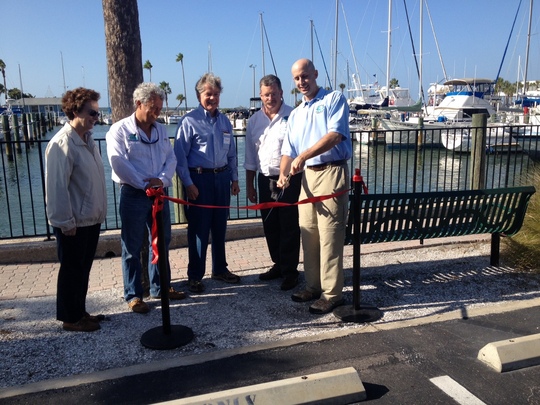 Coastal and Aquatic Managed Areas staff celebrate with a ribbon cutting Tuesday in Dunedin.
DUNEDIN – On Tuesday, the Florida Department of Environmental
Protections’ Office of Coastal and Aquatic Managed Areas celebrated the
re-opening of the Tampa Bay Aquatic Preserves office, a field site of the
office. A ribbon cutting was held at the City of Dunedin Municipal Marina overlooking
the preserve.
“I am proud of the work that is being done to manage and
restore natural resources like this one, and provide additional recreational
opportunities to our local communities,” said CAMA Director Kevin Claridge. “I look forward to many generations being able
to enjoy the benefits from these and other state lands our department offers.”
The office for the Tampa Bay
Aquatic Preserves is re-opening because of re-evaluations of the functions of
the office in Tallahassee. Claridge directs nearly 50 coastal and aquatic
sites statewide and has shifted functions
away from the central office to field sites so that one full time position and two part-time positions were
available to staff the Tampa Bay Aquatic Preserves.
“The Tampa Bay Aquatic Preserves office
was established by the State of Florida to protect the abundant resources in
this estuary,” said Aquatic Preserve Manager Dr. Randy Runnels. “It is the
second largest urban estuary in the state and it is as important to commercial
and a recreational interests now as it was when Tampa Bay was first settled. We
attract tourists from around the world to these clean and beautiful waters
right off shore from one of Florida’s largest cities.”
A local steering committee, comprising business and environmental leaders, will have a voice in promoting the
activities of the aquatic preserves. Those activities focus on water quality,
restoration of islands and shorelines, and helping the public to understand how
they can keep the waters clean, the beaches beautiful, and the mangroves and
seagrass beds productive.
|