|
The Northwest District welcomed Heather Barrineau as our newest environmental specialist in the Potable Water section. Heather will handle all of our Public Boil Water Notices and Monthly Operating Reports. We're happy to have Heather on our team.
All small community water systems (population less
than or equal to 3,300) are required to monitor once in 2018 for the Synthetic Organic
Contaminants (SOCs).
However, systems may qualify for a reduction
in monitoring. To apply for reduced monitoring, complete the application form and submit it to Paula Smith at paula.smith@floridadep.gov.
You may also mail your application to:
Florida Department of Environmental Protection
160 W. Government St., Suite 308
Pensacola,
Florida 32502.
Applications should be mailed as soon as possible to allow
enough time to monitor if the request is denied or if partial sampling is
required.
If
you have any questions, please contact Paula Smith at 850-595-0632.
Yes, you read that correctly. CBT is back! We believe CBT will
be a benefit to our operators and water systems as it will allow for more
testing sites and times, immediate test results, and better understanding of
your testing areas needing further review.
For scheduling information, visit our CBT Information Page.
Prepare for the Exam
Use study guides and other reference materials to prepare for your examination. Be sure you read and understand the candidate handbook for your examination program.
Rest
Get plenty of sleep the night before your examination.
Breaks
Make sure you have eaten before the examination begins; food and drink will not be allowed in the testing room. You will be allowed
restroom breaks, but you will not be given additional testing time for time lost during
breaks.
What to Bring
Two current forms of identification are required, one being government
issued with photograph. Both IDs must have your name and signature. If a
calculator is allowed for the examination, make sure your calculator complies
with the calculator requirements and is in working order.
Location
Make sure you know where your testing center is located. Currently, the most convenient sites to Northwest District are in Mobile, Alabama, and
Tallahassee, Florida. Be sure to allow extra time for traffic, parking, and getting
settled before the examination.
Temperature
Dress in layers so you can adapt to any room temperature. Heavy
coats and hats are not allowed in the testing room.
Personal Belongings
No personal belongings - including cell phones, smart phones or
other electronic devices - are allowed in the testing room. You will be asked to
return them to your car or turn them to the off position and place them in a
soft-locker provided by the site. If your electronic device rings, vibrates or
makes any noise during the examination, you will be dismissed from testing and
no refund will be provided.
Your Results
You will be provided a pass/fail score report after your test that will reflect your strengths and weakness in each area.
Additional instructions are available in the candidate
handbook. If you have further questions, contact the Tallahassee main office at 850-245-7500 or by email at: operator.certification@floridadep.gov.
|
The Northwest District will soon be accepting applications for
the department’s 2018 Plant Operations Excellence Awards for both public water
supply facilities and domestic wastewater facilities.
Water systems
self-nominate for these awards and applicants are judged by a panel of judges
in the Northwest District DEP office.
Everyone is invited to apply! Please visit our website for more
details.
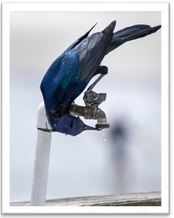
This amazing photo was captured by DEP's Lucas Grantham.
One of the
simple things we can do to save water is to turn off the tap (except when birds are getting a quick drink from it).
You can save up to eight gallons of water just by turning off the tap while you brush your teeth in
the morning and before bedtime. That
adds up to more than 200 gallons a month, enough to fill a huge fish tank that
holds six small sharks. The same is true when you wash dishes. Turn off the tap!
Scrape your dirty dishes into the trash and then put them in the dishwasher or turn off the water as much as you can while you are washing them.
For more tips
on how to conserve water, visit
https://www.epa.gov/watersense/watersense-kids
Scheduling Requirements
- Quarterly monitoring plans must identify the
specific week of the quarter that will be sampled.
- Systems must sample every 90 days. The 90-day
rule was developed to allow an equal amount of time between sampling. It is
understood that there are more than 90 days in some quarters and that a
specific day may fall on a weekend in certain years. To work with these
factors, facilities may collect samples during the designated week of
monitoring. For example: the second week of the second month
for each quarter.
- Annual and triennial monitoring plans must
designate the specific month when the systems will be sampled.
- Systems must monitor during the month of highest
DBP concentrations.
Compliance Samples
- Samples used for compliance purposes must be designated in
the system's state-approved monitoring plan. Systems may collect more than the
required number and frequency of sampling. However, to be included in the quarterly
average calculation used for compliance purposes, the additional samples must
be noted in the monitoring plan and approved prior to collecting samples.
Due dates
- Test results must be submitted to DEP within the first 10
days following the end of the required monitoring period, or the first
10 days following the month in which the sample results were received, whichever
time is the shortest.
Contact Lexie Woodson at 850-595-0640 to ensure your sampling plan is up to date.
- Notify both DEP and your local Department of
Health as soon as possible.
- Issue a PBWN and make sure to include the
following information.
- PWS name and number
- Area affected
- A statement of the problem
- The date of occurrence
- Customer corrective action
- PWS corrective action
- Rescission statement
- PWS phone number and contact name
- Correctly sample the affected area according to
DOH Guidelines for the Issuance of
Precautionary Boil Water Notices.
-
Rescind the notice in the same way the PBWN was
issued (i.e., if you use door-hangers to issue the PBWN, then you must rescind the PWN with
door-hangers).
-
Remember to record any abnormal operating
conditions, maintenance, and precautionary boil water notices in the comment
section of your Monthly Operation Report.
- Send a copy of your PBWN sample results along
with your Monthly Operation Report.
Please
note:
Even when best management practices are followed and a Precautionary Boil Water Notice is
not required to be issued, the adopted DOH guidelines still require that the
affected water main be repaired, flushed, disinfected, sampled, and monitored
for chlorine residual according to ANSO/AWWA Standard C651, as soon as
possible.
Our staff
is more than happy to review your templates and notices. Please email Heather Barrineau if you have any questions.
|