|
This issue focuses on the new testing requirements associated with the new storage tank rules that went
into effect in January 2017.
Our previous issue of
the Petro Pulse that reviewed all the
new rules can be found here.
We are here to assist, so please reach
out to any of our contacts listed at the bottom of the newsletter with any
questions, comments or ideas.
We have redesigned our website to make sure it’s functional,
visually appealing and easy to use. As part of the redesign, we
implemented a new, easy-to-remember web domain: www.floridadep.gov.
To be consistent with the new web address, DEP is also
changing email addresses from dep.state.fl.us to floridadep.gov.
For example, John.Doe@dep.state.fl.us
will now be John.Doe@floridadep.gov.
For a while, both email domain addresses will work, but please go ahead
and update your contact lists with this change.
1. Fill component with water.
- Spill bucket – to 1.5 inches from the top
- Sump – a minimum of four inches above the
highest sump penetration or sidewall seam
2. Measure the stick vertically from the
lowest point
in the bucket/sump, to above the water level;
document the
measurement.
3. After one hour, document the ending water
level
measurement.
4. Remove all the water from the sump/spill
bucket
and determine if the fluid is hazardous waste
before disposal.
- Test water that has no sheen on it is not
considered hazardous waste can be reused for
other testing.
- Test water that is determined to be
hazardous
waste must be hauled away by a registered
hazardous waste
transporter. A list of
transporters can be found here.
5. The test fails for each component if the
water level
drops more than 1/8 (0.125) inch.
6. Any integrity test that results in a
failure is
considered an incident. This
incident will need to
be reported, an Incident Notification Form
completed and
an investigation of the incident
conducted.
1. Clean and remove any liquid or debris.
2. Repair any loose or broken components.
3. Make sure the fill cap is secure and
leak-tight or
use a plumber’s plug in the fill riser.
4. Ensure the drain valve is also
leak-tight, or it can
be removed and permanently plugged.
5. Seal the test cover to the top of the
spill bucket.
6. Apply a vacuum of 30 inches of water
column and
close the valve. Be
sure the reading is in water
column and not mercury.
7. Document the initial pressure reading.
8. Hold the pressure for one minute and
document
the final pressure reading.
9. A final pressure reading of 26 inches
water
column or greater, passes the test.
|
All
dispenser liners, sumps and spill buckets, need to have routine hydrostatic
tests.
Single-walled components should have been tested by Jan. 11, 2018 and will need to be tested again every year.
Double-walled components, below-grade piping sumps and
below-grade dispenser sumps will
need to be tested by Oct. 13, 2018, and again every three years.
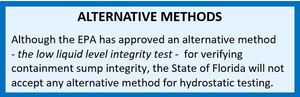
According
to underground storage tank rule Chapter 62-761, the integrity
testing needs to be done in accordance with the manufacturer’s specifications
or by following the direction provided in PEI/RP1200-12, 2012 Edition. Be sure to maintain records of the testing
results for review during your next routine inspection.
Tanks
installed after Jan. 11, 2017, are required to have an overfill device that:
• Automatically
shuts off at no more than 95 percent full
• Has a
flow restrictor that restricts flow at 90 percent full
• Alerts
the transfer operator when the tank is 90 percent full
Exemption
– Underground storage tanks with a capacity less than 2,000
gallons that don’t receive deliveries by a joined tight fill adaptor connection
and are never filled beyond 80 percent capacity.
Ball
float valves are no longer an option for new installations. Other methods such as shut-off valves or
alarms are now required. Flow
restrictors also need to be tested annually to verify they are operating
correctly.
All
level gauges, measuring devices, high-level warning alarms and high-level liquid
flow cutoff controllers are required to be tested every year.
Be sure to keep copies of testing results for review during future
inspections.

For your convenience, here are some quick links to well referenced sites:
• Storage Tank Compliance page
• Rules, Guidelines & Forms
• Announcements - Outreach Opportunities
• ESSA Business Portal (Tank Registration or to Pay Registration Fees)
• Operator Training
• Approved Equipment (EQ List)
|