2024 Florida Severe Weather Awareness Week: Thursday - Hurricane and Flooding Awareness
Florida Division of Emergency Management sent this bulletin at 02/08/2024 09:29 AM EST
This update is intended for government and emergency response officials, and is provided for informational and situational awareness purposes only. Forecast conditions are subject to change based on a variety of environmental factors. For additional information, or for any life safety concerns with an active weather event please contact your County Emergency Management or Public Safety Office or local National Weather Service forecast office.
Florida’s Severe Weather Awareness Week takes place from February 5-9, 2024. Severe Weather Awareness Week is an opportunity for Floridians to learn about the various weather hazards that frequently impact the state and how families and businesses can prepare for these natural events.
Thursday’s focus is on Hurricanes and Flooding.
Close to the tropics and surrounded on three sides by warm water, the unique location of Florida makes it particularly vulnerable to tropical systems as they develop across the Atlantic Ocean, Gulf of Mexico, and Caribbean Sea. No other state in the country has more hurricane landfalls per year on average than Florida does. Nearly 40% of all hurricanes that strike the United States make landfall in Florida.
The Atlantic Hurricane Season officially begins on June 1 and continues through November 30. However, tropical systems can still form outside of hurricane season as experienced during the 2023 Atlantic Hurricane Season when an Unnamed Subtropical Storm formed off the Northeast United States Coast in mid-January.
The Atlantic Basin saw 20 named storms in 2023, which ranks fourth for the most-named storms in a year since 1950. Out of the twenty (20) named storms, seven (7) strengthened into a hurricane and three (3) became major hurricanes (Category 3 or higher). Hurricane Idalia made landfall near Keaton Beach, Florida (Taylor County) at 7:45 AM EDT on August 30, 2023, as a Category 3 Hurricane with maximum sustained winds around 125 mph. Idalia became the first major hurricane on record to make landfall in this portion of the Florida Big Bend. Please read the article for a 2023 Atlantic Hurricane Season Summary.
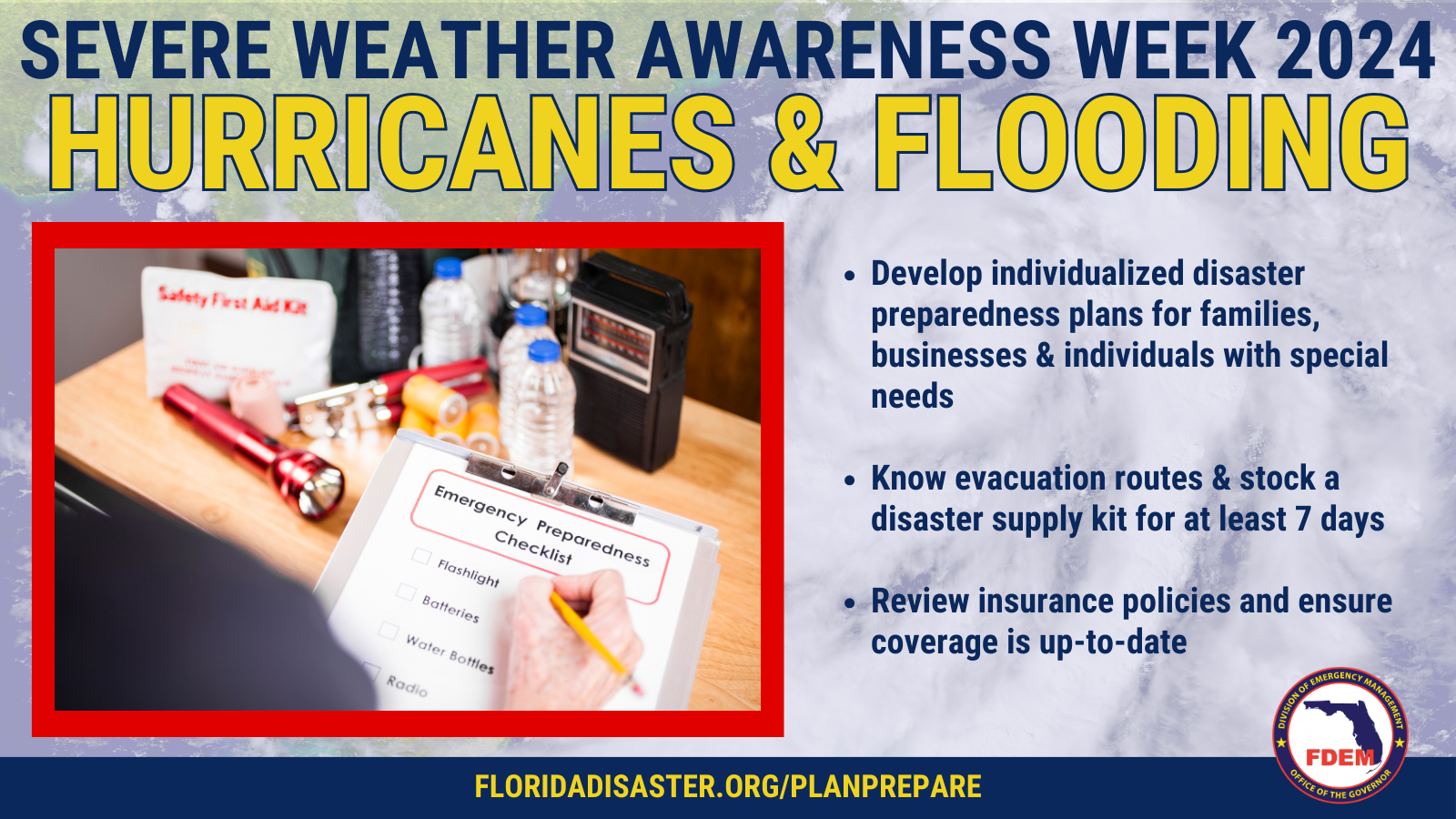
Determine whether you live in an evacuation zone (Know Your Zone, Know Your Home) – this information can be obtained from your local emergency management office through links at https://www.floridadisaster.org/know. If you live in an evacuation zone, know when and where you will be going to pass the storm.
Have a disaster supply kit ready – non-perishable food, batteries for electronic devices such as your NOAA Weather Radio, and enough supplies to last 7 days. Assess your property to ensure that landscaping and trees do not become a wind hazard.
About 90% of all hurricane fatalities occur from drowning in either storm surge or freshwater flooding. Life-threatening storm surge and historic freshwater flooding from Hurricane Ian in 2022 was a somber reminder of the true power of water. Regardless of the system’s intensity, the widespread flooding caused by Tropical Storm Fay in 2008 showed that tropical storms can cause as much or greater devastation than hurricanes with freshwater flooding.
Even outside of tropical systems, flooding is a serious concern in Florida since it can happen anywhere and at any time. Most deaths due to flooding in the United States are from people driving their cars into flooded areas. People are urged to be extremely cautious when driving in heavy rains, especially when water covers the road; it is difficult to determine the depth of water or the condition of the road under the water. If you come to a flooded road, remember the phrase “Turn Around, Don’t Drown”.