|
Issue No. 14

|
|

Director of Open Government’s Message
As BEGA’s Ethics Week 2026 approaches, it is worth underscoring a simple truth: open government is ethical government. Ethics is not only about avoiding conflicts of interest but about ensuring accountability. The public’s ability to see how decisions are made keeps the government accountable. Transparency must be built into government processes from the start. Whether posting clear agendas, conducting thorough FOIA searches, or ensuring new technologies preserve public records, the District government should be transparent.
As government communication shifts to emails, cloud platforms, messaging apps, and AI tools, the risk of an unintended transparency gap grows. The Office of Open Government has thusly focused throughout 2025 and 2026 on strengthening FOIA and Open Meetings Act training, monitoring compliance, and guiding agencies through emerging issues such as electronic communications, records retention, and responsible use of AI. Our goal is to help public bodies prevent transparency problems and not to just identify them after the fact.
This year’s Ethics Week theme, “Transitioning Ethically,” reminds us that change tests institutions but also creates opportunities to improve them. When adopting new technologies, launching programs, or forming public bodies, transparency must be considered at the outset. Residents may not agree with every decision, but they should be able to see their government at work and access the records they are entitled to. We encourage you to ask this simple question, “how do we do this openly?” This is how we make accountability visible and build public trust. Enjoy the latest issue of the Opengovist.
In Service,
Niquelle M. Allen, Esq.
Director of Open Government
|
|
|
Homeland Security Commission Dissolution Amendment Act of 2026
The “Homeland Security Commission Dissolution Amendment Act of 2026” passed as part of this year’s enacted Budget Support Act (“BSA”), which is currently under Congressional review. It requires that on October 1, 2026, the Homeland Security Commission (Commission) transfer all of it records and information to the Homeland Security and Emergency Management Agency (HSEMA). Those records and information “shall be destroyed by HSEMA by September 30, 2027.” It also restricts disclosure of closed Commission meeting information to anyone outside of Commission members in attendance at the closed meeting, and restricts Commission members, closed meeting attendees, and meeting presenters from disclosing “information presented or opinions formed as a result of a Commission meeting” in administrative, civil or criminal proceedings.
The legislation also designates all of the Commission’s records as confidential and HSEMA and the Commission cannot disclose this information due to a subpoena, discovery request, or D.C. FOIA request. It also prohibits this information from being introduced into evidence in any administrative, civil, or criminal proceeding; however, if the information and records could have been obtained through other sources, they may be disclosed.
The legislation also provides a narrow category for HSEMA to disclose information to related agencies. It reads, “information and records may be disclosed by HSEMA as necessary to carry out its duties and purposes…to another homeland security agency or a homeland security commission if the other agency or commission is governed by confidentiality provisions that afford the same or greater protections.”
B26-0655 - Protecting Judicial Privacy Act of 2026
On August 31, 2026, the Committee on Judiciary and Public Safety filed a Public Hearing Notice for a hearing on Wednesday, September 23, 2026. The measure was introduced in April by Chairman Mendelson, and referred to the Committee, with comments from the Committee of the Whole. The proposed law “would prohibit government agencies, individuals, businesses, private associations and organizations from, upon receipt of a written request, publicly displaying available content that includes a judicial officer’s personal information.”
B26-0670 - District of Columbia Government Data Privacy and Protection Act of 2026
On June 29, 2026, the Committee on Public Works and Operations held a public hearing on B26-0670, the “District of Columbia Government Data Privacy and Protection Act of 2026.” Introduced by Councilmember Brianne Nadeau on April 27, 2026, the measure establishes comprehensive privacy protections governing the collection, use, sale, and disclosure of individuals’ personal data by District government agencies and third parties. It also confers specific rights upon individuals regarding their personal information. This measure further provides for the creation of a Chief Privacy Officer (CPO) position within the Office of the Chief Technology Officer (OCTO) to ensure agency-wide compliance and implementation.
Witnesses broadly supported comprehensive privacy protections for personal data held by District agencies but recommended significant revisions. Privacy advocates called for stronger protections for publicly available government records, retroactive data audits, prompt breach reporting, stronger enforcement, an independent Chief Privacy Officer, and regulation of data brokers. Industry representatives cautioned that broad definitions and consent requirements could disrupt government contracting, fraud prevention, identity verification, and federally regulated activities. OAG and OCTO recommended clarifying key terms, preserving records-retention and litigation obligations, reconsidering deletion and consent requirements, identifying an independent enforcement entity, and providing OCTO with sufficient authority, staffing, funding, and technology. OAG and OCTO also discussed how the bill’s proposed individual access, deletion, and opt-out rights would interact with existing D.C. FOIA procedures, public-data practices, records-retention requirements, and litigation-preservation obligations.
B26-0588, the “Captive Insurance Company Act of 2026”
On June 15, 2026, the Council’s Committee on Health held a public hearing on B26-0588, the “Captive Insurance Company Amendment Act of 2026,” introduced by Chairman Mendelson. The proposed amendment reads: “Documents, materials, and other information submitted pursuant to this section, and any rules promulgated thereunder, shall be confidential and shall be exempt from the Freedom of Information Act of 1976, effective March 29, 1977 (D.C. Law 1-96; D.C. Official Code § 2-531 et seq.), and shall not be subject to subpoena or discovery or admissible in evidence in a private civil action, and shall not be divulged to any person except either as provided for in this subsection or with the written consent of the captive insurer or protected cell.”
The Captive Insurance Company Act of 2004 (D.C. Law 15-262) applies to an insurance company created by a parent company to insure the parent company’s own risks (“captive insurance” company).
The Captive Insurance Company Amendment Act of 2026 makes certain proprietary captive insurance regulatory records confidential under this statute. While these records could already be withheld under D.C. Official Code § 2-534(a)(1), which exempts trade secrets and confidential commercial or financial information, this new law would clarify the extent of the confidentiality of captive insurance company records submitted to the Department of Insurance and Banking (DISB). The primary justification for withholding records is now D.C. Official Code § 2-534(a)(6), information specifically exempted by statute, as a result of the amendment.
B26-0648 - DC Hospitality Amendment Act of 2026
The Committee on Public Works and Operations held a hearing on July 8, 2026, regarding B26-0648, “DC Hospitality Amendment Act of 2026” that would create a pop-up restaurant license category. Under the bill, the Alcoholic Beverage and Cannabis Board must make a licensee’s quarterly statements available to anyone protesting the license and to any member of the public who requests them under the D.C. FOIA. This disclosure would allow a protestant to determine the licensee’s gross annual receipts. However, the quarterly statements remain subject to the disclosure exemptions in D.C. Official Code § 2-534. The lengthy hearing did not produce an extended legal discussion of the D.C. FOIA issue, but the Restaurant Association of Metropolitan Washington (RAMW), opposed this provision on the basis that the statements contain proprietary trade secrets and confidential financial information and should not be available to competitors.
B26-0208 - Open Meetings Clarification Amendment Act of 2025
The Council has passed the “Open Meetings Clarification Amendment Act of 2025,” which establishes that: (1) a meeting is open if a public body takes “reasonably calculated” steps to allow viewing or hearing the meeting during, or as soon as reasonably practicable, “if not technologically feasible;” (2) designates an ‘appropriate officer of the Council’ for “compiling and posting … Open Meetings documents” for the Council; (3) “eliminate[s] unnecessarily duplicative language” to describe the subject matter of … meetings; and (4) “explicitly exempt[s] text messages from constituting an electronic meeting … consistent with…email messages” under the OMA.
The bill was enacted as Act 26-361, as of July 14, 2026. The 30-day Congressional review has ended, and the Act is now D.C. Law 26-167, effective August 20, 2026.
|
|
Jason Leopold, et al. v. Central Intelligence Agency
Case No. 16-cv-1833 (D.D.C.)
Federal FOIA Case (Adequacy of Records Search)
In this federal Freedom of Information Act (FOIA) case, the Plaintiffs were seeking documents that were cited in the publicly released Executive Summary of the Senate Select Committee on Intelligence (SSCI) Report on the CIA’s rendition, interrogation, and detention program. The Plaintiff’s FOIA request was for specific records that were “discussed in the Executive Summary” and were “identified in the footnotes of the SSCI Report.” The CIA failed to make a determination on the request by the statutory deadline and the plaintiffs brought suit. The CIA eventually produced 378 documents in whole or in part and withheld 225 documents in full. The CIA stated that it was unable to locate 19 of the documents cited in the SSCI Report.
The U.S. District Court for the District of Columbia granted in part and denied in part Cross-Motions for Summary Judgment. The Court held that the CIA adequately described its search of the Rendition, Detention, and Interrogation Network (RDINet) database. This database was identified by the CIA as the location that was reasonably likely to contain responsive records. However, the Court found that the CIA failed to sufficiently explain supplemental searches conducted in other offices likely to contain responsive records, precluding summary judgment on the adequacy of the search.
The Court also found the record insufficient to determine whether the CIA should have consulted an unredacted version of the Senate Report’s Executive Summary in searching for responsive documents. With respect to Exemption 5, which protects internal government documents and memos that would normally be shielded from civil discovery during a lawsuit, the Court upheld most of the CIA’s withholdings under the deliberative process, attorney-client, and attorney work-product privileges, but ruled that additional declarations and a more detailed Vaughn index were required for numerous documents because the agency had not adequately demonstrated that the records were privileged or that disclosure would cause the foreseeable harm required by FOIA. The parties’ Motions were denied without prejudice as to the disputed search issues and specified Exemption 5 withholdings, with leave for the CIA to supplement the record.
American Oversight v. Dept. of Energy
Case no. 25-2981 (D.D.C.)
The U.S. District Court for the District of Columbia granted summary judgment in favor of the plaintiff, American Oversight who had brought suit to challenge an agency notice that required all FOIA requesters with pending requests dated before October 1, 2024, to contact the DOE to express their continued interest in the material in order for the requests to remain open. The Court found that DOE exceeded the limited legal authority granted to it by Congress when it imposed a blanket “still interested” requirement that gave requesters with older FOIA requests 30 days to reaffirm their interest or risk having their requests administratively closed.
The Court stated that “Nothing in the Freedom of Information Act authorizes an agency to require all requesters to take affirmative steps to reassert their interest in FOIA requests still awaiting a response, even if the request has been open and untouched for a significant amount of time.” The Court noted that FOIA mandates that upon request for records, agencies “shall…determine within 20 days…after the receipt…whether to comply with such request and shall immediately notify the person making such request” and stated that FOIA “sets out only three specific circumstances in which the agency may toll that deadline: if it contacts a requester for more information regarding a request, if it contacts a requester for clarification regarding fees, or under ‘unusual circumstances’.” The Court found that “none of that indicates that the agency can tackle a backlog of requests en masse by making every requester identify and reaffirm requests it has already submitted on a very short timeframe and unilaterally closing or ignoring requests.”
|
|
Open Meetings Act Violations by the Boards of Trustees for District of Columbia Public Charter Schools
Advisory Opinion #OOG-2025-0036
On August 24, 2026, Director Allen issued an Advisory Opinion #OOG-2025-0036, in response to a complaint which alleged that Monument Academy Public Charter School Board (“Monument Academy PCSB”) failed to post an annual schedule of its meetings, meeting links, dates, times, and location, and specific meeting minutes.
Director Allen found that Monument Academy PCSB violated the Open Meetings Act (D.C. Official Code §§ 2-575, 2-576) by failing to publish its meeting notices on the Public Charter School’s website and/or the District’s Central Meeting Calendar. The Director also found that the Board violated the OMA for failing to publish draft and final meeting minutes or (access to) recordings on Monument Academy Public Charter School’s website and/or the Central Meeting Calendar as required by the OMA (D.C. Official Code § 2-578(b)).
Director Allen directed that the Monument Academy PCSB members who have not attended any of the Office of Open Government’s OMA training sessions in 2026 must complete OMA training within sixty (60) days of receipt of the Advisory Opinion to avoid further corrective action.
Read the Advisory Opinion here:
Open Meetings Act Complaint Dismissal Regarding Publication of Meeting Notices by a Board of Trustees for DC Public Charter School
Advisory Opinion #OOG-2025-0018
On July 28, 2026, Director Allen issued an Advisory Opinion #OOG-2025-0018, in response to a complaint which alleged that the District of Columbia International School Public Charter School Board (DCIS PCSB) does not publish the location, including web links, of its meetings.
Director Allen dismissed the Complaint pursuant to 3 DCMR §10403.1(b), because the Director found that DCIS PCSB did not violate the Open Meetings Act. OOG’s investigation did not substantiate the allegation of an unpublished meeting location, including web links. The investigation revealed that DCIS PCSB’s complete meeting notices from the date of the OMA complaint and for upcoming meetings were posted on the Public Charter School’s website.
Read the Advisory Opinion here:
Closure of One Public Charter School – Capital Village Public Charter School (CV PCS)
It was reported in January of this year by Capital Village Public Charter School (CV PCS) in Ward 5 and District of Columbia Public Charter School Board (DC PCSB) that CV PCS had decided to relinquish its Charter, effective at the end of the school year 2025-2026. The school closed in June 2026. There was one campus/school under the Local Education Agency (LEA), and therefore, there are no remaining campus/schools under the (relinquished) Charter.
In January 2026, DC PCSB reported that CV PCS was exploring a potential merger with Social Justice Public Charter School (SJ PCS) considering the schools’ core commitments to social justice, equity, and personalized learning. However, at the time of the report, DC PCSB had not granted formal approval of the merger. Prior to CV PCS’ closure, DC PCSB provided information for the families of students who chose to attend SJ PCS to apply to the institution and provided information that a series of informational sessions would be hosted by both schools for the families of CV PCS’ students. There is no report that CV PCS has partnered with SJ PCS for the new school year.
Advisory Opinion #OOG-2026-0006
On August 27, 2026, Director Allen issued an Advisory Opinion #OOG-2026-0006, in response to a complaint which alleged that the Complainant was questioned by a District of Columbia Pedestrian Advisory Council (DC PAC) representative about the reason for attending DC PAC-related events and was explicitly asked by the representative not to attend future events.
Director Allen dismissed the Complaint pursuant to 3 DCMR §10403.1(a), because it does not raise issues within the Director’s authority under the OMA; the entity complained of is not a public body that is subject to the OMA. The entity complained of is not DC PAC, but is the Bike Walk and Bus PAC, a political action committee that has no affiliation with DC PAC.
Read the Advisory Opinion here:
Advisory Opinion #OOG-2026-0007
On August 28, 2026, Director Allen issued an Advisory Opinion #OOG-2026-0007, in response to a complaint which alleged that the Complainant did not locate a website or any quarterly meetings for Condominium Association Advisory Council (CAAC). The Complainant also requested an operable weblink to CAAC’s website, or alternatively, the contact information of the current CAAC members.
Director Allen determined that the action complained of does not violate the OMA because CAAC is an inactive public body that has not convened to consider, conduct, or advise on public business since its creation in 2017. The Director dismissed the Complaint pursuant to 3 DCMR §10403.1(b) because the OMA does impose an affirmative requirement for a public body to conduct meetings; it is triggered by the holding of a meeting. Also, OOG’s enforcement authority under the OMA (D.C. Official Code § 2-579) does not extend to enforcing the meeting frequency mandate located in the CAAC’s enabling legislation or the statutory obligation to appoint CAAC members. The Complainant’s issues are most appropriately pursued through Department of Housing and Community Development (DHCD), the agency that administers the CAAC; the Mayor’s Office of Talent and Appointments (MOTA), the executive branch administrator for appointing CAAC members; and the Council of the District of Columbia, Housing Committee, which has oversight over DHCD.
Read the Advisory Opinion here:
Dismissal Letter #OOG-2026-0013
White House Law Enforcement Issues
Director Allen recused herself from this matter due to the appearance of a conflict of interest, pursuant to D.C. Official Code § 1-1162.23(a), and assigned it to Chief Counsel Louis Neal to review and issue a determination on her behalf. On June 30, 2026, Chief Counsel Neal dismissed Complaint #OOG-2026-0013 against the White House and the Executive Office of the President of the United States (the “Office of the President”), which alleged that no action was taken by the White House and the Office of the President on information that could be a threat to domestic security and the rule of law.
Chief Counsel Neal found that the White House and the Office of the President are not “public bodies” that are subject to the OMA. As such, the Chief Counsel dismissed the Complaint pursuant to 3 DCMR § 10403.1(a) because it does not raise issues within the Director’s authority under the OMA. He informed the Complainant that for allegations of misconduct related to federal officials or administration policies, the Complainant may consider contacting the relevant U.S. Representative or Senator to launch an inquiry. This matter is closed with respect to OOG.
|
|
|
There is a new Rule applicable to the Open Meetings Act (OMA). A newly added section of the D.C. Municipal Regulations (DCMR) clarifies the meaning of the clause “…and the subjects to be discussed” contained in D.C. Official Code § 2-575(c)(2).
On June 16, 2026, Director Allen issued the Notice of Final Rulemaking and adopted as final amendments to Chapter 104, Title 3 of the DCMR. A new section, 10411, sets forth the procedural requirements public bodies must follow to enter closed sessions of meetings covered by, and makes clarifying and conforming amendments consistent with, the OMA.
The OMA had not defined the degree of specificity required to satisfy the requirement to state the “subjects to be discussed.” Public bodies have adopted varying approaches. Some have limited statements to citation of just the applicable statutory exemption and recitation of the exemption language, while others have provided a general description of the specific matter to be discussed. This variation has resulted in inconsistent compliance practices and uncertainty regarding the level of detail required. This rule establishes a clear and uniform standard that ensures meaningful public notice of closed session topics while preserving the confidentiality interests protected by the OMA. It resolves ambiguity by requiring a general, non-confidential description of the specific subject matter, and strikes an appropriate balance between transparency and confidentiality by requiring sufficient information to inform the public of the nature of the issue, without requiring disclosure of protected details.
It is grounded in the statutory language requiring that the presiding officer state both the “reason for closure” and “the subjects to be discussed.” The inclusion of these distinct phrases indicates that the Council intended to require more than the mere citation of a statutory exemption. The rule gives independent effect to each clause by clarifying that public bodies must both identify the applicable exemption and provide a general description of the specific matter to be discussed. This interpretation is consistent with established principles of statutory construction, including the presumption that each word and phrase in a statute should be given effect and not rendered superfluous. It also reflects the remedial purpose of the OMA, which is to promote transparency in government decision-making while permitting limited exceptions for confidential matters.
Previous versions of the rulemaking contained another subsection that authorized voting to enter a closed session at a future public meeting. OOG received several comments that this proposal was problematic and might compromise the spirit of the OMA. To address those concerns, the final rules adopted on June 16, 2026, do not include that subsection, and OOG will take up that matter separately.
The new rule took effect upon publication in the June 26 edition of the D.C. Register and is posted on open-dc.gov.
|
|
Federal Records & AI Materials
Recently, the National Archives and Records Administration (NARA) issued a Memorandum of “Guidance on Applying the Federal Records Act to Artificial Intelligence Materials,” which explains how federal agencies should apply the Federal Records Act (FRA) to existing Artificial Intelligence (AI) uses, with a focus on the use of AI platforms.
The first part provides guidance to federal departments and agencies on how to apply the definition of a federal record to inputs, outputs, data, audit trails, software, and other materials involved in the use of AI (collectively, “AI materials”), explaining that agencies’ use of AI platforms does not, in and of itself, result in the creation of federal records. Subsequent use of AI-generated materials in agency business, however, may result in the creation of federal records. The guidance explains the factors agencies should consider when making these determinations; specifically, whether an AI material is a federal record depends on the circumstances surrounding the creation, maintenance, and use of the materials, such as whether the agency relies on it in decision-making, uses it to conduct official business, circulates the material to others, or incorporates it into an agency system.
The second part confirms that agencies may only dispose of AI-related federal records in accordance with a NARA-approved records schedule. It identifies existing General Records Schedules (GRS) that authorize agencies to dispose of AI-related federal records when they reach the specified retention period. It further explains that when agencies create federal records while using AI, these records may be “transitory” records that can be destroyed when no longer needed or “intermediary” records that may be destroyed upon creation of the subsequent record. An appendix to Part II identifies other GRS that authorize disposal of administrative and programmatic AI records that do not meet the definition of a transitory or intermediary record. The memo addresses records management requirements under the FRA only and states clearly that it does not establish policy related to AI governance, e-discovery, privacy, security, or ethical use.
Federal guidance on records, as on many other issues, is often directly relevant to interpreting and applying District governance.
The memorandum can be found:
FOIA ‘Still Interested’ Messaging
The NARA Office of Government Information Services (OGIS) posted a brief piece on federal agencies and attempts to “close old FOIA requests and reduce their backlogs by sending 'still interested' letters. Sent by agencies to confirm whether a requester still wants their pending FOIA request to be processed, “still interested” letters are typically issued when a FOIA request has been pending for a significant period, often due to backlogs or complexity…. to manage their workload…[and] if the agency doesn’t receive a response within the designated timeframe, it may close the request.”
It further cites the “Office of Information Policy (OIP) guidance on the issue advis[ing] agencies about 'being mindful' about the timelines for requesters to respond and indicate their level of interest. OIP updated this guidance in 2021 which includes a series of procedures that agencies should use when sending 'still interested' letters. In a nutshell:
Limit…'still interested inquiries' to situations where…a reasonable basis to determine that the requester’s interest in the records may have changed.
Limit…frequency of 'still interested' inquiries…concerning a particular request.
Use the requester’s preferred method of communicating.
Provide…a minimum of 30 working days to respond…
Ensure that “still interested” inquiries do not disadvantage the requester in the event…a requester responds to such inquiries within a reasonable amount of time after the deadline…”
Please see OGIS’ The FOIA Ombuds piece:
|
|
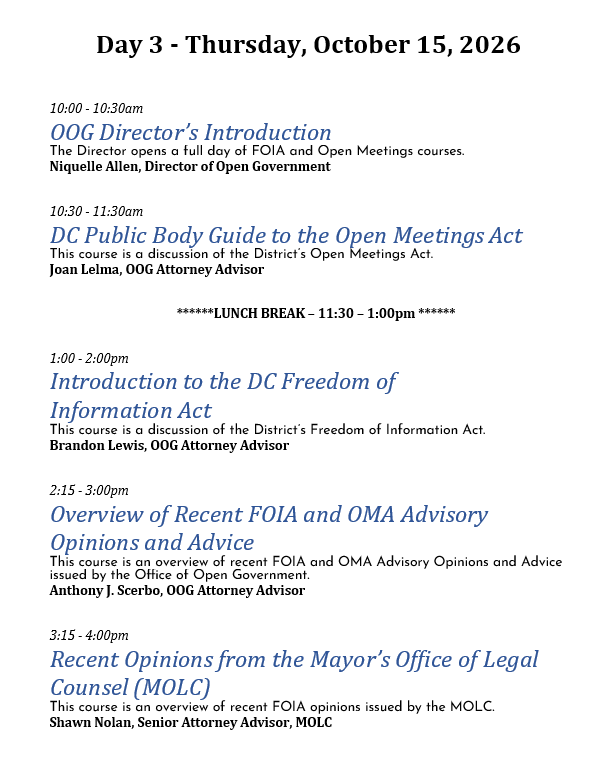 To register for each session, click the button below:
OMA Training for Boards of Trustees for DCPCS and
Local School Advisory Teams
The OOG’s Educational Training Series for Boards of Trustees for District of Columbia Public Charter Schools (Boards of Trustees) and DCPS Local School Advisory Teams (LSAT) are ongoing, and the schedules are published. The most recent training session for Boards of Trustees was on September 9, 2026, and the next session will be on December 9, 2026. OOG’s website (www.open-dc.gov) at the “News” tab is updated two weeks prior to each training with the login information for the respective training. In addition, OOG continues to send training invites to Boards of Trustees members two weeks prior to each training session and a reminder one week prior to the sessions.
The training schedule is accessible here:
Likewise, the training schedule for LSATs is available on OOG’s website. It is accessible along with login information that we will continue to provide at least two weeks prior to each training session here:
The next training session will be on November 10, 2026. OOG has informed Boards of Trustees and LSATs of general OMA training that will be provided by OOG at the Board of Ethics and Government Accountability (BEGA) “Ethics Week” in October of this year. In addition, OMA training materials are accessible on OOG’s website by clicking on the “Documents and Trainings” tab.
|
|
SUNSHINE MOMENT
 |
The Higher Education Licensure Commission (“HELC”, the “Commission”) is a consumer protection authority responsible for public protection of quality education in the District of Columbia. The Mayor appoints five members to serve on the Commission. The HELC is the only authority authorized to issue education licenses and is charged with advising the Mayor and the Council regarding postsecondary educational needs of the District. The purpose of the Commission is to establish standards for postsecondary educational operations, to provide oversight to all private postsecondary educational institutions in the District, to issue or deny educational licenses, approve programs, and to authorize operations within the District of Columbia’s educational institutions as well. The HELC ensures that the courses offered in District of Columbia institutions meet a standard of quality by enforcing postsecondary laws and regulations. Visit the Higher Education Licensure Commission's website to learn more information.
|
|
|
|
|