|
Issue No. 12

|
|

Director of Open Government’s Message
At the Office of Open Government, our mission is to help ensure that transparency laws work in practice. Every year we assist residents with understanding their rights under the D.C. Freedom of Information Act, help agencies improve compliance, and issue advisory opinions that clarify the requirements of the Open Meetings Act. Transparency is not just about records; it is about building trust between government and the public.
This year Sunshine Week begins on March 15, 2026. This nonpartisan event reminds us that open government is a shared responsibility. Agencies must be committed to proactive disclosure and timely responses to requests. Residents, journalists, and community organizations play an equally important role by asking questions, requesting records, and engaging in public meetings. When these pieces work together, transparency strengthens our democracy.
During this event, the Office of Open Government shares educational materials and resources to help government officials and residents better understand how to access public information in the District. Whether you are filing your first FOIA request, attending a public meeting, or simply learning about your rights, we invite you to join us in celebrating Sunshine Week. Transparency is not a once-a-year commitment, it is an everyday practice. Sunshine Week simply reminds us how important that commitment is.
In this issue of The Opengovist, we report on recent litigation and legislative action, D.C. FOIA Reports, and announce upcoming OMA and FOIA trainings that OOG will host. We hope you enjoy this issue and find it useful.
In Service,
Niquelle M. Allen, Esq.
Director of Open Government
|
|
|
American Wild Horse Campaign v. U.S. Bureau of Land Management (Case No. 22-2972 (D.D.C.))
This is a federal Freedom of Information Act (FOIA) case in which the Plaintiff, American Wild Horse Campaign (“Campaign”) brought suit against the U.S. Bureau of Land Management (“Bureau”) for attorney’s fees and costs after the Bureau finished producing records in response to the Campaign’s FOIA request.
The Court found that an advocacy organization is eligible for attorney’s fees in a FOIA request in which a lawsuit eventually caused a federal agency to complete its search and release 3,500 pages of responsive documents. The Court stated that the Defendant’s changing position regarding the FOIA request over the course of litigation indicated that it released the documents only in response to court orders and Plaintiff’s efforts.
The Court determined that it need not find that Defendant’s motion to dismiss was filed for an improper purpose or in bad faith to find that the Bureau lacked a reasonable basis for failing to timely respond to a request, moving to dismiss, or delaying in agreeing to the terms of an acceptable search. It was not unreasonable for Plaintiff to spend 36.2 hours researching and writing its 23-page opposition to a motion to dismiss, “which raised a series of attacks on [its] FOIA request.” Attorney’s fees for the time spent reviewing Defendant’s final production of documents, which would have been required even had the records been produced without litigation, are appropriate to ensure that nothing further remained to litigate after a lawsuit lasting nearly two years. The motion for fees and costs was granted in part and denied in part.
Terris, Pravlik & Millian, LLP v. District (Case No. 2020-CA-003087-B (D.C. Super. Ct.))
Travis, Pravlik & Millian, LLP (TPM) sued the District under D.C. FOIA, alleging that the District failed to produce and post online various budget-related documents related to the Office of the State Superintendent of Education (OSSE) and the District of Columbia Public Schools (DCPS).
D.C. Superior Court denied the Mayor’s motion to dismiss and granted TPM’s motion for summary judgment. The court ordered the Mayor to produce the requested documents and to comply with the publication requirements of D.C. Code § 2-536. The Mayor appealed.
On appeal, the D.C. Court of Appeals affirmed the Superior Court’s order requiring the production and online publication of the requested budget documents for fiscal years 2019 to the present. The court vacated and remanded the portion of the order requiring the publication of other documents under D.C. Code § 2-536 and instructed the lower court to clarify the scope of the required publication.
On November 12, 2025, TPM filed a Motion for Contempt and for Further Injunctive Relief, asking the court to hold the District in contempt of the Superior Court’s July 23, 2021, Order requiring the District to produce to TPM and post online the documents requested in TPM’s October 18, 2019, D.C. FOIA request. TPM contends that the Mayor continues to withhold the documents despite the Superior Court’s order compelling disclosure and the opinion of the D.C. Court of Appeals upholding that order and rejecting the Mayor’s legal defenses. TPM also asked the court to order further injunctive relief that requires the Mayor to post online the required budget materials for DCPS and OSSE on an ongoing basis.
On November 26, 2025, the District filed an opposition to TPM’s motion. The District contends that it was working in good faith to identify and produce additional responsive documents when TPM chose to move for contempt. TPM filed a Reply in Support of its Motion on December 3, 2025. TPM contends that the Mayor’s opposition confirms that she is in contempt of the Courts FOIA response and online publication orders.
On January 30, 2026, TPM filed a Notice of Recent Development Related to its Pending Motion to call the Court’s attention to a Memorandum to all Deputy Mayors and Agency Heads issued by the Chief of Staff of the Executive Office of the Mayor which instructs them to refuse to produce to the District of Columbia Council (Council) any “agency’s budget enhancement requests (such as ‘Form B’) submitted as part of FY25 and FY26 budget formulation.” TPM contends that the instruction contained in the memo is directly contrary to the decisions of both the Superior Court and the Court of Appeals and that the issuance of the memo is further evidence that the Mayor will not comply with the Court’s order or DC FOIA.
On February 11, 2026, the Court issued an order granting in part Plaintiff’s motion for contempt and for further injunctive relief. On February 26, 2026, the Court heard arguments on the motion for contempt. The Court set a deadline of March 4, 2026, for the District to produce the records, with a status report to be filed by March 13, 2026. A status hearing is set for March 17, 2026.
|
|
B26-0265
The Fiscal Year 2026 Budget Support Act of 2025 became law on December 6, 2025. Provisions provide authority for implementing the District’s FY26 budget and includes “Freedom of Information Clarification Emergency Amendment Act of 2025.” This emergency amendment of D.C. FOIA was introduced to clarify the scope of exemptions and created a new exemption for particular data or records that the Criminal Justice Coordinating Council (“CJCC”) and District of Columbia Sentencing Commission receive from a “court, federal agency, or federally established agency.”
B26-0555
In December, Councilmember Nadeau introduced B26-0555, the “Deadline Accountability Amendment Act of 2025.” This legislation seeks to address a persistent problem of missed deadlines in District government, creating an accountability mechanism: if a deadline has passed for any report or other document that the Council has required by a date certain, deliberative process privilege can no longer be used to withhold the draft document from a response to a D.C. Freedom of Information Act (D.C. FOIA) request.
Rulemaking Regarding the Office of Open Government and the Open Meetings Act
In December 2025, BEGA issued a Notice of Proposed Rulemaking for the Board Meetings section of BEGA’s regulations to the D.C. Register. The proposed amendment to Title 3 of the DCMR formalizes that the Director of Open Government shall present a report of the activities of that position at each regularly scheduled meeting of the Board of Ethics and Government Accountability. The notice was published to the D.C. Register for comment, which concluded in January.
In January 2026, the Director of Open Government issued a Notice of Proposed Rulemaking which creates a new section that sets forth the procedural requirements public bodies must follow to enter closed meetings. The proposed amendments to Title 3 DCMR create a new section, 10411, which provides specific instructions for the procedures public bodies must follow before entering closed meetings or closing portions of a meeting. Specifically, the newly added section clarifies that public bodies must hold closed sessions immediately after the public body votes to close the meeting, except for adjudicatory public bodies, which may vote to close a meeting no earlier than the public meeting that occurs directly before the date of the planned closed session. The notice was published to the D.C. Register for a 30-day comment period on December 26, 2025. The Comment period was extended to March 10, 2026. Following the receipt of comments, the Director of Open Government has further extended the comment period until April 10, 2026.
PR26-0521
In February, Council Chairman Mendelson introduced PR26-0521, the “Budget Enhancement Request Litigation Authorization Resolution of 2026.” By this measure “[t]he Council authorizes the Council’s Office of the General Counsel to initiate, defend, intervene, participate, or take any other action in a matter in any court or tribunal on behalf of and in the name of the Council of the District of Columbia to assert the interest of the Council in obtaining certain agency budget enhancement requests that must be furnished to the Council pursuant to D.C. Official Code § 47-318.05a.” In light of the appellate decision in District Of Columbia v. Terris, Pravlik & Millian, LLP, concerning the Mayor’s disclosure and publication obligations under the D.C. FOIA, primarily with respect to agency budget-request documents, the Council appears to be preempting any potential delays in receiving the Mayor’s budget package or required documents, particularly in light of the challenges experienced last year during the budget cycle and the ongoing litigation and recent motion to hold the Mayor in contempt of court for failing to follow the court’s orders. The Council retained the measure on February 3, 2026, by a vote of 8-5.
FOIA-related Legislative Action regarding Body-Worn Camera (BWC) Footage
By amending the “Body-Worn Camera Regulation and Reporting Requirements Act of 2015,” two Council measures expand the Body Worn Camera (BWC) law to require faster, automatic public release of key footage in serious incidents, going beyond the slower and more limited disclosure normally available through FOIA. The resolution makes transparency the default, not something only available after a FOIA request, and the bills temporarily expand the law so BWC footage must be released whenever an MPD officer is present during a serious use of force incident, even if the force was used by another agency (like a federal officer). They also require the release of all names of law enforcement officers involved. Mayor Bowser sent a letter to the Council before the legislative meeting opposing the legislation expressing her view that these are federal matters appropriately handled by Congress.
B26-0614
On March 2, 2026, Councilmember Robert White, along with 8 co-sponsors, introduced B26-0614, the “Full Accountability in Arrest Reporting Emergency Amendment Act of 2026” and PR26-0562, the “Full Accountability in Arrest Reporting Emergency Declaration Resolution of 2026.” The legislation “requires “Metropolitan Police Department officers to document identifying information for all law enforcement officers present at the scene of an arrest and any use of force in arrest reports and probable cause affidavits; and to amend the Body-Worn Camera Regulation and Reporting Requirements Act of 2015 to require body camera footage transparency in use-of-force events.” On March 3, 2026, the Council voted unanimously to pass the resolution and the bill, both of which took effect immediately.
B26-0617
On March 2, 2026, Councilmember Brooke Pinto introduced B26-0617, the “Body-Worn Camera Transparency for Use of Force Temporary Amendment Act of 2026,” which was co-sponsored by Chairman Mendelson “to amend, on a temporary basis, the Body-Worn Camera Regulation and Reporting Requirements Act of 2015 and Chapter 39 of Title 24 of the District of Columbia Municipal Regulations to require release of body-worn camera recordings of Metropolitan Police Department Officers present in the event of an officer-involved death or serious use of force by a law enforcement officer other than a Metropolitan Police Department officer.” The measure passed unanimously during the Council Legislative Meeting on March 3, 2026.
|
|
Mayor Bowser and Attorney General Schwalb have submitted their FY25 Freedom of Information reports to the D.C. Council, according to the requirements of the D.C. FOIA statute (D.C. Official Code § 2-538). The full reports are available using these links:
Mayor’s Report:
Attorney General’s Report:
________________________
According to the Attorney General’s litigation report, there were 36 D.C. FOIA cases active in FY25, with 24 of those cases open on January 29, 2026.
According to the Mayor’s FY25 summary, District government entities received 13,923 FOIA requests during FY25 (Oct. 2024–Sept. 2025), which was a more than 13% increase from the prior year, while the number of requests pending (though not necessarily overdue) increased from FY24 by approximately 35%. At the end of FY25 there were 1,131 requests pending and at the end of FY24, there were 834 requests pending. Once again, the most-cited exemption from D.C. Official Code § 2-575(b), as a basis for withholding, was Exemption 2 (“disclosure...would constitute a clearly unwarranted invasion of personal privacy”).
|
|
|
The Open Meetings Act (“OMA”) (D.C. Official Code §§ 2-571—2-579) is the District’s primary transparency law regarding “public business” when conducted by a “public body.” "Public body" includes: “any government council, including the Council of the District of Columbia, board, commission, or similar entity…a board of directors of an instrumentality, a board which supervises or controls an agency, the board of trustees of a public charter school, or an advisory body that takes official action by the vote of its members convened for such purpose;” but does not include: District agencies or instrumentalities; the District of Columbia courts; the Mayor’s cabinet; the professional or administrative staff of public bodies when they meet outside the presence of a quorum of those bodies; ANCs (notwithstanding D.C. Official Code § 1-309.11; or the Criminal Justice Coordinating Council (CJCC).
A key requirement of “Notice” relative to the OMA are the timing and placement requirements of the Act, found at D.C. Official Code § 2-576(1)-(3).
As to timing, other than establishing the “annual schedule of its meetings,” “[n]otice shall be provided when meetings are scheduled and when the schedule is changed…[and] [a] public body shall attempt to provide notice as early as possible, but not less than 48 hours or 2 business days, whichever is greater, before a meeting.” (D.C. Official Code § 2-576(1))."
With regard to placement, or location, there is: (1) a physical requirement; (2) a virtual/online requirement; and (3) a publication requirement.
Physically, “[n]otice shall be provided by posting…[i]n the office of the public body or a location that is readily accessible to the public.” (D.C. Official Code § 2-576(1)(A))." The requirement to post a physical version of notice in the office or a readily accessible location had been suspended by the Council during the public health emergency of a few years ago, but has since resumed.
Virtually, or online, the OMA requires notice posted “[o]n the website of the public body or the District government.” (D.C. Official Code § 2-576(1)(B)) Note here—the OMA allows electronic notice to be posted on either the public bodies’, or its supporting District agencies’, website. Alternatively, the District government’s website, the Central Meeting Calendar (CMC) - which is maintained by OOG) - is available. As OOG has advised frequently before, it is best practice to post in both locations to provide maximum exposure for public notice of meetings.
Finally, there is a publication requirement, where “[e]xcept for meetings of boards of trustees for public charter schools, notice of meetings shall be published in the District of Columbia Register as timely as practicable.” (D.C. Official Code § 2-576(3))
As always, OOG stands ready to assist public bodies and supporting agencies in fulfilling their responsibilities under the OMA.
.
|
|

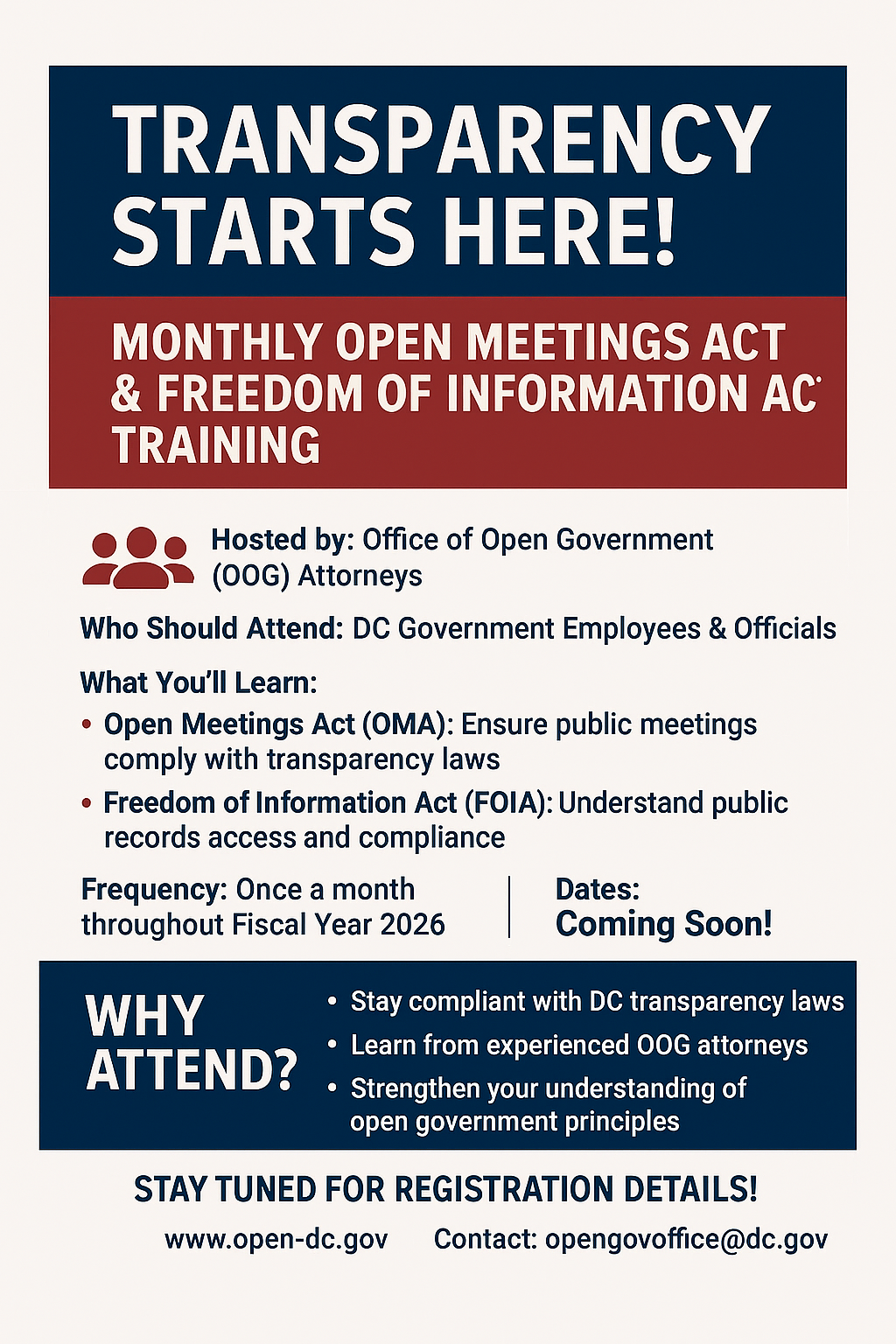
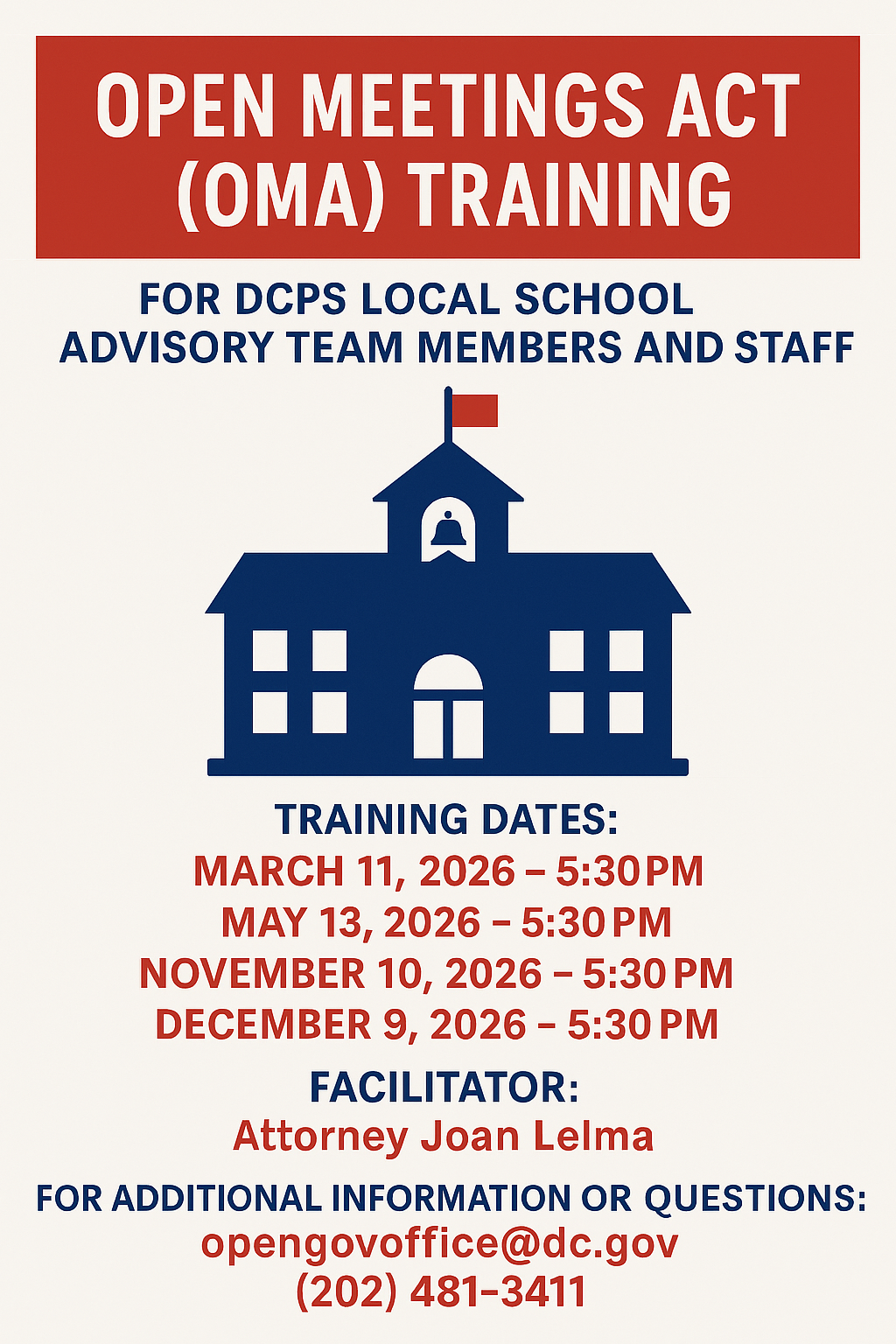 The OOG’s Educational Training Series for Boards of Trustees for District of Columbia Public Charter Schools (DC PCSB) and DCPS Local School Advisory Teams (LSAT) are ongoing, and the schedules are published. The next training session for DC PCSBs will be on April 8, 2026. The training schedule is accessible here:
OOG’s website (www.open-dc.gov) at the “News” tab will be updated two weeks prior to each training with the login information for the respective training. In addition, OOG will continue to send training invites to DC PSCB members two weeks prior to each training session and a reminder one week prior to the sessions.
Likewise, the training schedule for LSATs is available on OOG’s website. It is accessible along with login information that we will continue to provide at least two weeks prior to each training session here:
The next training session will be on May 13, 2026. Also, OMA training materials are accessible on OOG’s website by clicking on the “Documents and Training” tab. To access training materials select the button below:
|
|
 The Office of Open Government (OOG) is providing ongoing Freedom of Information Act (FOIA) training for all D.C. FOIA Officers. This month, OOG's first training session is targeting New FOIA Officers. On Thursday, March 19, 2026, at 2pm, OOG will present, "FOIA Basic Training for New FOIA Officers." Trial Attorney Brandon Lewis will facilitate this training and provide an overview of D.C. FOIA. If you are serving as FOIA Officer for your agency and its your first time, this training is for you! Registration is not required to attend. Please note that notice for this training will be sent via email and is forthcoming....stay tunned and be on the look out!!!!!
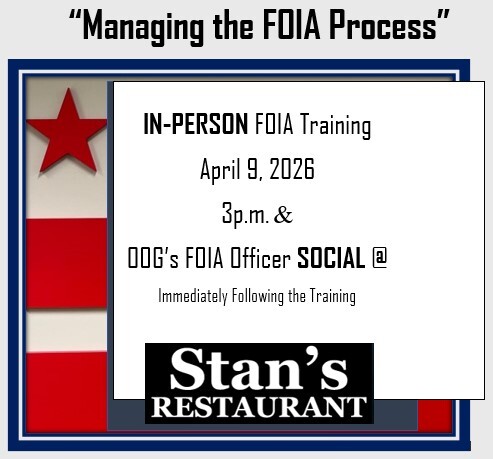
On Thursday, April 9, 2026, at 3pm, the Office of Open Government will host it's first In-Person FOIA Training, "Managing the FOIA Process" and FOIA Officer Social.
Meet the Team in our new home...you don't want to miss out on this !!!!
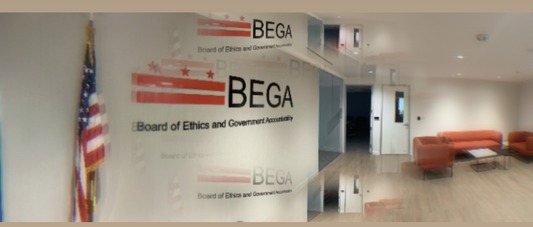
Training will be held in The BEGA Boardroom at 1015 15th Street NW, Suite 723, and will be facilitated by Attorney Advisor Anthony J Scerbo. This interactive experience will provide DC FOIA Officers with an overview of the FOIA process and strategies to manage the workload. Immediately following the training, FOIA Officers are welcome to walk with OOG's staff over to Stan's Restaurant, located at 1029 Vermont Ave NW, Washington, DC 20005, for a FOIA Officer Social. All DC FOIA Officers are invited to participate in this event.
OOG's FOIA Officer Social is a great opportunity to meet fellow colleagues, network, share unique experiences such as frequent challenges and learn helpful techniques to combat those challenges! Registration is not required to attend the training or the Social. We can't wait to see you there!!!!!!
|
|
Each March, communities across the United States pause to celebrate something fundamental to democracy: the public’s right to know. From March 15–21, 2026, we observe Sunshine Week, a national initiative that highlights the importance of open government and public access to information.
Sunshine Week is a nonpartisan collaboration among journalists, civic organizations, educators, and government institutions dedicated to promoting transparency and accountability in government. It takes place each year around the birthday of James Madison who was the principal author of the Bill of Rights. His vision of an informed public remains central to democratic governance today. During this week, organizations nationwide host events, publish educational resources, and encourage citizens to learn more about how public records laws empower communities to hold government accountable.
Here in the District of Columbia, Sunshine Week is an opportunity to reflect on the progress we have made toward more open and responsive government and the work that remains. The District’s Freedom of Information Act and Open Meetings Act exist for a simple reason: to make sure the public has full access to the government’s decision-making process. When information is accessible and decision-making happens in the open, District residents can participate more fully in civic life and have confidence in the institutions that serve them. To see scheduled events and activities, click the button below:
|
|
SUNSHINE MOMENT
The District Waterways Advisory Commission (“the Commission”) was established within the Department of Energy & Environment to plan, promote, advocate for, and facilitate stakeholder cooperation for the diverse use and access of the Anacostia and Potomac Rivers, the Washington Channel, and adjacent property. To fulfill its mission, the District Waterways Advisory Commission is required to facilitate communication between the District, Maryland, Virginia, the federal government, businesses, community organizations, and the public regarding issues relevant to the Anacostia and Potomac Rivers and the Washington Channel. Additionally, the Commission provides advice to the Mayor and the Council on issues such as public improvements, maintenance, operations, programming, budgeting, resiliency, planning, public safety, and security. The Commission is responsible for developing and publishing a District Waterways Advisory Plan for the District’s navigable waterways. The goal of the Advisory Plan is to address topics such as the orderly, safe, and efficient use of the Disrict’s waterways for boating and recreation; environmental conservation; defining ownership and roles to reduce ambiguity around responsibilities. The Commission has 14 voting members that are appointed by the Mayor and the Chairman of the Council and 16 non-voting members. The voting members are selected based on their use and knowledge of the local waterways or for their subject matter expertise. The remaining non-voting members are from various District and Federal agencies. The Commission meets quarterly and their meetings are open to the public. Visit the District Waterways Advisory Commission website to learn more information on the Advisory Plan.
|
|
|
|
|