|
Issue No. 10

|
|

Director of Open
Government’s
Message
Recent changes to the District’s Freedom of Information Act (FOIA) and Open Meetings Act (OMA) have narrowed the public’s ability to view and participate in their government. While these changes appear to be small, administrative changes – they represent a shift toward closing the doors of government to avoid public scrutiny.
The accountability required to maintain an open and transparent government should not be abandoned. When transparency is diminished, so is trust. When access is limited, accountability is as well. Government operating in the shadows is not good for democracy or the public trust. The residents of the District deserve a government that they can trust. Even as the law now allows more information to be withheld and more meetings to be closed to the public, the Office of Open Government (OOG) has become more diligent in enforcing the laws and encouraging transparency. The law may allow more secrecy, but OOG is encouraging the government to choose to remain open - trust is built in the daylight.
In this issue we will provide information on OOG’s efforts to keep the District government open and transparent as well as provide insight into government transparency laws and current events. I hope you enjoy the latest issue of The Opengovist.
In Service,
Niquelle M. Allen, Esq.
Director of Open Government
|
|
|
D.C. v. Terris, Pravlik & Millian, LLP (Case No. 21-CV-0543(D.C. Court of Appeals))
Travis, Pravlik & Millian, LLP (TPM) sued the District under D.C. FOIA, alleging that the District failed to produce and post online various budget-related documents related to the Office of the State Superintendent of Education (OSSE) and the District of Columbia Public Schools (DCPS).
D.C. Superior Court denied the Mayor’s motion to dismiss and granted TPM’s motion for summary judgment. The court ordered the Mayor to produce the requested documents and to comply with the publication requirements of D.C. Official Code § 2-536. The Mayor appealed, arguing that the documents were protected by executive privilege and that TPM lacked standing to enforce the publication provision.
On appeal, the D.C. Court of Appeals rejected the Mayor’s claim of executive privilege, noting that the budgetary process involves overlapping responsibilities between the Mayor and the Council, and thus does not fall under the exclusive purview of the executive branch. The Court also found that TPM had standing to seek enforcement of the publication provision, as the failure to disclose the documents caused a concrete and particularized injury to TPM.
The Court of Appeals affirmed the Superior Court’s order requiring the production and online publication of the requested budget documents for fiscal years 2019 to the present. The court vacated and remanded the portion of the order requiring the publication of other documents under D.C. Official Code § 2-536 and instructed the lower court to clarify the scope of the required publication.
|
|
|
|
On July 28, 2025, Chairman Mendelson introduced the “Fiscal Year 2026 Budget Support Emergency Act of 2025,” B26-0340, including the “Freedom of Information Clarification Emergency Amendment Act of 2025.” This Subtitle amends DC FOIA to create a new exemption for particular data the Criminal Justice Coordinating Council (CJCC) and District of Columbia Sentencing Commission receive from a “court, federal agency, or federally established agency.” The Bill passed by voice vote (10-2) on July 28, 2025. A final vote is scheduled for the post-recess Council legislative meeting in September.
|
|
|
On June 30, 2025, Act Number A26-0110, “Open Meetings Clarification Congressional Review Emergency Amendment Act of 2025” was enacted without Mayor's Signature, and is set to expire October 20, 2025. The Act “amend[s], on an emergency basis, due to congressional review, the Open Meetings Act to clarify the definition of meeting, to provide for a public body’s ability to be briefed about potential terrorist or public health threats so long as no official action is taken, to exempt from the act meetings between the Council and the Mayor provided that no official action is taken at such meetings, and to provide that a meeting shall be deemed open to the public if the public body takes steps reasonably calculated to allow the public to view or hear the meeting while the meeting is taking place, or, if doing so is not technologically feasible, as soon thereafter as reasonably practicable.” The act also exempts the Criminal Justice Coordinating Council (CJCC) from the OMA.
U.S. Senator Mike Lee has introduced U.S. Senate Bill 1450, “a bill to repeal the Open Meetings Clarification Emergency Amendment Act of 2025 enacted by the District of Columbia Council” (an earlier version of A26-0110), and which has been referred to the Senate Committee on Homeland Security and Governmental Affairs. On July 23, 2025, Lee, and House Member Harriet M. Hageman introduced joint resolutions ( S.J.Res. 68 & H.J.Res.109), both “Disapproving the action of the District of Columbia Council in approving the Open Meetings Clarification Temporary Amendment Act of 2025.” The House version was referred to the House Committee on Oversight and Government Reform, while the Senate version was also referred to the Senate Committee on Homeland Security and Governmental Affairs.
Act Number A26-0086, the “Open Meetings Clarification Temporary Amendment Act of 2025,” was enacted on June 26, 2025, without the Mayor’s Signature, and is now in the congressional review period with a projected law date of September 16, 2025.
Act Number A26-0112, the “Board of Trustees Training Amendment Act of 2025,” introduced by Councilmember Christina Henderson, on January 17, 2025, would require members of a Public Charter School Board of Trustees to complete training programs on best practices for school board governance, including training on the Open Meetings Act. It had its second and final reading on July 1, 2025, passing unanimously. It was signed by the Mayor, enacted, and transmitted to Congress with a projected law date of October 15, 2025.
Act Number A26-0111, the “Council Review of Agency Action Clarification Amendment Act of 2025,” introduced by Chairman Mendelson in January, passed with an amendment in the nature of a substitute” unanimously on final reading, and was signed by the Mayor in July. This Act codifies agency deference and clarifies that a reviewing court or tribunal shall defer to an agency’s reasonable interpretation of a statute or regulation the agency administers, providing that the interpretation is not plainly wrong or inconsistent with the statutory or regulatory language or the Council’s intent. It is largely in response to the Supreme Court’s decision in Loper Bright Enterprises v. Raimondo, 603 U.S. 369 (2024). It was sent to Congress on July 29, 2025.
PR26-0280, the “Council Period 26 Second Recess Rules Amendment Resolution of 2025,” which amends the Council’s Rules of Organization and Procedures for Council Period 26, to authorize the Committee of the Whole to take official action during the Council Recess passed the Council on July 14, 2025. It will expire on September 15, 2025.
|
|

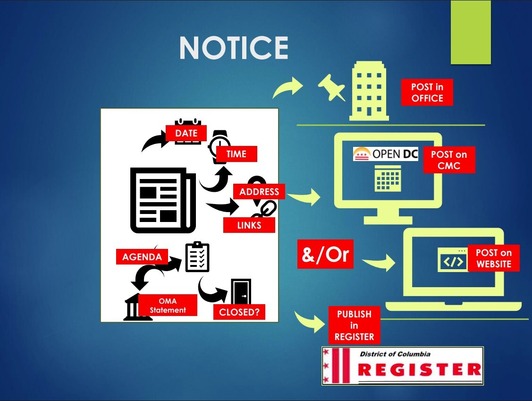
WHATS IN YOUR NOTICE?.....
|
*Elements labeled in red corresponds with the appropriate symbol.
A key requirement of the Open Meetings Act (OMA) is that ADVANCED NOTICE must be provided of changes in the schedule of public body meetings that are not “emergency” meetings.
Thus,
-
“Regular” meetings (which are normally scheduled when the body’s annual calendar is set)
-
“Special” meetings (which are meetings in addition to those set on the annual calendar); and
-
Cancellations of either of these meeting types, require notice.
There are three key requirements as to “where” notice must be provided and two key requirements as to “when” notice must be provided.
With regards to “where,” D.C. Official Code § 2-576 (2) requires that
“[n]otice shall be provided by posting: (A) In the office of the public body or a location that is readily accessible to the public; and (B) On the website of the public body or the District government,
while subsection (3) requires that “[e]xcept for meetings of boards of trustees for public charter schools, notice of meetings shall be published in the District of Columbia Register as timely as practicable.”
Most public bodies have a space to physically post notice, if they do not, then the District agency that supports it can usually provide an acceptable alternative. The same is usually true as to websites. And, while the online posting requirement allows for posting either on the body’s website or the CMC, we always encourage posting on both.
This gives maximum exposure to the information and increases public engagement.
OOG hosts the Central Meetings Calendar (CMC) for the District at:
https://www.open-dc.gov/public-bodies/meetings, and any eligible body can contact OOG at opengovoffice@dc.gov to request credentials to access the CMC and post notice, agendas, minutes, etc.
Finally, to post notice to the DC Register, please contact the Office of Documents and Administrative Issuances at dcdocuments@dc.gov for further information.
The remaining issue on notice is “when.” D.C. Official Code § 2-576(1) requires that “[n]otice shall be provided when meetings are scheduled and when the schedule is changed. A public body shall establish an annual schedule of its meetings, if feasible, and shall update the schedule throughout the year. A public body shall attempt to provide notice as early as possible, but not less than 48 hours or 2 business days, whichever is greater, before a meeting.”
Please note that the requirement is an “attempt…as early as possible,” and the minimal requirement is no less than 48 hours or 2 business days, whichever is greater.
So, knowing that a change in the schedule has been made, say, three weeks prior, but not noticing that change until three days prior is technically a violation.
Public engagement and transparency are best served when open government information is shared as early and as widely as possible.
As always, please feel free to reach out to OOG for assistance or with any questions…
|
|
 Open Meetings Act Violations by the Board of Trustee for a District of Columbia Public Charter School
On June 27, 2025, Director Allen issued Advisory Opinion #OOG-2025-0002, in response to a complaint which alleged that the Mary McLeod Bethune Public Charter School Board (the “Board”) posted meeting minutes for only one of its meetings since February 2024, and has not posted schedules for meetings since the school year (SY) 2023-2024 schedule was published on the Mary McLeod Bethune Public Charter School’s website. Also, the complainant expressed concern about the absence of links to access the Board’s meetings.
Director Allen found that the Board violated the OMA as follows: (1) failure to post draft and final meeting minutes for specific Board meetings on its website and/or OOG’s Central Meeting Calendar; and (2) failure to provide complete meeting notices for specific meetings - the location (valid dial in number and access code or valid weblink and login information). Further, the Director determined from the OOG’s investigation that certain dates on the Board’s schedules do not accord with the dates of the meetings on the Board’s meeting agendas. Concerning the meeting schedule, OOG’s investigation revealed that the Board’s SY 2024-2025 meeting schedule is posted on the Public Charter School’s website.
Since the Board is in violation of multiple OMA requirements, Director Allen’s directive is that the Board must take OMA training within sixty (60) days of receipt of the Advisory Opinion to avoid further corrective action.
Read the Advisory Opinion here:
Open Meetings Act Complaint Dismissal Regarding Public Comment at a Board of Trustee’s Meeting
On July 21, 2025, Director Allen issued Advisory Opinion #OOG-2024-0011, in response to a complaint which alleged that Sela Public Charter School Board (SPCSB) violated the OMA by only permitting certain content in the public comment section of its open session meetings. The complainant expressed concern that the public comment guidelines provided by the chairperson of SPCSB was “viewpoint discrimination” because it restricted negative comments.
The OMA does not require a public body to allow public comment at meetings covered by the statute. SPCSB’s Bylaws also do not address public comment. Content of speech permitted by a public body in public session is also not addressed by the OMA. The complaint was dismissed because there was no basis to determine SPCSB violated the OMA. While the OMA ensures that the exceptions to the public’s right to view a public body’s meetings are narrowly construed, this does not extend to an examination of a public body’s policy regarding public comments.
Read the Advisory Opinion here:
Open Meetings Act Complaint Dismissal Against District of Columbia Public Charter School Board
On July 25, 2025, Director Allen issued an Advisory Opinion #OOG-2025-0003, in response to a complaint which alleged that forty-seven Boards of Trustees for District of Columbia Public Charter Schools (“Boards of Trustees”) are not in compliance with the OMA, citing one or more acts of non-compliance by each of the forty-seven Boards of Trustees identified by the Complainant. The complaint alleged that the information pertaining to the forty-seven Boards of Trustees meetings was not accessible to the public and the District of Columbia Public Charter School Board (DCPCSB) should articulate standards for all public charter schools to follow when posting information on their websites required to comply with the OMA. The Advisory Opinion addressed the concern that DCPCSB should participate in ensuring OMA compliance. OOG is continuing to investigate the allegations against the 47 schools.
Director Allen dismissed the OMA Complaint against DCPCSB and found that the public body did not violate the OMA. DCPCSB does not have an affirmative obligation to ensure OMA compliance; that responsibility rests with OOG. Further, the Complainant’s allegation that DCPCSB should ensure universal, easy access to Public Charter School Boards of Trustees’ meeting information and provide a board meeting template to be used by DCPCS on their websites does not implicate the OMA and open meetings regulations. The opinion acknowledges District of Columbia Public Charter School Board’s effort to assist public bodies with OMA compliance, but acknowledges that it is not obligated to do so and failure to take a particular course of action, as alleged in the complaint, is not an OMA violation.
Read the Advisory Opinion here:
|
|

Closure of Two Public Charter Schools – Hope Community Public Charter School (HC PCS) and I Dream Public Charter School (IDPCS)
It was reported in April of this year by Hope Community PCS – Tolson (Ward 5) and District of Columbia Public Charter School Board (DCPCSB) that Hope Community Public Charter School Board (HCPCSB) had decided to relinquish its Charter, effective at the end of the school year 2024-2025. The school closed in June 2025. There was one campus/school under the Local Education Agency (LEA), and therefore, there are no remaining campus/schools under the (relinquished) Charter.
HCPCS had cited inability to meet specific requirements of DCPCSB within a given timeframe as germane to the HCPCSB’s decision to relinquish its Charter. DCPCSB and HCPCS leadership team expressed their resolve to work harmoniously to ensure a smooth transition for the students and parents.
HCPCS’ following statement reminds us of the closure of Eagle Academy Public Charter School in 2024. “We hope that our students and staff remain Eagles at heart and continue to soar!” The stark difference is that HCPCS’ closure was not as abrupt as Eagle Academy’s.
In like manner, to HCPCS, it was reported in April of this year by I Dream Public Charter School (IDPCS) and DCPCSB that the I Dream Public Charter School Board (IDPCSB) had decided to relinquish its Charter, effective at the end of the school year 2024-2025. There was one campus/school under the LEA, and similarly to HCPCS, IDPCS cites its inability to meet certain requirements imposed by DCPCSB by June 30, 2025, as the reason for the relinquishment of its Charter. DCPCSB reported in April of this year that they were working with IDPCS to ensure that the students have access to quality school options for SY 2025-2026.
|
|

OMA Training for Boards of Trustees for DCPCS and Local School Advisory Teams
OOG offers an ongoing Educational Training Series for Boards of Trustees for District of Columbia Public Charter Schools. The next training session will be held on Wednesday, September 10, 2025. If you are a new Board member serving on a Board of Trustees for DCPCS, contact Attorney Advisor Joan Lelma at joan.lelma@dc.gov to be added to our Subscribers List and receive the latest training information.
OOG introduced a new training series for Local School Advisory Teams (LSAT) in March of this year, and has since met with Sharona Robinson, District of Columbia Public Schools Community Affairs and Engagement Manager, to discuss revisions to the LSAT training schedule to further accommodate LSAT members. OOG aims to provide a revised training schedule that aligns with the schools’ academic calendar and LSAT elections.
OMA Training Series
The OOG has offered ongoing training on the OMA for Public Bodies and Agency Support Staff throughout the course of this year. OOG has adjusted the training schedule to pause the previously scheduled monthly training sessions and will now offer OMA training available upon request. Please contact Attorney Advisor Anthony J Scerbo at anthony.scerbo1@dc.gov to request and schedule future OMA trainings!
BEGA’s 2025 Ethics Week
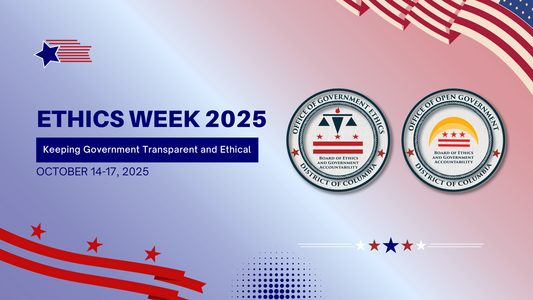 Ethics Week 2025 is coming! BEGA is hosting an annual ethics conference that will take place Tuesday, October 14, 2025 - Friday, October 17, 2025. OOG will present FOIA and OMA training on Thursday, October 16, 2025. Select courses will be offered virtually and in person. To access training registration, review the list of topics, and see detailed course descriptions:
|
|

 |
|
|
The Commission on Climate Change & Resiliency (CCCR) is an independent body created to assess the impacts of changing climate, the possibility of adverse weather events, the ability of the District to reduce the impact of harmful conditions, and the District’s ability to prepare, plan for, absorb, and recover from adverse events. The CCCR is tasked with transmitting reports and recommendations to the Council and to the Mayor, and is responsible for establishing the Climate Change and Resiliency Fund. The Commission is composed of 16 members with 8 members appointed by the Mayor and 8 appointed by the Council. Each member is appointed to one of the following eight designated seats: energy, emergency preparedness, environmental science, public health, transportation, natural resources, environmental justice, and insurance. CCCR conducts their meetings quarterly and invite the public to listen to the latest discussions on topic such as DC weather, climate change, trends, and projections. To learn more about the CCCR and submit questions or ideas:
|
|
|
|
|