 Friends,
The Council is in the process of closing Council Period 23 on January 1, 2021. We will have one additional Legislative Session on December 15. Council Period 24 will begin with a female majority on January 2, 2021! During this past Tuesday's penultimate session, I was able to gain final approval of measures to place a moratorium on Voluntary Agreements, expand tenant rights, and help prevent foreclosures against senior homeowners (Below).
Additionally, I supported several pieces of legislation that will be sent to Mayor Bowser for her signature to become law, including; a bill that requires electrical vehicle infrastructure to be built in new or renovated multi-unit buildings, a bill establishing a new Tax Revision Commission, a bill for WMATA Police accountability by establishing a civilian complaint board, a bill that sets energy efficiency standards for various appliances sold, offered for sale, or installed in the District, a bill to increase opioid treatment and prevention, and a bill to amend the existing law that supports whistleblowers who report persons who knowingly present false or fraudulent tax claims to the District.
Thanks to Mayor Muriel Bowser, who announced this week, a new COVID relief program for small landlords and affordable housing providers using Federal CARES Act funds. The program will pay 80% of a tenants delinquent rent to the landlord if they will forgive the remaining 20%. This is one of the rental relief ideas I've been working with the Executive to implement. We also have numerous other emergency relief programs to help residents with their rents and/or mortgages that are highlighted below in this newsletter. I encourage you to inform your friends, neighbors, and associates of these home-saving funds.
As always, staff and I are available to assist you, so don’t hesitate to call 202-724-8064 or email me at abonds@dccouncil.us.
Stay safe and healthy,
Anita
SHARING JOY AT THANKSGIVING
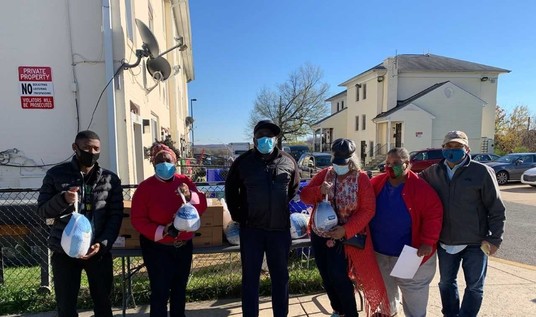 Photo at Vida Senior Services

Councilmember Anita Bonds continued her tradition of providing Thanksgiving turkeys to those with less. This year, 350 turkeys were distributed throughout the District to seniors, public housing residents, and unemployed individuals. Sending heartfelt thanks to all those who joined and supported these efforts.
|
DC COUNCIL APPROVES MEASURES THAT EXPAND TENANTS RIGHTS, STOPS SENIOR FORECLOSURES
On Tuesday, December 1, the Council of the District of Columbia gave final approval to several of Councilmember Bonds' measures to enhance the rights of the tenant, preserve affordable housing units, and prevent foreclosures on seniors behind on reverse mortgages.
The Voluntary Agreement Moratorium Amendment Act of 2020 enacts a two-year moratorium on voluntary agreements between tenants and housing providers, including to establish rent ceilings, provide for capital improvements, and alter services. Currently, if 70% or more of existing renters approve a voluntary agreement, the housing provider can increase the rent above the legally allowable amount. The funds are supposed to be used to finance capital and other improvements.
The Rental Housing Source of Income Amendment Act of 2019 establishes that housing vouchers or rental housing assistance provided by the government shall be considered as the income of the tenant for the purposes of any minimum income qualification for rental of a dwelling unit. This will prevent landlords from denying housing to a person because the person's payment is in whole or in part through a voucher for rental housing assistance.
Additionally, the Council gave unanimous approval to Councilmember Bonds' bill, Reverse Mortgage Insurance and Tax Payment Program Emergency/Temporary Extension Amendment Act of 2020 (ReMIT), which extends the District of Columbia Housing Finance Agency’s Reverse Mortgage Insurance and Tax Payment Program for an additional 12 months. The ReMIT program has saved many senior households from foreclosure over the past 18 months, totaling $123,936. The $248,569 remaining will now be carried over until January 2022 and will assist additional seniors from foreclosure.
|
SUPPORTING DC SENIOR VILLAGES

On Wednesday, November 25, Coucilmember Anita Bonds held a virtual meeting with representative of the District's Senior Villages.
The discussion focused on the Villages operations and service delivery challenges during the global pandemic and concerning the overall vision of aging in the community and ways to support that vision. Four years ago, Councilmember Bonds led efforts with full funding that expanded the Senior Village network with the Far Southeast Village and Southwest Waterfront Village.
If you would like to join or create a Senior Village in your community, visit Senior Villages Locator - Interactive map
|
NEW- SMALL LANDLORD ASSISTANCE
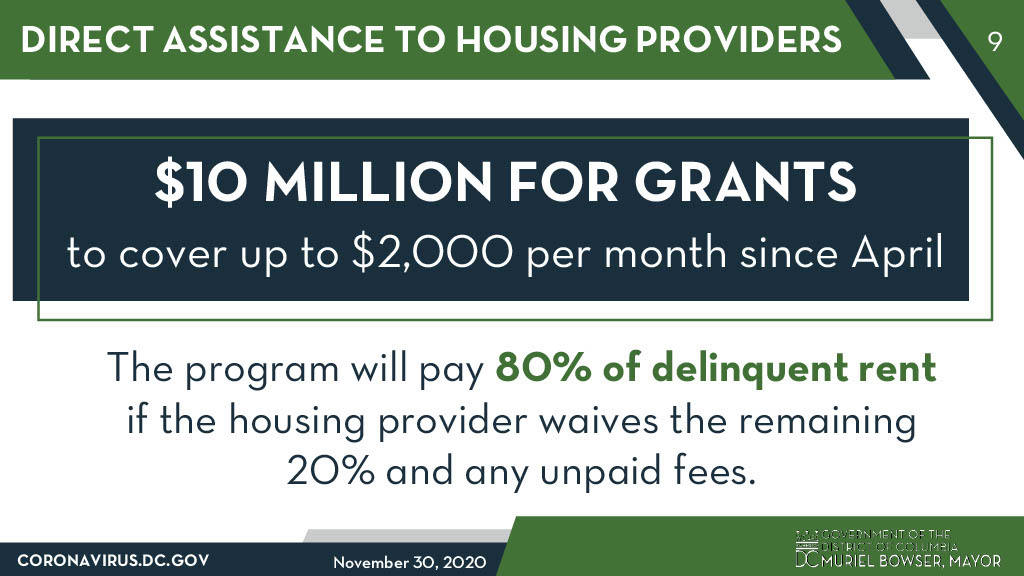 Mayor Muriel Bowser has announced a new $10 million investment in Housing Stabilization Grants to provide support for the District’s portfolio of affordable and small housing providers. The grants will utilize federal CARES Act funding to cover rent arrears during the COVID-19 public health emergency in order to assist renters and to stabilize properties that may be heading toward distress.
The Housing Stabilization grant programs will cover rent arrears accrued from April 1, 2020, through November 30, 2020, and will be paid by the District to housing providers in an 80:20 split, with the District contributing 80% of the rent, up to $2,000 in assistance, and the landlord forgiving the rest. Applications will open on December 1, 2020 and close on December 11, 2020.
As a condition for the assistance, the housing provider will be required to absolve the tenant of all arrears, including fees, penalties, and interest, accrued during the period of April 1, 2020, through November 30, 2020.
The Housing Stabilization grant programs will be available to two groups of housing providers:
-
Group A, to be administered by the DC Housing Finance Agency (DCHFA), will include housing providers in the District’s portfolio of income restricted affordable housing projects financed by the Housing Production Trust Fund, Low-Income Housing Tax Credits, or other local and federal affordable housing funds.
-
Group B, to be administered by the Department of Housing and Community Development (DHCD), will include small housing providers with 20 units or fewer in their portfolio.
CHAP PROGRAM RENT ASSISTANCE
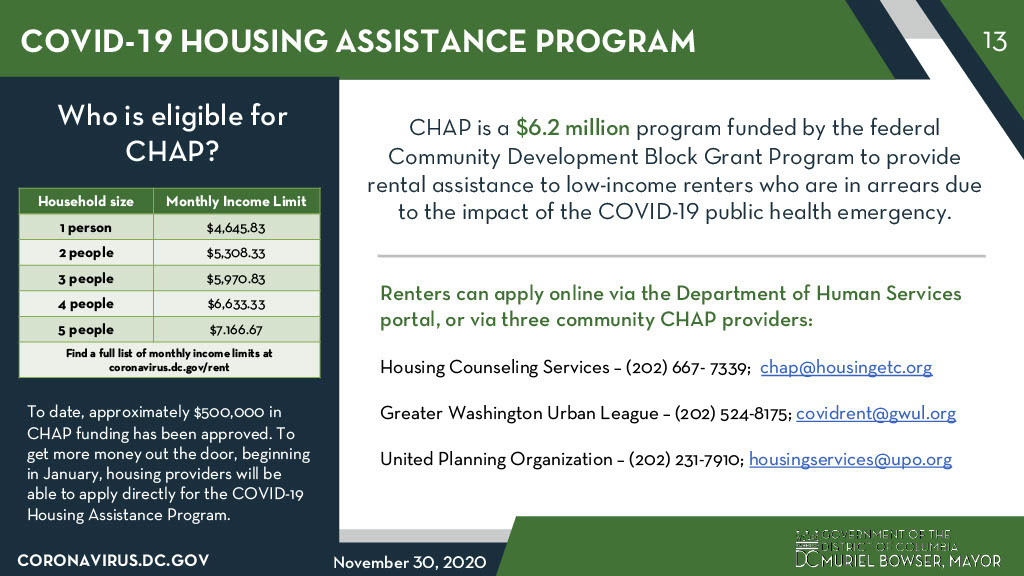 The Department of Housing and Community Development (DHCD) has developed the COVID-19 Housing Assistance Program (CHAP), a $6.2 million program funded by the federal Community Development Block Grant (CDBG) offering rental assistance to low-income renters who are in arrears. Tenants must earn 80% of the Median Family Income (MFI) or below based on the COVID-19 Income & Rent Schedule. Financial assistance will be based on income and household size. Assistance can be applied for rent from April 2020 onward for up to three months of overdue rent depending on available funds—eligible applicants may be able to apply for an additional 3 months for a total of 6 months of rental assistance. Interested applicants are asked to fill out intake information by going to the central intake portal for emergency rental assistance. Click here to apply and read more about this program.
EMERGENCY RENTAL ASSISTANCE (ERAP)
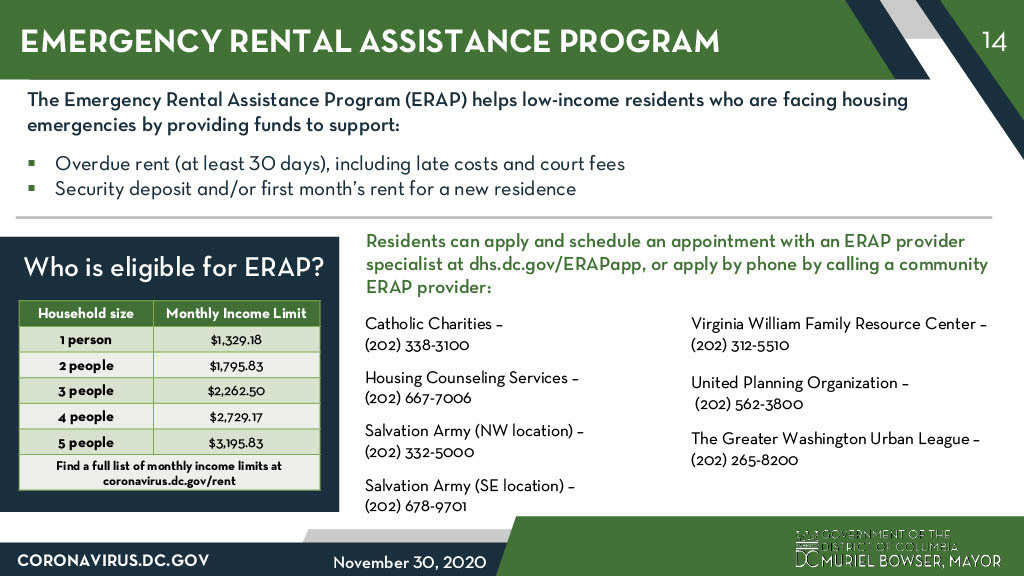 ERAP, administered by the Department of Human Services, helps income-eligible District residents (up to 125% of the Federal Poverty Level) facing housing emergencies by providing funding for overdue rent if a qualified household is facing eviction (including late costs and court fees). The program also supports security deposits and first month’s rent for residents moving to new apartments. The amount paid on behalf of eligible households depends on a household’s income and available resources and is subject to certain limitations. ERAP may provide up to 5 months of rent arrears or $4,250, whichever is less. Eligible households may only apply one time a year. In FY21, ERAP has $14 million in funding.
MORTGAGE ASSISTANCE PROGRAM (DC MAP)
The District of Columbia Housing Finance Agency (DCHFA) recognized an opportunity to provide financial assistance to those impacted by the effects of COVID-19. Through the DC MAP (Mortgage Assistance Program) COVID-19, qualified borrowers can receive a loan up to $5,000 monthly toward their mortgage for up to six months. Borrowers must be applying for financial assistance for their primary residence, which must be located in the District of Columbia. DC MAP COVID-19 relief commences with April 1, 2020 payments associated with monthly mortgages. Interested applicants are asked to take the survey on DCHFA’s website to confirm if they’re eligible to apply. Click here to review the full list of borrower qualifications and to apply to the program.
REVERSE MORTGAGE INSURANCE & TAX PAYMENT PROGRAM (ReMIT)
 Reverse Mortgage Insurance & Tax Payment Program (ReMIT) allows qualified homeowners to receive financial assistance for delinquent property taxes, homeowner’s insurance, condominium fees/homeowners association fees and certain property related expenses paid by your Servicer that have put the homeowner at risk of foreclosure. Qualified homeowners can receive up to $25,000 in assistance in the form of a zero-interest, non-recourse loan.
You may apply for ReMIT assistance by contacting Housing Counseling Services at (202) 265-2255. For additional information or questions about the program, email remit@dchfa.org or visit ReMit Program.
COVID-19 RESPONSE EMERGENCY AMENDMENT ACT FOR FAMILY LEAVE
 During the public health emergency, an employee who has worked for 30 days for an employer of any size may use up to 16 weeks of “COVID-19” leave for one of the following reasons:
- Care for Self: A recommendation from a healthcare provider to quarantine or isolate, including because the employee or an employee’s household member is high risk for serious illness from COVID-19;
- Care for Family or Household Member: A need to care for a family member or a member of the employee’s household pursuant to a government or healthcare provider’s order to quarantine or isolate;
- Childcare Closure: A need to care for a child whose childcare facility is closed or childcare provider is unavailable.The right to COVID-19 Leave terminates when the public health emergency has ended, even if an employee has not exhausted the 16-week entitlement.
This applies to any employer in the District of Columbia with one or more employees. For more information, visit- DCFMLA
|