|
Friends-
I am reaffirming my commitment to uphold the District of Columbia as a sanctuary city. The entire Council voted to reconfirm our support for human rights and applauded Mayor Bowser for her commitment to advocating for the District's immigrant community. We will continue to be by her side on this important issue. Mayor Bowser and I are fully committed to protecting undocumented immigrants in Washington, D.C. despite the new policies under the new administration. We face challenging times ahead and I will continue to defend all people moving forward regardless of where they come from or their current immigration status. All people that call Washington D.C. home should feel safe and protected.
Moving forward, we must continue to be kind to one another. Please continue to contact my dedicated staff if you have any questions about any of the Executive orders that may be released by the office of the President in the future.
-Anita

Veteran's residence photo- by Song Architects

NEW VETERAN HOUSING
On January 12, Councilmember Anita Bonds joined U.S. Secretary of Housing and Urban Development Julián Castro (left) and U.S. Secretary of Veteran Affairs Bob McDonald at the opening of the John and Jill Ker Conway Residence at North Capitol Commons.
This 14-story building, named after the late World War II Veteran and his wife, comprises 124 units of which 60 units are dedicated to permanent supportive housing for formerly homeless veterans. Additionally, 47 units of affordable housing are for tenants at or below 60% of the area median income, and 17 units of affordable housing are for tenants at or below 30% area median income.
The opening of the new residence helps the District reach it's goal of ending homelessness among Veterans in the District. Currently, roughly 200 veterans still need to be housed to reach the goal of zero homeless Veterans.
|
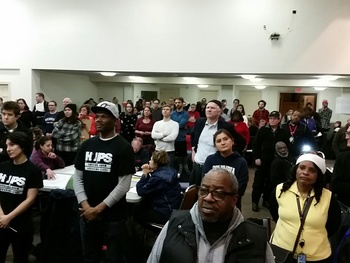
Volunteers listen to remarks from Mayor Muriel Bowser and Councilmembers Anita Bonds, Elissa Silverman and Brianne Nadeau.
POINT IN TIME HOMELESS COUNT
Councilmember Bonds sends her gratitude to the hundreds of volunteers who participated in the Community Partnership for the Prevention of Homelessness Annual Point in Time Census of the District's homeless population. Led by Executive Director Sue Marshall and the Point in Time Committee, advocates spanned across the District to identify and record persons living in shelters, transitional housing or on the streets.
The results from the Census will be available in spring. If you would like more information about Point in Time or other TCP projects, follow The Community Partnership on Facebook and Twitter (@PartnershipDC).

Legislation to Close Housing Loophole
On January 24, Councilmember Bonds introduced the “Disposition of District Land for Affordable Housing Clarification Amendment Act of 2017”, which amends previous legislation to clarify that the affordable housing set-aside requirements also apply to alleys, in addition to any other District property that is privatized.
The legislation changes the definition of “real property” under DC Law to include alleys held by the District as easements. Without the definition change, alleys could slip through this possible loophole, and once closed, not fall under affordable housing set-aside requirements. This legislation would close this potential loophole by requiring that all alleys, regardless if they are easements held by the District or whether they are owned by the District, fall under the affordable housing requirements of the Disposition of District Land for Affordable Housing Amendment Act of 2014.
MORE $$$$ TO BUY A HOUSE!!!!!
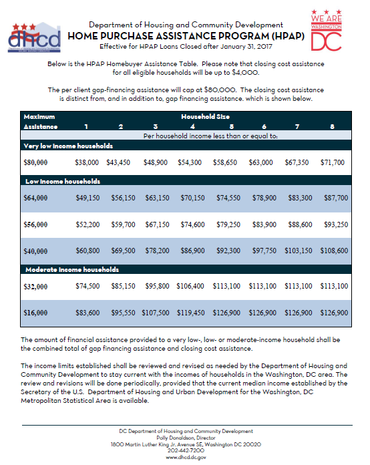
Following the passage and funding of Councilmember Anita Bonds' legislation, “Home Purchase Assistance Program Amendment Act of 2016,” we are pleased to announce that increased funds are available to qualified first time home buyers through the Housing Purchase Assistance Program (HPAP).
The legislation, now effective, increases the financing assistance available for first-time homebuyers from $50,000 to $80,000, plus $4,000 for closing cost assistance.The gap financing and closing cost assistance are based on household income reflected in the chart below. For more detailed information visit HPAP.
Emergency Legislation to Protect Tenants.
This emergency legislation is necessary to give the Rental Housing Commission (RHC) the authority to publish regulations certifying the most recent annual cost-of-living adjustment (COLA) of benefits for social security recipients, and the maximum annual rent adjustment that may be imposed on a unit occupied by an elderly tenant or a tenant with a disability. As B21-0173 will not likely become effective until sometime in March 2017, housing providers and tenants will only receive a few weeks’ notice of this change in the law before the May 1, 2017, annual date of allowed rent increases.
The Elderly Tenant and Tenant with a Disability Protection Emergency Amendment Act of 2017 while the permanent bill, the Elderly Tenant and Tenants with Disabilities Protection Amendment Act of 2016 (passed Dec. 6, 2016) awaits the 30 day Congressional review period before it can become law.
The “Elderly Tenant and Tenant with a Disability Protection Amendment Act of 2016” protects low-income elderly and low-income tenants with disabilities from sharp increases in rent, by exempting them from rent increases resulting from the following housing provider petitions: Hardship, Services and Facilities, Substantial Rehabilitation, and Voluntary Agreements.
The bill also allows more elderly or disabled tenants to qualify for the exemption by raising the maximum annual income of an elderly or tenant with a disability from $40,000 to 60% of the area median income. Additionally, for all elderly or disabled tenants regardless of income, the bill specifies that the housing provider may only raise the rent to the least of: the Social Security COLA, 5 percent of the current rent, or the Consumer Price Index (CPI-W).
Councilmember Anita Bonds also co-introduced the following pieces of legislation;
Ethics Reform Amendment Act of 2017 - The Ethics Reform Act requires the Board of Ethics and Government Accountability (BEGA) to submit an annual report of recommendations for ethics changes and provides specific areas for the report to cover. This act repeals the specific recommendation requirements but keeps the annual report requirement. Further, the bill prevents lobbying for a period of two years and permits BEGA to issue fines. Appeals of BEGA decisions may also be filed directly with the Court of Appeals for DC rather than only in the Superior Court. District employees must also disclose outside employment. Additionally, the bill requires reporting of donations in excess of $1000 to ANCs (the actual commissions, not the commissioners). Finally, the bill gives 5 additional days for filing activity reports.
Mixed-Use Affordable Housing Property Tax Exemption Act of 2017 - DC law currently provides a tax exemption for certain properties eligible for the low-income housing tax credit under the federal Internal Revenue Code. The Mixed-use Affordable Housing Property and Deed Transfer and Recordation Tax Exemption Act of 2017 would clarify that the existing exemption also applies if a portion of the relevant property is eligible for the low-income housing tax credit and the remainder of the property is owned by a non-profit organization.
Public Restroom Facilities Task Force Establishment Act of 2017 - The Open Restroom Facilities Task Force Establishment Act of 2017 would authorize a task force to research methods of improving access to restrooms in the District, particularly in the District’s commercial centers. This legislation is intended to improve the health and wellbeing of District residents, with particular attention to the homeless who have few restroom options and to others in our community who have uniquely urgent restroom needs such as pregnant women and the elderly. Specific guidance is given for purchasing and locating public restroom facilities as well as for incentivizing local businesses to keep their restrooms open to the public. The scope is generally in line with public restroom practices in other U.S. cities and major world cities. Further, the task force would provide a report detailing their policy and site recommendations. Finally, the bill provides guidance on the composition of the task force.
Public School Health Services Amendment Act of 2017 - At the end of last year it was announced the school nurse program would be retooled, resulting in several schools losing a full-time nurse on site. The Committee on Education held a roundtable and heard from many public witnesses, including staff from LEAs about their concerns regarding the DOH’s new approach, particularly fear of losing full-time school nurse services. Both the Academy of Pediatrics and the Centers for Disease Control and Prevention recommend having at least one full-time nurse in every school.
The Council passed emergency legislation in November 1 to delay any reduction in school nurse services for the remainder of SY2016-2017; however, many school budgets were reduced prior to that action. This provides the Council with the ability to have a full debate on whether D.C. should have a policy of having full-time nurses in every public school.
Senior Citizen Tax Relief Amendment Act of 2017 - This bill is to exempt lower income seniors from real-property taxes if they are at least 70 years old and have owned a residence in the District for 20 consecutive years or longer; allows for a transfer of the tax cap benefit, if a senior downsizes; eliminate the tax on pensions and restore the deduction for long-term care insurance. This crucial tax relief will allow seniors to continue to live independently in their own homes and remain in the District.
During my first year as Councilmember (2013), I introduced similar legislation that became law. However, during the budget process, that law was changed into a tax deferral program. This new version of the law will allow low income seniors to keep their homes against rising property taxes and cost of living.
Expanding Access to Justice Amendment Act – As introduced, this bill establishes a right to counsel in civil cases for those who meet low income criteria whenever fundamental human needs are at risk. It requires the DC Bar Foundation to adopt policies and procedures, issue requests for proposals, and make grants to designated legal services providers for the purpose of creating civil right to counsel projects. The bill also establishes a fund, the Establishment of the Civil Right to Counsel Innovation Fund, to fund the provision of legal services to individuals or groups in certain proceedings.
Extreme Weather Protection for Animals Act of 2017 – Prevent owners from keeping pets outside for extended periods of time when temperatures are below freezing.
ANNOUNCEMENTS:
Saturday, February 18
Coffee in the Community
with
Councilmember Anita Bonds
at
COFFY CAFÉ- COLUMBIA HEIGHTS
10:00am- 11:30 am- 3310 14th St. NW
Join me for coffee and discussion about community issues!

Nominate a Community Cornerstone Awards Recipient!
Do you know an unsung hero in the community? We need your help to identify and honor outstanding individuals, businesses and organizations making a significant impact on citizens of the District of Columbia.
Click here to make a nomination today.
|