Weld County Commissioners are used to the state’s legislative season, that time at the beginning of the year spanning a little over three months when they monitor, support, or oppose state legislation that affects residents and the ability of Weld County to govern and provide needed services. It can be a challenging time, but it’s one they look forward to, as their effort — through personal testimony or editorials — is critical to giving residents a voice in important decisions.
Ask them, though — as they were late last year — if a trip to Washington, D.C. to take Weld County’s concerns to the federal level would be beneficial, and they’d admit there was some concern. Would the trip make an impact? Would Weld County’s voice be heard, and most importantly, is such a trip in the best interest of residents?
It wasn’t too long after they landed in the nation’s capital in January that the answer was clear: A resounding yes.
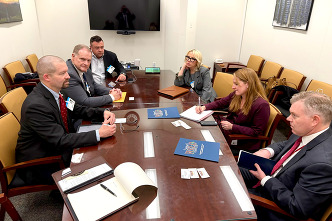
“When you put the effort to actually go see (representatives) and truly talk to them about Weld County, who we are, what we do, why (legislation) is important, and what we’re looking for as far as support at the federal level, that pays dividends,” Weld County Commissioner Jason Maxey said, glancing at the business card of Ryan Peay, an official from the U.S. Department of Energy and one of several important people Maxey met with on the trip. “They truly were engaged. They wanted to meet with us, and they were happy to hear from us in person.”
Commissioners Kevin Ross and Scott James also had similar positive impressions after meeting with federal departments, which in addition to the Department of Energy, included the Environmental Protection Agency (EPA), Department of Transportation and even officials from the White House.
Don’t blame them if they can’t agree on a singular moment that was most impactful. There was a lot discussed and advocated for — from showing how Gov. Polis’ ambitions for electrification are unachievable in a county stretching more than 4,000 square miles to more broadly showing the federal legislation’s impact on local governments, something that had a lasting effect on James.
|
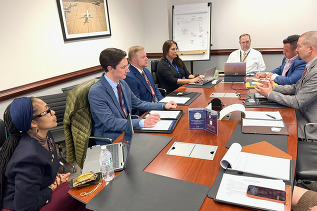
“It’s invaluable,” James said of meeting with federal representatives. He explained that sometimes federal legislation, made in good faith, can put extra stress on local government, both with increased staff demand and a greater cost to taxpayers. It’s good for the federal representatives to take that into account.
“We’re the doers, the ones that have to implement changes from the federal level locally,” James said. “So, while I may agree with a bill in principle, how’s it going to work? It’s a good reminder, ‘We’re not against you. We’re asking for rules and maybe (more time) so we can gear up to do this.’”
With this approach, commissioners met with federal representatives on a variety of topics, all important to the county environmentally and economically.
|
Energy
It’s no secret that energy has a major impact on Weld County’s overall economy. Oil and gas production routinely accounts for more than half of Weld County Government’s assessed value and is a primary economic driver to the budgets of school districts, fire departments, and municipal governments countywide.
While the Weld Oil and Gas Location Assessment (WOGLA) process has worked well at the county level to safely permit surface sites in unincorporated Weld County, the state’s permitting process has faced burdensome delays, with approval taking anywhere from six to 18 months — a delay driven by changing regulations and difficulty interpreting state rules. These burdens show that despite Weld County’s efforts to alleviate delays by creating a memorandum of understanding with the Colorado Oil and Gas Conservation Commission in 2021 — now the Colorado Energy and Carbon Management Commission — and updates to its WOGLA process in 2024 and 2025, permits in Weld County remain an issue at the state level.
As permitting delays hurt Weld County’s economy and cause uncertainty in the industry, the commissioners asked for “federal support and primacy in managing oil and gas resources and siting, ensuring local government, not distant state regulators, can best serve the interests of communities.”
Transportation
Weld County maintains thousands of miles of roads, hundreds of bridges, and thousands of culverts. This is a big challenge in itself; add population growth into the equation and the challenge is that much greater.
Meetings with the Department of Transportation brought several projects to light, notably the interchange project planned for Interstate 76 and Weld County Road 8 and continued improvements to Interstate 25 from Colorado Highway 7 to Colorado Highway 66. While the commissioners asked for consideration for federal funding for these projects, they also pointed out steps the county’s taken to create a safer transportation system, one major step being completion of a Safety Action Plan in 2025.
Aviation
The focus on aviation was most exciting, as the topic fostered continued discussions about the progress made in rebuilding the Greeley-Weld County Airport to a regional facility, built to handle greater air traffic and larger planes.
“We were able to find potential funding solutions for our airport improvements and timeline," Ross said of meeting with the Federal Aviation Administration.
Ross explained the discussions helped the board and the agency identify ways to keep the project moving forward, receiving instructions on how to expedite potential federal funding as well as important technicalities, such as getting the airport’s runway approved for greater load capacity.
Air quality and ozone
Over the past several years, much has been written about Weld County’s air quality. In their meeting with the EPA, the commissioners’ goal was simple: Work to get the EPA’s designation of Weld County as a non-attainment county lifted.
Through the placement of air quality monitoring stations and the launch of an informative air quality website, the county has taken great steps to monitor its air. The commissioners’ discussion with the EPA centered around attainable goals for the county and the ineffectiveness of a one-size-fits-all approach to the Clean Air Act, considering unique challenges to different parts of the country, notably size and topography. Some of the air quality goals can be difficult to meet or may not make sense in more spread-out counties like Weld County.
Similar arguments were made concerning energy and Gov. Jared Polis’ push toward electrification. The argument was made that the governor’s reliance on electricity is not the best approach, given energy-reliability challenges throughout Colorado — the recent public safety power shutoffs being an example.
Why now and what does the future hold?
While there was initial hesitation about traveling to Washington, D.C., a trip organized by Purple Label Solutions LLC after the federal lobbying group was hired by the board last year, one thing experienced consistently during Colorado’s Legislative Session convinced James the trip was a must.
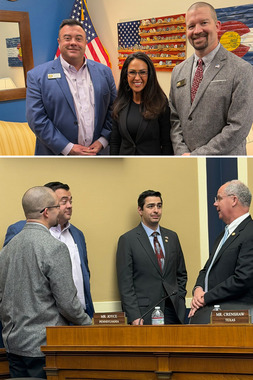
“Our voice has become so unheard at the state capitol” James said, explaining that he’s testified on a handful of bills so far this year, though Weld County’s concerns have largely been dismissed. “It’s become so performative and our efforts have become so unheard — we have a friendly administration at the federal level, especially when it comes to air quality and oil and gas permitting.”
It was a chance taken with a specific goal in mind: To take critical issues to the federal government to raise awareness and garner potential support through future legislative action. It was something that succeeded on both levels.
“Our concerns were definitely heard,” Ross said. “We walked away with deliverables and follow-up items to keep the various departments engaged with us. We believe the solutions we worked on will make it easier to do business in Weld County.”
A door has been opened, and it’s one the commissioners won’t mind walking through in the future if Weld County’s voice needs to be heard.
“I asked myself, ‘Is this trip going to have an impact?’” James said. “One hundred percent (it did.) We should do it again.”
|
|