|
By Shaley Dehner, Communications Specialist |
|

Government and paperwork seem to go hand in hand but for good reason. The paperwork preserves important history by documenting county actions in the form of commissioner meetings and minutes.
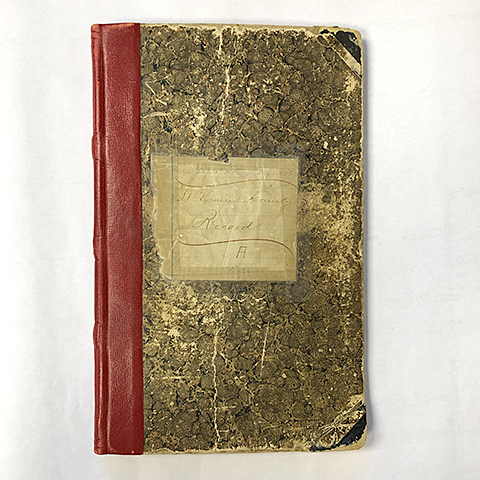
For example, tucked safely away in a secure spot is a small notebook with a dappled brown cover and rust red binding. Taped to the front is a faded square of paper that simply reads “St. Vrain County Record A” and inside are pages and pages of handwritten entries describing cattle brands and the formation of the Saint Vrain Claim Club, where early homesteaders entered descriptions of their 160 acres of land they were claiming as their own. The book, dubbed the 1859 book, is the first official record of business for what would later become Weld County Government.
That book, later paired with volumes and volumes of beautifully bound ledgers documenting multiple facets of official county business, falls under the direction and protection of Weld County’s Clerk to the Board, Esther Gesick — the official keeper of the records for the Weld County Commissioners.
During her 28 years working for Weld County Government, Gesick has seen a lot of change in how records, including meeting agendas, minutes, ordinances, and contracts, are not only preserved but also made available to the public for review.
“It’s so amazing to me to think the 1859 book we have likely sat in the little log cabin that is now at Centennial Village,” she said, referring to the one room cabin that stood on a farm near Platteville and served as the county’s first courthouse around 1861.
At a time when it could take a person an entire day to travel 15 miles by horse, engaging with county government wasn’t necessarily convenient.
Over the years, change was slow. Cars replaced horses; typewriters replaced pen and paper. But county business remained something that was conducted primarily in person.
|
When Gesick began her career with the county in 1997, she used a spiral notebook to take handwritten notes during commissioner meetings. A big, square cassette tape deck that held two cassettes at a time sat on the commissioners’ dais, and their microphones plugged into the deck, enabling the meetings to be recorded for an audio record.
After each meeting, Gesick went back to her computer (which took up most of her desk) and typed the meeting minutes. Once reviewed and signed by the board, another clerk scanned the minutes, which were posted on a bulletin board or could be emailed if a member of the public wanted a copy.
In the early 2000s, the tape deck was replaced by compact discs (CDs) and board meeting notes were taken on a laptop. By 2013, technology and processes evolved to digital recording and housing minutes online for the public to view on the county’s website.
“Up until late 2019, people had to attend the commissioner meetings in person to know what was being discussed,” Gesick noted. “We began livestreaming the meetings in November of that year, which made it possible for any member of the public to watch county commissioner meetings without having to come into the Administration Building in Greeley every Monday and Wednesday when meetings take place.”
Now, Gesick is excited about the most recent upgrades to record keeping and county business — upgrades that will allow the public to have a more reliable and accessible experience when viewing board meetings online.
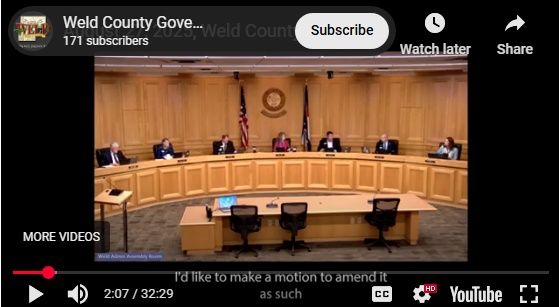
In August, the board of commissioners, in conjunction with the Department of Information Technology and Clerk to the Board’s Office, unveiled upgraded technology within the board’s hearing room, which now allows for livestreaming board meetings with closed captioning and makes meeting recordings available within 48 hours of the event.
“This move was fantastic for the county and public because the new livestreaming system is more reliable, the image and audio are clear, and it is widely accessible,” Gesick explained.
Every technological advancement the county makes is with residents in mind, and these upgrades are no exception. With the need for more reliability in livestreaming and with the passage of House Bill 21-1110, which required all state and local government’s digital content to be accessible to individuals with disabilities per the Americans with Disabilities Act (ADA) guidelines by July 2025, this change is an important one. Board meetings are now fully accessible to both visually impaired and hard of hearing individuals.
|
“It came down to the understanding that we needed a reliable software solution to comply with new regulations, as well as meet the evolving needs and expectations of the public,” Gesick said. “Technology is changing faster and faster these days, so we need to change with it and ensure county residents’ needs are top of mind.”
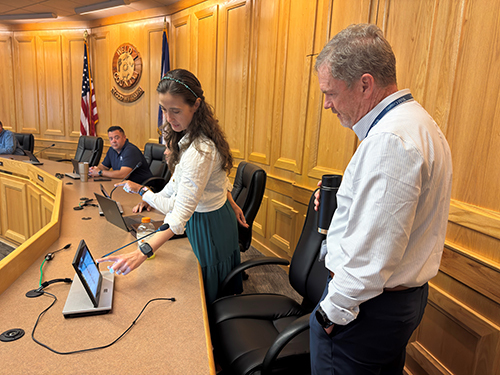
Today, new microphones adorn the presentation table, as well as the public podium. Behind the dais, touchscreen monitors allow the commissioners to view presentation documents. With accessibility and reliability for residents and staff at the forefront of the project, each presentation microphone available for use by those addressing the board during a meeting also includes an audio jack where a hard of hearing individual can plug in a headset to better hear comments made by the board.
These upgrades are a huge step forward for the county, according to Gesick.
“The fact that people can watch a livestream with captions, or access a recording to watch on demand, is a huge benefit to the public,” Gesick said. “I am excited to see these updates in action for years to come and usher in another new technology when the time comes.”
|
That time is fast approaching as the Clerk to the Board’s Office will soon be utilizing another new tool as its records repository of historical and current county commissioner business. This system will allow the public to search scanned documents based on content filters and not just specific metadata entered by clerk staff. Additionally, the program will enable staff to more efficiently prepare digital agenda and hearing packets for public use.
As Gesick looks toward the future of technology related to her office and the county in general, she knows one thing is certain: The county will continue to find technology to provide government records to the public in more accessible and efficient ways. And while CDs might not hold the same historic reverence as the 1859 book, the goal of preserving and sharing the business of the board with county residents is just as important now as it ever was.
|
|
|
The 1859 book is the county’s first commissioner record book. It houses handwritten minutes that were taken at board meetings. |
Livestreamed commissioner meetings now offer closed captioning, and meeting recordings are available within 48 hours of the event. |
Weld County’s Facilities and IT departments worked to make board meetings more accessible, completing work in under two weeks. |
|
|
miscellany: a group of or collection of different items.
- Work on the county’s portion of High Plains Boulevard is underway. As crews work to construct a one-mile segment of road — extending Weld County Road (WCR) 9.5 from WCR 32 to 34 — the High Plains Boulevard newsletter will serve as a resource for information highlighting project progress, pictures and sharing information on relevant closures that impact the traveling public. See the latest newsletter update and learn more about the county’s portion of the project at www.weld.gov/Go/HighPlainsBlvd.
-
The Northern Colorado Workforce Symposium returns on Sept. 30. This event is a regional collaboration between Weld and Larimer Counties aimed to bring business leaders and community partners together for a day of dynamic discussions. Purchase tickets before they sell out!
|
|
|
Welcome to County Roots, the official newsletter of Weld County Government. For those of us who work in county government, we think what we do is pretty interesting. So the goal of this newsletter is to highlight some of the partnerships, technology and efficiencies we are using to make government stronger and more effective for its residents.
Our goal is to establish regular communication with residents, spur interest in county projects, highlight county accomplishments and provide meaningful information to the public. In fact, our goal is to live up to the name “County Roots.” Want to know more about the meaning behind the name? Please visit our webpage, where you can also find previous editions of this newsletter.
|
|
|
|
|