|
By Kristen Sigg, Communications Specialist |
|
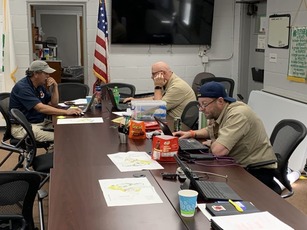
David Burns has spent over six years with Weld County and 14 years in emergency management, ensuring that the communities are as prepared as they can be for any possible disaster.
As Senior Emergency Management Coordinator for the Weld County Office of Emergency Management, his daily responsibilities range from hazardous materials response and mitigation to overseeing the county's Emergency Operations Center and developing comprehensive preparedness plans. He works closely with local agencies to coordinate responses so that Weld County can recover swiftly from any crisis that might strike.
Last fall, his role took a different turn when Hurricane Helene affected the small town of Edgefield, South Carolina.
Hurricane Helene wreaked havoc in South Carolina, leaving a trail of destruction in its wake. Straight-line winds and tornadoes demolished entire areas, including Edgefield, where not a single power pole stood. Residents were without power, water and food.
The local emergency manager, new to the profession, needed support. This was where Burns and a team of responders from the Eastern Colorado Incident Management Team came in. They deployed under the Emergency Management Assistance Compact, an interstate agreement that allows states to request help from other states during large-scale disasters.
"I received the call, and within 48 hours, I was in South Carolina, ready to lend a hand," Burns said. "The situation there was beyond anything I’d ever experienced. It was like Ground Zero."
Upon arriving, Burns found a town in complete disarray. Edgefield, the town he was deployed to, had no functioning power grid, no clean drinking water and residents were struggling to access even the most basic necessities.
His mission was clear: provide leadership and help stabilize the situation.
|
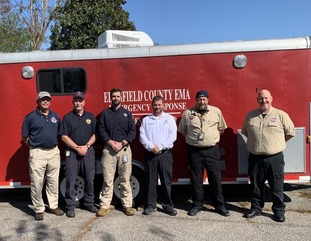
Burns and his team were tasked with assisting the local response efforts by providing strategic planning and logistical support. Burns had dealt with localized incidents back in Weld County, and he was now facing a new countywide crisis in a different community.
“The devastation was kind of comparable to the Windsor tornado in 2008, something I responded to as part of the fire service years ago,” Burns reflected. “But the biggest difference compared to my role with Weld County was that the disaster had already happened, and instead of preparation, we needed to focus on full-fledged recovery, including getting resources like food, water and shelter to people who needed them immediately.”
Burns and his team immediately went to work, helping establish a Disaster Assistance Center (DAC) to provide residents with access to food, water, medical care and support from the Federal Emergency Management Agency (FEMA). It wasn’t just about the logistics of getting supplies to those in need but also about the accountability of resources.
"One of the key lessons I learned in South Carolina was resource accountability," Burns said. “In Weld County, we have systems in place to track resources, from dollars to supplies. But down there, they were struggling to keep tabs on what they had and what they needed. Resource management is absolutely critical in these situations. It makes the difference between getting help to people quickly or letting them suffer for longer than necessary."
Burns quickly implemented systems he utilized in Weld County to track everything received — between FEMA, local responders and volunteer organizations. His experience from Weld County proved invaluable, and within days, the distribution of resources was running more smoothly.
But the job wasn’t easy. Burns ate emergency food kits, or MREs (meals ready to eat), as they are referred to, slept on an army cot inside a local recreation center, used community showers brought in by FEMA and had Starlink internet to stay connected.
|
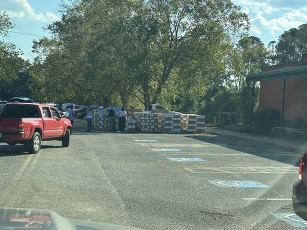
“It was grueling work, but it was incredibly rewarding,” he said. “We were literally bringing hope to people who had lost everything. The hardest part was seeing how much devastation there was, but the most fulfilling part was knowing that our efforts were helping people recover and rebuild.”
Burns’ experiences in South Carolina not only shaped his approach to large-scale disaster recovery but also reinforced the importance of emergency preparedness and resource management back home. He saw how vital it was for emergency managers to have detailed plans in place and to track resources meticulously, and he was eager to bring that expertise back to the county.
Following the incident, Burns began applying the lessons learned to improve Weld County’s preparedness systems. He reinforced the importance of maintaining an accurate inventory of resources, ensuring that there were clear plans for distribution and that every response effort was measured and well-coordinated.
“One of the things I stress with my team is that every resource we use in a disaster must be accounted for,” Burns said. “It’s not just about having enough supplies; it’s about knowing exactly what you have, where it’s located and how to get it to the people who need it most. That’s what makes emergency management effective. I bring back what I learned from these larger-scale operations to ensure we’re prepared, not just to respond, but to recover as quickly as possible.”
His role in Weld County involves not just responding to emergencies but also planning and preparing for the unknown in coordination with municipalities and first responders. And while his recent deployment was a stark reminder of the unpredictability of disasters, it also reinforced the importance of preparing for the worst.
“At the end of the day, it’s all about helping people,” Burns said. “Whether it’s here in Weld County or across the country, we’re all working toward the same goal: to save lives, protect property, and help communities recover.”
|
|
|
Burns is a part of the Eastern Colorado Incident Management Team, a specialized group of responders who work in large-scale disaster situations. He is a qualified incident commander and planning chief. |
The overall goal of the Weld County Office of Emergency Management is to support Weld County and its citizens in preparedness, prevention, mitigation, response and recovery. |
Weld County Office of Emergency Management staff go through over 600 hours of training a year that includes preparation, response and recovery. These training hours are often done with municipalities throughout Weld County. |
|
|
miscellany: a group of or collection of different items.
- Weld County is offering free soil lead testing at the Greeley Farmers’ Market on Saturday, April 19, 2025, from 9 a.m. to noon at Zoe’s Café and Events, 715 10th St. in Greeley. This SoilSHOP event provides on-site screening, expert advice and educational resources to help residents identify lead contamination in their soil. For full details and sample preparation instructions, visit www.weld.gov/go/lead.
- Do you have an idea for how roads, bridges, sidewalks and more can be improved? Weld County’s Safety Action Plan is seeking feedback on how Weld County’s transportation system can do just that. Drop a pin on our interactive map and share your thoughts at weldsafestreets.com.
- Spring weather season has arrived in Weld County, bringing the potential for severe storms, high winds and rapidly changing conditions. Watch our Facebook and X platforms regularly throughout the spring months for preparedness tips and view our many resources at www.weldoem.com or www.weld.gov/go/pio.
|
|
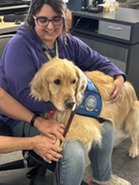
In the high-stress world of 911 dispatch, a four-legged friend brings needed smiles and comfort to those helping residents when they need it most.
In the next issue of County Roots, meet Zacchaeus and learn how he is just one element used to boost the mental health of those in Weld County’s Regional Communications Center.
|
|
|
|
Welcome to County Roots, the official newsletter of Weld County Government. For those of us who work in county government, we think what we do is pretty interesting. So the goal of this newsletter is to highlight some of the partnerships, technology and efficiencies we are using to make government stronger and more effective for its residents.
Our goal is to establish regular communication with residents, spur interest in county projects, highlight county accomplishments and provide meaningful information to the public. In fact, our goal is to live up to the name “County Roots.” Want to know more about the meaning behind the name? Please visit our webpage, where you can also find previous editions of this newsletter.
|
|
|
|
|