|
By Baker Geist, Communications Specialist |
|
“Ready for takeoff!”
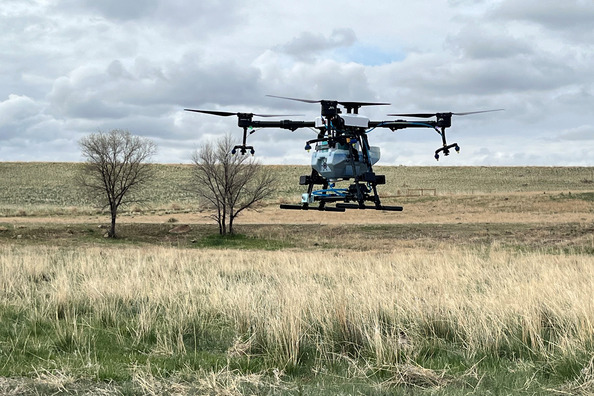
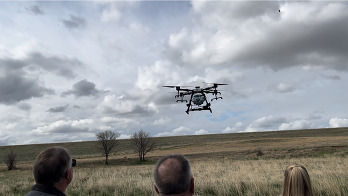
With those words, the silence usually found in a remote area of Weld County is broken, replaced by a few beeps and the whips of propellers, which launch a new spray drone into the sky — the latest tool in the county’s battle against the spread of noxious weeds.
As county commissioners, Tina Booton, and other members of the Weld County Department of Public Works watch the drone spray Scotch Thistle, there’s a sense of fascination at the drone’s precision and in the efficiency it could bring in the future.
“It’s exciting,” said Booton, who serves as Weld County’s Weed Division Supervisor. “It’s another example of how we're always trying to do a better job and be more efficient with time and the amount of chemical used when working to control noxious weeds.”
Controlling noxious weeds is a challenge, and an important one. Noxious weeds are those not native to Colorado or the U.S. that are very invasive and fast spreading without human assistance. They can displace vegetation, and certain weeds can be toxic to humans and livestock. Every year, as required by state statute and the Weld County Code, Booton and her 12 staff members work to prevent, suppress or eliminate noxious weeds along county roads, property and facilities.
It's a challenge that’s attacked in many different ways. There are bare ground treatments, usually performed from October to March, on county property or around communication towers, which help prevent noxious weed growth before it starts. From April to October, staff can be found treating noxious weeds in various regions of unincorporated Weld County by manually spraying or mowing. As residents are responsible for controlling noxious weed growth on their property, Weed Landowner Specialists can provide educational information to assist. These methods are continually having a positive impact, as evidenced by the Weed Division treating more than 2,000 acres of noxious weeds in the last two years combined.
There is a strong belief that the spray drone can increase those numbers and add to the county’s efforts. Its small size is beneficial in that it can easily maneuver to areas difficult to reach otherwise. This limits the risk of injury to staff who can avoid having to manually walk uneven, rocky, or thick terrain spraying weeds. The drone can also be a time saver — something made possible by the ability to pre-plan its route. When the drone takes off it knows exactly where to fly, stop and disperse chemicals — technology that allows for quicker treatment of noxious weeds.
“Even with having to charge and refill it, we were able to spray the area in a couple hours,” Booton said, following the drone’s debut mission in May. “Normally, it would’ve taken us a few days.”
Working hand-in-hand with technology
|
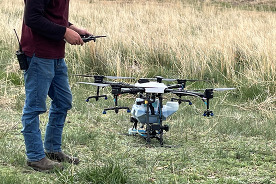
While the spray drone has many efficiencies, it’s not meant to eliminate the effort or effectiveness of treating weeds manually, but rather add to it. In fact, the drone can’t operate without critical work done by staff beforehand. Before the drone’s route can be determined, problem areas must be identified — a task completed when evaluating different regions of the county and submitting inspection reports, which are uploaded using an iPad application created in partnership with Weld County’s Geographic Information Systems Division in 2019. The information in the reports can be used to help determine where the drone might be most effective. In some cases, mapping is done by flying another drone over the area, which can record images and other data.
Those who fly drones for Public Works must be licensed and certified. Public Works’ Unmanned Aircraft Systems team consists of eight individuals, but currently Booton, Weed Landowner Specialist III Cathy Griffee, and Foreman Greg Hoff are the only ones licensed to fly the spray drone specifically.
A flight with the spray drone takes two people, with someone watching a graph on a computer to ensure it’s staying on course and another person standing by to take manual control if needed. With its 2.5-gallon tank, it isn’t economical to use the drone in every location; it’ll be used mostly near fence lines, rail lines and for spot treatments in small open areas.
Although new, the drone is strengthening a team devoted to helping Weld County’s landscape look as good as possible.
“We’re trying to be good stewards of taxpayer money and our resources,” Booton said. “That means selecting the best option that allows us to be as effective as possible and help care for the environment.”
A continued history of innovation
|
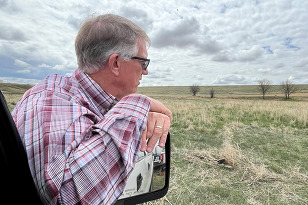
"Nope. Never thought I’d see this.”
A sense of pride can be found in the words of Weld County Public Works Director Curtis Hall as he stands against a Weld County truck, waiting for the drone to receive more chemicals before making another round. It’s not as though technological advances are new; he’s seen many in more than 20 years with Public Works. The pride in his words comes from the longstanding commitment of the department to find new ways to improve service to the public.
“We always encourage new ideas no matter what the task, whether that’s building a road or spraying weeds,” Hall said. “What I really look for with a new idea or request for equipment is that ROI — return on investment. Is it something that gets the most value out of taxpayer money? Can it help us do a job more safely or efficiently for residents?”
The spray drone, which was purchased in 2023 for $20,000, is just the latest example of the county’s investment in new technology for Public Works. For years, drones have helped the department capture aerial images of its many projects and helped evaluate the supply levels at the county’s gravel mines.
Innovation doesn’t stop with technology — especially when it comes to noxious weeds. Over the years, biological processes have also been utilized. In the ’90s, the Flea Beetle was used on Leafy Spurge, mites have been used to reduce Field Bindweed and most recently in 2020, Gall Wasps, 1.7 to 2.3 millimeters long, were released to control the growth of Russian Knapweed.
One can expect the hard work of Weld County’s Weed Division to continue along with innovative ideas from Public Works — the latest perched after a successful mission spraying Scotch Thistle.
There are surely many more successful missions ahead.
|
|
|
Nicknamed “Blue” a new spray drone is the latest tool in the county’s effort to control, suppress or eradicate noxious weeds in Weld County. |
The drone was purchased in 2023 for $20,000. |
The drone can spray weeds in areas difficult for staff members to reach manually. |
|
|
miscellany: a group of or collection of different items.
-
Weld County has a rich history, and we have a website where all that history lives. View the Weld County history website.
-
The Weld County Board of Commissioners proclaimed June Reunification Month at its meeting on June 3. The main goal for the Weld County Department of Human Services (DHS) continues to be the reunification of children and youth with their families after foster care. During the month of June, check out the county Facebook and Twitter pages for special spotlights on some of the DHS staff members who work hard every day to facilitate successful reunifications. Learn more about Foster Care in Weld County.
|
|

Get excited for the fun and the food of the Greeley Stampede! Did you know months before enjoying your favorite foods at the event, the county health department and food vendors have been working together to ensure food is prepared as safely as possible? Learn more in the next edition of County Roots.
|
|
|
|
Welcome to County Roots, the official newsletter of Weld County Government. For those of us who work in county government, we think what we do is pretty interesting. So the goal of this newsletter is to highlight some of the partnerships, technology and efficiencies we are using to make government stronger and more effective for its residents.
Our goal is to establish regular communication with residents, spur interest in county projects, highlight county accomplishments and provide meaningful information to the public. In fact, our goal is to live up to the name “County Roots.” Want to know more about the meaning behind the name? Please visit our webpage, where you can also find previous editions of this newsletter.
|
|
|
|
|