|
|
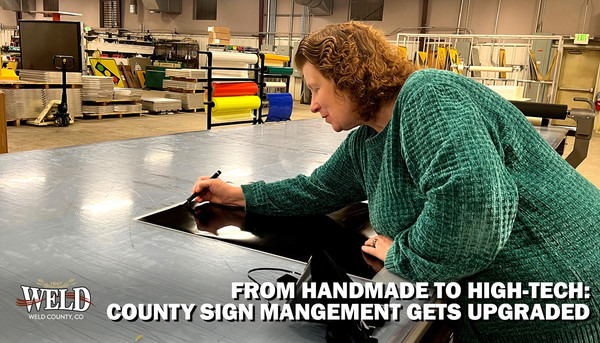
If looking for an adjective to describe the process of creating and maintaining road signs throughout a county stretching just over 4,000 square miles, simple wouldn’t be one to use, even if Weld County Public Works Sign Technician Becky Turner makes it look that way.
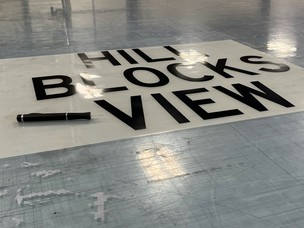
For the past 16 years, Turner has spent her days in Public Works’ sign shop making Weld County road signs with manual labor and artist-like precision. First, she attaches the appropriate background to a blank sign — think red for stop signs or white for speed limit signs. Then, after printing the desired wording or numbering for a sign from a computer, Turner pokes it out of thin, black material and has the meticulous task of making sure the letters or numbers don’t stick to one another, get placed crooked or become rippled during installation onto the sign’s background — if either occurs, she’ll most likely have to start the whole process over.
Ask Turner and her supervisor Kevin Hettinger, and they would call the task just an average day’s work. There is renewed excitement, however, when discussing a new digital sign printer the shop received in late March. The quicker, more cost-effective process the new printer provides is expected to create cost-savings for taxpayers and better road signs, which will enhance traffic safety.
“The process we have now is effective, but there are many benefits to this new printer,” said Hettinger, who oversees the Maintenance Support Division for the Weld County Department of Public Works. “It allows us to save on material and labor costs, and I believe it will produce a sign with better reflectivity and quality.”
To understand why Public Works is looking to enhance its sign making process, it’s necessary to understand the challenge that faces Turner and the 12 to 15 employees who work within the maintenance support division every year. While Turner primarily makes the signs, her co-workers focus on many other tasks that enhance county roads. Several are tasked with monitoring the county’s 10,000 sign locations, reporting each week on a portion of those signs’ conditions and sending those reports back to Hettinger and Turner for evaluation. Ten thousand sign locations may seem like a lot, however, the actual number of signs the county is responsible for maintaining is likely far greater. For example, one sign location could feature a stop sign with four or five additional signs attached to it, such as a county road sign or two-way or four-way marker. While the specific number changes yearly, Public Works is aiming to replace 1,900 signs this year due to fading from sunlight or weather or because of vandalism or theft.
It's a process that can be time consuming and expensive given the amount of labor and material involved, which is why there is excitement around the new technology. The printer will eliminate the possibility of mistakes that come from placing lettering on a background by hand by instead printing signage to the exact specifications needed, allowing a finished background to quickly be attached to a blank sign. There will be no need for the long sheets of thin, black material Turner pokes lettering out of — much of which is excess and has to be thrown away — or other costs associated with supplies like ink or adhesive tape. Currently, with materials, the average cost to make a new sign is $126.10, meaning that if Public Works hits its intended target of replacing 1,900 signs this year, more than $225,000 will be spent on sign repair. With the new printer, Public Works anticipates saving $30,000 per year.
|
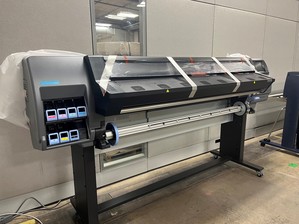
“We aim to get 12 to 15 years of life out of a sign before it needs replaced, so we really ask people to respect them and not to vandalize or steal them,” said Curtis Hall, Director of Weld County’s Department of Public Works. “Not only does it create a safety issue for first responders and commuters, but it costs taxpayers to replace them. However, adding more technology to our process enhances our ability to replace a sign more quickly and produce a better end product.”
It's not just the ability to produce signs at a greater speed and a lower cost that has Public Works excited. It’s also the possibility it provides maintenance support to enhance its overall contributions to projects. In addition to making, monitoring and replacing road signs, those who work in the division are involved in many different elements of road construction. Crews stripe pavement, maintain and repair county snow fences, and set road closed signs for county crews maintaining other county assets. Often, those projects involve sign maintenance, and having a high-tech tool to assist with that process will mean being able to fully complete many projects sooner rather than later.
“This printer will allow us to better align our signing needs with other construction,” Hettinger said, explaining that although a new sign isn’t always needed, if one is, it can be made and installed more quickly than before, which can be a final step in a project. “It better aligns our overall processes in terms of making roads safer.”
Aside from greater efficiency, the printer is also expected to have an impact in making signs that are more resilient, meaning barring vandalism or theft, signs will reach their anticipated lifespan. A laminator accompanying the printer will make new signs laminated, offering greater protection against wear from sunlight or weather.
|
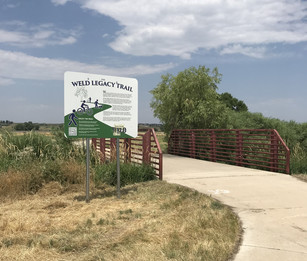
New technology will also allow the sign shop to do more designs in- house, a need identified shortly after the Weld Legacy Trail, located at Weld County’s Southwest Services Complex in Firestone, opened in 2021.
“The sign near the trail had so many colors, layers and a QR Code, that there was no way we could make it, and there are more and more signs like that one,” Hettinger said.
Signs too complex for the sign shop have to be printed by an outside company at an additional cost, a problem that could soon be eliminated.
“With this new printer, we should be able to make anything,” Hettinger said.
Even with the new technology, it’s not as though the human element of sign making will be eliminated completely. There will no doubt be a learning curve that Turner will have to adapt to as she learns what the new printer can do. But because the process is simpler, it will be easier to train others in the process, giving staff more skills and making the division an even stronger asset.
All the features mentioned above are exciting, but they’re not what Turner is most looking forward to. She remains most eager about what she’s done for the past 16 years — making the best product possible for the traveling public.
“In order for our department to better itself and continue replacing the number of signs we need to, we need this to be able to get the signs produced faster than we’re doing it now,” Turner said. “To have something that will allow us to make a better sign, without having to worry so much about fading and cracking, that’s what I’m excited about.”
|
By Baker Geist, Weld County Communications Specialist
|
|
Public Works aims to replace 1,900 county road signs this year (1,200 due to aging, and 700 due to vandalism or theft). |
|
The new digital printer, plotter and laminator was purchased by Public Works with the approval of the Weld County Board of Commissioners on March 15 for $34,663.05. |
|
Every new sign is designed to last 12 to 15 years before replacement is needed. |
|
When Maj. Stephen H. Long traveled to this area in 1821, 40 years prior to it being established as Weld County, he reportedly said the region was not fit for human habitation and should forever be used by native hunters, bison and jackals. Just over 200 years later, Weld County is bustling with growth while still being tied to the land’s rich agricultural roots.
Find out more about the history of Weld County by visiting https://history.weldgov.com.
|
|
|

In the next installment of our County Government 101 series, we introduce Weld County's public safety superheroes and the many departments who have a direct impact on public safety.
|
|
|
|
Welcome to County Roots, the official newsletter of Weld County Government. For those of us who work in county government, we think what we do is pretty interesting. So the goal of this newsletter is to highlight some of the partnerships, technology and efficiencies we are using to make government stronger and more effective for its residents.
Our goal is to establish regular communication with residents, spur interest in county projects, highlight county accomplishments and provide meaningful information to the public. In fact, our goal is to live up to the name “County Roots.” Want to know more about the meaning behind the name? Please visit our webpage, where you can also find previous editions of this newsletter.
If you have a topic idea or general feedback about this new venture, please let us know at jfinch@weldgov.com.
|
|
|
|
|