|
As Weld County Senior Emergency Management Coordinator Dave Burns spreads a training schedule across the table loaded with different courses throughout the year, it becomes apparent just how big of a role Weld County’s Office of Emergency Management (OEM) has in helping the county as a whole prepare for emergencies.
“Yeah, it’s a lot,” he said, as he breaks down the training the office attends or administers annually to 26 fire districts, 14 law enforcement agencies and 32 municipalities located throughout Weld County.
A few minutes later, he adds up the total number of hours OEM will spend either attending or administering trainings this year — 600. It’s a number that draws little more than a smirk from Burns as the commitment to training and emergency preparation is year-round for the staff of five. Knowledge gained and shared, the opportunity to learn about different hurdles facing different entities in response and establishing relationships is critical to emergency response.
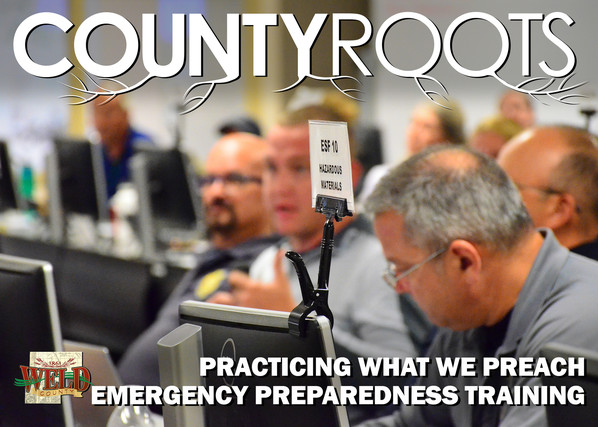
However, when a flood, tornado or pandemic impacts a county stretching nearly 4,000 square miles, OEM doesn’t act alone. County employees across many different departments work around normal job duties assisting with response and recovery, something that often involves working with the Board of County Commissioners, municipal and nonprofit representatives. And to be sure a real-life response effort assists residents by mitigating the impact of an event, there’s no substitute for practice — something received by participating in a full-scale emergency response to cap off a four-day Whole Community Immersion Training held September 27-30.
“We’ve just received a call about a train derailment and hazmat spill near LaSalle,” Weld County Emergency Management Coordinator Denise Bradshaw announced, causing the county’s Emergency Operations Center (EOC) to activate. Just as calls came in providing more information, someone interrupted with another situation.
“We have reports of a bus crash at Highway 119 and I-25!” Each emergency announced — there were four in total — was met by county staff, municipal and state representatives working alongside one another to quickly respond to the fictional events. Hazardous material teams role-played different scenarios in north and south Weld County, the Carbon Valley EOC was activated, and Weld County Public Information Officers worked with others throughout the county to disseminate information to the public, just as they would in a real event.
“What we’re really trying to do is gauge the county’s capability to respond to emergency events,” Burns said, explaining that the exercise goes a long way in identifying the strengths and weaknesses of trainings OEM conducts with municipalities in hopes of ensuring everyone is better prepared for a real-life event.
The full-scale exercise was preceded by three days of classroom instruction from county, state and municipal experts as well as representatives from The Blue Cell LLC. Courses emphasized the importance of situational awareness, effective communication, refreshers on how the EOC should operate, tips to remember during hazmat response and more. Beyond leading a few classes, Todd Manns, owner of The Blue Cell LLC., was sure to commend Weld County for its consistent commitment to training; a commitment he said that's not commonly found everywhere.
“Weld County is the most progressive in regard to training. Among our customers at Blue Cell, we count about 800 different counties in the United States, and Weld County’s in the top five for being proactive in training. And when it comes to the preparedness of elected officials, Weld County is number one,” Manns said, explaining how their familiarity with the different agencies in emergency response can greatly reduce the impact of an incident. “It’s a huge advantage.”
Regardless if an employee has had this training many times before or participates in their first one, Weld County Commissioner Chair Steve Moreno said the experience is invaluable to helping employees make county government even more responsive to residents when they need it most.
“It’s not a matter of if Weld County will be faced with an emergency, but when. These trainings allow our employees to gain new skills they can use to serve residents in more critical ways,” Moreno said. “It also ensures that we have the best processes and procedures in place to be able to quickly mitigate the impact of an emergency on our county. And because every emergency is different, we rely on these types of trainings to make sure we’re prepared to respond in the best manner possible.”
The investment into training has paid off many times in Weld County’s history and was noticed by Weld County Commissioner Mike Freeman early on in his first term when heavy rainfall resulted in the 2013 flood. Freeman said the coordination between department supervisors and county departments like Public Works to quickly reopen more than 100 closed roads spoke to the importance of effective emergency response as well as the strength of Weld County Government.
“While [the flood] resulted in tremendous property damage, there were no deaths,” Freeman said. “I was so impressed with employees across Weld County; how dedicated they were and how knowledgeable and really qualified they were to guide us through something like that.”
The impact of continued training was seen again last year during Weld County’s COVID-19 response. For 135 days from mid-March to September, county staff worked to coordinate different elements of the COVID-19 response.
With the Whole Community Immersion Training now over, much work will be done to determine what can go better. While OEM discusses how to implement those improvements in the future, the takeaway for residents is much simpler and more impactful: Weld County Government and its municipal, state and nonprofit partners remain committed to being at their best during emergencies.
By Baker Geist, Weld County Communications Specialist
|