Weld County Area Agency on Aging Summer 2021 Newsletter

AAANewsletter


Summer 2021


In this issue: Veteran Excavates Dream, Top 10 Financial Scams for Older Adults, Stroke Awareness, Weld Aging Well Workshops, Friendly Fork Summer Menu, The New Nutrition Label 


Air Force Veteran Excavates Lifelong Dream

VETERAN

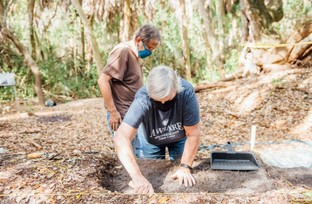
What started as an innocent backyard exploration dig one day after school, turned into a passion for all things buried underground for Pat. The 71-year-old Air Force veteran has been intrigued by the history that lies beneath Earth’s surface since she was a little girl. After serving 22 dedicated years in the Air Force and raising four kids on her own, Pat’s lifelong wish was granted. Through the Denver-based organization Wish of a Lifetime from AARP, she was able to participate in a five-day archeological dig at Weedon Island Preserve, one of Florida’s most fascinating active archaeological sites. Pat joked, “Well, if a 70-year-old can do something that their 18-year-old self wanted, I think that would be inspiring to anybody…I think this would inspire people to see that they can do things out of the ordinary, even in old age.”


Inspiring generations through captivating stories like Pat’s is what Wish of a Lifetime from AARP does best. As a charitable affiliate of AARP, we grant life enriching wishes to individuals 65 and older across the country. Through granting these unique and personal wishes, our vision is to not only improve the lives of Wish Recipients, but to embrace aging and share the inherent wisdom that comes with it. The wishes are experiential in nature, bettering lives through meaningful experiences. Our Wish Recipients report that they are happier, healthier, and feel more involved in the world after having a wish granted. We connect seniors with people, purpose and passions to eliminate their feelings of isolation and help them live both vibrant and meaningful lives.


Do you or someone you know have a wish that would be life changing? We are granting wishes thoughtfully and safely during the current pandemic and are eager to continue telling empowering stories. Visit www.wishofalifetime.org to learn more about our organization and to submit your Wish of a Lifetime. If you have any questions, please contact Shannon Hollis at shannon.hollis@wishofalifetime.org.


Top 10 Financial Scams Targeting Older Adults

Scam

National Council on Aging


Financial scams targeting the elderly can be devastating, leaving older adults in a vulnerable position and without time to recoup their losses. The FBI has estimated that older adults lose more than $3 billion each year to financial scams.


It’s not just wealthy seniors who are targeted. Low-income older adults are also at risk of financial abuse. And it's not always strangers who perpetrate these crimes but often is the older person’s own family members, like their adult children, grandchildren, nieces, and nephews.


Financial scams are considered a “low-risk” crime because they often go unreported or are difficult to prosecute. However, they're tragic to many older adults and can leave them in dire straights financially.


Learn to protect yourself and your loved ones from financial fraud. Listed are the top 10 most prominent scams:


1.Government impostor scams

Government impostors call unsuspecting victims and pretend to be from the Internal Revenue Service (IRS), Social Security Administration, or Medicare. They may say you have unpaid taxes and threaten arrest or deportation if you don’t pay up immediately. Or they may say your Social Security or Medicare benefits are in danger of being cut off if you don’t provide personal identifying information (that can then be used to commit fraud). Government impersonators often “spoof” the actual phone numbers of the government agency, or call from the same zip code (970 for Weld County, for example).


2.The grandparent scam

Scammers will place a call to an older person and say something along the lines of: “Hi Grandma, do you know who this is?” When the unsuspecting grandparent guesses the name of the grandchild the scammer most sounds like, the scammer has established a fake identity without having done any background research. Once “in,” the fake grandchild will ask for money to solve some unexpected financial problem (overdue rent, car repairs, jail bond) and will beg the grandparent not to tell anyone. Because scammers ask to be paid via gift cards or money transfer, which don’t always require identification to collect, the senior may have no way of seeing that money ever again.


3.Medicare/health insurance scams

Every U.S. citizen or permanent resident over age 65 qualifies for Medicare, so there is rarely any need for a scam artist to research what private health insurance company older people have in order to scam them out of money. In these types of scams, perpetrators may pose as a Medicare representative to get older people to give them their personal information, or they will provide bogus services for elderly people at makeshift mobile clinics, then bill Medicare and pocket the money. Medicare scams often follow the latest trends in medical research, such as genetic testing fraud and COVID-19 vaccines.


4.Computer tech support scams

Computer technical support scams prey on people’s lack of knowledge about computers and cybersecurity. A pop-up message or blank screen usually appears on a computer or phone, telling you that your device is compromised and needs fixing. When you call the support number for help, the scammer may either request remote access to your computer and/or that you pay a fee to have it repaired. The Federal Trade Commission (FTC) found that seniors who fell for this scam lost an average of $500 each to computer tech support scams in 2018.


5.Sweepstakes & lottery scams

Here, scammers inform their mark that they have won a lottery or sweepstakes of some kind and need to make some sort of payment to unlock the supposed prize. Often, seniors will be sent a check that they can deposit in their bank account, knowing that while it shows up in their account immediately, it will take a few days before the (fake) check is rejected. During that time, the criminals will quickly collect money for supposed fees or taxes on the prize, which they pocket while the victim has the “prize money” removed from his or her account as soon as the check bounces.


6.Robocalls/phone scams

Robocalls take advantage of sophisticated phone technology to dial large numbers of households from anywhere in the world. Robocallers use a variety of tactics to cheat their victims. Some may claim that a warranty is expiring on their car/electronic product and payment is needed to renew it. One popular robocall is the “Can you hear me?” call, where when the senior says yes, the scammer hangs up after recording their voice, thus obtaining a voice signature to authorize unwanted charges on items like stolen credit cards.


7.Romance scams

As more people use the Internet for dating, con artists see an opportunity to find their next victim. Romance scammers create elaborate fake profiles, often on social media, and exploit seniors’ loneliness for money. In some cases, romance scammers may (or pretend to) be overseas, and request money to pay for visas, medical emergencies, and travel expenses to come visit the U.S. Because they drag on for a long time, romance scammers can get a lot of money from a senior—the FTC found that in 2019 alone, seniors lost nearly $84 million to romance scams.


8.Internet and email fraud

While using the Internet is a great skill at any age, the slower speed of adoption among some older people makes them easier targets for automated Internet scams that are ubiquitous on the web and email programs. Pop-up browser windows simulating virus-scanning software will fool victims into either downloading a fake anti-virus program (at a substantial cost) or an actual virus that will open whatever information is on the user’s computer to scammers. Their unfamiliarity with the less visible aspects of browsing the web (firewalls and built-in virus protection, for example) make seniors especially susceptible to such traps. Phishing emails and text messages may look like they’re from a company you know or trust. They may look like statements from a bank, a credit card company, or an online store. Phishing emails request your personal information, such as a log-in or Social Security number to verify your account or ask that you update your credit card payment. Then they use that information to steal your personal and financial information.


9.Elder financial abuse

Unlike many of the other scams, elder financial abuse is carried out by someone a senior knows. This can be a family member, friend, power of attorney, or caregiver. These trusted individuals try and gain control of a senior’s money, assets, and credit. They also may withhold needed care to retain control over the person and their assets. Seniors who have a disability or cognitive impairment (such as dementia) may be at particular risk.


10.Charity scams

Charity scams rely on seniors’ goodwill to pocket money they claim they’re raising for a good cause. Some scammers may use a name like a legitimate charity. They often capitalize on current events, such as natural disasters, and may set up a fundraising page, which don’t always have the means to investigate fraud. Charity scammers may insist you donate immediately, sometimes with a payment method that should be a red flag—e.g., gift cards or money transfer.


If you think you have been the victim of a scam, don’t be afraid or embarrassed to talk about it with someone you trust. You are not alone, and there are people who can help. Doing nothing could only make it worse. Keep handy the phone numbers and resources you can turn to, including the local police, your bank (if money has been taken from your accounts), and Adult Protective Services.


Weld County Adult Protective Services: (970) 346-7676


Stroke Awareness

Stroke.2

By: Brenda Tousley, DNP, ACCNS-AG, AGCNS-BC, ASC-BC, CCRN-K, CLNC

Tiffany Rogers, BSN, RN, CEN


When a stroke happens, it can be devastating. Anyone can be affected by a stroke. Although more common in people over 65 years old, strokes can occur at any age. In the most recently published Weld County data, strokes are the fifth leading cause of disability and death.


Knowing your risk factors is the first step in preventing a stroke. Risk factors include high blood pressure, high cholesterol levels, diabetes, atrial fibrillation (abnormal heart rhythm) and many more. A healthy lifestyle and managing your risk factors can help prevent stroke.


When symptoms occur, they are sudden and without warning. A person may be normal one moment and unable to speak or move the next. When this happens, it can be terrifying. Recognizing a stroke and getting your loved one the care they need is vital to saving their life and provides the best chance for recovery. Rapid recognition and calling 911 are the first steps in the chain of survival for anyone experiencing stroke.  Getting to the emergency room allows for the skilled ER team to intervene and provide treatments that can reduce disability in patients that qualify. 


Remember, BE FAST because TIME IS BRAIN! 

B - balance/dizzy/unsteady gait

E - eyes/vision changes


F - face, one side of the face droop

A - arms/legs, weakness or unable to move

S - speech, not able to talk or make sense

T - time, call 911 and get medical care quickly. 


Research shows that stroke care at a facility that specializes in stroke treatment provides the best outcomes for patients. North Colorado Medical Center’s quality of care meets the unique and specialized needs for all types of stroke patients from the Greeley community and surrounding areas. NCMC’s commitment to the Greeley community starts before patients even arrive at our facility through community education. 


Join the Stroke Program Manager from NCMC’s Primary Stroke Center for a virtual class on June 16 from 10:00-11:30 that explains about strokes, how to recognize them, and what to do when they occur. Register by calling 970.400.6117 or email wjanzenpankratz@weldgov.com


Caregiver Appreciation Day

Caregiver

In light of the global pandemic, the Weld County Caregiver Appreciation Day, a day to honor family caregivers caring for an aging loved one, has been postponed until 2022. Stay tuned for more information regarding this in-person event later this year.


On behalf of the caregiver committee, we would like to express our gratitude to area caregivers who graciously give and sacrifice so much as they provide the best possible care to their loved one.


We see you and appreciate you!

Caregiver Shout

Weld Aging Well Summer Workshops

Age Well

Make your wellness a priority and join us for one of these evidence-based workshops!


Healthier Living Workshop:

Learn tools to become a better self-manager of your chronic condition(s) like heart disease, diabetes, arthritis, COPD, etc. Learn to apply the knowledge you already know such as proper nutrition, developing an exercise program, problem-solving, and setting achievable goals. Meet once a week for six weeks. FREE for those 60 years or older, but registration is required by calling 970-400-6117 or

email wjanzen-pankratz@weldgov.com. Offered in partnership with UCHealth Aspen Club.

Thursdays, 6/10/21 to 7/15/21 from 9:00 – 11:30 am: Windsor Recreation Center, Windsor


Powerful Tools for Caregivers Workshop:

If you are caring for a loved one at home, this workshop will help you learn to reduce stress, guilt, and anger. You will practice relaxation technique, set goals, and problem-solve. Workshop meets once a week for six weeks. FREE but registration is required by calling 970-400-6117 or email wjanzen-pankratz@weldgov.com.


Mondays, 7/12/21 to 8/16/21 from 1:00 – 3:00 pm: North Colorado Medical Center, Greeley


Aging Mastery Program

Build your own personal playbook for aging well. This fun, innovative program empowers you to take key steps to improve your well-being, add stability to your life and strengthen ties to your community. Self-Guided toolkits with weekly check-in calls from Whitney, Wellness Coordinator for the Weld Aging Well Program through the Area Agency on Aging. FREE for people 60 and older. Registration is required by calling 970-400-6117 or

email wjanzen-pankratz@weldgov.com. Offered in partnership with UCHealth Aspen Club.


Tuesdays, 7/13/21-9/14/21 from 10:00-11:30 am: Greeley Medical Clinic, Greeley


A Matter of Balance Workshop

Learn ways to reduce the fear of falling and break the fear of falling cycle. A variety of activities address physical, social, and cognitive factors affecting fear of falling by focusing on practical coping strategies. Workshop meets once a week for eight weeks.

FREE but registration is required by calling 970-400-6117 or email 

wjanzen-pankratz@weldgov.com.  


Tuesdays, 8/3/21 to 9/21/21 from 1:00-3:00 pm: Carbon Valley Parks & Recreation, Frederick


Friendly Fork Summer Evening Meals

Friendly Fork

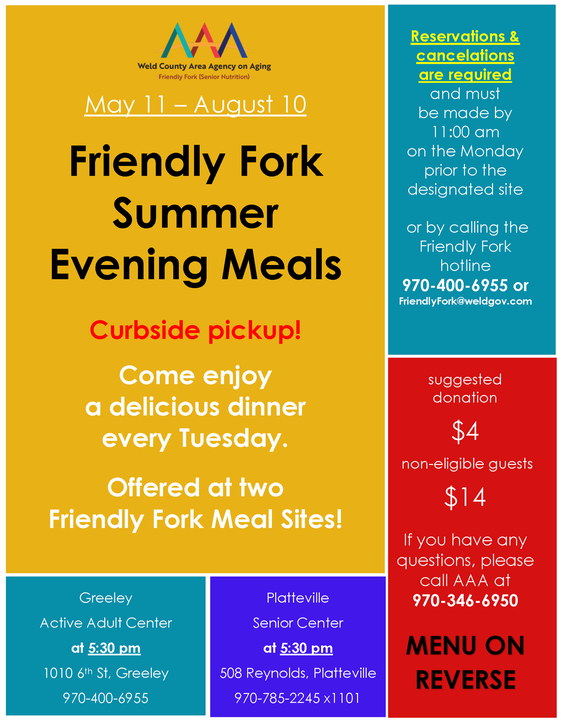
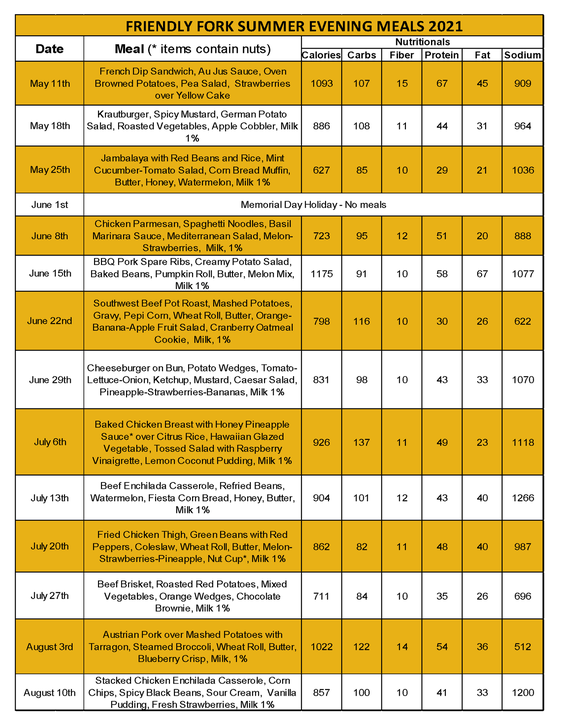
The Weld County Friendly Fork Senior Nutrition Program is hosting summer evening meals every Tuesday from May 11-August 10, 2021. Summer dinners are offered at the Greeley Active Adult Center and Platteville Senior Center at 5:30 p.m. Reservations and cancellations are required and must be made by 11:00 a.m. on the Monday prior to the designated meal site by calling (970) 400-6955 or FriendlyFork@weldgov.com.


Please refer to the flyer below for more information and weekly menu.

Friendly Fork 1Friendly Fork 2

The "New" Nutrition Label

Label2

Online video recording by

Lorrie Wellman, Friendly Fork RDN


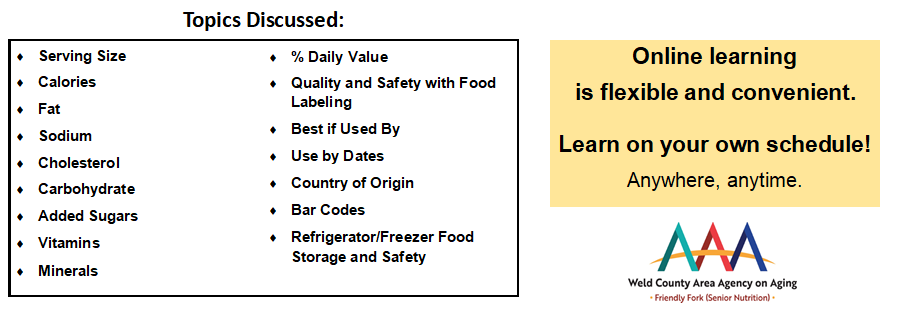
Learn about the newly revised nutrition label

that was implemented in 2020.Follow along with Lorrie Wellman’s video presentation. Link also includes educational material and a short quiz after the presentation.


To register, click the link below:

https://www.weldgov.com/Government/Departments/Human-Services/Area-Agency-on-Aging-AAA/Friendly-Fork/Education


Label3

Centennial


If you or someone you know is celebrating a 100th birthday, the Centennial Club of Weld County wants to know! The Centennial Club honors residents turning 100 years old or older with a proclamation by the Weld County Board of Commissioners at a livestreamed board meeting, as well as recognition on our social media channels. All you have to do is fill out the questionnaire on our Area Agency on Aging webpage, www.weldaaa.org.


We can’t wait to celebrate with you!