|
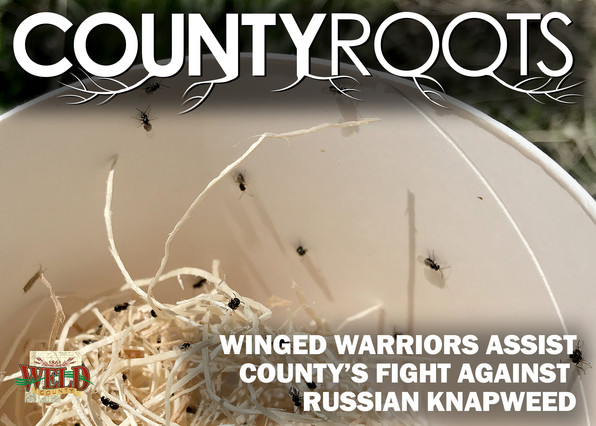
The Weld County Weed Division is utilizing some tiny new team members to help suppress the growth of Russian Knapweed - and they are only 1.7 to 2.3 millimeters long.
They’re the Gall Wasp, and the Weld County Weed Division is hoping they can become a new tool in helping suppress a noxious weed that is toxic to horses and commonly found in the southwestern part of the county.
Using biological processes to kill weeds isn't new to the Weed Division. In the '90s the Flea Beetle was used to help reduce the growth of Leafy Spurge. Mites have also been used against Field Bindweed. The use of wasps, however, is a new experiment.
The Weld County Weed Division was established in the '90s after Colorado voters decided noxious weed control on county roadways and property should shift from being the responsibility of taxing districts and become a countywide program (although a few counties still operate using taxing districts). The Weed Division also provides landowners with education and treatment options they can use to keep their properties free of noxious weeds.
“This was the very first release of the wasps, as we’re looking to establish colonies in Colorado,” Weld County Weed Division Supervisor Tina Booton said. “Spraying the weed is still encouraged, but if the biocontrol can be out there working, then it gives us another line of defense.”
After being contacted in the winter of 2018 by the Colorado Department of Agriculture and agreeing to test the wasps’ effectiveness, Booton spent weeks looking for a willing landowner with enough Russian Knapweed — at least an eighth of an acre — who would agree to let the wasps feed on the plant.
In early May 2019, the wasps arrived at the Weed Division on the back of a FedEx truck in a chilled cooler. Booton and Weed Division Landowner Specialist Kent Lynch unboxed the wasps and then spent half an hour releasing 800 wasps on Russian Knapweed.
Russian Knapweed, like all noxious weeds, is nonnative to the U.S. and Colorado. Therefore, in some cases, the biological treatments used are nonnative as well. Russian Knapweed growth originated in central Asia, and the specific type of Gall Wasp brought to Weld County originated from Turkey. Tests conducted by the U.S. Department of Agriculture in the Asian countries of Uzbekistan and Turkey, as well as plant tests conducted in Wyoming, showed the wasps were only attracted to Russian Knapweed. They’re far more delicate than other types of wasps — about the size of a small flying ant — and aren’t a threat to animals or people. As adults, they live for five days meaning the majority of their one to two-year lifecycle is spent as larvae attached to the plant in a small sack known as a gall.
“The gall limits the knapweed’s normal growth characteristics of flowering and putting nutrients into the roots,” Booton explained.
Booton also said the Gall Wasps don’t share the same stinging ability as the more familiar Yellow Jacket Wasp, in part because of their delicate size and different characteristics.
“These are parasitic wasps, and there are quite a few out there,” Booton said, explaining that dairies use parasitic wasps to control the fly population around cattle. “These ones just happen to go after plants.”
Booton wants to see if enough wasps will procreate and form new galls. If so, Booton and her staff can relocate the wasps to other areas where Russian Knapweed growth is a concern. The effectiveness of the Gall Wasps will be judged by comparing before and after growth statistics and by the appearance of more native grasses.
Booton believes chemical treatments will always be the most effective treatment to suppress Russian Knapweed but also said the use of Gall Wasps could potentially reduce the amount of chemical homeowners need to use to limit weed growth.
“It’s pretty cool,” Booton said of the Gall Wasp experiment. “Just the possibility and the hope that something new is going to help us in the fight against noxious weeds. We’re trying to find answers for landowners. We know about chemical and mowing treatments, and we’ll see if this does or doesn’t work.”
FIRST RELEASE OF WASPS SUCCESSUL
The Gall Wasps released by Keenesburg have successfully formed galls. The Weed Division will work over the next couple of years to increase the number of Gall Wasps. If the numbers increase, Booton will work to find another landowner willing to let the wasps feed on Russian Knapweed. Then, either the U.S. Department of Agriculture’s insectary or the Weed Division will hatch the galls and spread the wasps. For now, Weed Division staff will monitor this first batch to see how effective the wasps are in reducing the growth of Russian Knapweed.
By Baker Geist, Weld County Communications Specialist
|