|
Colorado Public Utilities Commission (PUC) |
|
PUC March 2025 Newsletter |
|
Commission Updates
PUC Adopts Rules for Utility Participation in Markets
The PUC Commissioners adopted rules on Aug. 22 regarding electric utility participation in an organized wholesale market, such as a day-ahead market (for example, SPP Markets+) or a full Regional Transmission Organization (for example, SPP RTO West). The rulemaking in Proceeding No. 22R-0249E was prompted by Senate Bill 21-072 which requires Colorado electric utilities to join an RTO by Jan. 1, 2030, or otherwise seek a waiver from that requirement from the PUC.
SB21-072 sets forth several specific characteristics for an RTO that a utility will join. The new rules also address greenhouse gas tracking and accounting systems as well as other features of the wholesale markets. The rules also seek detailed modeling to show the benefits of joining the market, such as production cost decreases, reliability improvements, and emission reductions.
New Xcel Energy Time of Use Rates Announced, Proceeding No. 24AL-0377E
The PUC finalized deliberations on Xcel Energy’s Time of Use (TOU) rate proposal on Feb. 19, 2025. TOU rates, which vary electricity costs based on demand, will be the default for residential customers, though an opt-out for a flat rate is available.
Most customers will see little to no bill increase, even if they make no changes in energy use patterns, and long-term savings are expected as reduced peak demand lowers infrastructure costs. However, consumers that do choose to make minor adjustments (e.g. using high energy appliances during off-peak times) may see immediate bill savings.
New TOU rates will take effect no earlier than October 2025, allowing time for consumer education. New TOU Periods:
- On-Peak: 5 PM – 9 PM on non-holiday weekdays, year-round
- Off-Peak: All other hours
Customers who prefer a consistent rate can opt for a flat-rate plan. Xcel Energy will provide an online calculator for bill comparisons and an opt-out option via the “my-account” portal.
Read the Press Release.
Visit the Time of Use Proceedings page.
Black Hills Colorado Electric Proposed Rate Increase, Proceeding No. 24AL-0275E
On June 14, 2024 Black Hills Colorado Electric requested a rate increase for its electric service in Colorado. In their filing Black Hills stated that an increase in annual revenue of approximately $25 million is necessary to cover the rising cost of operating and maintaining its electric system in Southern Colorado. This includes the cost of equipment like poles, wires, and transformers, as well as competitive pay and benefits for local employees
The PUC held four public comment hearings in the Fall on the proposed rate increase, including two in Pueblo, one in Canon City, and a virtual meeting in early December.
On Mar. 12 the Commission concluded its deliberations on the Black Hill Electric Rate Case proposal, a significant and complex proceeding, which required the Commission to make dozens of separate decisions across a range of issues. The Commission approved a $17 million revenue increase, resulting in an average monthly bill increase of $7.40 for residential consumers. The bills of small commercial customers will also go up by about $17.50 a month. The new rates went into effect on March 22, 2025. Parties to this proceeding have until April 7 to request that the Commission revisit this decision, which is known as a Request for Reconsideration, Reargument, or Rehearing.
See the release about the decision related to the Black Hills Electric Rate Case
See the frequently asked questions related to this decision.
Understanding Xcel Energy's Virtual Power Plant Program, Proceeding No. 25A-0061E
On Jan. 31, Xcel Energy took a significant step toward modernizing Colorado’s energy grid by seeking approval for its Aggregator Virtual Power Plant (AVPP) program. With a proposed budget of approximately $79 million over five years, the program aims to enroll about 125 megawatts (MW) of new AVPP resources during that period. This initiative aligns with Senate Bill 24-218, which promotes competitive aggregation of energy resources. The Commissioners are considering whether to consolidate this VPP proceeding with Xcel’s 2025-29 Distribution System Plan (Proceeding 24A-0547E).
What is a Virtual Power Plant (VPP)?
A Virtual Power Plant (VPP) is a network of decentralized energy resources—such as residential solar panels, battery storage systems, and demand response programs—that are aggregated and managed as a single entity. Unlike traditional power plants that rely on centralized infrastructure, VPPs leverage digital technology and real-time data to balance supply and demand efficiently. By pooling smaller energy sources, VPPs can provide grid reliability, enhance renewable energy integration, and reduce the need for fossil fuel-based power generation.
How Xcel Energy’s AVPP Works
Xcel Energy’s AVPP program seeks to aggregate distributed energy resources (DERs) across its service territory. The initiative allows third-party aggregators to enroll participants, who contribute their distributed energy assets—such as home battery systems or smart thermostats—into the program. These resources are then managed collectively to optimize grid performance, particularly during peak demand periods.
Key elements of the AVPP program include:
- Competitive Aggregation: The program aligns with Senate Bill 24-218, ensuring that third-party aggregators can competitively bid to provide energy capacity.
- Grid Flexibility: By utilizing distributed resources, Xcel Energy can enhance grid reliability without building new power plants.
- Consumer Participation: Customers with eligible DERs can enroll, potentially receiving financial incentives for their contributions to grid stability.
- Decarbonization Efforts: The AVPP helps integrate more renewable energy sources, reducing reliance on traditional fossil fuel generation.
|
|
First Meeting of the Incarcerated People's Communication Services (IPCS) Stakeholder Task Force
On Feb. 11, the IPCS program team held the first meeting of the IPCS Stakeholder Task Force. Led by Telecom Programs Section Chief Daryl Branson, with support from team members Royal Cameron and Clarence Wallace, the meeting aimed to bring together key groups—including service providers, facility operators, and advocacy organizations.
The goal of these meetings is to identify challenges and explore solutions to improve communication services for incarcerated individuals and their families. The first meeting had strong attendance from all stakeholder groups, and participants agreed to continue meeting quarterly.
The overall role of the PUC is based on SB21-120, which was later updated as SB 23-1133. It established the IPCS program within the PUC in order to ensure free and quality communication access to incarcerated peoples.
What are Gas Cost Adjustments?
Wholesale natural gas prices were deregulated by the federal government in the 1980s and 1990s. Neither the Public Utilities Commission nor the regulated gas utilities have control over wholesale gas prices. Utilities obtain their gas supplies in this unregulated market and pass these costs on to their customers on a dollar-for-dollar basis. Because this is an international market, prices are influenced by both regional (large storms) and global (wars and conflict) events.
Because the price of natural gas is market-driven and potentially volatile, Commission Rules require Colorado’s regulated gas utilities to adjust retail gas prices on a quarterly or semi-annual basis to reflect changes in wholesale prices. These changes are called the “gas cost adjustment” (GCA) and must be approved by the PUC. Although quarterly adjustments are the most common, all utilities are allowed to adjust prices more frequently when unexpected changes occur – such as a sharp spike in wholesale natural gas prices.
In March of 2025 Xcel Energy filed a GCA for the second quarter of 2025. This GCA, which must be approved by the PUC, will affect gas rates starting April 1, 2025.
Learn more about What a Gas Cost Adjustment Means and What Changes Have Been Made to Protect Consumers.
The Importance of Using CO811: Safe Digging & Compliance
Before starting any excavation project, whether for construction, landscaping, or repairs, it is essential to contact CO811. This service ensures that underground utilities are properly marked, preventing costly and dangerous damage. Calling before you dig is not just a precaution—it’s the law.
When Is Hand Digging Required?
In some cases, mechanical excavation is prohibited, and hand digging must be used to protect buried utilities:
-
Within the Tolerance Zone: The area surrounding marked utilities where hand digging is required to prevent accidental strikes.
-
Potholing for Verification: Using hand tools to safely expose utilities before heavy machinery is used.
-
Near Critical Infrastructure: Gas lines, fiber optics, and electrical conduits require extra care to avoid hazardous incidents.
Stay Safe with Training
To further enhance excavation safety, professionals can take advantage of CGA’s Damage Prevention Training Courses, which cover safe digging practices, emergency protocols, and compliance regulations.
The Energy Assistance Data Dashboard
The PUC has launched a new, public Energy Assistance Data Dashboard web page that reports monthly data on energy assistance programs, that are called Energy Affordability Programs, or Percentage of Income Payment Programs (PIPP). Per Colorado PUC rules, investor-owned utilities (Xcel Energy, Black Hills Energy, Atmos Energy, and Colorado Natural Gas) are required to provide PIPP programs to income-qualified customers that are designed to limit a customer's electric and gas bills to a percentage of their income. The PIPP programs are funded through customers’ monthly bills.
The Energy Assistance Working Group that meets quarterly partnered over the 2023-2024 heating season to gather monthly data on the affordability program applications, enrollments, referral pathways, disconnections, and reconnections. This data collection effort resulted in a dashboard that is updated monthly to create accountability, provide transparency, and help see data trends to inform energy affordability program improvements.
|
|
PUC Requests Public Comment on Xcel Energy's Just Transition Solicitation
The Colorado Public Utilities Commission (PUC) invites community members to provide comments regarding Xcel Energy’s Just Transition Plan, Proceeding 24A-0442E. Xcel Energy filed for PUC approval of its 2024 “Just Transition Solicitation” (JTS) on Oct. 15, 2024. The JTS is Xcel Energy’s next Electric Resource Plan to address the acquisition of new utility resources to meet future electricity needs on its system.
The primary objectives of the JTS include fulfilling resource adequacy and providing reliable service; continuing progress on emissions reductions; and, delivering a just transition in communities where generation assets are retiring. Xcel Energy’s Unit 3 coal-fired facility in Pueblo will retire no later than Jan. 1, 2031, and coal-fired facilities in Craig and Hayden are set to retire in 2027 and 2028.
Pueblo In Person Public Comment Hearing:
- Who: Local community members and PUC Commission
- When: 4 - 6 PM, Thursday, April 17
- Where: Hoag Recital Hall, CSU-Pueblo Campus, 2200 Bonforte Blvd., Pueblo
- Services: Light refreshments and a children’s play area. ASL or Spanish interpretation services can be requested by contacting Holly Bise at 303-894-2024 or holly.bise@state.co.us by Thursday, April 3.
Hayden In Person Public Comment Hearing:
- Who: Local community members and PUC Commission
- When: 4 - 6 PM, Thursday, May 1
- Where: Hayden Community Center, 495 W. Jefferson Ave., Hayden
- Services: Light refreshments and a children’s play area. ASL or Spanish interpretation services can be requested by contacting Holly Bise at 303-894-2024 or holly.bise@state.co.us by Thursday, April 17.
Virtual Public Comment Hearing:
- Who: All community members, stakeholders and PUC Commission
- When: 11 AM - 1 PM, Monday, April 28
- Services: ASL or Spanish interpretation services can be requested by contacting Holly Bise at 303-894-2024 or holly.bise@state.co.us by Monday, April 14.
-
Register here
|
|
Xcel Energy Wildfire Mitigation Plan, Proceeding No. 24A-0296E
The PUC will host virtual public comment hearings on Xcel Energy’s Wildfire Mitigation Plan (WMP). The PUC invites community members to provide comments regarding the Company’s $1.9 billion plan for wildfire mitigation.
The Wildfire Mitigation Plan includes Xcel Energy’s proposed mitigation activities and investments, including targeted equipment inspections, repairs and replacements; expanded vegetation management; system protection enhancements; weather and wind modeling; practices related to public safety power shut-offs; and community and stakeholder outreach.
Wildfire Mitigation Plan Virtual Public Comment Hearings:
PUC Towing Task Force Seeks Members
The PUC’s Towing Task Force is responsible for making comprehensive recommendations to the PUC about maximum towing rates for nonconsensual tows and advising the PUC concerning investigations of overcharges made by towing carriers. The Task Force currently has two vacancies, including one for a member that represents communities that may be disproportionately affected by nonconsensual towing and for a member that is a representative for consumers of tow services, private property owners. The Towing Task Force meets quarterly and more information is available on the PUC website.
Anyone interested in applying to serve on the Towing Task Force can contact Hadija Abdirahman at hadija.abdirahman@state.co.us for more information. You can also apply to serve on the Task Force from the Governor's Office’s Boards and Commissions website.
|
|
Commission Calendar & Upcoming Events
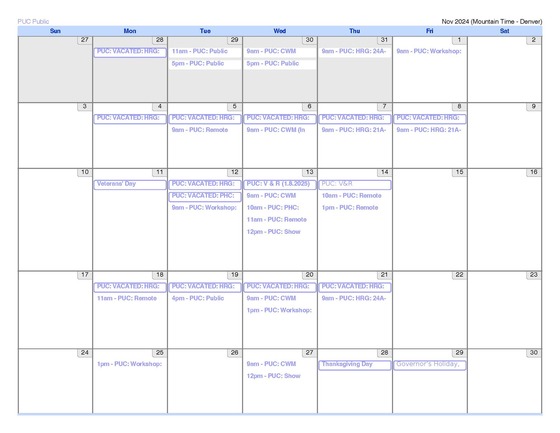
Please visit the PUC Calendar to learn about upcoming PUC events and hearings. Visit the PUC calendar.
 More Opportunities for Comment
Have something to say? Anyone can submit written or verbal public comments. Public comments should reference a proceeding number by:
- Submitting written comments through the Commission’s Electronic Filing System (E-Filings)
- Submitting written comments using the Commission’s online form.
- Submitting through email at dora_puc_website@state.co.us.
- Mailing comments to the Commission’s offices at: Colorado Public Utilities Commission, 1560 Broadway, Suite 250, Denver, CO 80202.
- Calling (303) 869-3490 to leave oral comments (English and Spanish options).
|
|
|
|
|