Healthy Rivers and Landscapes Program: Updates on Outreach and Planning
Winter/Spring 2026
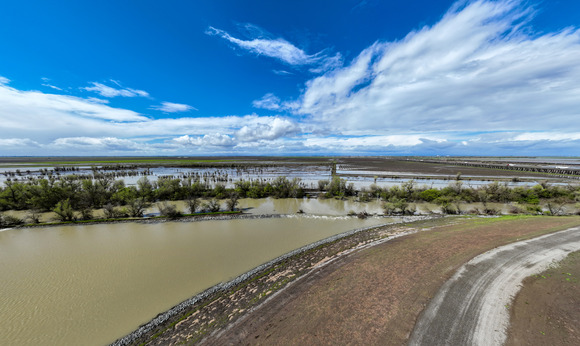 Lower Elkhorn Basin Levee Setback Project
The Healthy Rivers and Landscapes (HRL) Program continues to advance and plan for engagements with California Tribes. Recognizing the cultural and spiritual significance of the Bay-Delta watershed to Tribal communities, HRL parties are focused on providing meaningful engagement opportunities as the Program moves toward implementation.
Preliminary Outreach and Recommendations
In 2025, HRL parties undertook a primary outreach phase with Tribal entities and organizations. This initial work was designed to better understand Tribal perspectives regarding the watershed and to identify potential barriers to participation.
Based on the findings from this phase, several recommendations were provided to HRL leadership for consideration in future planning. These suggestions include exploring culturally appropriate engagement approaches, establishing formal structures to compensate Tribal representatives for their technical expertise, and considering a Tribal liaison to serve as a bridge between HRL leadership and Tribal communities.
Requirements for a Tribal Engagement Plan
As the State Water Resources Control Board works toward finalizing the Bay-Delta Plan, the HRL Program is preparing for its next steps. According to the Draft Bay-Delta Plan (released in December 2025), HRL parties will be required to develop a formal Tribal Engagement Plan in coordination with Tribes. This plan must be approved by the State Water Board’s Executive Director prior to the first year of the Program’s initial eight-year term.
As outlined in the Draft Bay-Delta Plan, the Tribal Engagement Plan for the HRL Program and associated Program requirements include:
-
The designation of a Tribal Coordinator: A designated individual who will be responsible for engaging with Tribes and liaising between HRL participants and the State Water Board on relevant Tribal matters.
-
Regular engagement meetings: The plan must include a schedule for regular meetings to inform Tribal leaders of progress toward Program objectives and provide opportunities for Tribal representatives to offer feedback on implementation and adaptive management.
-
HRL Target Setting: HRL participants are required to solicit input from California Tribes in the development of quantitative biological and ecological targets for the Program's supplemental science and monitoring efforts.
-
Incorporation of Traditional Ecological Knowledge (TEK): Annual reports submitted to the State Water Board must include a summary of outreach and describe how Tribal input, including TEK, is being incorporated into Program implementation.
Tribal Involvement in HRL Governance and Science
The HRL Program’s governance framework—approved for release in late 2024—outlines opportunities for Tribal involvement in Program oversight. Representatives from California Tribes are welcome members in the HRL Systemwide Governance Committee and the HRL Science Committee. TEK is a Best Available Science as identified in the 2023 California Water Plan Update and the inclusion of Tribal science in the implemental of the HRL Program is critical, which is further acknowledged in the Science Committee Charter.
HRL parties remain committed to working with Tribes that have an interest in the deployment of flow and habitat measures. By engaging Tribes with respect to decision-making and scientific evaluation, the HRL Program aims to improve the health of the watershed while acknowledging the historical and ongoing role of Tribes as stewards of these landscapes.
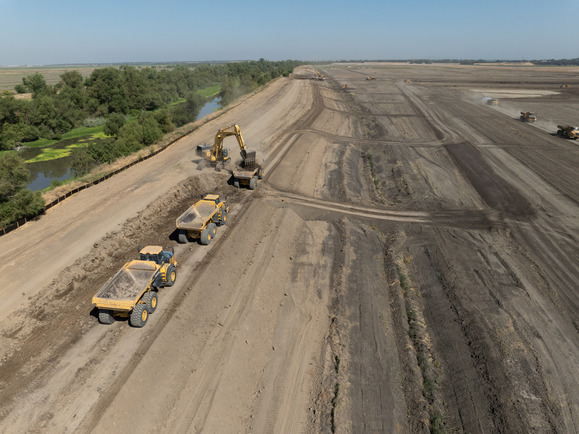 Lower Elkhorn Basin Levee Setback Project, part of the HRL Early Implementation portfolio
While the HRL awaits adoption of the Bay-Delta Water Quality Control Plan, the state and local agencies involved have successfully completed a comprehensive trial run that simulated the planning and decision processes, without deployment of water. Conducted throughout the spring of 2025, this simulation allowed participants to practice the coordination and accounting procedures required to deliver and protect environmental flows under real-time water conditions.
The exercise simulated the deployment of more than 600 TAF (Thousand Acre-Feet) of environmental water across 10 different sources, demonstrating the functional readiness of the HRL Program. A key success of the trial was testing of the Delta Accounting procedures, which will be used to track releases from upstream tributaries and ensure they are passed through the Delta as additional outflow.
Practicing Coordination
The 2025 trial involved the formation of a HRL Flow Operations Team (FOT)—a group including water agencies/purveyors, the Department of Water Resources, the U.S. Bureau of Reclamation, California Department of Fish and Wildlife, and the State Water Resources Control Board. The FOT met weekly from April through June to practice deploying Flow Measures as hydrology changed in real-time.
Using a "look ahead/look back" process, operators provided weekly forecasts of "Reference Flows"—the flows that would have occurred without the HRL Program—and then simulated the deployment of HRL flows on top of that reference. Operators also provided comparisons of actual operations for the previous week with their forecast and explanations for any differences. This practice ensured that all participants reached a shared understanding of how reference flows are defined and how the additional water that the HRL Program provides is quantified.
Looking Toward Implementation
The primary goal of the 2025 trial was to identify and resolve technical accounting questions before the HRL Program begins. By testing these protocols against the actual hydrology of 2025, the HRL Program has refined its reporting tools and established the FOT. Next steps include continued refinement of this process and developing a workflow that includes the HRL Science Committee to enhance the ability to consider best available science for maximizing the fisheries benefit of HRL environmental flows.
The results of this exercise indicate that the HRL Program’s unique multi-agency coordination model is ready to provide immediate, transparent, and verifiable environmental benefits once the HRL Program is officially launched.
During a December 2018 State Water Resources Control Board meeting, state leadership encouraged HRL parties to begin implementing habitat restoration projects prior to a formal adoption of the Voluntary Agreement (now known as the HRL Program). This batch of early implementation projects fulfilled a number of functions. First, it allowed HRL parties to get a head start on some of the more complex projects that may have implementation timelines that would exceed the 8-year HRL term. Second, this effort allowed HRL parties to demonstrate their willingness and ability to implement critical projects. This allowed the HRL Program to build momentum while Program details were under negotiation. Third, and perhaps most importantly, early implementation projects provide beneficial habitat improvements to California’s rapidly declining fish species before the Water Quality Control Plan would be formally updated.
All together, there are 58 early implementation projects in the HRL portfolio of projects. Of these, 35 are already complete. Seven projects are currently under construction, 11 are slated to begin construction in 2026, and the remaining five will be going into construction within the next two to three years.
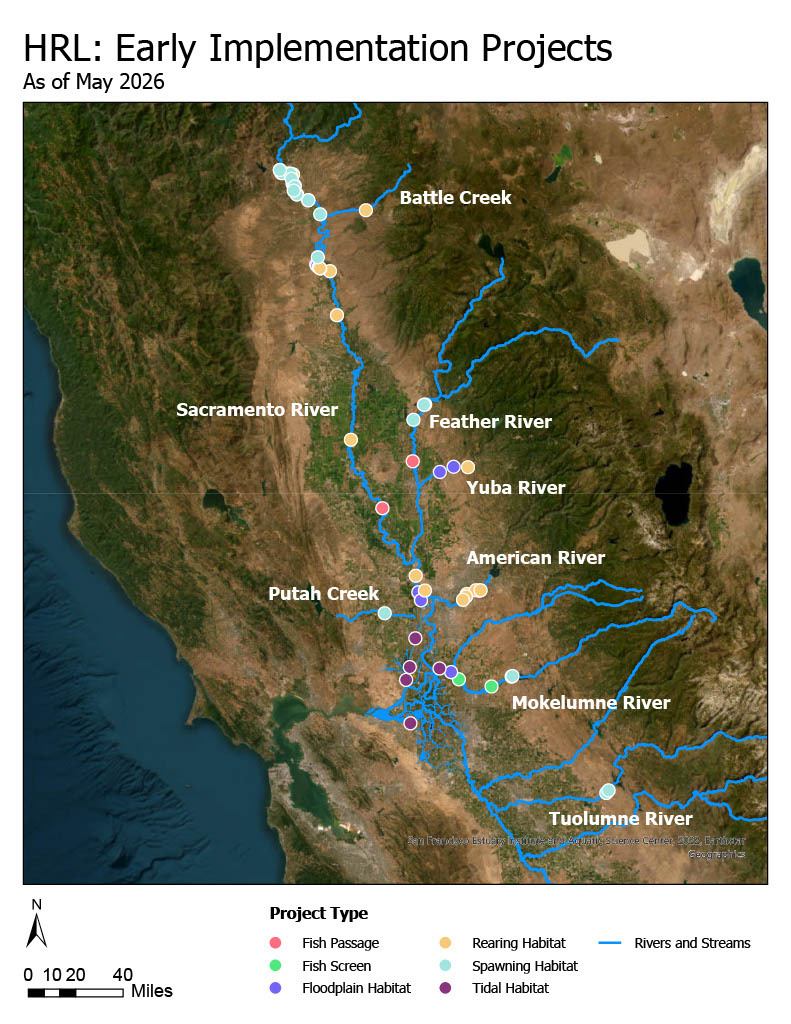 Above: Map showing the location of habitat restoration projects that may be credited under early implementation of the Program, pending testing and refinement of the non-flow measure accounting process, as described in Appendix F of the Strategic Plan.
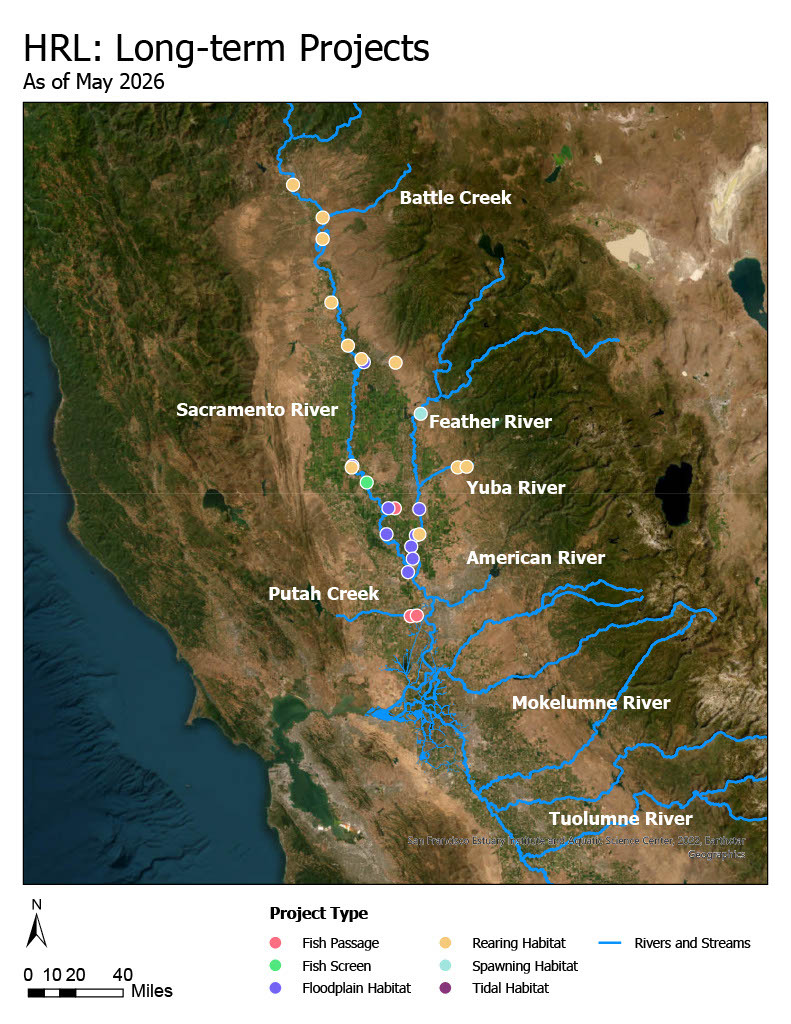 Above: A non-exhaustive map of potential projects that are under consideration for future implementation under the HRL Program. Note that the projects shown in Figure 2 are subject to change. The HRL parties may elect to remove, modify, or add projects. As such, this map will be updated periodically as the Program proceeds.
In March 2026, the Legislative Analyst’s Office (LAO), a nonpartisan fiscal and policy advisor to California lawmakers, released a comprehensive report on the HRL Program. The LAO concluded that the HRL Program offers some benefits and additional flexibility compared to traditional regulations, could provide water agencies more certainty, and could be implemented more quickly. The LAO noted that the HRL Program involves significant uncertainties and suggested that the Legislature provide oversight through hearings, reporting, independent scientific evaluation, and review of how State funds are spent. The LAO report is available here.
On Jan. 28-30, 2026, the State Water Board held a Public Hearing on the Revised Draft Sacramento/Delta Updates to Bay-Delta Plan and Chapter 13 of Supporting Draft Staff Report:
January 28 Recording | Staff Presentation
January 29 Recording | Staff Presentation
January 30 Recording | Staff Presentation
|