California State Parks Graduates 36 Cadets at Law Enforcement Academy Graduation Ceremony
Story from: Tyler Hersko, Law Enforcement and Emergency Services Division
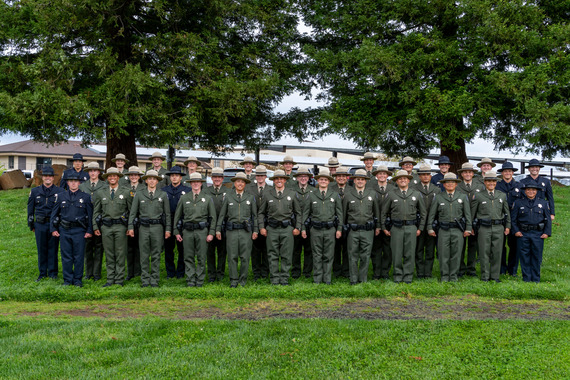 State Parks’ newest class of peace officers. All photos from Brian Baer, Communications and Marketing Division.
California State Parks celebrated the graduation of 36 new peace officers from the Basic Visitor Services Training (BVST) 52 Academy on April 10 in Paradise. The state’s newest rangers and lifeguards were honored by family, friends and department staff while receiving official badges that recognized them as state park peace officers (SPPOs) who will protect and educate the public across California’s 280 state parks.
State Parks Director Armando Quintero spoke to the cadets during the graduation ceremony and praised their dedication to the academy class, which began on Sept. 2, 2025, and required the class to spend time away from their families. Director Quintero noted that the cadets’ loved ones would be pinning their badges — the first year that had happened in the graduation ceremony’s history.
“I want to extend my congratulations to the whole graduating class because you have reached this milestone through discipline, resilience and a commitment to excellence,” Director Quintero said. “I know that’s the only way you get through this class, and completing this academy is an achievement to you and those who supported you. You should be proud of that, and so are we.”
The cadets’ extensive training included lessons in strategic communication, de-escalation techniques, search and rescue operations, visitor services, public education, interpretation, firearms training and first aid, among other instruction areas. This year’s class of 36 cadets was selected from a competitive pool of 1,539 applicants. Their class motto is: “Standing tall, we answer the call.”
Academy Director Jason Smith commended the cadets at the graduation ceremony for their accomplishments and noted that their coursework required them to demonstrate proficiency in a variety of fields.
“These graduates have completed a demanding training program designed to prepare them for the realities of this profession,” Smith said. “They’ve been tested mentally, physically and professionally and have met the standard. They now move forward as peace officers and are entrusted with enforcing the law and serving the public. We are confident in their training, their judgment and their ability to carry on with their duties with integrity and professionalism.
Several of the cadets were presented with special awards during the event:
Valedictorian and Academics: James Farmer
Salutatorian: Hampton Trainer
James Whitehead: Zach Knighton
Defensive Tactics: Ishmael Solomon
Emergency Vehicle Operations: Erik Hylkema
Firearms: Rycker Grindstaff
Park Operations: Joshua Penton
Physical Training: Anthony Nassar
The next stage in the cadets’ journey is a 13-week field training program, where they will gain hands-on, on-the-job training, applying what they have learned in the academy into the field under the guidance and supervision of seasoned officers who serve as field training officers. Congratulations to BVST 52!
More information about the graduation ceremony is available in the press release. You can also watch the graduation ceremony on YouTube.
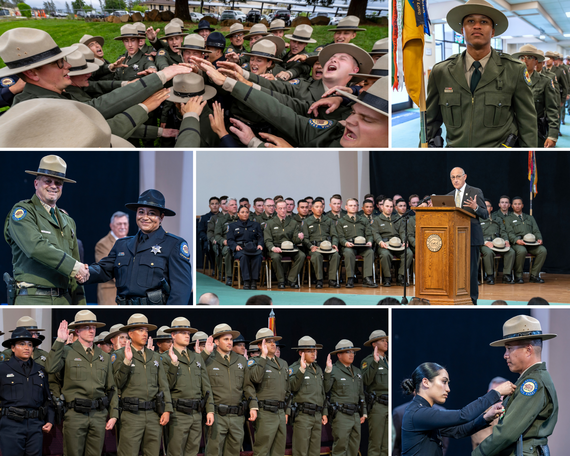 Top left: The graduating class gathers for a team huddle. Top right: New SPPO Ishmael Solomon leads the graduates into the auditorium. Middle left: Central Division Chief Matt Bellah shakes the hand of new SPPO Kailey Banayat. Middle right: State Parks Director Armando Quintero addresses the graduating class. Bottom left: The graduating class stands during the ceremony. Bottom right: New SPPO Vincent San Juan III (right) is pinned by his cousin during the ceremony.
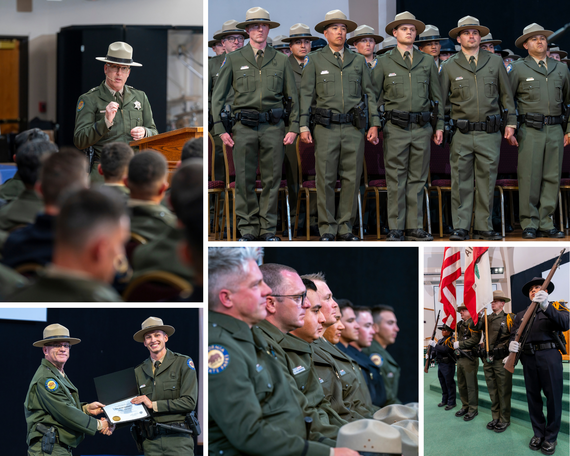 Top left: Academy Director Jason Smith addresses the graduating class. Top right: The graduating class stands to attention. Bottom left: SPPO Supervisor Kirk Coon (left) awards class valedictorian James Farmer. Bottom middle: The graduating class listens to a speech. Bottom right: The Color Guard made up of graduating cadets stands during the ceremony.
Submit a Golden Bear Award Nomination by April 30
Story from: Sonya Jones, Strategic Planning and Recreation Services Division
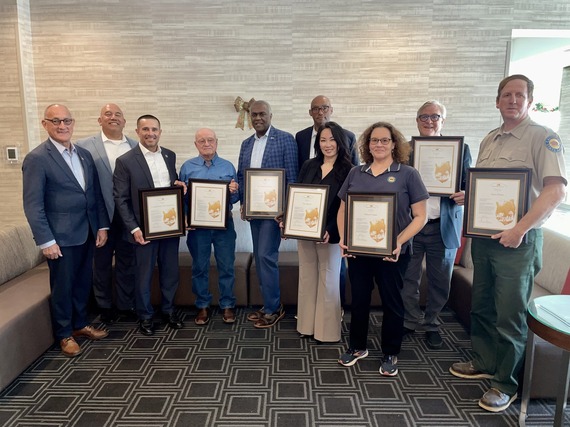 Four of the 2024 Golden Bear Award recipients with State Parks Director Armando Quintero (left) and members of the State Park and Recreation Commission. Commissioners hold the awards of those who attended last year's ceremony virtually. Photo from Kevin Murphy, Communications and Marketing Division.
Who makes a difference to California State Parks? The California State Park and Recreation Commission wants to hear from you as it is now accepting nominations for its Golden Bear Awards Program until Thursday, April 30. Do you know someone who has helped create a healthier California through their work in public outdoor spaces? Make sure to submit a nomination.
The Golden Bear Awards recognize and celebrate individuals and organizations that have, through their work for, with or in support of State Parks, demonstrated leadership and contributed significantly toward a healthier California by helping to preserve the state's extraordinary biological diversity, protecting its most valued natural and cultural resources, and creating opportunities for high-quality outdoor recreation.
Six awards, one statewide, one per geographical division (Central, Coastal, Desert and Northern) and one honorary partner, will be presented by the SPRC during a public commission meeting. Recipients of the awards will receive a framed certificate commemorating their contributions.
To learn more about the history, qualifications, past award recipients and how to nominate candidates for a Golden Bear Award, please visit parks.ca.gov/GoldenBearAward.
Carnegie State Vehicular Recreation Area Hosts
Hands-on Workshop to Study Rare Amphibian
Story and photos from: Elizabeth Gutberlet, Diablo Range District
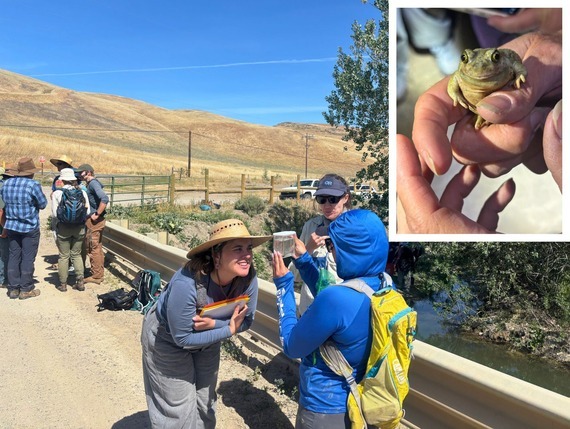 Scientists participated in a workshop designed around the elusive Western spadefoot. Inset picture: An adult western spadefoot toad being held by a participant.
Wildlife viewing may not be the main draw for visitors to a state vehicular recreation area (SVRA), but at Carnegie State Vehicular Recreation Area (SVRA), that may be changing. For the second year in a row, biologists from across California and beyond have gathered at the 1,300-acre off-highway vehicle (OHV) park in the Diablo Range between Livermore and Tracy, hoping to catch a glimpse of the elusive western spadefoot toad (Spea hammondii).
This terrestrial amphibian, native to California and Baja California, has been petitioned for federal listing due to population declines driven by habitat loss and climate change. The workshops held at Carnegie SVRA are designed to equip field biologists with critical skills to survey for and mitigate impacts to the species, while also showcasing real-world examples of habitat conditions and management strategies.
Despite broader declines, monitoring at Carnegie SVRA tells a more hopeful story. The park has documented consistent and successful breeding in seasonal pools and puddles throughout the SVRA — an especially notable finding given the species’ absence on a nearby undisturbed property.
Biologist and former Carnegie SVRA staff member Nicole Kleponis believes that the conditions present at Carnegie SVRA have provided successful breeding habitat, refuge and foraging opportunities for this resilient species through documented occurrences. In addition, park management strategies such as restricting OHV activity after sundown and closing sensitive breeding areas have helped protect the western spadefoot while still allowing for recreation. These approaches, she notes, could serve as a model for managing similar species on other recreational lands.
Kleponis admits that she fell in love with amphibians, particularly the western spadefoot, when working for Carnegie SVRA. Although she no longer works for State Parks, she cares greatly about the landscape and its wildlife and visits the park often. She was one of 24 workshop participants who, on March 28, crowded the entrance area at Carnegie SVRA, eager to find a spadefoot at the site.
Workshop hosts Jeff Alvarez, Nicole Kleponis, Jakob Woodall and Ivan Parr led the group through daytime and evening sessions. The daytime portion detailed survey and decontamination protocols, upland habitat types, management recommendations and a demonstration on dipnet survey protocols. The evening portion provided demonstrations on breeding habitat ecology, acoustic equipment and bacterial swabbing demonstrations and an opportunity to handle and identify adult spadefoots in a nocturnal survey.
Hands-on field workshops are crucial for bridging theoretical knowledge with real-world application for biologists and build essential skills like species identification, data collection and environmental stewardship. This workshop is provided via the support and coordination of Jakob Woodall from San Francisco State University's Vrendenberg Lab and the Western Section of the Wildlife Society.
Capital District Holds Third Annual Fellowship Symposium
Story and photos from: Ileana Maestas, Capital District
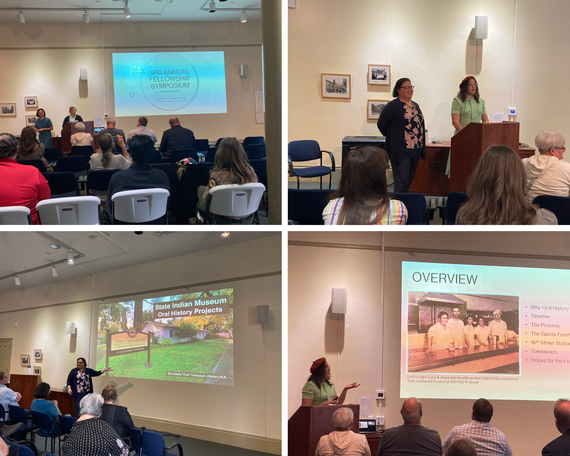 Top left: Museum Curator III Melanie Tran and Capital District Cultural Resources Manager Emma Silverman open up the symposium. Top right: 2026 Fellows Bria-Marie “Pua” Tennyson (left) and Julissa Gomez Ruvalcaba. Bottom row: Pua and Julissa presenting their projects.
The Capital District sponsored its third annual Fellowship Symposium on April 10. The Fellowship Program has evolved out of the internship program designed for early career professionals. Candidates with previous museum experience are recruited so the program draws upon their museum/archiving skills while providing opportunities to acquire new skills. Two program fellows are hired concurrently and together attended regular check-ins with the mentors.
The position lasts one year and has deliverables that expand the accessibility of the Capital District museum and library collections. Fellows are mentored by Museum Curator III Melanie Tran (California State Railroad Museum) and Cultural Resources Manager Emma Silverman (Capital District). Emma and Melanie developed the fellows program to fit within the constraints of the State Parks hiring system and district resources.
This year the fellowship focused on oral history research. Julissa Gomez Ruvalcaba conducted two oral history projects. The first project included three oral histories of the Garcias, a family of five who lived in box cars, and explained their connection to the railroad. In the second project, Julissa documented West Oakland's 16th Street train station history through interviewing five West Oakland residents and previous 16th Street Station employees and their family members. The stories highlighted the 16th Street Station's historical importance to Oakland's industrialization and community while advocating for the station's restoration as it battles with gentrification. These oral histories will be housed in CSRM's library and archives and the transcripts will also be available at the Oakland History Center.
Meanwhile, Fellow Bria-Marie “Pua” Tennyson developed two oral history projects for the State Indian Museum State Historic Park (SIM). Pua interviewed curator Michael “Mike” Tucker, who served as a Capital District curator from 1984 to 2007, and his wife, Cindy Tucker, a long-time volunteer at the museum. The project focused on their participation in the 1985 renovation of the SIM. Pua also interviewed renowned basket weaver Dixie Rogers (Karuk), who has contributed vital cultural programming to the SIM for decades. Pua will also record the oral history of Elder Claudette Rogers (Karuk), mother to Dixie, over the summer. Pua’s second project documents oral histories related to Honored Elders Day, an annual community event that has taken place at the SIM for over four decades. At this year’s Honored Elders Day, Pua will launch the “Memories Together” pop-up activity, which will invite families to share experiences and wisdom.
Not only did Julissa and Pua identify narrators and record their stories on these topics, but they also faced the challenge of developing Capital District’s oral history process from start to finish, creating best practices and workflows, and assembling needed equipment. Out of these efforts, Pua and Julissa co-authored a 90-page Oral History Guidebook focused on establishing the Capital District’s oral history program’s methodology and best practices. The document will be available soon.
The program ended with an afternoon symposium where Pua and Julissa reported their findings to the district and their family members; the California State Railroad Museum Foundation provided catered refreshments.
Congratulations Julissa and Pua!
Visiting Authors Ramp Up 'Book Time at the Butte' at Antelope Valley Indian Museum State Historic Park
Story and photos from: Kady Lee, Great Basin District
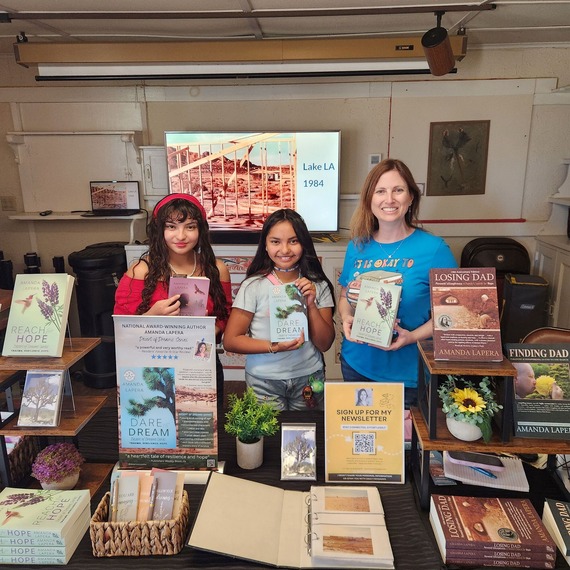 Author Amanda LaPera (right) poses with sisters Katelyn and Emily Dominguez at Antelope Valley Indian Museum State Historic Park during Book Time at the Butte.
Park guests flocked to Joshua Cottage to sit and listen to visiting authors at Antelope Valley Indian Museum State Historic Park (SHP) in March. Sage Andrew Romero (Paiute/Taos Pueblo) kicked off the month on March 1 by reading his story “Wolf and Isha Make the Land.” This was one of four stories published in “Tribal Water Stories,” a collaborative effort between the California Department of Water Resources and California Native American tribes to share the connection to their waterways while also sharing creation stories from each of the tribes involved. Traditional language speakers helped translate each story, which were then illustrated and made into animations. Romero noted that his contribution “was actually the last part of the book and the first portion which utilized 100% Native/Indigenous story, language, illustration and animation in the project.” Guests sat in awe listening as he read in the Paiute language, allowing readers to then ask questions and get in-depth responses.
Author Amanda LaPera followed on March 22, bringing her young adult series “Desert of Dreams.” The series captures what life was like in the community of Lake Los Angeles while it was still being built in the 1980s, as well as what it was like for young people coming of age in Antelope Valley. It showed the ability to overcome trauma through hope and resilience. As guests entered, she read excerpts from her books about events happening around places like Saint Andrew’s Abbey, Antelope Valley Indian Museum SHP, Antelope Valley Fair and others. At the end of each reading, participants were given time to ask questions and purchase copies of books as well as receive personalized signatures.
Katelyn and Emily Dominguez, who originally heard LaPera speak at their schools, told their mother that they had to see her again at the museum. After the reading, the young girls sat with LaPera, asked questions and had a long conversation. Katelyn even mentioned her love of writing. LaPera lit up, providing tips and advice. Their mother was very happy to see them asking so many questions and engaging in hopeful conversation.
Book Time at The Butte continues to look for authors to share their writings each Sunday, but until then, I will continue to read three books each Sunday at 11:30 a.m., 1 p.m. and 2:30 p.m. in Joshua Cottage. A few of the books will include: “Coyote Rescues Hawk,” written by Alan Salazar, “Forest Tracks: What Animal Am I?” written by Hannah Alice, and “Tejedora Del Arcoíris/Rainbow Weaver,” written by Linda Elovitz Marshall.
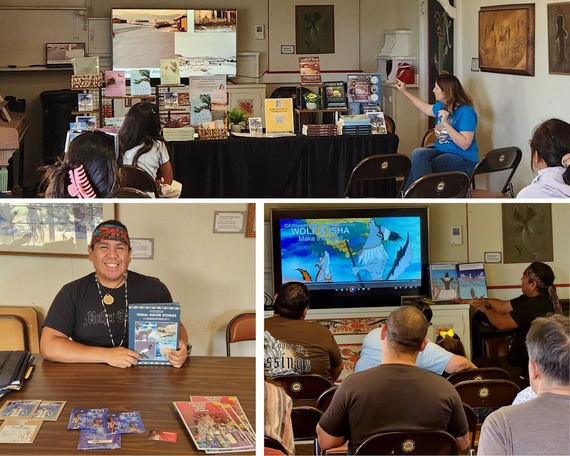 Authors Amanda La Pera and Sage Andrew Romero both participated in Book Time at the Butte by sharing stories.
Pismo State Beach Team Strengthens Protection for Monarch Butterfly Grove
Story from: Danielle Bronson, Oceano Dunes District
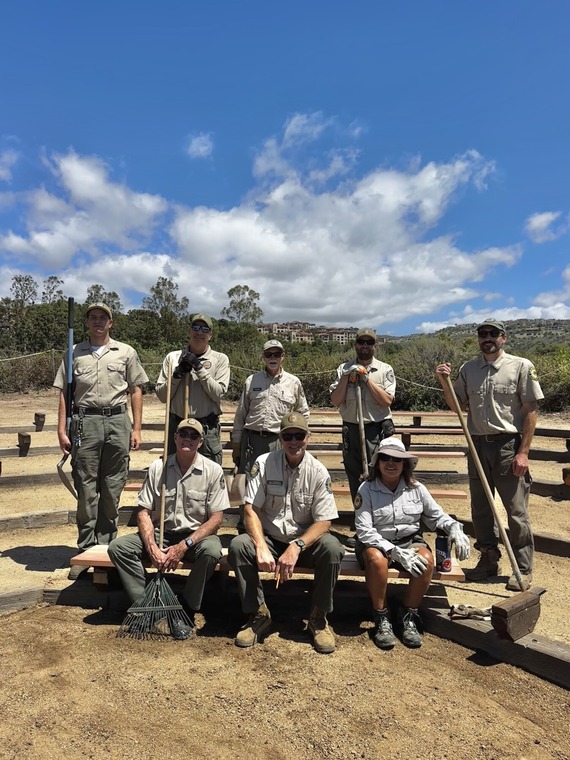
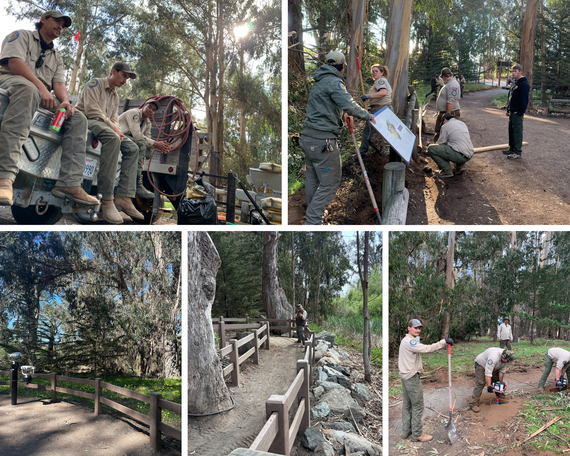 Clockwise from top left: Maintenance staff Camryn Evangelista, Grant Cena and Raymundo Acosta sitting on tailgate; Evangelista, Sarah Foster, Jarod Owen, Thomas Jameson and Nathan Smith digging setting posts; Cena, Jameson, Alex Velasquez and Owen using hole diggers; Josh Simunich; finished fencing. Photos from Abrienne Benzon, Oceano Dunes District.
The dedicated maintenance team at Pismo State Beach (SB) has successfully completed a major improvement project at the Pismo SB Monarch Butterfly Grove — enhancing both conservation and visitor experience.
New, long-lasting and highly durable fencing has been installed to protect the critical overwintering habitat of the western monarch butterfly population that returns to Pismo SB each year. This important upgrade helps safeguard the delicate environment these butterflies rely on for survival during the winter months.
In addition to the fencing, the highly skilled maintenance team replaced a failing retaining wall and resurfaced the pathway through the grove. These improvements ensure the area is safer, more accessible, and welcoming for all visitors — making it easier for the public to experience the seasonal magic of viewing monarchs clustered in the trees.
This project reflects Pismo SB’s ongoing commitment to balancing environmental protection with meaningful public access — preserving a treasured natural wonder for generations to come. This work was made possible through generous funding from local nonprofit Central Coast State Parks Association donors, along with a grant from the California State Parks Foundation.
Parking Lot Rehabilitation Project Protects Public Access to Topanga State Park
Story and photos from: Angeles District
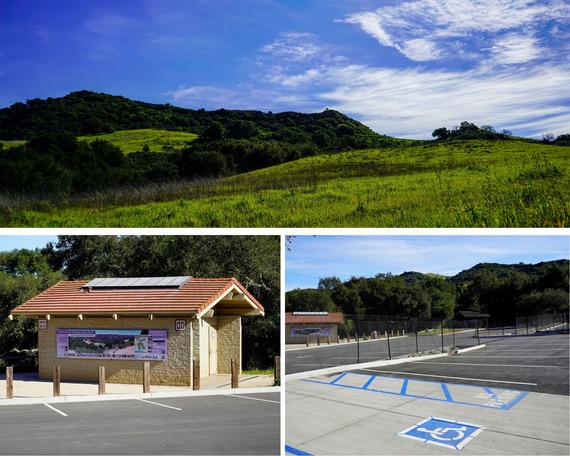 Many trails inside Topanga State Park are accessible from the Trippet Ranch parking lot, now protected from storm runoff after a recent rehabilitation project.
The Trippet Ranch Parking Lot Rehabilitation Project represents a major step forward in protecting one of the most important access points to Topanga State Park in the Santa Monica Mountains. For years, this heavily used day-use area faced serious challenges from uncontrolled stormwater runoff. During storms, water rushed down steep canyon slopes and, because soils could not absorb it, high-velocity flows cut directly across the parking lot. This led to severe erosion, forming deep gullies that threatened infrastructure, including restroom foundations, and undermining mature coast live oak trees. Sediment also washed into Topanga Creek, impacting sensitive habitats.
To address these issues, the project focused on capturing, slowing and redirecting stormwater. Improvements included the regrading and stabilization of fire roads, installing check dams and constructing bioswales and bio-infiltration systems within the parking lot. Eroded gullies were repaired with energy dissipation structures, backfilling and habitat restoration.
Now that the parking lot is reopened, this milestone reflects a collaborative effort and marks a lasting investment in safety, resilience and environmental preservation for future visitors.
  
|