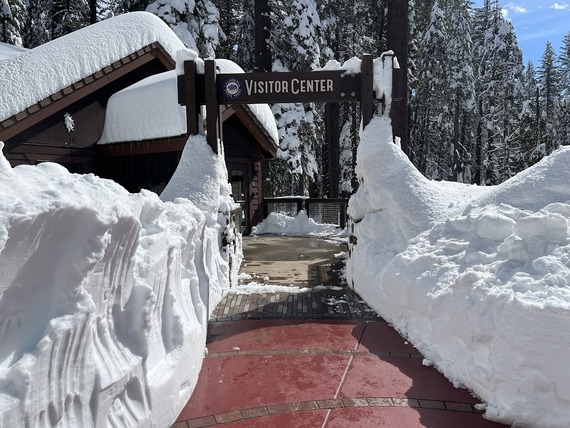
California State Parks Invites Community to Help Shape the Future of Bidwell Mansion State Historic Park
Story from: Communications and Marketing Division
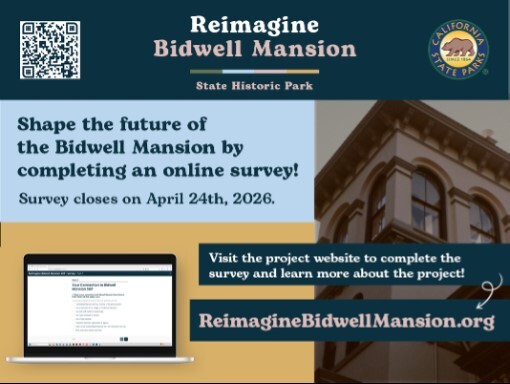
California State Parks invites the public to participate in an online survey that will help shape the vision for the future of Bidwell Mansion State Historic Park (SHP). Responses to the survey will help inform the development of the Reimagine Bidwell Mansion SHP Vision Plan, which will guide the future of the historic park in the aftermath of the December 2024 fire.
The online survey will be open until Friday, April 24. The survey is available on the project website reimaginebidwellmansion.org. For all the details, please read the recent press release.
State Parks and Partners Celebrate Bowtie Community Welcome Day
Story and photos from: Angeles District
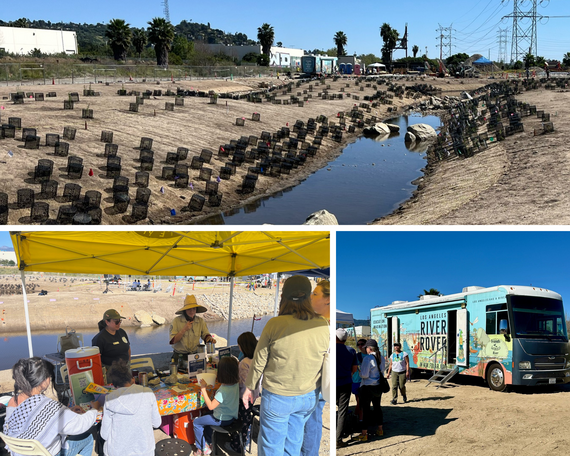 Top: Progress at the Bowtie Wetland Demonstration at the Los Angeles River seen during Community Welcome Day on March 7. Bottom left: Kat Williams and Brenda Yancour of Angeles District's Community Engagement Team at the State Parks table. Bottom right: Friends of Los Angeles River's River Rover educational vehicle.
Community members gathered on March 7 for Bowtie Community Welcome Day, a public celebration marking significant progress of the Bowtie Wetland Demonstration, an important new demonstration project and partnership between California State Parks and The Nature Conservancy along the Los Angeles River. The event brought together State Parks, The Nature Conservancy and Clockshop to welcome residents to the Bowtie parcel and highlighted the ongoing transformation of the site into an ecological and community destination.
Located along the eastern bank of the Los Angeles River in Northeast Los Angeles’ Glassell Park neighborhood, the 18-acre Bowtie parcel is a former railyard and was a largely unused postindustrial land after its acquisition in 2003. Clockshop, an arts and cultural organization located across the river in Elysian Valley, partnered with State Parks in 2014 to activate the underutilized site. Offering a robust profile of community programming including art installations, performances and traditional nature-focused programming such as Bowtie Field Days and LA River Campouts, the organization was instrumental in raising public awareness of the site and its potential for formal park development.
With the combined efforts of The Nature Conservancy and Clockshop, the Bowtie parcel is being reimagined as a network of natural habitats, public open space and community gathering areas. State Parks has worked with The Nature Conservancy since 2016 to develop the Bowtie Wetland Demonstration, which has multiple nature-based benefits, including the improvement of water quality and habitat, the cleanup of historic soil contamination, the improvement of public access and opportunities for education and community engagement.
In addition to the 3.5-acre Bowtie Wetland Demonstration Project, several major projects are currently underway and expected to open to the public by the end of 2027. The Paseo Del Rio project will create a one-mile river greenway as part of the multi-agency 100 Acre Partnership at Taylor Yard. Meanwhile, Bowtie Park Development Phases II and III will expand park amenities and ecological restoration across the broader site.
Momentum for the project continues to grow thanks to new funding. A recent $2 million federal Community Project Funding appropriation through the U.S. Department of Housing and Urban Development, secured by U.S. Representative Jimmy Gomez, will support construction of the Bowtie welcome center. The funding helps close a $5 million gap for Phase II development and will enable completion of a green-roofed community center that may be operated in partnership with Clockshop as a State Parks cooperating association.
Bowtie Community Welcome Day celebrated not only the site’s progress but also the long-term vision of turning a once-industrial landscape into a thriving public park along the Los Angeles River.
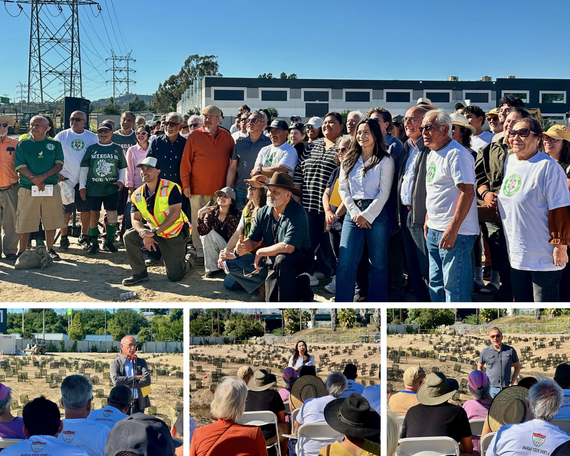 Top: Participants at the event included dozens of members of the public and several organizations. Bottom (left to right): Speakers at the event included State Parks Director Armando Quintero, California State Assemblymember Jessica Caloza and Santa Monica Mountains Conservancy Chairman Miguel Luna.
30x30 Outreach Ambassador Workshop Launches Community Engagement Campaign
Story from: Julie Ira and Cleo Domingo, Interpretation and Education Division
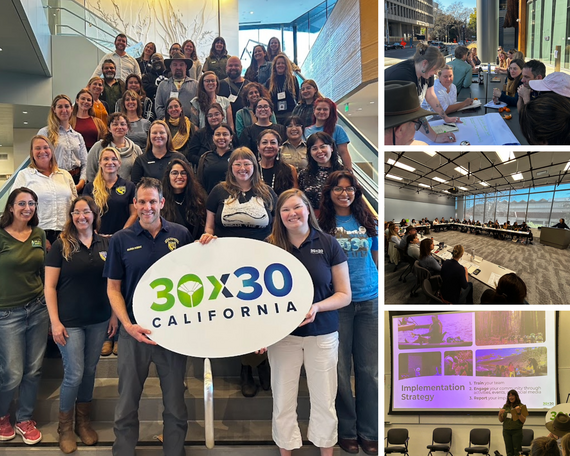 Clockwise from left: The 30x30 Outreach Ambassadors. Regional groups of ambassadors worked together to develop locally relevant communication strategies. Dr. Allison Agsten, from the University of Southern California’s Annenberg Center, trains ambassadors in techniques for communicating complex climate and biodiversity concepts. State Parks Watershed, Climate and Coastal Interpretive Programs Manager Elizabeth Evans explained how to implement local 30x30 outreach strategies. Photos from Rida Ali, California Natural Resources Agency.
California State Parks’ Climate and Environmental Literacy Team co-led a 30x30 Outreach Ambassador Workshop in partnership with the California Natural Resources Agency (CNRA), California Department of Fish and Wildlife (CDFW) and Ocean Protection Council on March 3. The workshop brought together 30 community leaders from across the state, including representatives from State Parks, CDFW, University of California, California Native American Tribes and nonprofit organizations affiliated with conservation and environmental justice, to strengthen how we raise awareness of and engagement in California’s 30x30 vision.
The 30x30 goal is to conserve 30% of California’s lands and coastal waters by 2030. This goal is intended to help accelerate conservation of our lands and coastal waters through voluntary, collaborative action with partners across the state to meet three objectives: conserve and restore biodiversity, expand access to nature and mitigate and build resilience to climate change.
The program launched in January with a kickoff webinar introducing the goals and statewide progress of 30x30, followed by a competitive application and selection process. The selected ambassadors traveled from across the state for a full-day workshop at the CNRA Headquarters Building in Sacramento, where they gained practical skills in communicating the vision and opportunities of 30x30 within their local communities. The training featured leaders from across California’s conservation and communications fields, including CNRA Secretary Wade Crowfoot, who opened the day with an interactive discussion on California’s remarkable biodiversity and the importance of public engagement in conservation.
Allison Agsten, director of the University of Southern California’s Annenberg Center for Climate Journalism and Communication, shared research-based strategies for communicating about biodiversity and environmental protection, while panels with members of the 30x30 Partnership Coordinating Committee created space for dialogue. Following a networking lunch sponsored by Parks California, the day concluded with a surprise appearance from State Parks Director Armando Quintero, who highlighted the agency’s role in advancing 30x30 through land acquisition and community engagement.
Throughout the year, the 30x30 Ambassadors will train their colleagues and community members to become Local Ambassadors for the 30x30 movement. Through community events, stewardship activities and social media campaigns, the ambassadors will continue to bridge local voices with statewide impact, ensuring that 30x30 is not just a policy goal, but a shared movement toward climate resiliency and conserving biodiversity.
State Park and Recreation Commission Tours Clear Lake State Park, Meets in Santa Rosa
Story and photos from: Kevin Murphy, Communications and Marketing Division
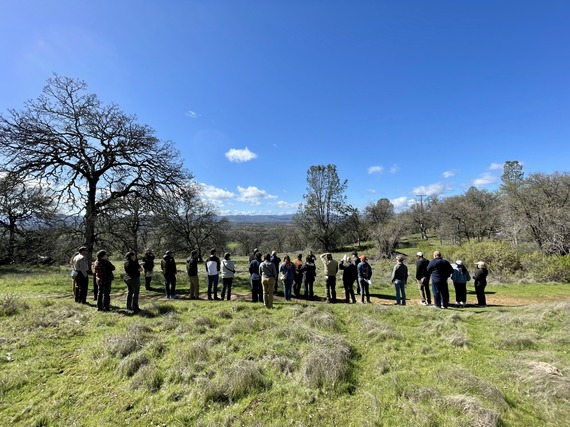 Participants during last week’s State Park and Recreation Commission tour of Clear Lake State Park got a post-lunch workout with a short hike along the park’s Dorn Nature Trail.
In anticipation of reviewing a general plan update in 2027, the State Park and Recreation Commission toured Clear Lake State Park (SP) last week. About 50 members of the public and State Parks staff joined the half-day tour, which included several stops and a short hike high above California’s largest natural freshwater lake within its borders.
After a welcome from Northern Buttes District Superintendent Matthew Allen, District Planner Jared Zucker led the way to six locations within the park to discuss its past, present and future. The Clear Lake Basin, including 590-acre Clear Lake SP, was a home and gathering location for several regional tribes, including the Southeastern Pomo and Lake Miwok. The 590-acre park property became a state park in 1949 and officially opened in 1952. Today, it hosts four campgrounds with 140 sites and eight modern cabins nestled along the lakeshore. The park and its visitor center welcome between 80,000 and 120,000 visitors per year, many using the park’s small marina.
According to Zucker, the original general plan for the park was two pages: a cover page and a map. The general plan update being completed now is funded by State Parks’ Waterways Connection Initiative (WCI). The purpose of WCI is to increase and expand inland water-related outdoor access to priority communities. Approximately 45% of the Clear Lake Basin is federally managed public land, but the vast majority of that total is the hills and mountains encompassing the lake. Although city and county parks offer some lakeshore access, Clear Lake SP and nearby Anderson Marsh State Historic Park are the largest protected areas along the lake with the greatest stretch of publicly accessible shoreline.
At the park’s interpretive pavilion, built in 2011, Park Interpretive Specialist Tyler Lindberg shared information about park activities and interpretive programs, including tribal events, stargazing, bird-watching, school programs and fishing programs. The park also has several community relationships, including one with the Lake County Literacy Program, in addition to a strong park partner, the Clear Lake State Park Interpretive Association. In 2024, State Parks signed an agreement with the Big Valley Band of Pomo Indians to improve the tribe’s access to the park, which is situated on its ancestral homelands. The agreement encourages greater collaboration on interpretation programs as well as resource management activities.
During the Commission meeting in Santa Rosa, staff presented the State Park and Recreation Commission’s Annual Report, highlighting accomplishments from the past two years. The Commission also heard updates on the department’s Recreational Trails Plan and California Trails Survey, budget and real property acquisitions and leases. Commissioners also reelected Chairman Phil Ginsburg and Vice Chairwoman Francesca Vietor to continue serving in their current roles. A full video recording of the Commission meeting is available through CAL-SPAN.
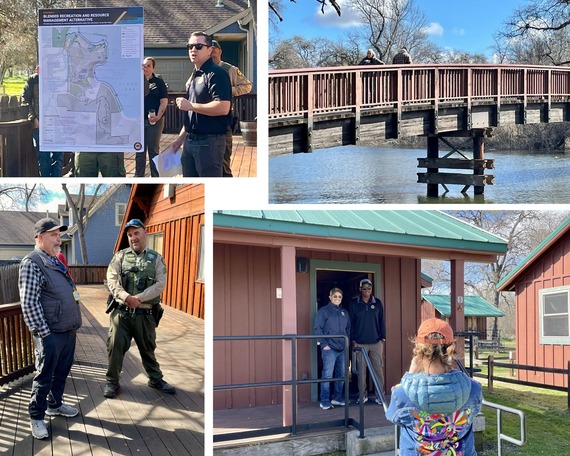 Clockwise from top left: Jared Zucker provides an orientation to Clear Lake SP. Visitors take in a view of the lake from a bridge inside the park. Commissioner Francesca Vietor snaps a photo of fellow commissioners Phil Ginsburg and Jeff Williams on the porch of one of the park’s eight cabins. Former Lakeport Chief of Police and current Lake County Supervisor Brad Rasmussen chats with State Park Peace Officer (Supervisor) Chris Glenn.
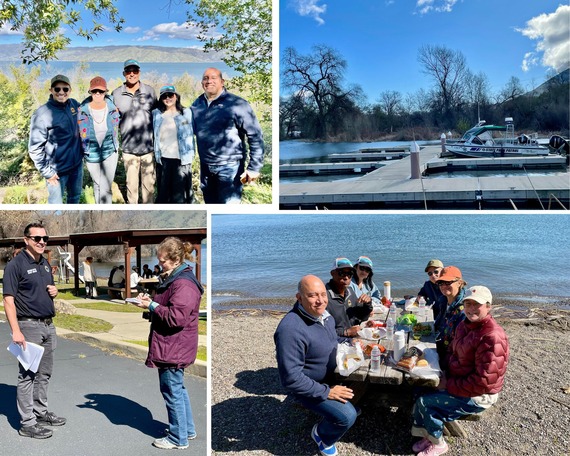 Top left: Commissioners Ginsburg, Vietor, Jeff Williams, Christina Jaromay and David Galaviz pause for a photo along the Dorn Nature Trail in Clear Lake SP. Top right: The marina at the park provides slips for boaters and a home for a State Parks patrol boat for law enforcement staff. Bottom right (clockwise from left) Commissioners Galaviz, Williams, Jaromay, Ginsburg and Vietor are joined for lunch along the shoreline by State Parks Chief Legal Counsel Tara Lynch. Bottom left: Zucker is interviewed by Elizabeth Larson, editor and publisher of the Lake County News, about the general plan update process.
Glaziers Unite! Historic Window Restoration Training at Railtown 1897 State Historic Park
Story and photos from: Bryan Dugan, Diablo Range District, and Tim White, Capital District
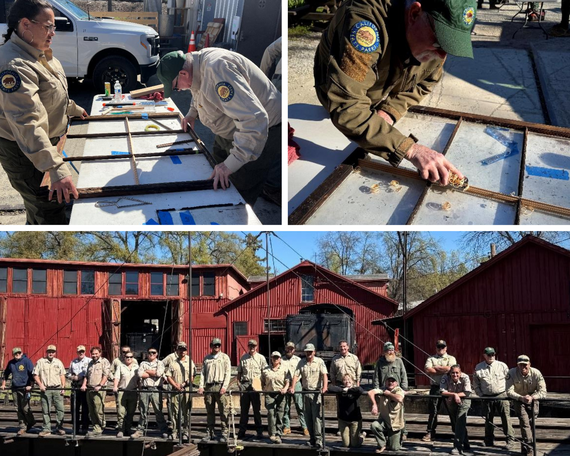 Top left: Park Maintenance Assistant Fonda Thomas and Park Maintenance Worker I Larry Martinelli finish fitting the meeting rail on their sash featuring newly milled and coped muntins at Railtown 1897 State Historic Park. Top right: Martinelli planes a new muntin to match the originals. Bottom: The class lined up on the park's historic turntable for a photo. Track and turntable taken out of service and protection provided in accordance with 49 CFR 214.327
The Training Section’s District Maintenance Skills Training team and the Central Valley District conducted a hands-on historic window restoration training at Railtown 1897 State Historic Park in early March. The training brought together instructors and staff from all over the department. The class was opened by Training Specialist/Park Maintenance Chief (PMC) I Ricky Roldan, Chief Safety Officer Lance Chi and Capital District Restoration Supervisor II and lead instructor Tim White.
Participants learned through extensive hands-on instruction how to remove, assess and repair historic windows sourced from the park using original-like methods and materials. As with many historic structures, lead paint was present in the windows rebuilt during the class. Extensive lead safety training and personal protective equipment such as HEPA dust collectors, Tyvek suits and N100 respirators were used to safely strip lead paint from the windows and collect it for hazardous waste disposal. Participants learned about the many regulatory requirements regarding safe work around lead and how to test for and plan around it.
A highlight of the class was a focus on linseed oil-based paint, which was the industry standard prior to the introduction of petrochemical paints in the 1920s. This historic paint formulation prevents rot and decay by resisting moisture entering the wood, but allowing it to exit easily rather than trying to hermetically seal the wood and inevitably trapping moisture inside.
Restoration glass, produced by using historic methods and sometimes referred to as wavy glass, was used to replace broken or modern lights of glass to maintain a period-accurate appearance. Dutchman repairs, where a small section of new material is spliced into a larger existing piece, were used to strengthen failed sections of the wood sashes to preserve as much of the historic material as possible. All told, eight historic sashes were stripped of lead paint, repaired, reglazed and repainted. Additionally, at least 10 individual broken lights of glass were replaced throughout the park as participants practiced in-situ repairs.
The Training Section would like to thank Central Valley District Superintendent Danielle Gerhart and project manager PMC I Ryan Canutt for their hard work in hosting, preparing and providing an opportunity to make the window restoration training a success. The Training Section team would also like to give a big thank you to instructor Zeb Marjanovich, who, together with us, put in hard work and time to prepare the historic windows and working hands-on instructing the class. And Central Valley District would like to extend their gratitude to their partner – the California Railroad Museum Foundation – for funding the materials and expenses associated with this training.
Please check your FOCUS calendar for the spring and fall 2026 upcoming maintenance classes and updates. Classes fill quickly. For any questions, please email Ricky Roldan at ricky.roldan@parks.ca.gov.
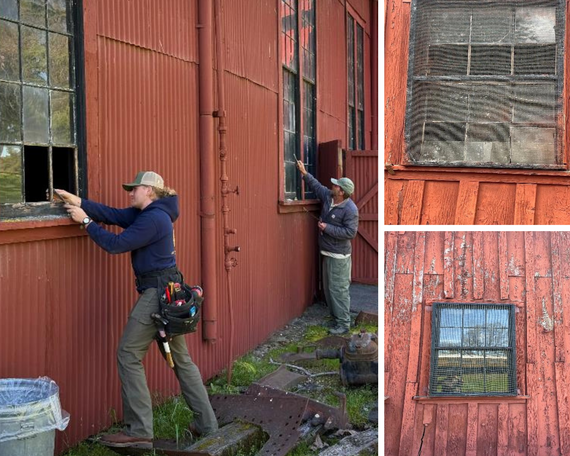 Left: Skilled Laborer Hazen Kunde (left) and Restoration Specialist Scott Blanchard replace broken lights in-situ. Top and bottom right. The windows before and after the restoration work.
Sonoma–Mendocino Coast District Interpreters Train with HEART
Story and photo from: Michelle Levesque, Sonoma-Mendocino Coast District
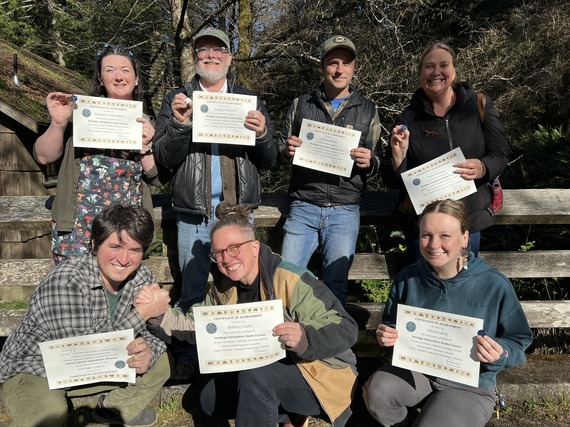 Graduates display their certificates and pins after four sessions of highly rewarding team building and mutual support for each other’s professional development. Top row: Kat Gabrielson, Gregory Woodruff, Steve Jahelka, Anica Williams. Bottom row: Casen Jaquez, Britt Ouzts, Kenzi Lamb.
Sonoma-Mendocino Coast District interpreters and docents recently completed 18 hours of a new interpretive training program: the Heritage Interpretive Guide (HIG) HEART course. HEART stands for Holistic, Engaging, Appropriate, Rewarding and Thematic — elements that help interpreters create meaningful connections between visitors and the resources they explore.
The course was developed in 2024 by Tim Merriman, retired executive director of the National Association for Interpretation. It was designed to reach the many seasonal staff, docents and guides around the world who interact most frequently with visitors but may not have the time or financial resources to attend traditional, multi-day training programs.
Current and former NAI-certified interpretive guide trainers were invited to participate in the HIG Trainer’s Course. The Mendocino Sector’s cooperating association, MendoParks, generously funded my course tuition and purchased the HIG pins for our new graduates to proudly wear on their uniforms.
The training can be delivered either in person or virtually and includes a 50-page workbook filled with thought-provoking exercises. Participants explore foundational concepts of the interpretive profession while also learning new tools for today’s workplace. The curriculum even includes prompts for using AI platforms to assist with researching resources, developing activities and helping interpreters craft strong themes and program outlines. The training culminates with participants delivering a 7–12-minute interpretive experience, evaluated by their trainer. I am happy to say that this group blew me away with their outstanding presentations and by how clearly they grasped the course content.
As a HEART Trainer, I am authorized to train other interpretive trainers which will take our staff to the next level as future trainers themselves.
To learn more about the HEART/Heritage Interpretive Guide program and other courses, visit interpretivetraining.org.
 PARTNER NEWS
Parks California CEO Reflects on Caring for California’s Public Lands
Story from: Parks California
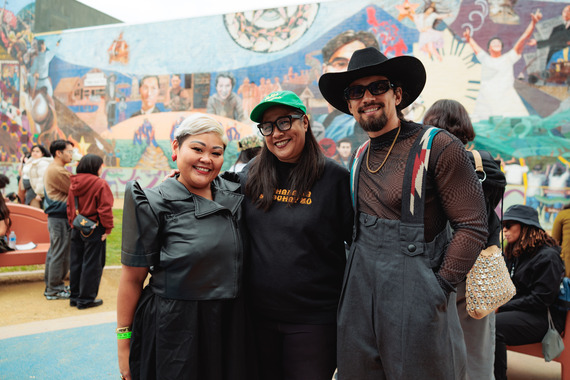 Arts in California Parks grantee FilAm Arts during its Eskwela Kultura Baryo HiFi event. Photo from FilAm Arts.
Parks California CEO Kindley Walsh Lawlor recently shared her thoughts on why caring for our state’s public lands and the communities they serve is so vital. From the towering redwoods and dramatic coastlines to vibrant desert landscapes and city parks, these extraordinary places are at the heart of California’s identity. They protect our biodiversity, celebrate our cultural heritage and create opportunities for everyone to connect with nature and with one another.
Through partnerships, Parks California works to strengthen stewardship and expand access so more people can experience these landscapes. Programs that reduce transportation barriers are helping thousands of Californians visit parks — many for the first time.
Parks California also supports initiatives like Arts in California Parks, which brings art, culture and community into outdoor spaces across the state. These programs help strengthen connections between people and the lands they share.
Read the full article to learn more about how partnerships are helping care for California’s public lands.

|