Hundreds Celebrated the New Year with First Day Hikes
Story from: Kai Levato, Communications and Marketing Division
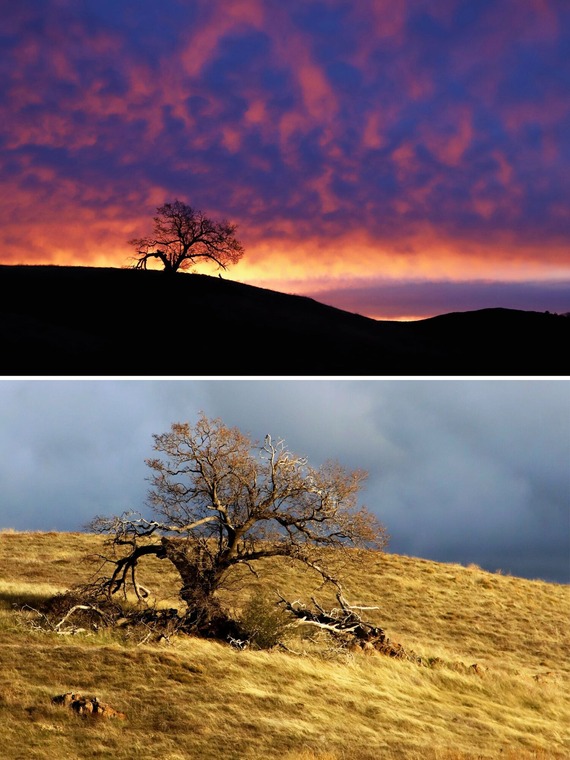
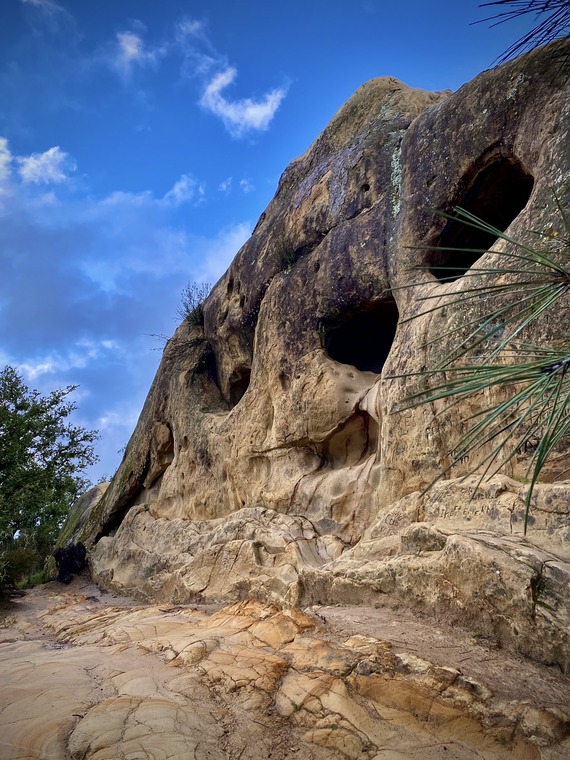
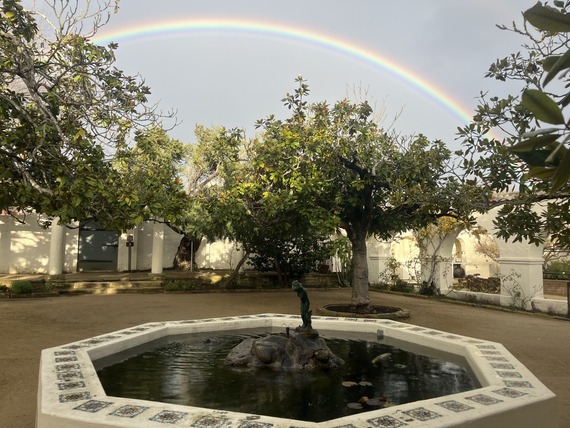
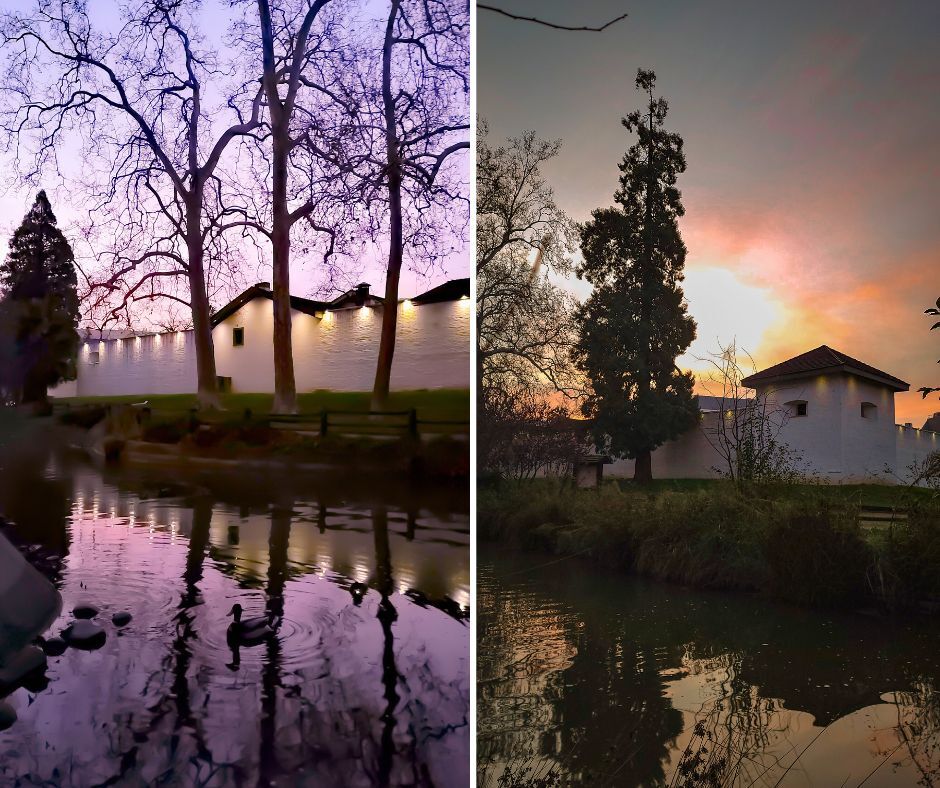
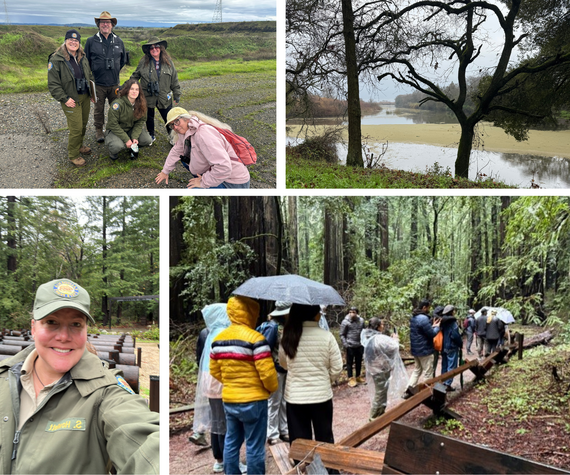 Clockwise from top left: Participants discover an intact articulated vertebrae (system of specialized joints) from a juvenile snake at Prairie City State Vehicle Recreation Area. Photo from Edward Santin, Gold Fields District. View from Delta Meadows Park Property. Photo from Logan Currin, Diablo Range District. First Day Hike visitors at Armstrong Redwoods State Natural Reserve. Photo from Carin Johnson, Sonoma-Mendocino Coast District. State Park Interpreter Sara Howlett ready for the hike at Pfeiffer Big Sur State Park (SP). Photo from Sara Howlett, Monterey District.
At the beginning of the new year, visitors across California stepped out of 2025 — and into their local state park! A total of 579 people across California participated in State Parks’ annual First Day Hikes, an event focused on connecting people to the outdoors by offering guided hikes to kick off the new year.
This year, State Parks initially offered a total of 98 hikes throughout 69 state parks. Unfortunately, many hikes were canceled or postponed due to the storms across California on Jan. 1.
While the rain may have put a damper on some hikes, State Parks offered a variety of hikes, ranging from a quick half-mile urban walk to a 19-mile trek. Some parks offered a different kind of First Day Hike with interactive experiences for visitors, from exploring tide pools at Point Lobos State Natural Reserve (SNR) to a polar plunge at Cardiff State Beach (SP) (see story below).
Thanks to the contributions of numerous State Parks staff, volunteers and partners, nearly 600 First Day Hike participants were able to start the new year off on the right foot! As we look forward to the year ahead, we wish everyone continued success and happiness for 2026! Keep reading to learn more about different First Day hikes throughout the state.
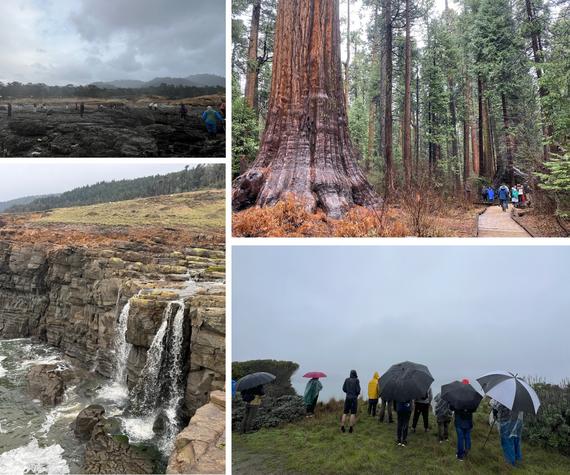 Clockwise from top left: Tidepooling at Point Lobos SNR. Photo from Ashley Wemp, Monterey District. Walking amongst the giants at Calaveras Big Trees SP. Photo from Lillie Oravetz, Central Valley District. Participants had a chance to whale watch at Angel Island SP; a small pod of gray whales swam through Raccoon Strait. Photo from Crystal Saephan, Bay Area District. The First Day Hike landscape at Salt Point SP. Photo from Hank Birnbaum, Fort Ross Conservancy.
New Year Brings New Traditions for Cardiff State Beach
Story from: Claire Andrews, San Diego Coast District
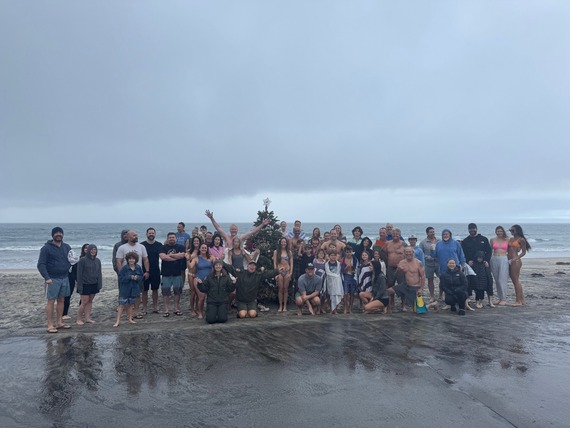 Participants in the first wave of the First Annual First Day "Polar Plunge" pose at Cardiff State Beach before hitting the water. Photo from San Diego Coast District.
In lieu of a traditional First Day Hike this year, beachfront interpreters from the San Diego Coast District and over 150 participants traded in their boots for swim fins at Cardiff State Beach’s first annual First Day "Polar Plunge". As the event approached, so did a storm and concerns of cancellation rose, but the greater community prevailed and throughout the misty morning waves of people joined to dip in the ocean as a way to start the new year.
Many steadfast ocean swimmers had toes in the sand ready to plunge right at the start of the event while others joined in at their own pace later. Some participants came in full polar bear spirit with onesies and signs to match. Throughout the morning, participants joined in other activities, such as writing new year’s resolutions on cobblestones, taking photos with a decorated tree and warming their bellies with hot cocoa and coffee. Firepits and rain shelters rounded out the festivities and allowed the community to connect over shared appreciation for the ocean and California's state parks. As participants exited the water, many expressed gratitude for the day, the community and a new tradition started.
A warm thank you to San Diego Coast District’s North Sector team at large for making this first event a success. From the maintenance team prepping the space to seasonal lifeguards keeping the public safe and to the interpreters who hosted the event, kudos on a job well done! Finally, special shoutouts to Lifeguard I Jack Shaver, who led the charge with a countdown for the plunge; Interpreter I Anita Balcar, who plunged in her uniform to help some young swimmers brave the waves; Bump Coffee for donating warm beverages for participants; and Outdoor Outreach for providing additional activities, prizes and support for the event. This is the first polar plunge this team has hosted, but it surely won’t be the last. We hope you’ll join us next year!
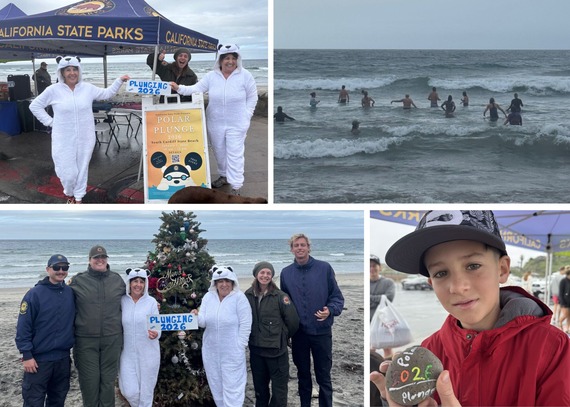 Clockwise from top left: a pair of "polar bears" prepare to take the plunge. Participants brave the waves. A young participant with a self-decorated souvenir of "Polar Plunge" 2026. San Diego Coast District staff pose with the polar bears. Photos from San Diego Coast District.
Don’t Let the 'Peaceful' Ocean Fool You: First-Ever First Day Hike Led by a Seasonal Lifeguard on the Mendocino Coast
Story from: Michelle Levesque, Sonoma-Mendocino Coast District
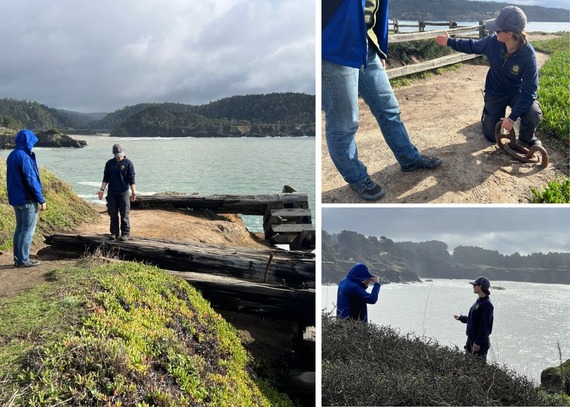 Clockwise from left: These timbers are all that remain of the chute house at Shipping Point.
Seasonal Lifeguard Rouge Russel lifts the heavy chain that anchored the lumber chute in place more than 150 years ago. Russel describes a “dog hole port” near the mouth of Big River to the intrepid visitor. Photos from: Volunteer in Parks Program Docent Britt Ouzts, Sonoma-Mendocino Coast District.
“The Pacific is ‘rough,’ for seven or eight months in the year — not stormy, understand me — not what one could justly call stormy, but contrary, baffling and very ‘rough.’ ” - Mark Twain
After surviving stormy seas at the tip of South America, explorer Ferdinand Magellan entered the vast, calm ocean that laps against our coast and named it the Pacific — meaning peaceful. Seasonal Lifeguard Rouge Russell knows, as Mark Twain did, that this calm is often deceptive.
The First Day Hike of 2026 sold out. Several visitors gathered inside the Mendocino Headlands State Park visitor center, standing by the replica lumber chute, enjoying warm cider and learning about coastal history as Russell and the park docent described the hazards the ocean posed to early sailors and mill workers who came for the redwoods. Only one visitor, however, braved the cold drizzle to continue the hike outdoors.
Russell led the way out onto the headlands to the historic “shipping point,” where remnants of giant iron chains, the chute house and other industrial features still cling to the cliffs. These elements once anchored the lumber chute used to send millions of board feet of massive old-growth timber down to waiting schooners. Those small ships “schooned” across the choppy, rocky coastline into dog holes — tiny coastal ports so small and treacherous that sailors joked only a dog could turn around in them.
No one envied the worker stationed at the bottom of the chute, operating a wooden brake to control the lumber’s descent. It was dangerous work, with long hours and no unions for protection. Nearby, the remains of two massive flagpoles still stand. Before lighthouses existed along this stretch of coast, workers raised a red flag for “DO NOT ENTER” or a white flag for “ENTER,” guiding ships through perilous conditions.
As the hike continued, Russell connected this history to present-day hazards. She spoke of sneaker waves, unstable cliffs and the risks that still catch visitors off guard. As a State Parks lifeguard, she has rescued and assisted many who mistakenly trust the “peaceful ocean.” Special thanks to our nonprofit partner, MendoParks, for promoting the event and providing homemade hot apple cider. Enjoy our coast! Witness its rugged beauty! Find peace on these headlands — but do so safely, if not always warm and dry. Happy New Year from the Mendocino Coast!
2026 First Day Urban Hike at Sutter’s Fort and the State Indian Museum in Sacramento
Story and photos from: Ileana Maestas and Jared Jones, Capital District
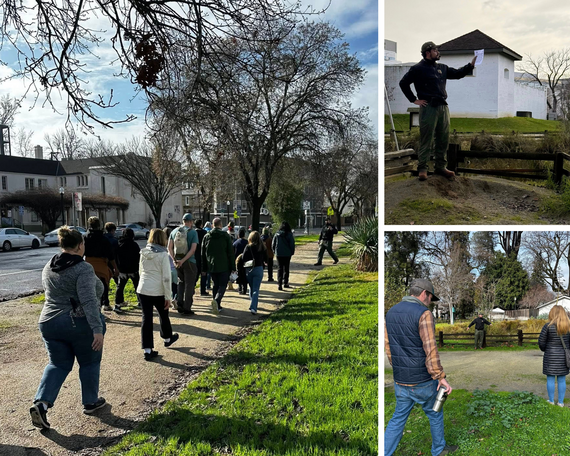 Senior Park Aide Marco Reyes and Park Aide Anthony Brown lead urban first day hikers around the grounds of Sutter’s Fort State Historic Park and the State Indian Museum.
Cultural resources staff in the Capital District hosted their second annual First Day Hike on Jan 1. Over 60 visitors joined Senior Park Aide Marco Reyes and Park Aide Anthony Brown on the exterior grounds of Sutter's Fort State Historic Park and the State Indian Museum to learn about the history of these two institutions, in addition to the vital role urban parks play in our local communities and ecosystems.
Participants encountered a variety of native plants and animal species on a half-mile tour around the park grounds, including several oak and redwood groves dating back to the original 1904 landscape plan. The rain cleared up just in time for the first tour to depart from the bridge at the pond. And with the park’s accessible pathways, families with strollers and visitors in wheelchairs were able to safely participate and spread out during the tour.
North Coast Redwoods District Kicks Off 2026
with Annual All-Hands Meeting
Story and photos from: Karla Jovel, North Coast Redwoods District
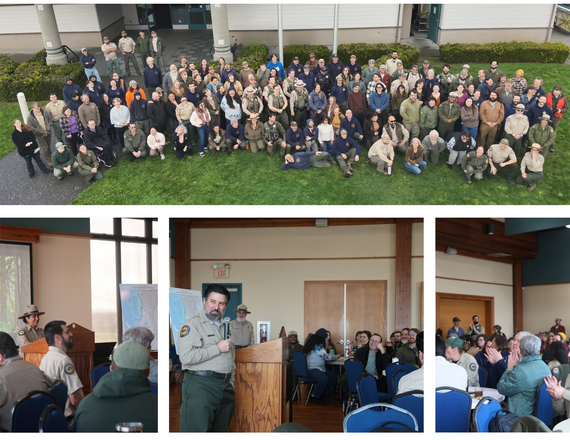 Counterclockwise from top: Group photo of North Coast Redwoods District staff taken via drone. Deputy Superintendent Shelana deSilva provides opening remarks at podium. Field Division Chief Greg Martin addresses all park staff in front of podium. Staff applaud speakers.
To kick off the new year, North Coast Redwoods District hosted its Annual All Hands Meeting at the Wharfinger Building and Eureka Public Marina in Humboldt County. State Parks staff from across the district gathered on Jan. 7 to connect with coworkers, share a meal together and learn about ongoing district operations, project updates and accomplishments from district and division leadership.
District Superintendent Victor Bjelajac and Deputy Superintendent Shelana deSilva provided a warm welcome and the opening remarks to almost 150 district staff, acknowledging the hours of hard work people put in every day to provide the best possible park experience for local communities and visitors from near and far. The group was joined by Desert Field Division Chief and Acting Northern Field Division Chief Greg Martin, who led an open discussion on the importance of teamwork and collaborations with park partners and key stakeholders, both internal and external to the department.
“North Coast Redwood District personnel and our partners work hard every day to protect cultural and natural resources and give the visiting public a chance to experience these special places," said Bjelajac. "It's good to pause for a moment and come together to share stories and remind ourselves why we do this work. I am grateful to have such dedicated people stewarding these lands for the public.”
This gathering was made possible thanks to support from Redwood Parks Conservancy and Humboldt Redwoods Interpretive Association.
Putting Dos Rios on the Motus Map
Photos and story from: Chrissy Sullivan, Central Valley District
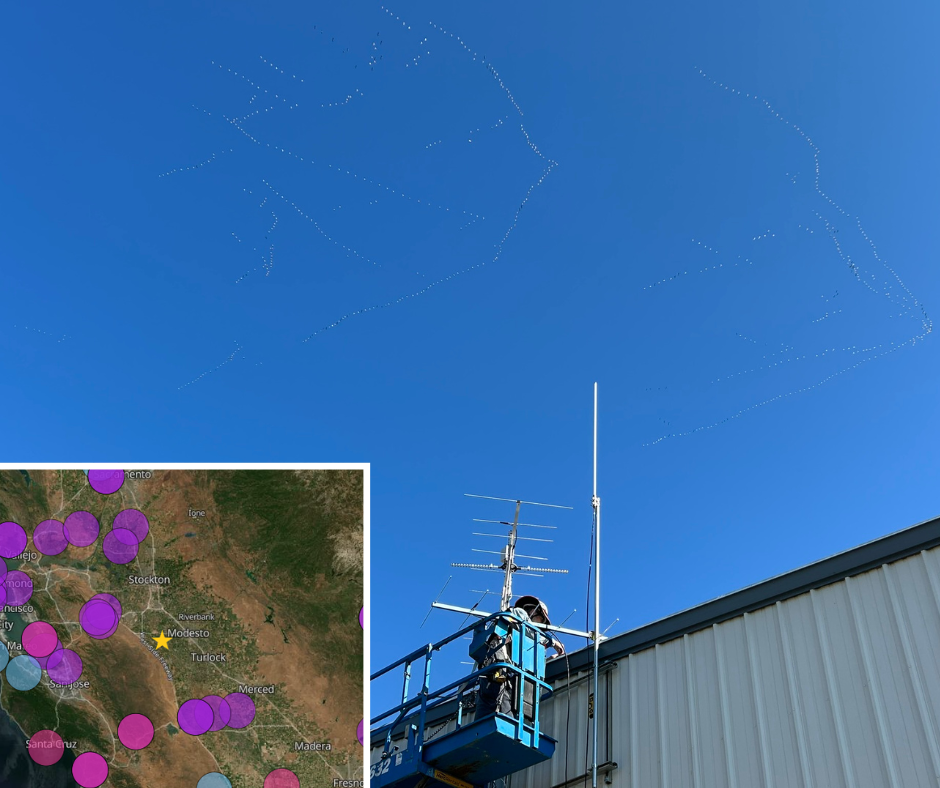 Flocks of geese fly overhead as Pat Lorch from Southern Sierra Research Station installs the park's Motus tower. Inset picture: The Dos Rios Motus station fills a large gap in the Central Valley, providing researchers a more complete understanding of wildlife behavior.
Dos Rios gained a new point of interest this week. An intricate cluster of antennas, known as a Motus tower, now connects our park to the Motus Wildlife Tracking System, which brings together an international network of researchers to track and study wildlife. Researchers anywhere can tag animals with tiny trackers small enough to mount on a butterfly. Motus stations, like the one at Dos Rios, can detect those trackers traveling within a 20-kilometer radius (about 12.5 miles) to provide valuable data that can be used to infer migration patterns, habitat preferences, population dynamics and more. An abundance of this data is openly accessible on the Motus website and may be able to help park officials shape land management decisions, conservation priorities and public engagement.
River Partners led the effort to make Dos Rios a Motus station, and the nonprofit is excited to add this powerful tool to its robust repertoire of on-site monitoring measures. This location fills a crucial gap of Motus stations in the Central Valley, an important migratory corridor for many birds. They hope to use this data to gauge the progress of riparian habitat restoration by locating certain indicator species, like tricolored blackbirds, possibly even supporting a tracker deployment project in the future.
Installation was no small feat — 10 antenna structures were fastened and wired atop a 25-foot warehouse by Motus installation experts from Southern Sierra Research Station and the Audubon Working Lands program, adding a modern touch to the park's skyline of remnant farm equipment and barns. See if you can spot our state-of-the-art telemetry tower on your next visit!

Arts in California Parks Grantee Spotlight: Anawakalmekak
Story and photo from: Parks California
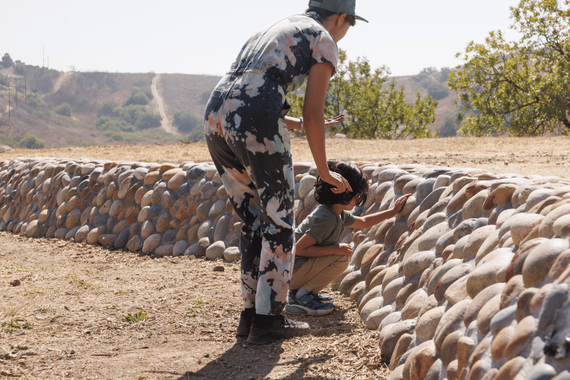 Participants leave their handmarks on one of the sculptures of Generations of Wisdom – Taaxor: An Indigenous Serpent Mound Project.
Parks California sheds light on its grantee Semillas Sociedad Civil, Anawakalmekak. The Indigenous-led educational nonprofit is dedicated to advancing Indigenous autonomy in education and operates Anawakalmekak, a public charter school focused on native language, cultural teachings and intergenerational learning. The organization is part of the Arts in California Parks grants program, a partnership between State Parks, Parks California and the California Arts Council, which supports nonprofits, local organizations and tribal communities in creating art installations and programs that reflect California’s diverse stories.
As part of its grant project, Semillas Sociedad Civil created the Generations of Wisdom – Taaxor: An Indigenous Serpent Mound Project, a land-art installation with two serpent sculptures symbolizing knowledge shared across generations and geographies. The serpents, built from river rock, native plants, earth pigments and natural materials, form a ceremonial space at the Chief Ya’anna Vera Rocha Regenerative Learning Village, honoring the Gabrielino-Shoshone Nation and other tribes of the Los Angeles Basin, Nahua peoples and all Indigenous communities within the Uto-Nahua language family.
Learn more about Arts in California Parks and Semillas Sociedad Civil’s Generations of Wisdom – Taaxor: An Indigenous Serpent Mound Project here.
|