ADVENTURE OF THE MONTH
Santa Cruz Mission State Historic Park Connects Native Past and Present through New Multimedia Exhibit
Story from: Andreas Agocs, Communications and Marketing Division
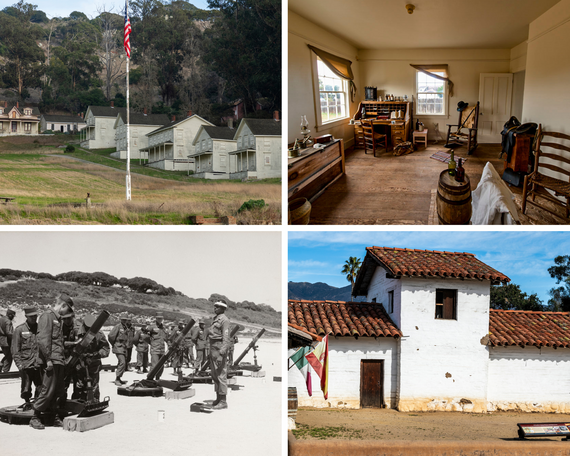
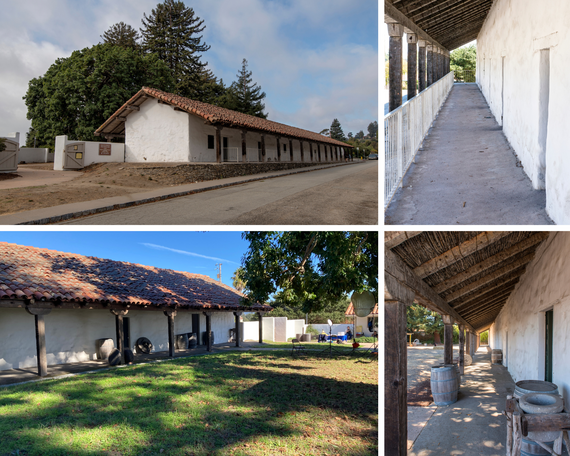 The only remaining original building of Santa Cruz Mission is the adobe that housed converted Native families. A new multimedia exhibit at Santa Cruz Mission State Historic Park tells the story of five individuals who lived here. Photos from Brian Baer (top row and bottom right) and Andreas Agocs, Communications and Marketing Division (bottom left)
Santa Cruz Mission, completed in 1795 on a hill overlooking the city that carries its name, was the 12th in the chain of Spanish missions along the California coast. Santa Cruz became known as the “Hard Luck Mission,” a nickname that only hints at the challenges and hardships for its population of Native converts, who provided most of the hard labor, succumbed to diseases and were often held at the mission against their will.
Santa Cruz Mission State Historic Park consists of a visitor center and the only remaining original building of the mission complex, the adobe that housed converted Native families. The park has long focused on telling the stories of the mission population; now, a new multimedia exhibit, cocreated by contemporary Native community members, builds a bridge from the past to the present and breathes life into stories full of tragedy and loss but also joy and human connections.
“Emotional” was a term that came up frequently among visitors, State Parks staff including Director Armando Quintero and Cultural Resources Division Chief and Tribal Liaison Leslie Hartzell, invited guests and about 60 Amah Mutsun Tribal Band members at the exhibit opening at the park on Nov. 2. The multimedia tour and exhibit, titled “People Who Lived Here,” explores history through narrative recordings on the Virtual Adventurer Mobile App, which can be downloaded through QR-codes displayed in the mission adobe’s rooms.
The project is based on the research and book of Dr. Martin Rizzo-Martinez, a professor at University of California, Santa Cruz, and was supported for State Parks by District Historic Lead Julie Seidel. Based on archeological and archival records, the exhibit reconstructs and documents the lives of five Native or mixed-race individuals who were connected to the mission. The life stories were scripted and narrated by contemporary young Native community members whose own ancestors experienced mission life and its impacts generations ago.
The tour leads through seven stops of the adobe, each of them centering on an individual life story and highlighting different aspects of mission life. Room 5, for example, connects everyday household items to the story of converted Native Maria Buena. Maria’s account, as scripted and narrated by Amah Mutsun tribal member Carolyn Rodriguez, breathes life into the story of a woman whose life illustrates the blending of Native and Catholic traditions that characterized much of mission society. Carolyn, a doctoral student at UCLA, said that assuming Maria's voice was a very emotional experience and that she wanted to “tell the story in a way that honored all the women” who shared Maria's experiences.
Visual artist Weshoyot Alvitre, of Tongva/Gabrieleño and Scottish descent, created another link between the Native past and present. Her portraits of the historical adobe residents are based on the five contemporary tribal members who “embodied” them with their voices. Weshoyot herself is the exhibit’s voice of Clementina Montero, who shared the artist’s Tongva background, and whose story centers on the challenges of navigating mixed-race identity and displacement in colonial Spanish and Mexican California.
The event ended with a closing ceremony and a podium discussion with the project’s cocreators, which highlighted the exhibit’s powerful emotional impact on everyone who attended. Amah Mutsun Tribal Band Elder Eleanor Castro, who led the event’s opening prayer, described Santa Cruz Mission SHP’s exhibit as “closer to the truth” of Native people, whose voices have been suppressed or ignored for too long. Ultimately, though, the event was not only about the ”People Who Lived Here” but just as importantly, about the people who still live here, and who will continue to create stories for future generations.
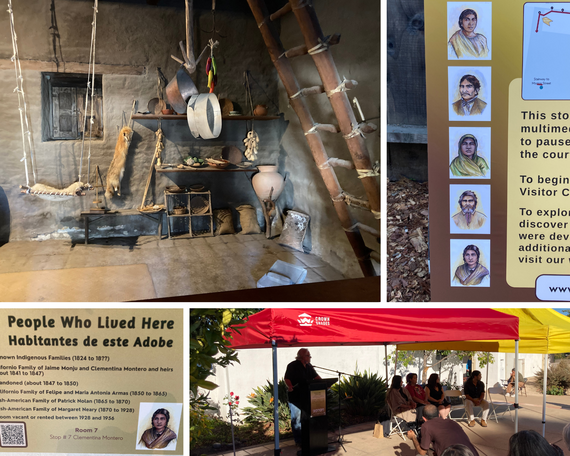 Top row: The objects in room 5 tell the life story of Maria Buena, one of the five historic individuals at the center of the exhibit. Bottom left: The biographical information of Clementina Montero in Room 7. Bottom right: Dr. Martin Rizzo, whose historical research provided the basis for the exhibit, stands at the podium while four of the cocreators who scripted and narrated the tour discuss their work. Photos from Andreas Agocs, Communications and Marketing Division.
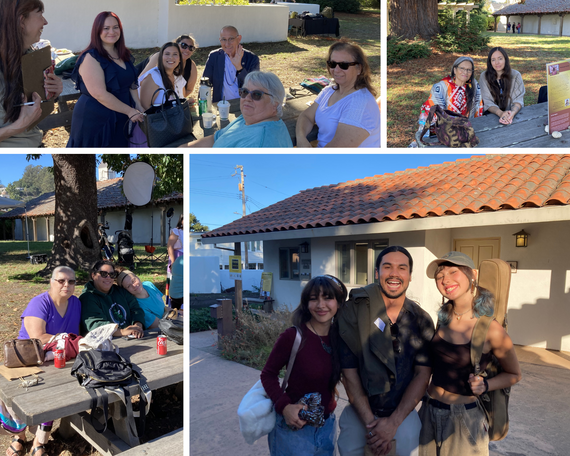 Attendants of the exhibit launch. Top left: State Park Interpreter Julie Seidel (left) and State Parks Director Armando Quintero (center, waving) with tribal members and families. Top right: Linda Lopez-Larios (Tongva), at left, with artist Weshoyot Alvitre, who painted the portraits of the historical individuals. Bottom left: Amah Mutsun Tribal Band Elder Eleonor Castro (left) with family members. Bottom right: "We are still here" — The next generation of contemporary Native community members, including Alexii Sigona (center), who developed and narrated the life story of Lorenzo Asisara. Photos from Andreas Agocs, Communications and Marketing Division.

Partnerships Division Hosts 'Engaging in Partnerships Training 2025'
Story from: Rachel Young, Partnerships Division
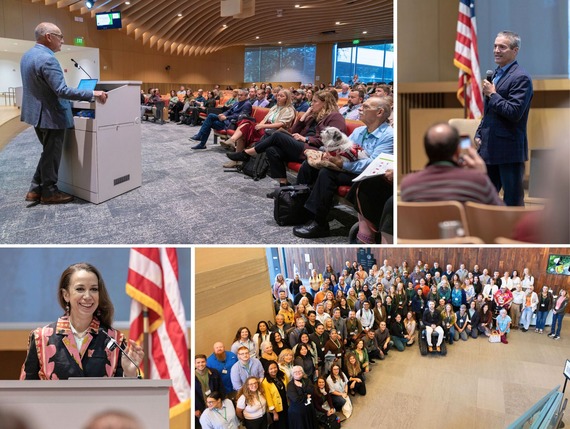 Counterclockwise from top right: California Natural Resources Agency Secretary Wade Crowfoot, Director Armando Quintero, and California Tribal Affairs Secretary Christina Snyder-Ashtari address attendees at the Engaging in Partnerships Training. Photos from Brian Baer, Communications and Marketing Division. Bottom right: A group photo of participants in the training. Photo from Damion Sanders, California Natural Resources Agency.
California State Parks’ partners from around the state gathered with Partnerships Division staff for Engaging in Partnerships Training, Oct. 28-30. After hosting the last training in Monterey, the Partnerships Division was excited to welcome our partners to our home base at the California Natural Resources Agency Headquarters Building in Sacramento. The theme for this year’s training was “Growing Stronger Together,” and attendees had opportunities to grow in both relationships and in knowledge throughout the week.
Each day featured keynote speakers, followed by a day full of sessions on a variety of topics attendees could choose from. This year’s keynote speakers were Tribal Affairs Secretary Christina Snider-Ashtari, from the Office of Gov. Gavin Newsom; Austin Nicassio from Accessible Off-Road; and Alex Stehl and Jim Newland from the Strategic Planning and Recreation Services Division. Additional sessions were offered supporting the collaborative themes — topics including Building Fire Resilience, Change Management, Cultivating Community Programming, Interpretation, Fundraising, Emergency Preparedness, Partnership and Cocreation with Tribes and much more.
The training provided opportunities to connect outside of sessions, including three social events: a train ride and dinner at the California State Railroad Museum, hosted by California State Railroad Museum Foundation; a trivia night hosted by Save the Redwoods League; and a lunch and tour at Sutter’s Fort and California State Indian Museum, hosted by California State Parks Foundation. Attendees were also able to network and learn about the local district and history as they participated in guided tours of the Leland Stanford Mansion State Historic Park and California State Capitol Museum.
Thank you to all who helped make this training inspirational, educational, meaningful and engaging. From speakers to attendees and sponsors — all came together to make this training a success as existing partnerships were strengthened, and new relationships were built. We are eagerly anticipating gathering for our next Engaging in Partnerships training in 2027.
Día de Los Muertos: Art, Music, Community and Remembrance in Old Town San Diego State Historic Park
Story from: Alexandra Latona, San Diego Coast District
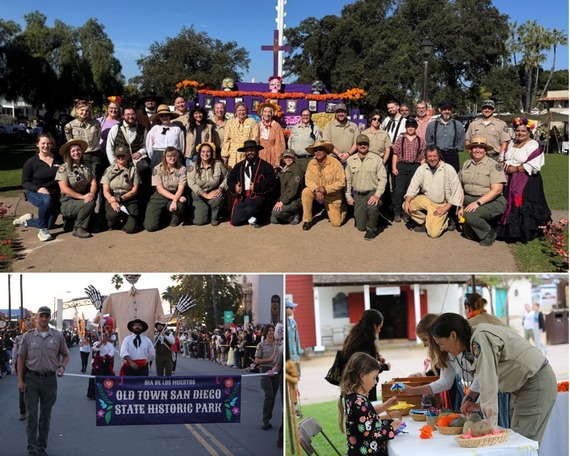 Top: Interpreters, volunteers and administrative team members pose in front of the community altar before Day Two begins. This is just a fraction of the team that made this event possible. Bottom left: Interpreters carry a 12-foot skeleton wearing a custom-made State Parks uniform down San Diego Avenue during the procession from Old Town San Diego State Historic Park to El Campo Santo Cemetery as more than 15,000 people watch. Bottom right: Interpreters and volunteers assisted over 7,000 visitors making historic crafts such as paper flowers and papel picado. All photos from Claire Nauman, San Diego Coast District.
Old Town San Diego State Historic Park celebrated Día de Los Muertos on Nov. 1-2, with a record setting 75,000 visitors enjoying historic altars, live music, ballet folklorico, a 12-foot community altar, historic crafts, student art show and more.
Saturday and Sunday visitors joined California State Parks and the Old Town Chamber of Commerce for a full day of live music and performances, story time with San Diego Public Library, magic lantern shows, hands-on art activities such as decorating sugar skulls, making papel picado, and paper flowers. Visitors could add an offering to the 12-foot-tall community altar or add their loved one's name to a wooden butterfly display on the park’s historic ficus tree. Saturday evening, over 1,000 families pulled up blankets and chairs to watch the Disney movie “Coco” in the plaza and were treated to a “Thriller” flash-mob before the show!.
Sunday evening, over 30,0000 visitors watched as, State Parks staff in period clothing (and a 12-foot skeleton in a State Parks uniform, including Stetson), joined Catrina’s, traditional Aztec dancers and the Diablos from Oaxaca in a candlelit procession from Old Town San Diego to Campos Santos Cemetery in the historic district.
This event would not have been possible without the support of many departments and park units, and outside organizations including the Old Town Chamber of Commerce, The Boosters of Old Town, San Diego Public Library, Park Concessions, and our State Park maintenance workers, interpreters from San Diego Coast District and Interpretation and Education Division, public safety officers, and administrative staff. This year, Old Town San Diego staff were joined by attendees of the Interpretive Special Events Training who came to the park starting on Wednesday to learn more about event planning, preparedness, and assisted with prep and execution of the event.
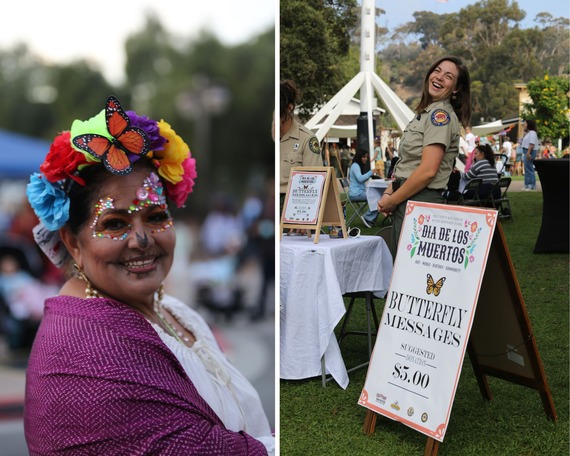 Left: State Park Seasonal Interpreter Araceli Ortega prepares for the Nov. 2 procession down San Diego Avenue wearing period attire and catrina makeup. Right: State Park Interpreter I Claire Andrews assists families with messages to loved ones in the “Butterfly Grove.”
Sonoma State Historic Park Celebrates Día de Los Muertos with Sonoma County Community
Story from: Deborah Lee, Bay Area District
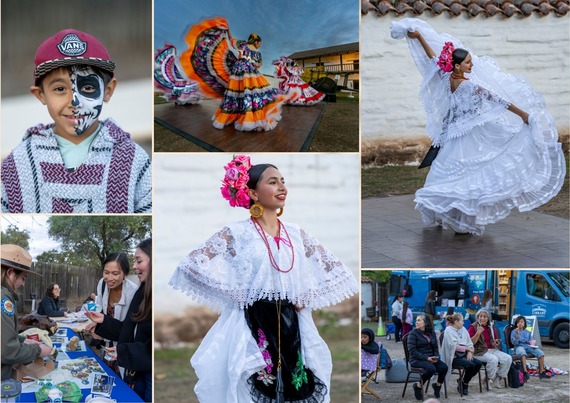 State Parks staff, visitors and dancers all took part in celebrating Dia de Los Muertos at Sonoma State Historic Park. Photos from Brian Baer, Communications and Marketing Divisions.
Sonoma State Historic Park had another amazing Día de Los Muertos movie night on Oct. 24 at the Sonoma Barracks with our wonderful community partner, the La Luz Center. Luckily the weather cooperated, and guests enjoyed watching the movie “The Book of Life”, under the stars in the courtyard.
Guests also enjoyed the arts and crafts tables provided by the La Luz Center and Kids Scoop News, the perennial California State Parks skulls table, and face painting. Attendees browsed books in the Bibliobus from the Sonoma County Public Library. An ofrenda to the Vallejo Family and the PBS Artbound movie “Día de los Muertos" delighted those in the AV room. The Grupo Folklórico Quetzalén of Sonoma Valley dazzled the audience with traditional dances and attire. We had a robust raffle with prizes donated by numerous local businesses and our co-op Sonoma Petaluma Parks (SPParks).
No one went hungry or thirsty during this event! Gerado, with the Sonoma Community Center, provided delicious pizza made on the spot. The Granito Café served flavorful Mexican hot chocolate and spiced coffee. There were also fan favorites, pan de muerto (Day of the Dead bread) and popcorn.
We would like to extend a hearty thank you to the SPParks team for obtaining the City of Sonoma Recreation & Community Services Program Grant to help pay for this event. Nearly 200 guests enjoyed this year's event. See you all next year!
A Vibrant Día de Los Muertos Celebration at California Citrus State Historic Park
Story and photos from: Jose Cabello, Inland Empire District
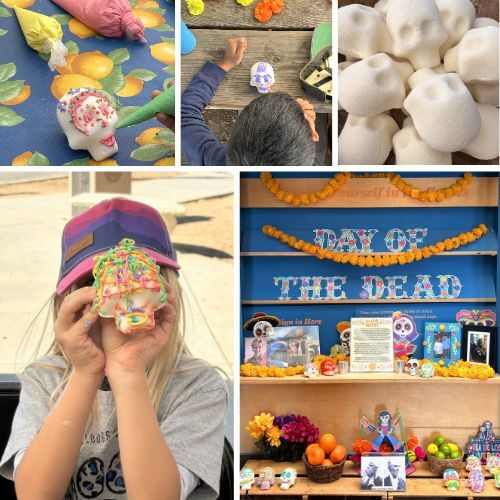 Scenes from this year's DÍa de los Muertos celebration at California Citrus State Historic Park, during which visitors decorated their own sugar skulls and donated them to the community altar.
California Citrus State Historic Park celebrated DÍa de Los Muertos on Nov. 1. Visitors had the opportunity to decorate their own sugar skulls, or calaveritas, a tradition meant to honor deceased loved ones. It’s common to write the names of loved ones across the foreheads of the skulls as a gesture of remembrance. This was my first time ever making sugar skulls, and I was really happy with the results. The process was surprisingly simple.
This holiday is meant to celebrate life and not see death as something to be feared. Altars or ofrendas are built and decorated with marigolds, food, photos of the deceased and much more. Several participants generously donated their sugar skulls to our community altar, making it even more vibrant.
My dream is to grow this event in the future with food vendors, performers and a face painter. Overall, I’m extremely happy with this year’s turnout and I can’t wait to do it again next year!
Dance, Art and Storytelling at Antelope Valley Indian Museum's Native American Celebration 2025
Story from: Peggy Ronning, Great Basin District
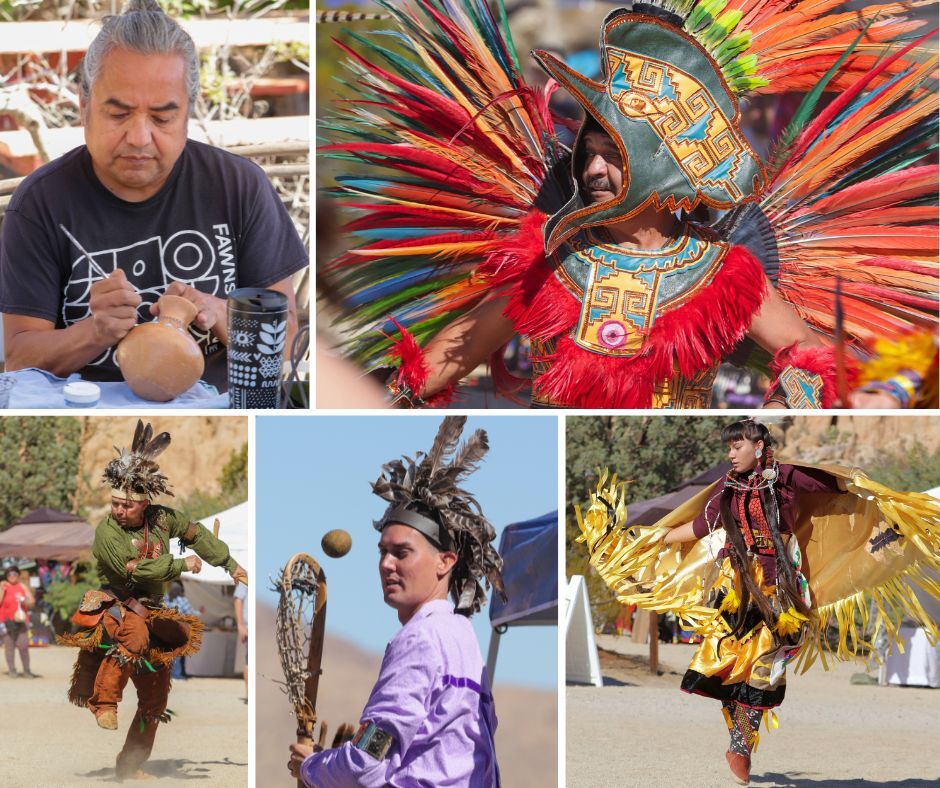 An outstanding group of artists presented traditional dances and arts to hundreds of visitors at Antelope Valley Indian Museum's annual Native American Celebration. Photos from California State Parks.
Close to 900 visitors, dancers and artists enjoyed blue skies and 80-degree temperatures at the Antelope Valley Indian Museum State Historic Park 2025 Native American Celebration on Oct. 18-19. (Antelope Valley residents also appreciated that there was no wind instead of the usual 14 to 20 mph sand-filled gusts.)
Friends of the Antelope Valley Indian Museum (FAVIM) board member Cydnee Ashmore (Diné) organized an outstanding group of artists for the dance arena. Blue Star (Northern Traditional) and Kaelene Ashmore (Diné) provided songs. FAVIM board member Sage Romero (Paiute/Taos Pueblo) and Caitlin Ashmore (Diné) gave a hoop dance exhibition, including a workshop with volunteers from the audience. Danza Azteca Xochipilli presented traditional dances and regalia from the Aztec culture. Survarious Twoknives and his son (Mohawk), Thomas James Reed (Oneida), and Michael Runningwind (Seneca) demonstrated the Iroquois smoke dance.
The Fernandeño Tataviam Band of Mission Indians (FTBMI) shared their culture at Joshua Cottage. Elders Ted and Dennis Garcia provided the blessing for the event and told traditional stories. They were joined by the Fernandeño Tataviam Band bird singers. Tribal staff provided information about tribal programs such as the Sikwa’puhawam Urban Forestry project.
Fourteen artists interacted with visitors and displayed their creations, including pottery, gourd art, jewelry, crafts and food. The State Parks maintenance, interpretive, visitor services, peace officer, cultural resources and volunteer staff and their partners on the FAVIM board of directors that worked so hard to plan and set up the event were thrilled that the participants and visitors were happy and had a good time.
State Parks Dive Team Helps Preserve History Beneath the Waves
Story from: Todd Shanklin, Orange Coast District
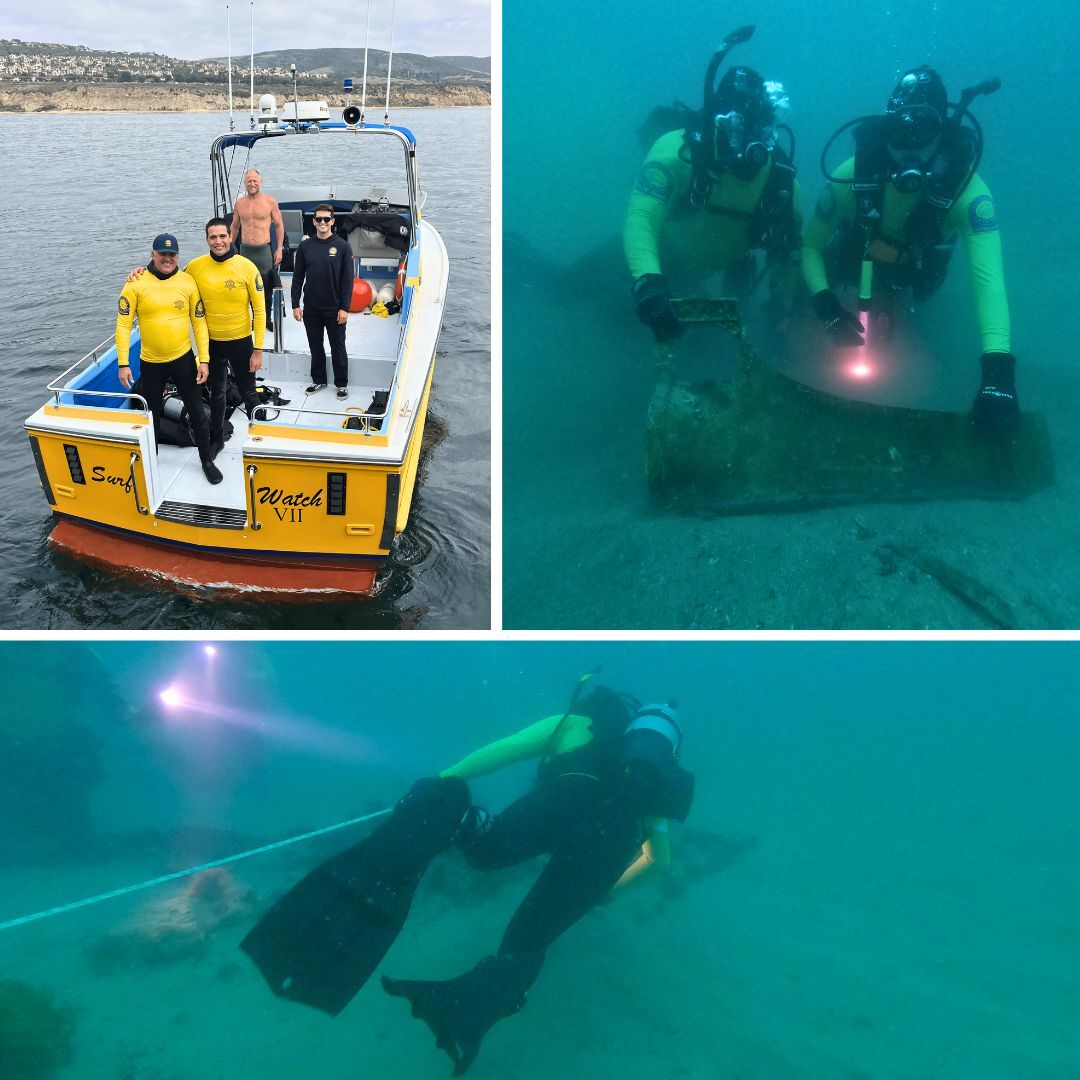 Clockwise from top left: Lifeguards Jon Hernandez, Andy Mendoza, Todd Shanklin and Jake Carrera aboard a Surf Watch vessel as they arrive at the site of the Corsair wreck. Photo from Ken Kramer, Training Section. Hernandez and Mendoza pose with an uncovered panel from the Corsair discovered buried nearby. Lifeguard Cameron Faris swims a measuring tape across the length of the plane's wingspan. Photo from Todd Shanklin, Orange Coast District.
State Park Dive Team members joined forces with Los Angeles Port Police (LAPP) and scientific divers from the University of Southern California (USC) to survey the wreck of a World War II-era F4-U Corsair resting on the ocean floor in the Crystal Cove Marine Protected Area on Oct. 25.
The history of the wreck dates back to 1949, when the Corsair took off from Los Alamitos Air Station for a routine training flight to San Diego, experienced engine difficulties off Laguna Beach and crashed into the sea. The pilot was quickly rescued by a passing fishing boat, but the Corsair sank and was forgotten until 1961, when military divers discovered the wreckage by accident. When Crystal Cove became a state park in 1979, the site became a managed underwater cultural resource. The condition of the plane has been consistently monitored by archaeologists since.
During the dive, lifeguard divers arrived on Surf Watch boats and helped LAPP locate the wreckage using their underwater ROV (remote operated vehicle) by using their plotter and dropping a marker buoy on the coordinates of the wreckage. They then assisted the LAPP and USC teams perform photogrammetry surveys, taking measurements and photographing artifact placement and wreckage condition.
Because the wreck sits 70 feet underwater and can be difficult to find, locating it was a true team effort. Once discovered, divers successfully captured a wealth of data for the archaeological record. Well done to the team!
Inland Empire District Enhances Emergency Preparedness with Groundworks Grant
Story and photo from: Alexandra Jonassen, Inland Empire District
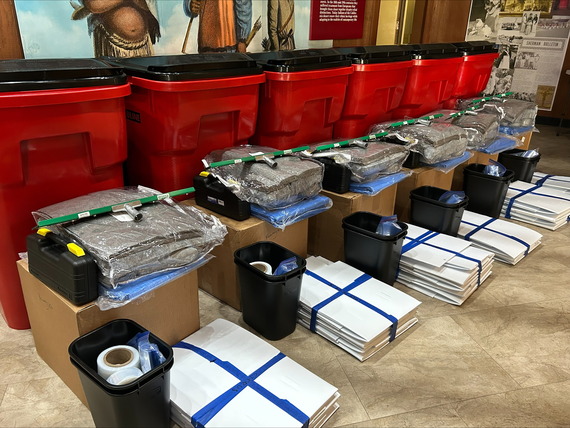 The emergency kits being packaged at the Ya'i Heki' Regional Indian Museum at Lake Perris State Recreation Area.
The Inland Empire District recently received a Groundworks Grant I award to improve emergency preparedness for its collections and facilities. This grant provides funding for the purchase and collection of emergency evacuation supplies, preservation materials and specialized staff training.
With this support, the district assembled and distributed eight comprehensive emergency kits, ensuring that each park unit and collections storage area is equipped with essential resources. Each kit includes a water emergency kit, a collections recovery kit, personal protective equipment and written guides detailing response procedures for a variety of emergencies. The materials are stored in durable trash cans, allowing for easy storage and quick transport during an emergency.
These kits will enable on-site staff to respond immediately to collections-related emergencies such as water leaks, approaching wildfires or other disasters. Before this initiative, park units often had to locate supplies or rely on deliveries from other district offices — delays that could prove costly when time is critical.
In addition to the physical supplies, the grant funds staff training on emergency response and collections prioritization. Trainings will cover digital preservation strategies, building care, preventative maintenance and fire mitigation, further strengthening the district’s overall resilience.Having the necessary materials and knowledge readily available will ensure that museum and visitor center collections are better protected in the face of unforeseen events. These efforts represent a significant step forward in safeguarding the region’s cultural and natural heritage.
The Groundworks Grants Program, administered by the California State Library in partnership with Myriad Consulting and Training, is part of the library’s Ready or Not: California Cultural Heritage Disaster Preparedness Project, funded by the State of California. The Inland Empire District extends sincere thanks to the Groundworks Grant program for their generous support.
Up, Up and Away: Helicopter Contributes to Fuels Reduction Project at Castle Crags State Park
Story and photos from: Rosie Blackburm, Northern Buttes District
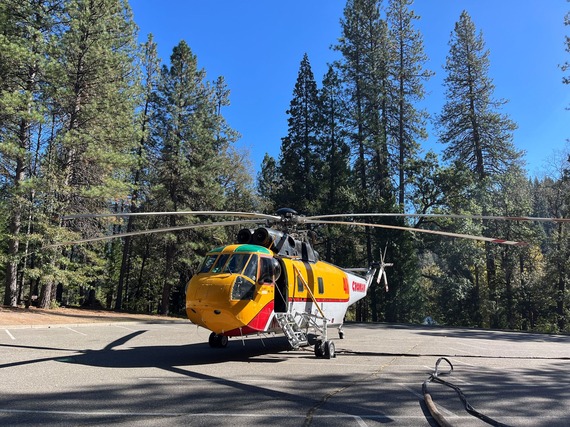 A Sikorsky S-61 rests at a landing site in Castle Crags State Park during a fuels reduction operation.
Northern Buttes District conducted a helicopter operation at Castle Crags State Park (SP) as part of the ongoing fuels reduction project in the Root Creek Basin. Within 24 total flight hours, more than 2 million pounds of material were removed from roughly 20 acres of steep terrain. These slopes were specifically targeted because they could not be safely or effectively treated using ground-based equipment.
This operation required extensive coordination across multiple units to ensure safety and efficiency. District natural resources staff collaborated with the Natural Resources Division (NRD), maintenance, public safety and visitor services to manage logistics, minimize disruptions and ensure the safety of both staff and the public. The park was closed for the duration of the operation, with signage posted to inform visitors about the project’s objectives and its importance to forest health and community safety.
State Parks contractor Warner Enterprises, with subcontractor Croman Corporation, carried out the helicopter work following several months of preparation. Tree marking and prescriptions were completed by natural resources staff under the guidance of NRD foresters. The project outcomes support the district’s long-term forest management goals, resulting in improved forest health, increased biodiversity and reduced stand density — key steps toward creating a more resilient landscape in Castle Crags SP.
The next phase of the project will focus on developing a comprehensive burn plan and implementing a broadcast burn in collaboration with NRD. This prescribed burn will further reduce surface fuels, promote native vegetation recovery and build upon the progress achieved through the helicopter operation.
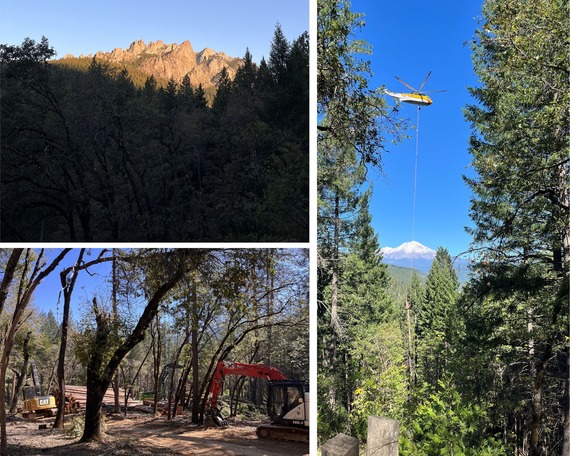 Clockwise from top left: Castle Crags at first light. The Sikorski S-61 helicopter picking up trees with Mount Shasta in the background. Landing zone operations in the park.
Who Were the Zephyrettes? California State Railroad Museum Staff Connect with a Former Stewardess
Story from: Miranda Bello and Ileana Maestas, Capital District
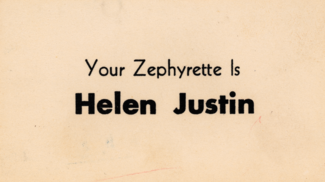
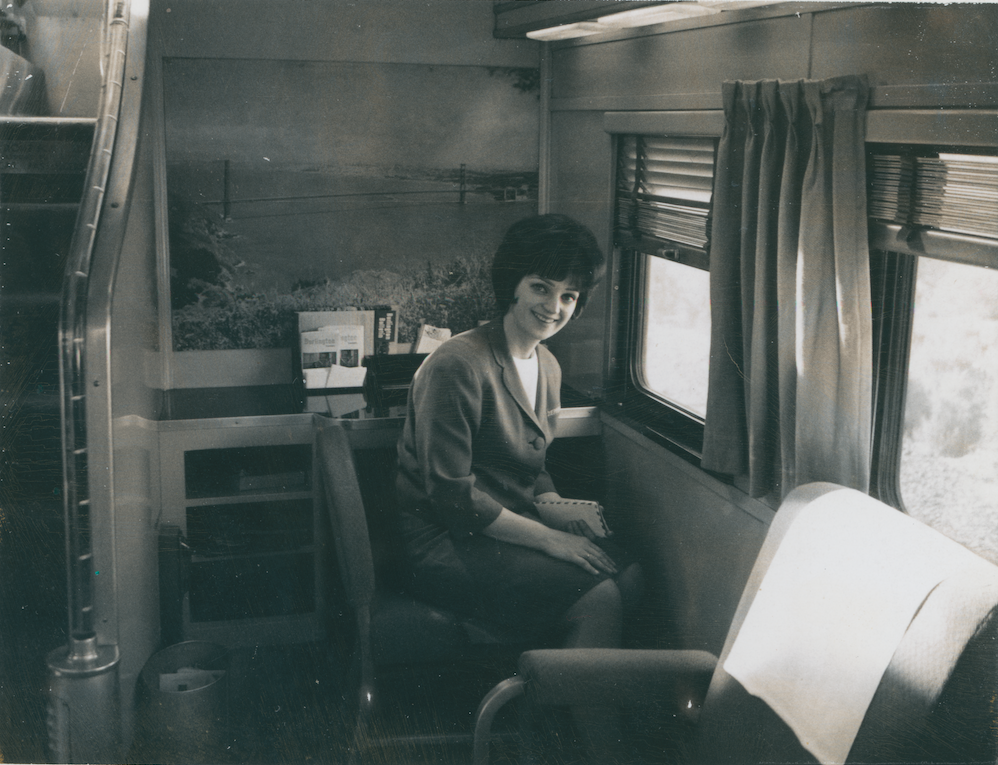 Above: Photograph of Helen Justin from the Helen Justin Webb Collection. Below: Helen Justin Business Card from Helen Justin Collections. Images courtesy of the California State Railroad Museum Library and Archives.
While doing research in the archives of the California State Railroad Museum (CSRM), Senior Park Aid and Curatorial Assistant Miranda Bello located objects associated with the Zephyrettes. The California Zephyr ran from 1949 to 1970 and was designed to make passenger train travel more appealing than flight travel and competing passenger trains. Numerous employees made passengers’ ride more comfortable and the Zephyrettes worked as stewardesses making rounds on the three-day trips from Oakland to Chicago, checking on passengers and attending their needs. Miranda discovered the luggage of Zephyrette Helen Justin in the CSRM collection and decided to do more research. Her hard work led to locating Helen Justin Webb, who is now living in the Bay Area.
Helen was a Zephyrette from 1964 to 1970 and her older sister Dolores was one of the first group of nine Zephyrettes to be hired in 1949. She remembers that recruiters for the positions were looking for young women who were intelligent, outgoing and attractive. According to Helen, the list of regulations for those applying for the Zephyrette job were not strictly applied and she claimed that she herself was over the suggested weight. One of the first tasks a Zephyrette did was hand out their cards introducing themselves to all the passengers and the pictured above is one of Helen’s cards. Helen remembers her time on the rails fondly and thought it was a marvelous experience that one hardly deserved to get paid for, though she did admit that on some runs you more than earned your pay.
Helen was delighted to find out about Miranda’s project and ended up donating several more objects to the archives, including a photograph with herself in the uniform she donated to CSRM previously, correspondence and an annotated Zephyrette manual.
|
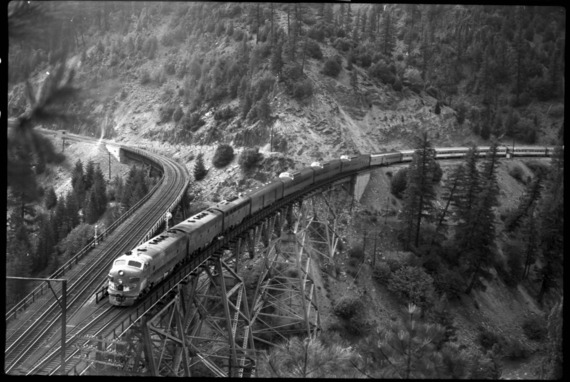 The California Zephyr ran from 1949 to 1970. Photo from California State Railroad Museum.
California Boating and Waterways Commission to Host Next Meeting During Marine Recreation Association's Annual Convention
Story from: Kevin Murphy, Communications and Marketing Division
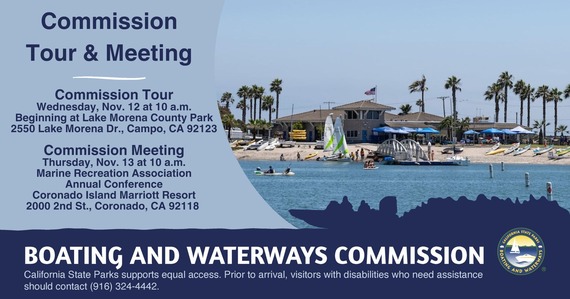 As part of its last tour of the year, California Boating and Waterways Commission will visit three sites in San Diego County next week. You can join the commissioners for the tour on Wednesday, Nov. 12, at 10 a.m., beginning at Lake Morena in Campo, to view a proposed boat launching facility project. Additional stops will include the Shelter Island Boat Launching Facility in San Diego and Crown Cove Aquatic Center in Coronado. The tour is expected to end at 5 p.m.
A Commission meeting will follow on Thursday, Nov. 13, at 10 a.m. at the Coronado Island Marriott Hotel. The meeting will be held in conjunction with the Marine Recreation Association’s annual conference. The association represents marinas, boatyards and allied businesses throughout the Western U.S. The agenda will include comments from the commissioners on the proposed grant for Lake Morena and updates from the Division of Boating and Waterways. The public can join commissioners at the meeting in person or participate virtually via Zoom or CAL-SPAN.
Agendas and additional information for both the tour and meeting are available here. Registration links to join the Commission meeting virtually are also available on the website. For more information about the California Boating and Waterways Commission, visit the Commission webpage. California State Parks supports equal access. Prior to arrival, visitors with disabilities who need assistance should contact 916-324-4442.

|