PHOTO OF THE WEEK
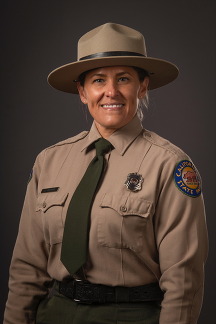
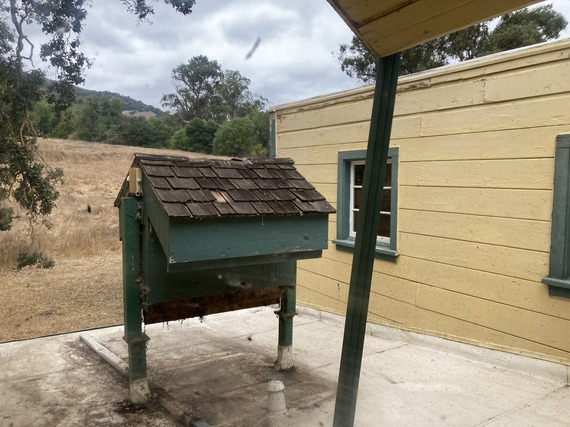
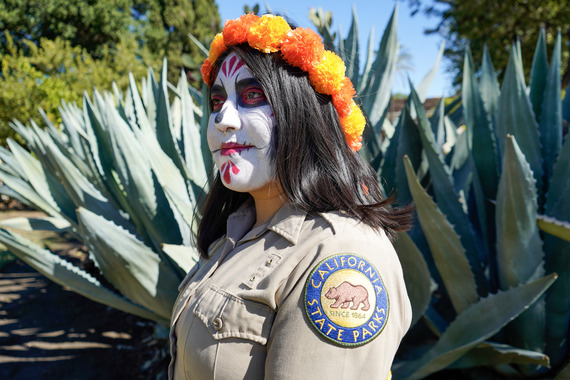 Los Encinos State Historic Park
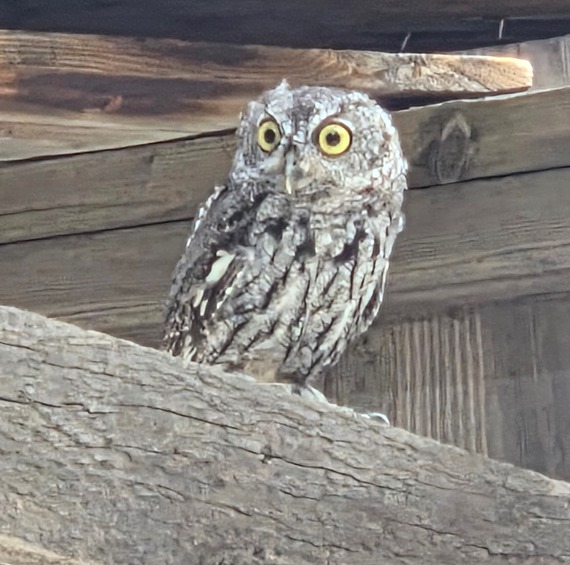
Angeles District has not just one, but two Dia de Muertos events coming up (see Upcoming Events, below). Park Aide Tatiana Estrada is ready for it.
Photo from Cassandra Chavez, Angeles District
Summer Rains Spark Monsoon Blooms in Anza-Borrego Desert State Park
Story and photos from: Brianna Pinto, Colorado Desert District
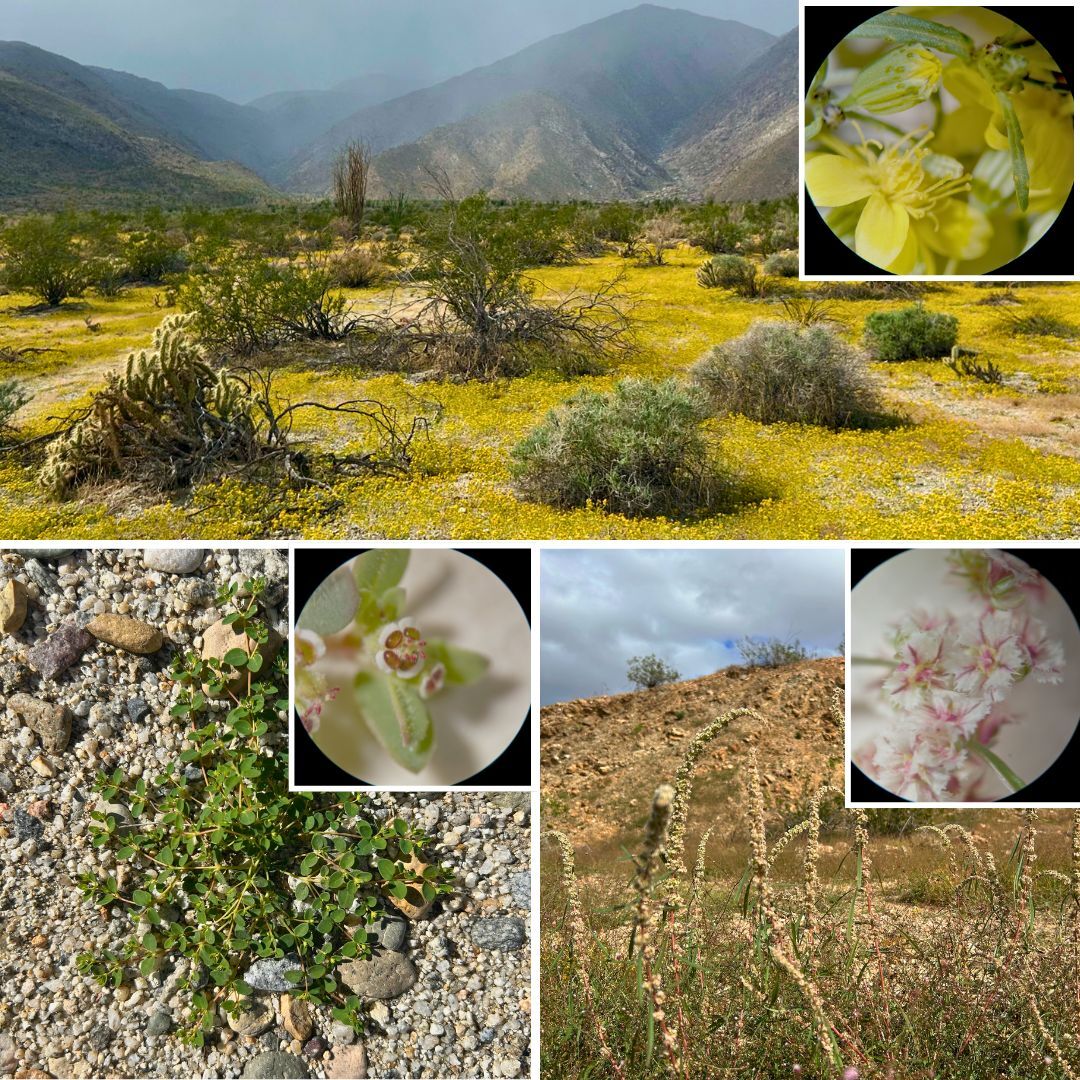 Monsoon flowers as seen by the naked eye and under a microscope (in the inset of each picture). Clockwise from top: Yellow chinchweed, fringed amaranth and euphorbia.
Meet Anza-Borrego Desert State Park’s monsoonal annuals: short-lived plants that can bloom, when conditions are right, at the end of summer.
Following heavy late-summer rains, yellow chinchweed (Pectis spp.) paints drainages in areas of Anza-Borrego near the town of Borrego Springs. Under a microscope, oil glands are visible. These give the flower its distinctive “spicy" scent.
Look carefully along popular trails to spot foot-tall stems of fringed amaranth (Amaranthus fimbriatus) waving in the autumn breeze. A closer look at the flowers might provide a clue to how this plant came to be known as “fringed.”
Many species of spurges (Euphorbia spp.) spring up after the summer rains. While they may seem like green groundcover from afar, a microscope reveals remarkably tiny flowers.
If you visit Anza-Borrego after the rains, you might just catch these short-lived wildflowers showing how water can bring a desert to life. As a reminder, desert terrain changes due to weather. Most dirt roads require vehicles with AWD or 4x4. Some areas can only be traversed with a high clearance vehicle.
State Park Peace Officers and Lifeguards Strengthen Statewide Response Through Swift Water Rescue Training
Story from: Ennio Rocca, Training Section
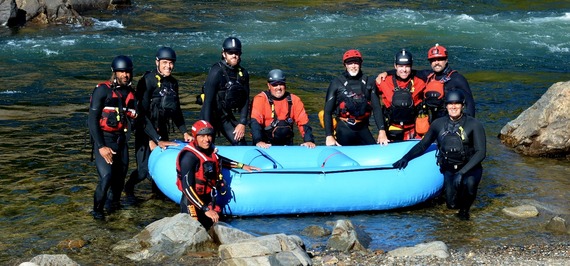 Swift Water and Flood Rescue Tech Advanced Group 3, from left to right: Nate Elmore, Nick Tuttle, Micah Moore, Shane Scoggins, Instructor Don Lester, Dave Terry, Drasko Bogdanovich, Jack Valdez and Ennio Rocca. Photo from Elizabeth Parino, Training Section.
From powerful snowmelt surging down Sierra rivers to sudden desert flash floods and unpredictable coastal storm surges, water remains one of California’s most formidable and dynamic natural forces. For California State Parks, preparing to meet challenges head-on is essential to our mission of public safety and resource protection.
Recently, state park peace officers (SPPOs) and lifeguards from across California united for an intensive three-day swift water rescue course along the American River near Coloma, one of the state’s most iconic and challenging training environments. Over the course of three demanding 10-hour days, participants immersed themselves in both classroom instruction and real-world field exercises designed to replicate the unpredictable conditions they may encounter in the field.
The curriculum combined technical knowledge with hands-on experience, requiring participants to complete classwork, nightly assignments and field-based problem solving. Training included advanced victim approach strategies, throw-bag deployment, contact and self-rescue maneuvers, specialized rafting techniques, rope-based rescue systems and replacement operations used to safely remove victims from swift-moving water. Emphasis was placed on individual skill development as well as coordinated team response, critical capabilities when seconds count and conditions are constantly changing.
This training represents far more than a professional development course. It is part of a broader statewide strategy to strengthen water rescue operations, expand mutual aid capacity and ensure SPPOs and lifeguards are ready to respond to complex emergencies wherever they occur. During floods, rescues and severe weather events, our teams are often among the first to arrive on scene, and increasingly, they deploy beyond their home districts to support regional and statewide incidents.
Those capabilities have already proven essential. During last year’s flood emergencies, State Parks swift water teams worked alongside fire agencies, sheriff departments and the California Governor’s Office of Emergency Services to rescue stranded motorists, evacuate communities, and support search and recovery operations. These coordinated efforts, built on shared training and mission focus, enhance the effectiveness and resilience of California’s emergency response network.
The value of this training extends beyond emergency operations. The skills and knowledge gained by participants strengthen public outreach and safety messaging, improve how State Parks manages rivers and waterways and enhance preventive measures to reduce accidents before they happen. With a deeper understanding of how visitors interact with water-based environments, our teams are better equipped to safeguard both people and natural resources.
From rugged mountain rivers to inland waterways and expansive coastlines, State Parks manages 280 park units and hundreds of miles of aquatic environments. Swift water rescue training ensures that, no matter the location or the conditions, our public safety professionals are prepared to respond with skill, confidence and precision. This training is more than a certification; it is a clear demonstration of State Parks’ dedication to readiness, service and public safety. It reflects the department’s ongoing commitment to protect lives, preserve natural resources and ensure the millions of people who visit our parks each year do so safely.
Acorn Day at the State Indian Museum Demonstrates the Importance of a Native Food Staple
Story from: Ileana Maestas, Capital District
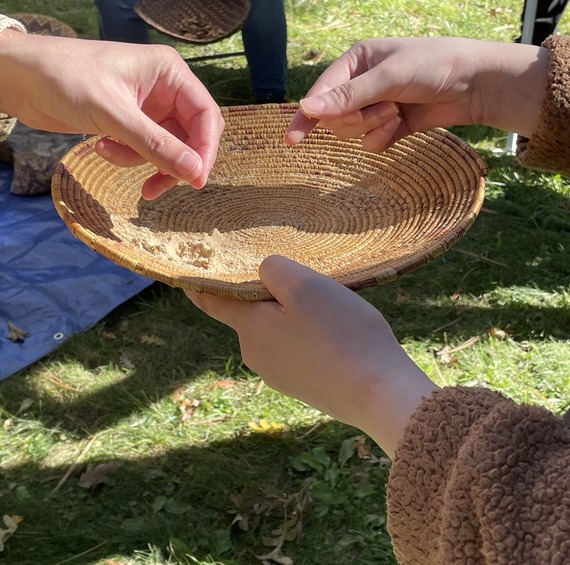 Guests feel freshly ground acorns during Acorn Day at the State Indian Museum. Photo from Kevin Murphy, Communications and Marketing Division.
The State Indian Museum in the Capital District hosted Acorn Day on Oct. 11, an event that has been celebrated on the grounds of the park since 1981. It has become one of the largest events at the museum, second only to the Honored Elders Day, which takes place annually in June. This family-friendly celebration was held outdoors under the sprawling oak trees surrounding the museum, all filled with a heavy crop of acorns.
Participants learned about the significance of acorns in California Indian culture and diet, as well as the importance of conserving native oak trees and their associated wildlife. Activities included demonstrations on acorn processing, basket weaving and flint knapping. Attendees also had the chance to create gel prints using oak leaves found in the park, make crafts with acorns, gather acorns on-site and learn from animal ambassadors such as insects and bats.
Twelve community groups set up tables outside the museum, including conservation agencies, Native advocacy groups and authors, Heyday Books and the California Highway Patrol NATIVE. The Bigfoot Frybread truck was also on-site, selling Indian tacos, frybread desserts and Native shortbread. The day was beautifully sunny and over 460 people attended.
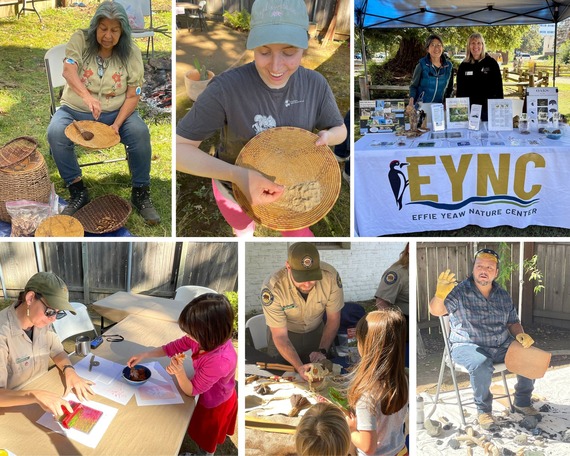 Top (left to right): Diana Almendariz (Maidu-Wintun), demonstrates the initial steps in the processing of acorns. Elizabeth Kubey, formerly of Parks California, examines freshly ground acorns. Effie Yeaw Nature Center was one of a dozen community groups attending this year's event. Pictured are Melanie Loo (left) and Kathy Moorse. Bottom (left to right): Guide I Theresa Havelka works with a young visitor to create oak leaf gel prints. Senior Park Aide Mike Hopper shares an animal skull with visitors. Edgar Huerta demonstrates the art of knapping to craft tools, including arrowheads. Photos from Kevin Murphy, Communications and Marketing Division.
Frontier Army Days at Fort Tejon State Historic Park
Story and photos from: Michael Deagon, Great Basin District
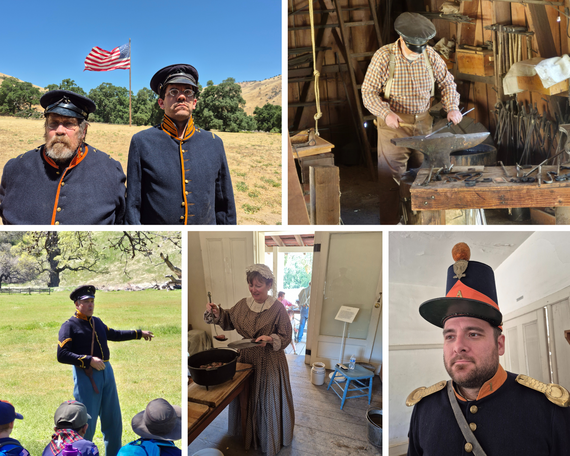 Staff and volunteers at Fort Tejon State Historic Park wore period attire and engaged with visitors during the park's Frontier Army Days event.
Fort Tejon State Historic Park hosted its Frontier Army Days event on Oct. 4. Visitors reported coming from communities around the region such as the Santa Clarita and San Fernando valleys, Bakersfield, Taft, Lancaster, and of course, from “on the mountain,” as the local residents of the Frazier Park area call it, in a bid to “time travel” to a remote frontier U.S. Army mountain outpost in the new state of California in 1856. A Scout troop even made sure to reserve the park’s group camp so as to incorporate the unique historic experience into their weekend.
Many a visitor experienced the opportunity to learn to make their own adobe brick; cook over a wood-fired open hearth; work with the Army blacksmith and farriers to make their own souvenirs; and even tried their hands, literally, at old fashioned laundry for the Army; as well as making their own candles for evening light. Park volunteers and staff were also on hand in and around the Army barracks portraying soldiers from the era to engage with visitors regarding military life and operations for the soldiers on the post nearly 170 years ago. The noon-time cannon drill and demonstration were a highlight for many visitors — and perhaps a little surprise, too, for passersby on Interstate 5.
Park staff and volunteers had the tiring, but gratifying occurrence of engaging with visitors from the official opening of the event until well after the official closing. To see groups of visitors still engrossed in historical park activities hours after they simply meant to make a quick bathroom break tends to be one the ol’ fort’s characteristic measures of interpretive success.
Cemetery Tours Return to Shasta State Historic Park
Story from: Wyatt Hein, Northern Buttes District
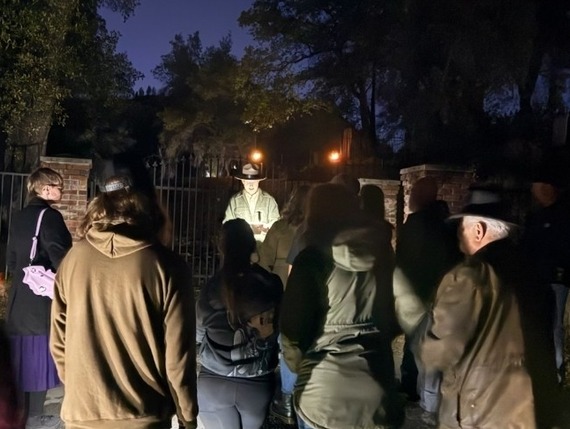 Interpreter I Jonathan Sutliff leads an evening tour of Shasta Union Cemetery. Photo by Robyn Alexander, volunteer, Northern Buttes District.
The return of the hauntingly fun Beneath the Autumn Moon Cemetery Tours at Shasta State Historic Park returned Oct. 10-11. Nearly 200 people joined park staff and volunteers to start the spooky season off right with a night of history and fun. Visitors registered for a guided tour and learned about the lives (and deaths) of pioneers buried in the Shasta Union Cemetery. Visitors also explored the museum after dark and enjoyed refreshments.
This event would not have been possible without the support of our wonderful volunteers, the Town of Shasta Interpretive Association and the planning and preparatory efforts of Interpreter I Jonathan Sutliff. We extend hearty thanks to everyone working behind the scenes to make this event happen and to the public who joined in making it another successful year!
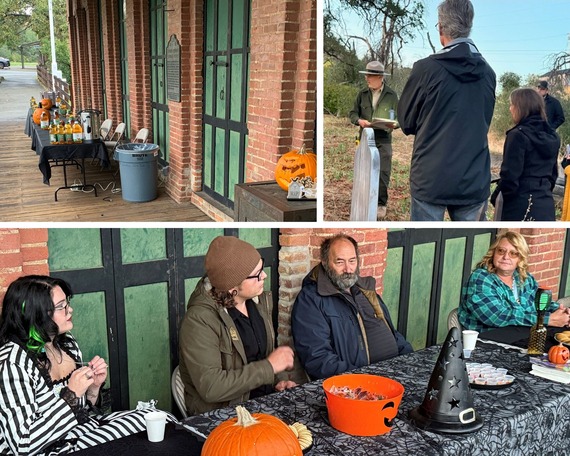 Top left: Refreshments and a greeting table in front of the courthouse museum. Photo from Wyatt Hein, Northern Buttes District. Top right: Interpreter I Jonathan Sutliff guiding the first tour of the day. Photo from Robyn Alexander, Northern Buttes District. Bottom: Our lovely volunteers waiting for the crowds. Photo from Mike Flanagan, Northern Buttes District.
Fossil Fragments of Camels, Rodents and Lizards Found During Paleontology Workshop at Red Rock Canyon State Park
Story from: Damion Laughlin, Great Basin District
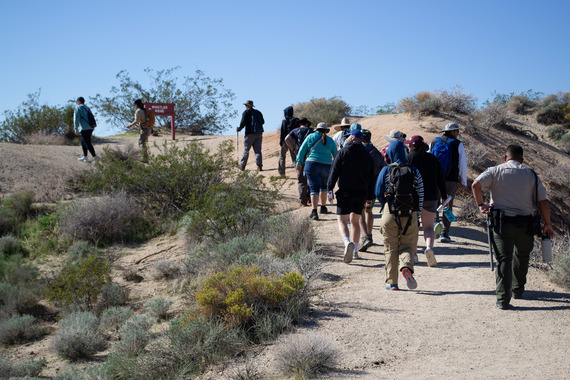 Attendees hike through Red Rock Canyon State Park as part of an annual paleontology workshop. Photo from Marc Jones, Red Rock Canyon Interpretive Association.
The annual Red Rock Canyon paleontology workshop for teachers, organized by the Red Rock Canyon Interpretive Association in partnership with California State Parks, was held on Oct. 11. The workshop was led by Jack Tseng, associate professor of vertebrate paleontology at University of California, Berkeley. Dr. Tseng is actively involved in ongoing research at Red Rock Canyon State Park (SP) and has provided numerous interpretive opportunities for the park's visitors.
This was a special day, specifically geared toward educators. Dr. Tseng was joined by 15 middle and high school teachers from the area. They all hiked from Ricardo Campground to three different locations in the park to discuss and experience the spectacular geologic and fossil history of the late Miocene time period (between 12 to 8 million years ago) in the western Mojave region.
Dr. Tseng relayed his satisfaction with the outing, stating, “In addition to learning about the formation of the classic red and gray sedimentary sequences that define the iconic landscape of Red Rock Canyon SP, participants also prospected for vertebrate fossils around the area.”
Dr. Tseng holds an active scientific collections permit with Great Basin District. “The recent precipitation (and heavy flooding) in the area apparently provided enough erosional energy to uncover new fossil fragments throughout the park," he said. "Among our finds were limb fragments of camels, pronghorn, rodents and lizards. Planning is already underway for another trip back to Red Rock Canyon to further investigate the extent of the newly exposed fossil concentrations in areas that were depleted of fossils for some years.”
That same evening, Dr. Tseng treated the park visitors and campers to an evening lecture on what happens after they find a fossil, highlighting some of the research his paleontology lab does on the fossils they find in the field.
Red Rock Canyon SP is world renowned for the fossil-rich formations in the exposed sedimentary layers that span millions of years. The park is a frequent destination for active field research from universities and professionals from all over the country. Many of the fossils found in the park are on display in the Ricardo Visitor Center in the park.
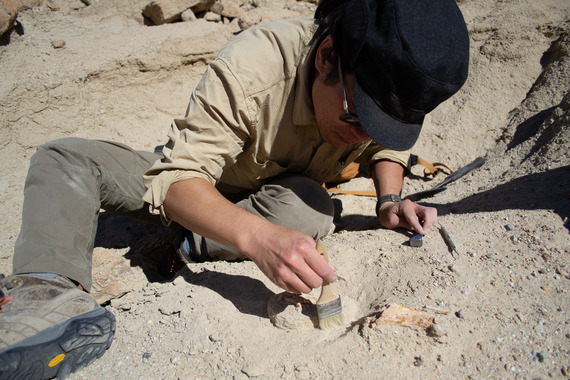 Dr. Jack Tseng unearthing one of the many fossils discovered during the workshop. Photo from Marc Jones, Red Rock Canyon Interpretive Association.
Cultural Resources Division Visits Indian Grinding Rock State Historic Park
Story from: Rachel Hensler, Cultural Resources Division
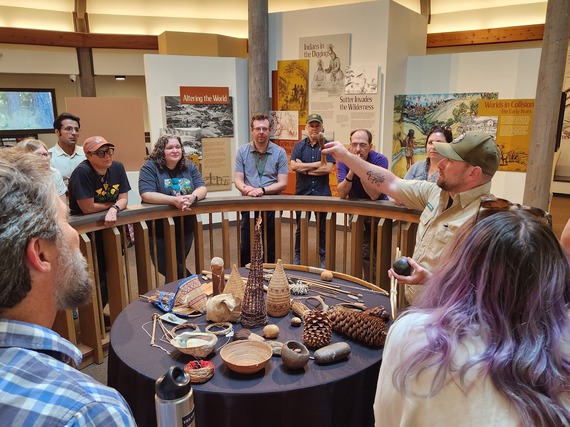 Indian Grinding Rock State Historic Park Senior Park Aide Mike Hopper shows off reproductions of cultural items to visiting staff from the Cultural Resources Division. Photo from Leslie Hartzell, Cultural Resources Division.
With the fall colors just turning, the Central Valley District welcomed Cultural Resources Division (CRD) staff to Indian Grinding Rock State Historic Park on Oct. 8. The 135-acre park preserves a massive outcropping of marbleized limestone, with 1,185 recorded mortar holes, where generations of Native Miwok have come together to process acorns and other plant foods for thousands of years. The park is known for both the Chaw’se Regional Indian Museum and reconstructed village structures that include acorn granaries, u’macha’ (bark houses in the Miwok language), and an actively used hun’ge (roundhouse).
Cultural Resources Manager Lee Eal shared stories about the unique ways cultural resource management is performed in close partnership with local California Native American tribes, ensuring stewardship of the park’s cultural and natural resources is done in consultation and collaboration with CRD. Thanks Lee Eal, Mike Hopper, Amber Sprock and all the park staff for their warm welcome, knowledgeable tour and productive discussions.
Superintendent Maria Mowrey Represents Bay Area District at Central California Singletrack Summit
Story from: Peter Ostroskie, Bay Area District
Bay Area District Superintendent Maria Mowrey recently joined trail leaders and advocates at the inaugural Central California Singletrack Summit in Fairfax. Hosted by the California Mountain Biking Coalition (CAMTB), the summit brought together park professionals, trail stewards and recreation partners from across the state for a weekend of learning, networking, and hands-on trail work. The event featured a full lineup of activities, from the Caballo Rojo Dig Day and a Freehub Film Night to lively workshops and discussions at Camp Tamarancho.
Participants explored key issues shaping the future of trails and recreation, including:
- Non-System Trails: Lessons from East Bay Regional Park District’s Briones Pilot Program.
- Agency Partnerships: New opportunities for collaboration with groups like Santa Cruz Trails and Mount Diablo Trails.
- Fire-Hardened Trails: Integrating resiliency into trail design.
- eMTB Policy: Navigating the growing role of e-bikes on public lands.
- Bicycling on Long-Distance Trails: A look at the ambitious Orogenesis/Sierra Camino Trail.
Building on the success of the original 2019 NorCal gathering, CAMTB has expanded its summit series to four regions - Northern, Central, Southern and Sierra - helping connect the state’s vibrant trail community through shared knowledge and advocacy.
Superintendent Mowrey shared that she “enjoyed hanging out and connecting with the trail community,” emphasizing how events like this strengthen California State Parks’ commitment to responsible recreation and lasting partnerships that keep trails open, sustainable and fun for all.
 PARTNER NEWS
More than $2.6 Million awarded to 30 organizations for 2025/26 Arts in California Parks program
Story and photo from: Parks California
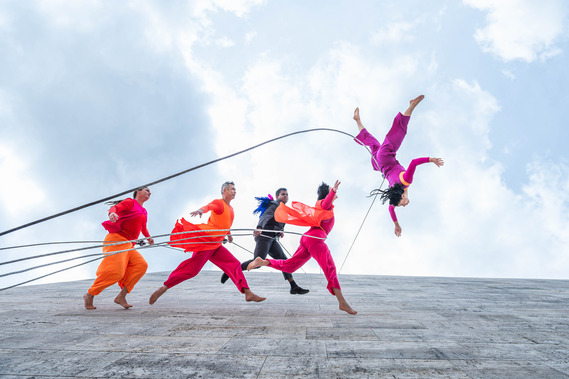 2024-25 grantees include Project BANDALOOP in Oakland that connects the human spirit, nature and communities through dance using climbing technology to challenge what is possible.
More than $2.6 million in community grants were recently awarded to organizations statewide as part of the Arts in California Parks partnership between California State Parks, the California Arts Council and Parks California.
Arts in California Parks, the multiyear, $8 million State Parks grants initiative launched in 2024, supports artists, culture bearers, California Native American tribes and local groups in creating art and cultural experiences in outdoor spaces. Thirty organizations were announced as recipients for 2025-26 grants ranging from $28,000 to $150,000. These funds will enable local nonprofit, community and tribal organizations to bring music, dance, storytelling, visual art and cultural programs into parks, transforming them into vibrant spaces that foster creativity, honor cultural heritage and strengthen community connections.
Projects reflect the diversity of California’s people and landscapes. From large-scale performances to culturally focused installations, each initiative provides opportunities for residents and visitors alike to engage with the arts while deepening their connection to nature and local history. Read the press release to learn more about the grantees and Arts in California Parks.

|