October Celebrates the Work of Archaeologists
Story from: Amy Eubanks, Office of Historic Preservation
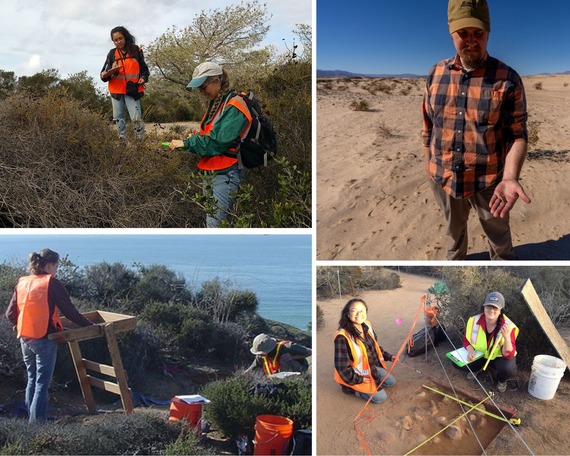 Archeologists play important roles in protecting California's cultural and historical resources. Photos from California State Parks.
October is Archaeology Month, a nationwide month of recognition created to celebrate the work of archeologists in preserving cultural heritage. In California, the month is highlighted during International Archaeology Day on Oct. 18.
Archaeologists play important roles within several state agencies in California. Inside State Parks’ Office of Historic Preservation (OHP), archaeologists work as part of the Archaeology and Environmental Compliance Unit. The unit supports the State Historic Preservation Officer's review of federal and state development projects for compliance with historic preservation laws, statutes and regulations. They also work alongside OHP historians to help ensure places of cultural and historical significance in California are considered and protected with concern to proposed federal and state development and land management projects. From the expansion of a highway to the maintenance of levees, federal or state-initiated projects are likely reviewed with the help of an OHP archaeologist. Additionally, these archaeologists also liaise with federal and state agencies in emergency situations, such as floods and wildfires.
The Archaeology and Environmental Compliance Unit comprises a diverse group of archeologists; however, a common theme in pursuing archaeology as a profession is their interest in learning about and preserving cultures. "As a descendant with a cultural connection to the Maya of Mexico and Central America, I became an archaeologist not only to honor that connection but also to ensure cultural histories are preserved with respect and meaning,” said Associate State Archaeologist Alvin Rosa-Figueroa. “This commitment extends beyond my own cultural heritage to include the cultural contexts of other descendant communities as well."
The variety of projects submitted for review provides the archeological staff with the opportunity to evaluate work being performed across the state. "I enjoy hearing from the people of California about what the rich culture and history of our state means to them and working with them to preserve it so that future generations can reflect on where they come from," said Senior State Archaeologist Brendon Greenaway.
Both Greenaway and Rosa-Figueroa acknowledge the role archaeologists play in identifying and connecting cultural artifacts with the present-day cultures, with Greenaway emphasizing to “always be mindful that first and foremost, the work archaeologists do should be in service to the living communities that descend from the places that we study and that the research questions that we ask should be relevant and meaningful to them.“
From working in the field at a state park to reviewing proposed federal and state projects, State Parks provides opportunities for archaeologists to develop and apply their knowledge. For those considering pursuing the field of archaeology, Rosa-Figueroa advises to “stay curious and keep learning, but also remember that archaeology isn’t just about artifacts; archaeology is also about living heritage.”
Learn more about this exciting field by visiting these resources:
Calaveras Big Trees State Park Celebrates 50 Years of Prescribed Fire with 'Harold Biswell Day'
Story from: Jim Suero, Central Valley District
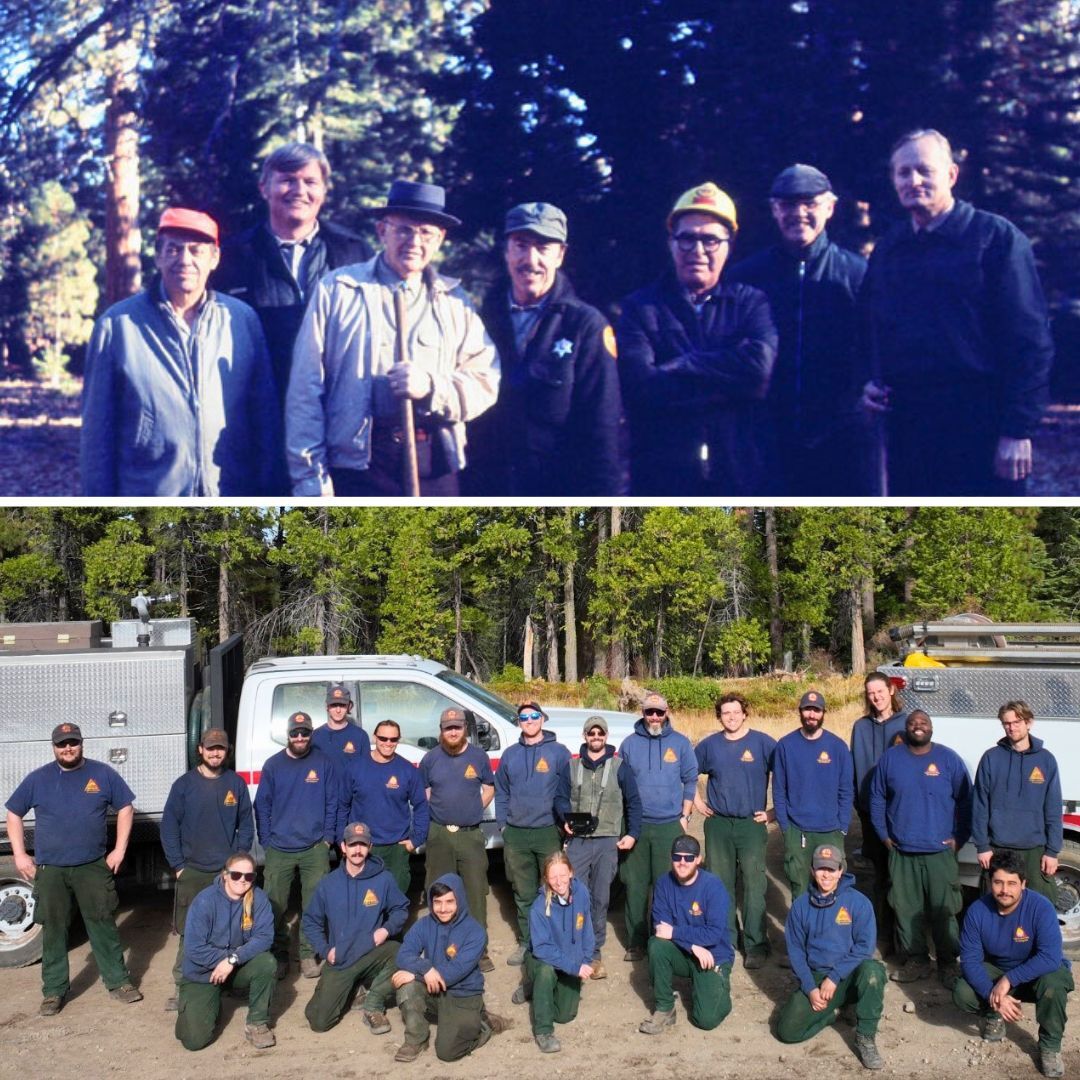 Top: The first State Parks crew to conduct a prescribed fire at Calaveras Big Trees State Park 50 years ago, pictured with Dr. Harold Biswell (third from left), whose pioneering work helped shape modern fire management. Bottom: The park’s current prescribed fire crew, continuing that legacy with a burn in South Grove last fall. Photos from California State Parks.
Calaveras Big Trees State Park (SP) celebrated 50 years of prescribed fire with an event aptly named "Harold Biswell Day" on Sept. 25. Harold Biswell was professor emeritus of forestry and resource management at the University of California (UC), Berkeley, and an early pioneer in the use of prescribed fire as a management tool in California. In the late 1960s and 1970s, his prescribed fire workshops drew attention statewide, including from California State Parks, which contracted with Dr. Biswell in October 1975. A month later, on Nov. 18, the first prescribed burn at Calaveras Big Trees was conducted in the South Grove Preserve, kickstarting a program that has advanced the use of prescribed fire in managing giant sequoia and Sierran mixed-conifer forests for 50 years. Dr. Biswell’s influence extended far beyond Calaveras Big Trees SP. He developed the first State Parks prescribed fire curricula and conducted numerous prescribed burns in parks around the state, including at Cuyamaca Rancho SP and Big Basin Redwoods SP.
The event included talks by UC Berkeley Research Fire Scientist Scott Stephens, UC Davis Forest Ecologist Malcolm North, UCLA Research Ecologist Jon Keeley and Ethnoecologist Kat Anderson. Also highlighted were the contributions of early State Parks resource management visionaries and pioneers, including Resource Protection Program Chief Jim Tryner, State Park Forester Fred Meyer, Plant Ecologist Dr. Jim Barry and Calaveras Big Trees SP Ranger Glenn Walfoort. In attendance were current and past members of State Parks' prescribed fire program, including Jim Barry, who conducted the first prescribed fire in a state park at Montaña de Oro in 1973, as well as members from Save the Redwoods League, CAL FIRE, the Giant Sequoia Lands Coalition and academia.
The celebration honored not only Harold Biswell’s groundbreaking legacy but also the generations of resource professionals whose dedication has shaped Calaveras Big Trees SP's forest stewardship and State Parks’ prescribed fire program over the past half century.
Soccer Balls and Sycamores: Refurbished Athletic Fields Open at Rio de Los Angeles State Park
Story and photos from: Planning, Public Affairs and Community Engagement Team, Angeles District
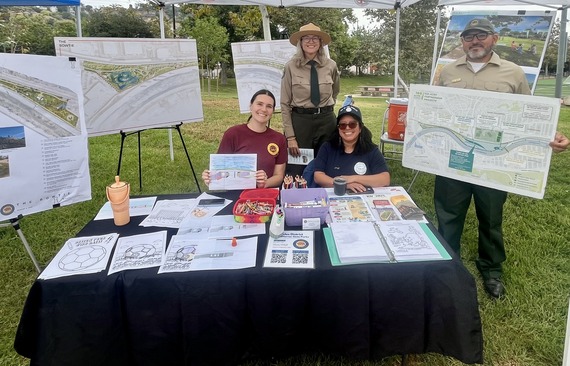 Community Engagement Team at Celebration, clockwise from top: Senior Park and Recreation Specialist Stephanie Campbell, Angeles District; Community Engagement Coordinator Luis Rincon, Angeles District; Staff Park and Recreation Specialist
Brenda Yancour, Angeles District; Bowtie Development Project Manager Kelsey Henck, Southern Service Center.
California State Parks, the City of Los Angeles, elected officials and community partners celebrated the opening of refurbished athletic fields at Rio de Los Angeles State Park State Recreation Area (SRA) on Sept. 27. If cutting the ribbon on brand new soccer fields seems out of the ordinary for a California state park, that's because active recreational facilities and programs are the exception rather than the rule. At Rio de Los Angeles State Park SRA, they are the result of an innovative partnership with the City of Los Angeles Department of Recreation and Parks, as well as a legacy of local environmental activism and community-centered planning begun over 20 years ago in downtown and northeast Los Angeles.
One of the flagship projects of State Parks' urban strategic initiative, opened in 2007, Rio de Los Angeles State Park SRA was designed to meet the complex needs of a densely populated urban community lacking in both naturalized open space and active recreational opportunities. In the early 2000s, the Coalition for a State Park at Taylor Yard fought for the creation of park space, rather than an industrial warehouse development on the former railyard complex. Community advocates such as Anahuak Youth Soccer Association voiced the critical need for active recreational opportunities, alongside desires for access to nature and open space.
The result is an innovative partnership wherein the City of Los Angeles operates approximately 20 acres of active recreational facilities including a playground; splash pad; and athletic facilities including soccer, baseball, and basketball; while State Parks maintains and operates 20 acres of seasonal wetland habitat. The wetland is home to a robust volunteer program and native plant restoration and stewardship opportunities, led by Angeles District Community Engagement Coordinator Luis Rincon.
The renovation was made possible by a grant of $4,75 million and was one of the first projects championed by the 100 Acre Partnership at Taylor Yard, which includes the City of Los Angeles, California State Parks and the Mountains and Recreation Conservation Authority. This multi-agency collaborative is focused on design, development and improvement of 100 acres of public land, including Rio de Los Angeles State Park SRA and the 18-acre State Park Bowtie parcel, adjacent to the Los Angeles River. Through efforts like the Taylor Yard Equity Strategy (TYES) and the 100 Acre Partnership, State Parks is helping ensure that NELA supportive communities thrive in place alongside investments in parks and open space. The future is bright for Rio De Los Angeles, where natural habitat and recreation not only coexist, but thrive, in this unusual ecosystem of soccer balls and sycamores.
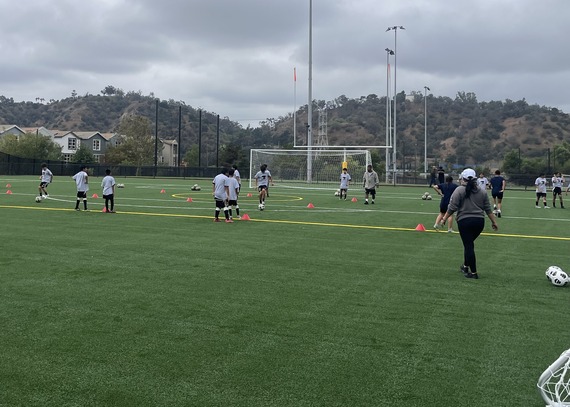 Area youth enjoying the use of refurbished sports fields at Rio de Los Angeles State Park.
Ohana Festival 2025 Hits the Shores of Doheny State Beach
Story and photos from: Michelle Figueroa, Orange Coast District
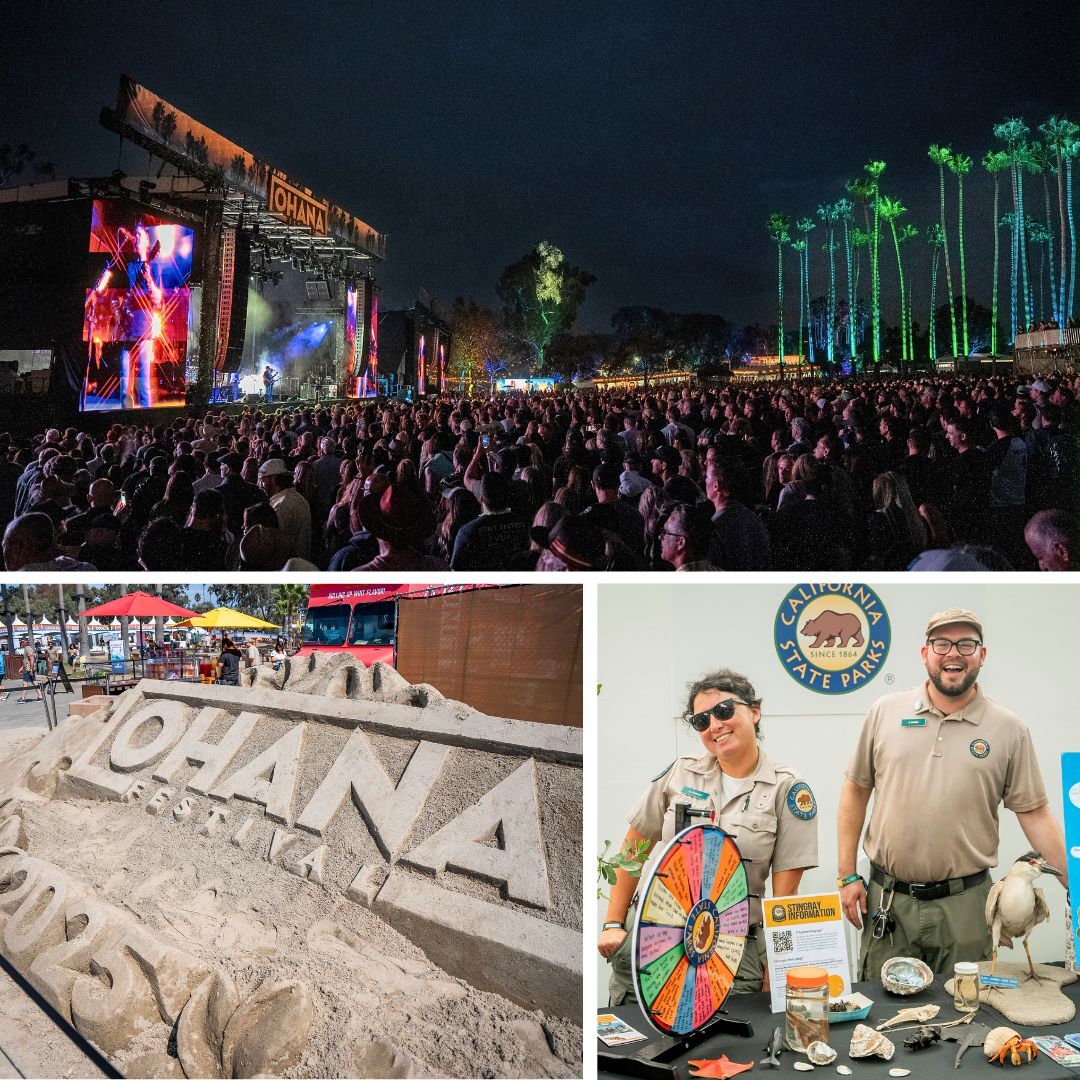 Clockwise from top: Kings of Leon delivers an unforgettable performance to thousands of Ohana Festival attendees. Interpretive staff Elizabeth Bailey and Joseph Buss invite guests to explore their table of marine creatures, along with ocean trivia. A hand-crafted sand sculpture within the festival grounds.
The 2025 Ohana Festival hit the shores of Doheny State Beach (SB) for another successful year of captivating live music, interactive educational booths and panels, and an array of art exhibits.
The festival featured over 35 performances from artists across multiple genres, including Kings of Leon, Leon Bridges, Hozier, Green Day, Cage the Elephant and Ohana Festival founder Eddie Vedder himself. Spanning two stages, the three-day festival brought a continuous hum of great music to beachgoers and festival attendees alike.
Accompanying the music, leading conservationists, environmentalists, researchers and professional surfers brought their storytelling skills to the “Cove” area of the festival grounds, where they spoke in detail about their passions for ocean conservation, environmental justice, art, community and Indigenous voices. The Cove also featured exhibits from State Parks, the Doheny State Beach Interpretive Association, San Onofre Parks Foundation, Crystal Cove Conservancy, Surfrider Foundation and many more partners.
Thank you to our California State Parks law enforcement officers and seasonal lifeguard staff, the Orange County Sheriff's Department (Dana Point) and Irvine Police Department for keeping the peace and ensuring the safety of our visitors. Additionally, thank you to the staff, festival crew and attendees that made this fun-filled weekend one for the books!
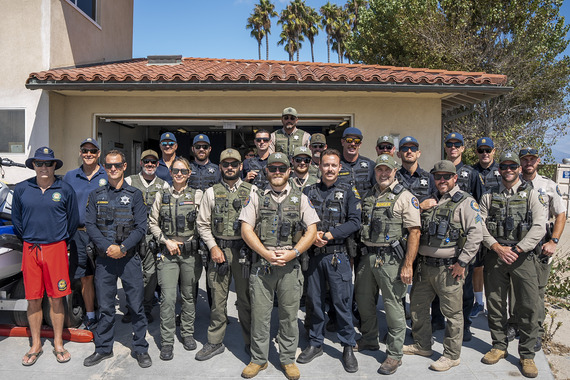 Law enforcement staff from all around the state and Orange Coast District seasonal lifeguards prepare for a jam-packed festival weekend in front of Doheny State Beach’s Lifeguard Headquarters building.
Clear Lake State Park Takes First Place at 2025 Kelseyville Pear Festival Parade
Story from: Tyler Lindberg, Northern Buttes District
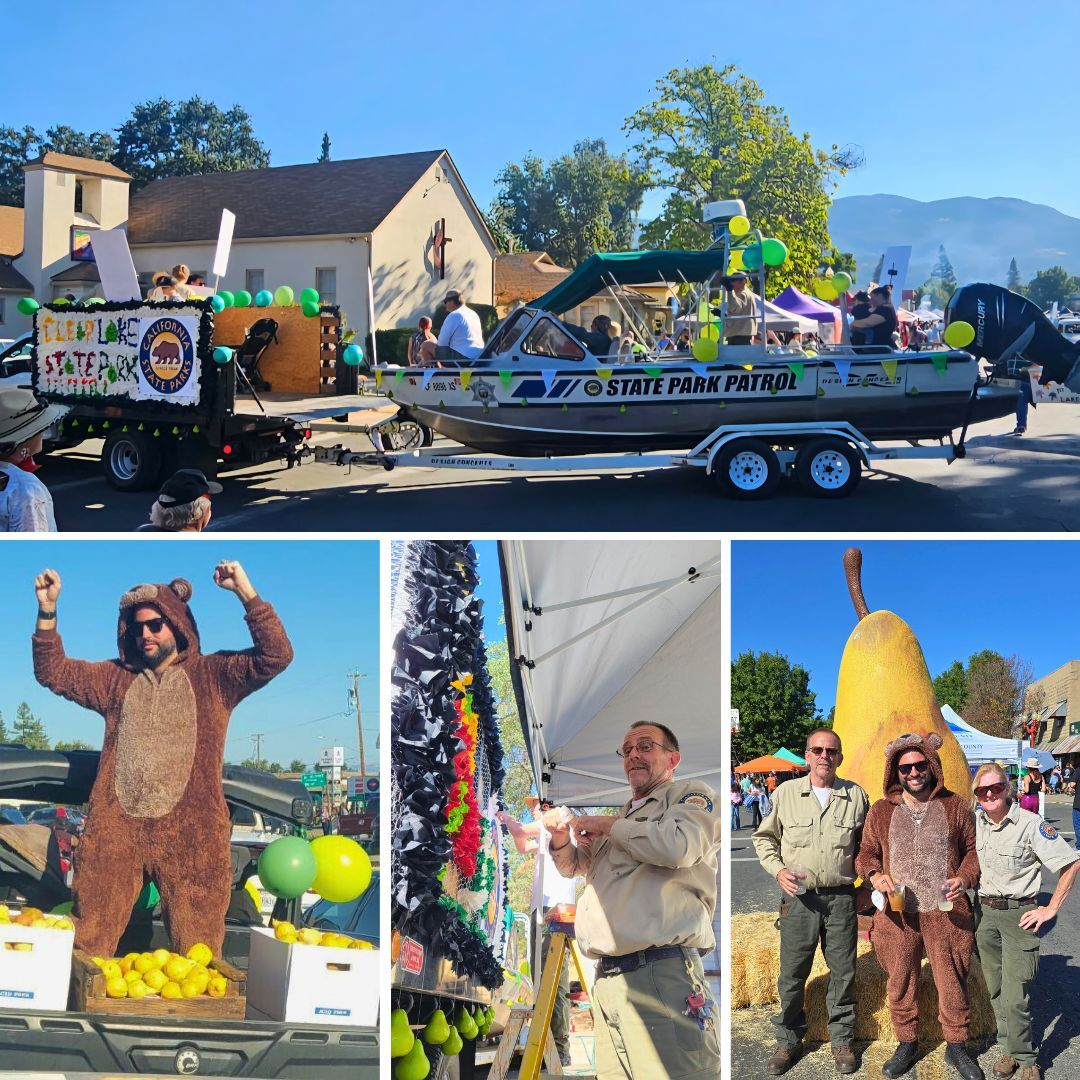 Clockwise from top: Clear Lake State Park's float makes its way down Main Street as part of the 31st Annual Kelseyville Pear Festival parade. Left to right: Park Maintenance Worker Kevin Maddux, Park Interpretive Specialist Tyler Lindberg and Park Maintenance Chief Wendy Lieberg. Maddux works on the float. Lindberg as the "Pear Bear" during the parade. Photos from Wendy Lieberg and Tyler Lindberg, Northern Buttes District, and parade attendee Bill VanDerWall.
Clear Lake State Park (SP) made a splash this year at the 31st Annual Kelseyville Pear Festival on Sept. 27, winning first place in the festival’s Grande Pear Parade with a creative and crowd-pleasing float that celebrated both the park as well as Lake County’s agricultural heritage.
The festival is one of Lake County’s most cherished annual events, drawing thousands of visitors to the small town of Kelseyville. It honors the region’s deep-rooted history of pear farming by bringing together the community for a day of live music, food and craft vendors, a farm-to-table dinner and competitions such as a pear baking contest, a pear pie-eating contest and the Grande Pear Parade. The parade features an array of floats, school athletics teams, local organizations and classic vehicles meandering down Main Street in front of cheering crowds.
This year, Clear Lake SP’s float wowed the judges and audience alike, winning first place over several dozen participating groups. The park’s theme for the float involved a thieving “Pear Bear” escaping with the park’s pears as park staff rode in a one-ton flatbed truck towing the park’s patrol boat in pursuit of the bear.
The Pear Bear was me, who designed and executed the completion of the park’s float alongside Park Interpretive Specialist Andrew Carpenter. Dressed in a head-to-toe bear onesie, I stood among boxes of pears from Mr. Carpenter’s orchard on a Can-Am driven by Park Maintenance Worker Kevin Maddux and accompanied by Sergeant Chris Glenn.
Park Maintenance Chief Wendy Lieberg drove the flatbed truck. The truck was outfitted with poultry wire meticulously stuffed with thousands of napkins spelling “Clear Lake State Park” in various colors, with each letter "A" in the shape of a Bartlett pear. Both vehicles were adorned with balloons, bunting and dozens of artificial pears. Park staff and relatives on the float lifted picket signs with messages such as “THAT BEAR STOLE OUR PEARS!"
This victory wouldn’t have been possible without the dedicated work of park staff and contributions from the Clear Lake State Park Interpretive Association (CLSPIA), who generously covered float expenses. We extend a heartfelt thanks to CLSPIA and Kelseyville Pear Festival organizers and volunteers for another unforgettable event.
Desert Lifeguards Complete Training at Hungry Valley State Vehicular Recreation Area
Story From: Kevin Overduin, Great Basin District
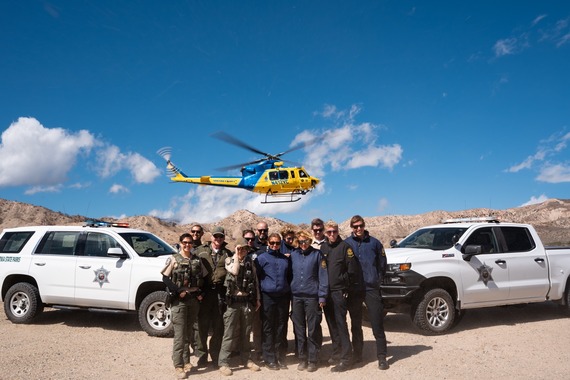 Feeling the exfoliating effect of Ventura County's helicopter, from left to right: Ranger Mckayla Butymhill, Ranger Kevin Overduin, Supervising Ranger Charles Verrigni, Ranger Chelsea Dulaney, Off-Highway Motor Vehicle Recreation (OHMVR) Division Assistant Chief Jack Gorman, OHMVR Division Chief Callan McLaughlin, Lifeguard Megan Ditlof, Lifeguard Cole Sturgeon, Lifeguard Quinn Nachbar, Chief Ranger John Cunningham, Lifeguard Tristan Sturgeon, Lifeguard Tivon Williams. Photo from Bobby Scruggs, Great Basin District.
Ah, fall. That lovely time of year with the relaxing shuffle of colorful dry leaves, the smell of pumpkin spice and the powerful roar of two-strokes and four-strokes kicking up dust in the desert. Fall means something else to the Great Basin District: Desert Lifeguard training.
This year, five new Desert Lifeguards answered the call to help protect the public who recreate in the Great Basin District. Before jumping into the busy season, the guards attended a three-day training designed to familiarize them with off-highway vehicles (OHVs), including OHV culture and potential injuries.
The vast desert landscapes, full of valleys, peaks, and washes, contain all manner of challenges that are distinct from the operations on California’s beaches. Still, the lifeguard’s wide knowledge base from their time by the water serves as a valuable foundation to build their skill in an off-highway setting.
The training included contributions from cooperating agencies that will assist the Desert Lifeguards in their efforts; projects structured around the unique pieces of equipment used in the OHV community; and high-stress scenarios designed to inoculate against the pressures that State Parks OHV emergency responders can see in the field.
Rangers from across the district assisted in the training. Off-Highway Motor Vehicle Recreation (OHMVR) Division Chief Callan McLaughlin and OHMVR Division Assistant Chief Jack Gorman also took the opportunity to meet the new lifeguards and explain the value and history of the program and detail some of the OHV Desert Lifeguard operations throughout the state vehicular recreation area system. They also participated as patients in scenarios.
In the end, the Desert Lifeguards completed the training with a high level of professionalism and confidence — and hair full of sand.
Audits Unit Hits the Dirt at Prairie City State Vehicular Recreation Area
Story from: Harmann Takhar, Audits Unit
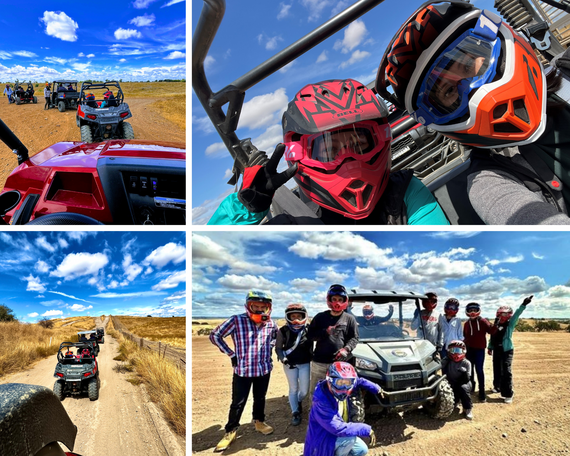 The Audits Unit traded spreadsheets for dirt trails at Prairie City State Vehicular Recreation Area. Pictured in the group photo, from left to right: Daniel Benitez, Jae Ellescas, Harmann Takhar, Audrey Lu, Dennis Carlson, Jasdeep Uppal, Megan Gramble, Amira Bontia, Sandeep Mangat and Dan Tran. Photos from Joleen Ossello, Gold Fields District, and Jae Ellescas, Audits Unit.
California State Parks' Audits Unit traded spreadsheets for dirt trails during a recent team outing at Prairie City State Vehicular Recreation Area (SVRA). Led by Audit Chief Jasdeep Uppal, the group spent the day learning about off-highway vehicle recreation and safety, guided by State Park Interpreter I Joleen Ossello.
Ossello provided excellent instruction on the basics of operating and maintaining safety while riding recreational off-highway vehicles. After a hands-on orientation, the team geared up and hit the open terrain, exploring the scenic trails and diverse landscapes that make Prairie City SVRA unique.
Throughout the day, staff learned about the history of the park and gained insight into California’s network of off-highway motor vehicle recreation (OHMVR) areas. Riding different types of off-highway vehicles offered both an exciting challenge and a new appreciation for the specialized work that goes into maintaining these recreation areas.
The outing was a memorable way to connect with States Parks' mission outside of the office, combining teamwork, learning and a little bit of adventure on the trails.

|