|
|
Welcome to DWR’s Yolo Bypass Fish Facilities Ops update, summarizing operations for all Yolo Bypass fish facilities for the 2024/2025 water year. This includes Sacramento River stage information, construction and status of the Big Notch Project, operations of the Fremont Weir Adult Fish Passage and Wallace Weir, and fish rescue operations. For more information about our program, please visit Riverine Habitat Restoration.
If you received this update, you’re on our e-blast notification list and will be updated on operational changes at Big Notch during the water year. To update your contact information or be removed from our e-blast list, send an email to BigNotch@water.ca.gov.
|
|
Sacramento River Stage
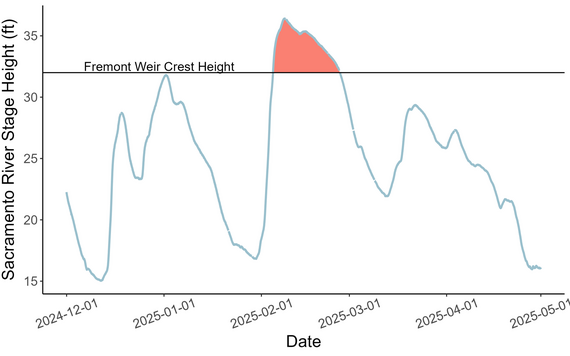 Figure: Graph of Sacramento River stage height (blue line) during operational period. The Fremont Weir Crest Height lays at 32ft indicated by the black line. Orange indicates overtopping of the Fremont Weir. Source: Rstudio, CDECRetrieve tool.
It was a notable water year in the Yolo Bypass with higher Sacramento River levels supporting water flow and fish migration. The Fremont Weir had a prolonged overtopping event with water flowing over the weir from the Sacramento River for 23 days (Feb. 5-27), causing inundation of the Yolo Bypass. All river stage data, including historical data, can be accessed via the California Data Exchange Center (CDEC). Information for this graph comes courtesy of the FRE station, which monitors the Sacramento River stage height at Fremont Weir.
|
|
Big Notch Project
Construction and Facility Operations
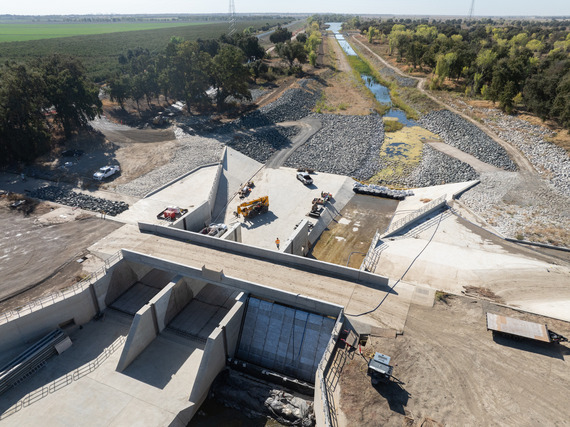 Photo: Construction of Big Notch continuing throughout the operational season.
Despite no gate operations occurring in the 2024/2025 water year due to weather-imposed construction delays, Big Notch construction continued throughout the season as water levels permitted. Stoplogs remained in place for the entirety of the operational window and overtopping event. Construction this year reached many milestones including increased power reliability, the addition of a back-up generator, and gate commissioning. With these construction milestones completed, Big Notch is anticipated to begin operations for the 2025/2026 water year.
The Yolo Bypass Fish Facilities will see huge changes in the coming water year with the anticipated operation of Big Notch! During operation, Big Notch is authorized to provide flow through the headworks to enhance juvenile rearing habitat and provide juvenile and adult fish passage. Flows through the headworks could begin as early as November 1. During the early season until March 15, flows through the three gates could go as high as 6,000 cfs. After March 15, operations will not exceed the available capacity of Tule Canal, around 1,000 cfs of flow. Tule Canal capacity is approximate and depends on flows from BNP as well as tailwater conditions from agriculture drainage, tides, and west-side tributary inflows, primarily Cache Creek and Knights Landing Ridge Cut.
If you received this newsletter, you are on our eblast notification list and will be updated on operational changes at Big Notch during the water year. To update your contact information or be removed from our eblast list, send an email to BigNotch@water.ca.gov.
|
|
Fremont Weir Adult Fish Passage
Facility Operations
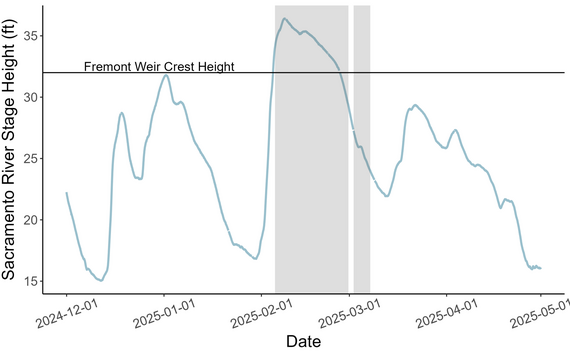 Figure: Graph of the Sacramento River stage height (blue line) during operational period. The Fremont Weir crest height lays at 32ft indicated by the black line. Gray highlight indicates periods the Fremont Weir Adult Fish Passage gates were opened. Source: Rstudio, CDECRetrieve tool
Fremont Weir Adult Fish Passage facility operations began on February 5, 2025, with DWR opening the gate following the start of overtopping. We used operational Scenario 2 for the first time this year. With this, the gate was closed following the end of overtopping on February 28, 2025 and was re-opened on March 3, 2025, once Sacramento River stage height reached 27 feet. During this time, fish passage continued and flow measurements were collected to update our rating curve for this facility. This rating curve allows DWR to better understand the amount of flow through the gate at different elevations of the Sacramento River. The gate was closed for the season on March 7, 2025.
|
|
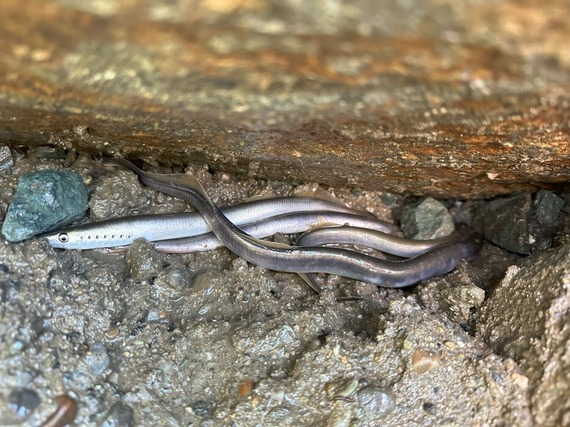 Photo: Lamprey rescued during the closing of the Adult Fish Passage gates during operational Scenario 2.
Power fluctuations at the Adult Fish Passage structure caused closure of the gate to be delayed by one day following the end of overtopping. Once gates were closed, 7 Pacific and 13 Western River lamprey were recovered and released.
|
|
Wallace Weir Fish Rescue Facility
A Brief History
The Yolo Bypass provides an ideal landscape for a variety of fish and wildlife including migratory, seasonal, and year-round residents. Juvenile migrating fish can easily find plentiful food resources in the shallow and slow-moving water. However, for upstream migrating adult fish, entering the Yolo Bypass at the wrong time may lead to a dead end.
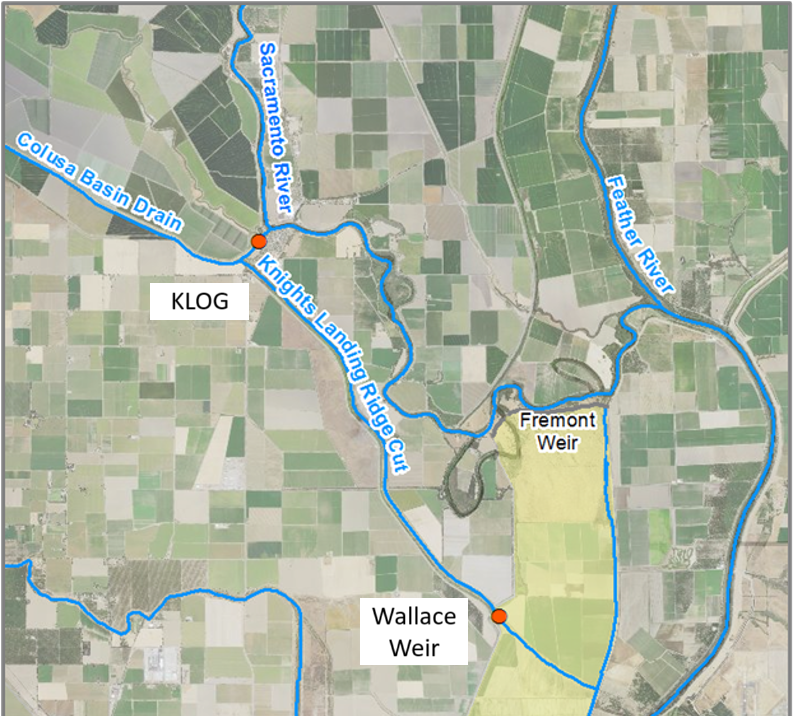
Wallace Weir, indicated by the lower red dot in the figure above, was previously an earthen weir that overtopped and allowed salmon passage into the Colusa Basin Drain near Knight's Landing Outfall Gates, indicated by the upper red dot, from the Knights Landing Ridge Cut Slough.
|
|
Why is Wallace Weir Important?
Photo: Spring 2013, salmon being rescued from Colusa Basin Drain.
In the spring of 2013, hundreds of endangered winter-run Chinook salmon strayed past the old earthen Wallace Weir and into the Colusa Basin Drain. Although California Department of Fish and Wildlife (CDFW) was able to rescue some of these fish, prolonged exposure to warm, poor-quality agricultural drainage water likely reduced their ability to complete their migration and spawn. It is estimated that 25% of the 2013 spawning population was lost in this event.
|
The Modern Day Weir
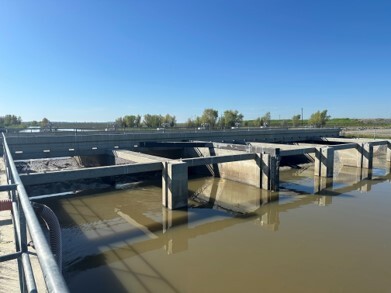 Photo: Construction of Wallace Weir.
To address the dead end these salmon faced in the Colusa Basin Drain, DWR and local Reclamation District 108 started construction on the Wallace Weir in 2016 with operations beginning in 2019. Salmon can now be successfully relocated to the Sacramento River where they may continue their migration to spawning habitat.
|
|
Wallace Fish Collection Facility Operations
Photo: CDFW staff processing Chinook salmon at the Wallace Weir Fish collection facility.
Wallace Weir experienced the most successful year of fish rescue efforts to date, with over 900 fish relocated to the Sacramento River to continue their spawning migration. Typical processing includes floy tag, genetic clipping, and weight and length. Fish monitoring data from the Wallace Weir Fish Rescue Facility can be found on the CalFish website.
|
|
Fish Rescues
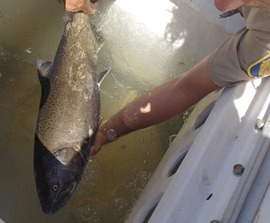
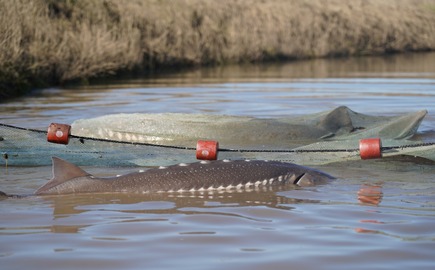
Photo: Rescued sturgeon from CDFW fish rescue efforts occuring throughout the Yolo Bypass after overtopping.
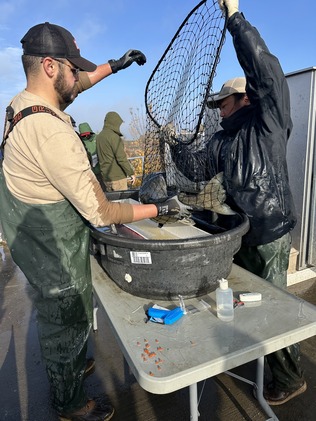
Various fish rescues occurred around the Yolo Bypass following overtopping with the help of agencies including, California Department of Fish and Wildlife, Department of Water Resources, and UC Davis. Listed and federally endangered fish were successfully rescued and released.
|
|
|
This season’s operations were successful with gate operations occurring at the Fremont Weir Adult Fish Passage Facility and a record number of adult Chinook salmon rescued and relocated at the Wallace Weir Fish Collection Facility. We would like to recognize staff at the Department of Water Resources, California Department of Fish and Wildlife, University of California Davis, and Solano County Water Agency for their diligence and collaboration throughout this season to effectively monitor fish passage and facilitate successful rescue operations. For more information, please visit Riverine Habitat Restoration. We look forward to another exciting year of collaborative operations in the 2025/2026 water year.
If you received this newsletter, you are on our eblast notification list and will be updated on operational changes at Big Notch during the water year. To update your contact information or be removed from our eblast list, send an email to BigNotch@water.ca.gov.
|
|
|
|
|