Big Valley Band of Pomo Indians and California State Parks Celebrate Cultural Items Returning Home
Story from: Cultural Resources Division
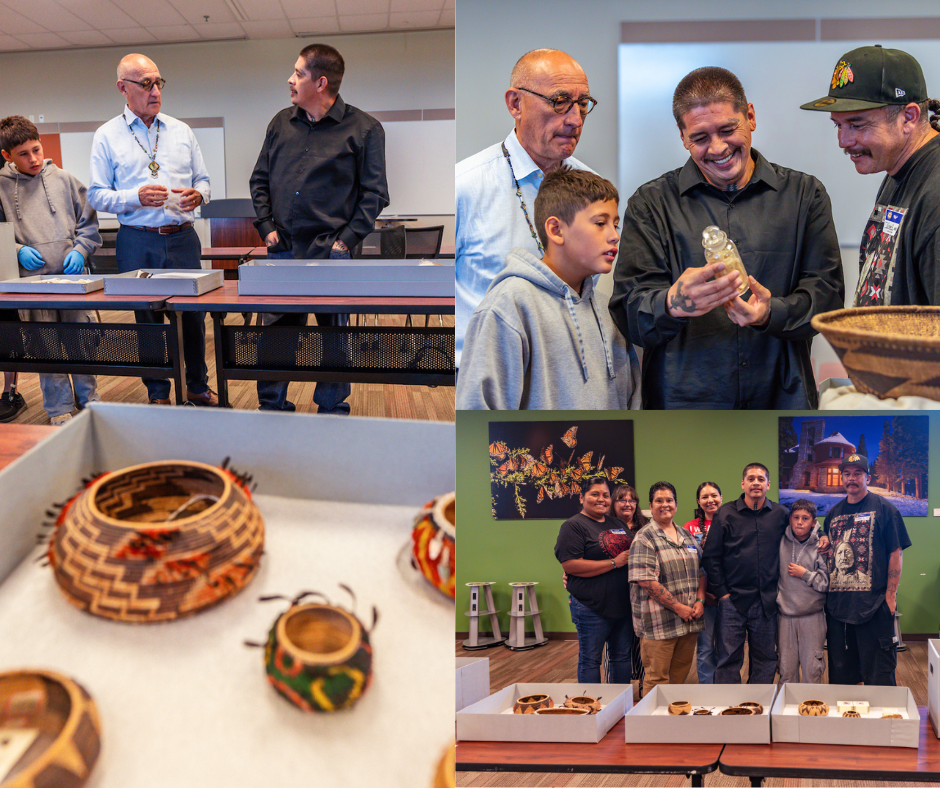 Big Valley Tribal Chairman Flaman McCloud Jr. (in black dress shirt), State Parks Director Armando Quintero, and tribal members discuss items being repatriated. Photos from Brian Baer, Communications and Marketing Division.
California State Parks has repatriated cultural items to the Big Valley Band of Pomo Indians (Big Valley) that have now returned home. Big Valley and State Parks met to complete the repatriation of 21 baskets, regalia and other cultural items from the State Indian Museum State Historic Park on July 23. This repatriation was part of State Parks’ compliance with the Native American Graves Protection and Repatriation Act (NAGPRA).
Big Valley Tribal Chairman Flaman McCloud Jr. and tribal members traveled to Sacramento to complete the repatriation and bring these cultural items back home to Lake County. For Big Valley, these cultural items are integral to Pomo culture and identity, and connect the community to their ancestors.
“It is an honor to be able to bring home items that our ancestors have touched and held and put sweat and their life into creating,” said Chairman McCloud. “It is a real blessing to be able to do that because we never got to know these ancestors in person. Through our oral history we know who they are, when they were in our community, what they did, whether it is for our ceremonies or just in our families. It is an honor to be able to have these things come home, however long it took, whatever work was needed.”
The Native American Graves Protection and Repatriation Act, is a United States federal law that requires agencies and institutions to return Native American ancestors and cultural items to their rightful communities. Visit State Parks’ NAGPRA webpage for additional information.
“State Parks is committed to fulfilling our legal obligation under NAGPRA,” said State Parks Director Armando Quintero. “We are honored to be a part of the important repatriation process that returns ancestors and belongings to their homes and peoples. The State Parks NAGPRA program will continue this very important work until every Native American ancestor and cultural item has completed the NAGPRA process.”
Read more in our press release.
California State Parks Issues 2024 Volunteers in Parks Program Annual Report
Story from: Rachel Young, Partnerships Division
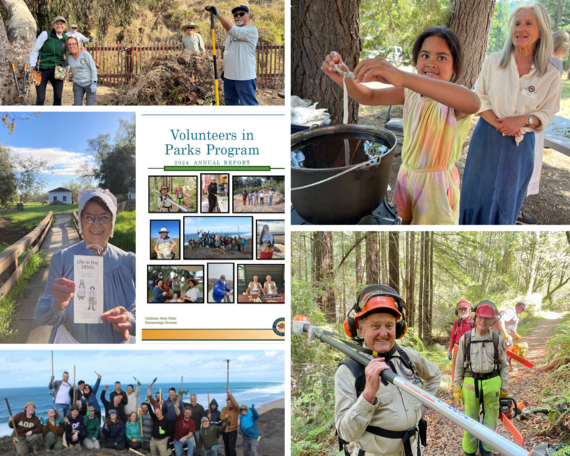 The 2024 annual report's cover (center) and a selection of volunteers in state parks in 2024. Clockwise from top left: Crystal Cove State Park (SP) landscape volunteers Debra Korb, Dennis Murphy, Paul Patterson, Ernie Preciado and Missy Rakestraw. Photo from Winter Bonnin, Orange Coast District. Plumas-Eureka SP volunteer Carol Martinez teaching candle making to visitor Elizabeth Holt. Photo from Jeremy Lin, Sierra District. Stewards of the Coast and Redwoods (Sonoma-Mendocino Coast District) volunteers Mark Anderson, Jim Feige, Tim Mayer and Paul Schwarz. Photo from Rich Lawton, Stewards of the Coast and Redwoods volunteer. Monterey District Natural Resources program volunteers on a work day at Fort Ord Dunes SP. Photo from Sam Winter, Monterey District. Pat Brown, volunteer at William B. Ide Adobe State Historic Park. Photo from Heather Lee, Northern Buttes District.
The Volunteers in Parks Program (VIPP) is proud to announce the publication of the 2024 VIPP Annual Report. This report highlights the extraordinary contributions made by the 30,794 volunteers who generously donated 798,977 hours of their time to our parks last year, which carry an equivalent value of over $32 million. This was a 2% increase in volunteer hours and a 19% increase in total number of volunteers over the previous year. Volunteers are vital partners supporting the operation of California State Parks, allowing the department to provide programs and services that would not be possible without volunteers.
Volunteer support is invaluable to the operation of our parks and the execution of State Parks’ mission. State Parks staff members and visitors all greatly benefit from the presence, hard work, talent and dedication of volunteers. Volunteers in public-facing roles often serve as the first (and sometimes only) representatives encountered by park visitors as they give tours, staff visitor centers and serve as camp hosts. Additionally, volunteers perform crucial behind-the-scenes work by caring for our natural and cultural resources, helping maintain park infrastructure and assisting staff with administrative tasks.
The report’s statistics also reflect the efforts of volunteer coordinators, superintendents and other field staff who are to be commended for their work in building and maintaining this robust program. You can request a copy of the report by e-mailing Volunteer.InParksProgram@parks.ca.gov.
State Parks wants to thank our amazing volunteers for their exemplary service and commitment to the stewardship of our parks.
McConnell State Recreation Area Celebrates 75 Years
Story from: Kathlee Yates, Central Valley District
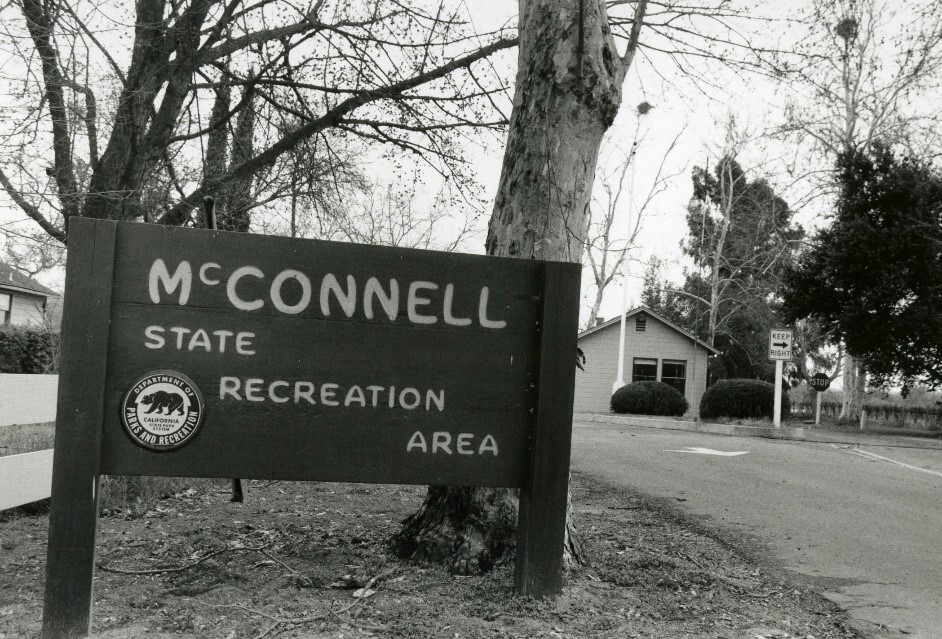 The entrance sign welcoming visitors to McConnell State Recreation Area, c. 1989. Photo from California State Parks.
McConnell State Recreation Area (SRA), located in Merced County, was inaugurated as McConnell State Park on Aug. 1, 1950, becoming the first state park in the San Joaquin Valley. Over the years, additional state parks have been established in the valley, including the most recent addition, Dos Rios. McConnell SRA is situated along the Merced River, north of Livingston. What was then the Division of Parks and Beaches acquired the property in 1949 and allocated $60,000 for the initial development of the new park.
In its first year, the park served 7,000 visitors before a significant flood event during that first winter, which covered much of the picnic area in 5 feet of water. After extensive cleanup and repairs, the park reopened the following spring. Initially, the park operated as a day-use facility, with an entrance fee of 25 cents per vehicle. Subsequently, camping facilities were introduced and in May 1963, the park was reclassified as McConnell SRA, its current designation.
The establishment of McConnell SRA was made possible through the efforts of numerous state and county officials, including State Senator George J. Hatfield. Following his death three years later, George J. Hatfield SRA was opened a few miles down the Merced River. Within a decade, five parks had been established along rivers in the San Joaquin Valley.
Today, McConnell SRA has become a beloved summer destination for many California families who return year after year to camp and recreate. Just last week, a park visitor named Natalie spoke with Central Valley District Superintendent Danielle Gerhart and Sector Manager Paige Haller about her experiences in the park. Natalie, herself from the Los Angeles area, shared that for more than 20 years her family has gathered annually at McConnell SRA, reuniting a family spread throughout California. Natalie’s story is one of thousands that share a connection to place through California State Parks. Happy 75th birthday, McConnell SRA!
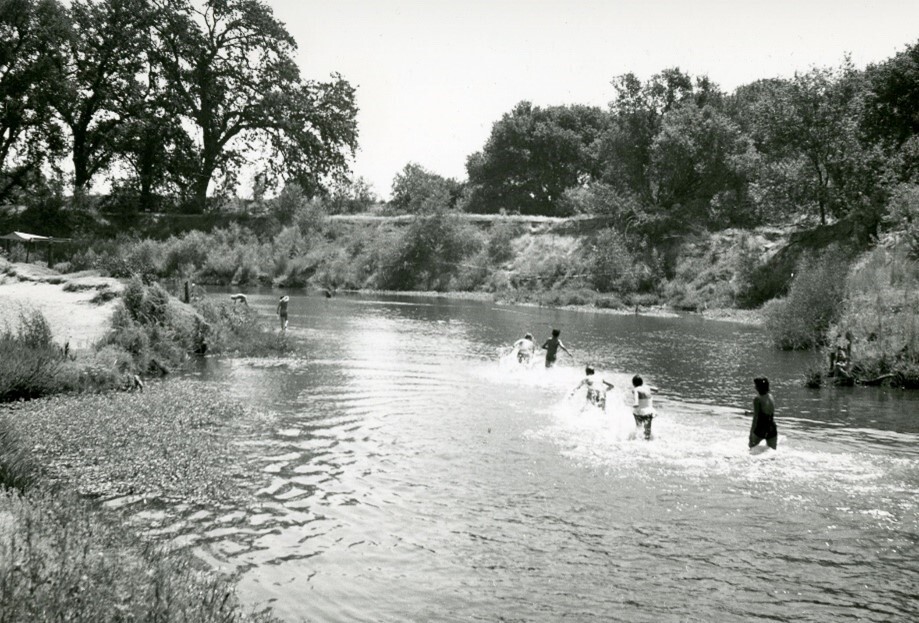 Visitors playing in the Merced River, c. 1980. Photo from California State Parks.
Volunteers and Agencies Help State Parks to Protect Endangered Aquatic Species During Palisades Fire
Story from: Malibu Creek Ecosystem Restoration Project
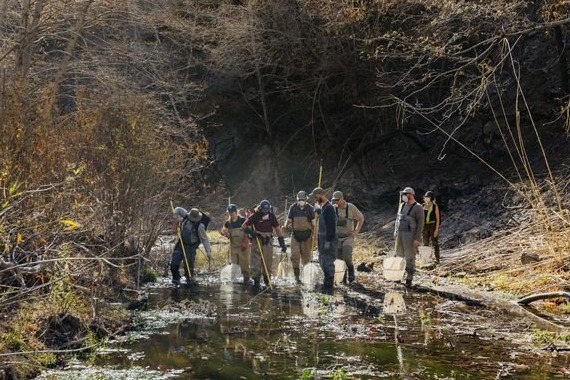 A rescue team works to capture and relocate endangered southern California steelhead during the Palisades Fire. Photo courtesy of Matthew Benton from Resource Conservation District of the Santa Monica Mountains.
The last known population of southern California steelhead (Oncorhynchus mykiss) in the Santa Monica Mountains survived the Palisades Fire as it swept through Topanga Canyon. But the atmospheric river that was to follow just weeks after the fire brought an equivalent threat of localized extinction for the species.
The destructive wildfire had stripped the slopes of stabilizing vegetation through the canyon. A heavy downpour could send suffocating amounts of sediment into Topanga Creek which would flush into Topanga Lagoon inside Malibu Creek State Park, creating a death trap for all fish downstream. This enormous flow of ash, sediment and debris flowing into the creek could wipe out the southern steelhead population.
The California Department of Fish and Wildlife (CDFW) quickly coordinated a rescue mission of southern steelhead in Topanga Creek before the rains. With the help of teams from the Resource Conservation District of the Santa Monica Mountains (RCDSMM), California Conservation Corps, Watershed Stewards Program, Cachuma Operation and Maintenance Board and California State Parks, the crew went fishing in the early morning of Jan. 23.
Groups working along two miles of the creek successfully caught and removed 271 endangered trout. Most of the netted fish were no bigger than 12 inches in length. The snorkel survey conducted by the RCDSMM in November documented over 500 trout. This effort rescued over 50% of the remaining estimated population. The captured trout were first relocated to CDFW’s nearby Fillmore Fish Hatchery and then transported to Arroyo Hondo Creek on the Central Coast. CDFW has reported that there is already about 100 newly hatched trout after they started to spawn the next generation at the new location.
Earlier this January, the RCDSMM team, working in collaboration with the U.S. Fish and Wildlife Service, Dr. Brenton Spies of California State University Channel Islands, and other partners successfully captured and relocated federally endangered tidewater gobies from Topanga Lagoon. Despite the seasonal challenge of locating the small, camouflaged fish hiding under rocks and vegetation, the team rescued 760 healthy gobies, well exceeding the original goal of 400 to 500. After being cared for at the Aquarium of the Pacific and Heal the Bay aquariums for several months, the gobies were recently returned to their home in Topanga Lagoon.
Before the Palisades Fire, the Franklin Fire in December 2024 caused significant habitat damage in the lower part of Malibu Canyon from Rindge Dam three miles to Malibu, burning critical habitat in Malibu Creek. The RCDSMM Stream Team recently completed longitudinal habitat profile and cross section mapping from Cross Creek Road to Rindge Dam. While the mapping team saw no trout, invasive crayfish and carp have rebounded since the Franklin Fire. The fire caused silty sandy sediment deposits throughout the system but the team reports that there is still good habitat remaining.
For a video of the rescue effort that took place in January, click on the button below. To learn more about State Parks' role as the lead agency to restore Malibu Creek, visit Malibu Creek Ecosystem Restoration Project.
William B. Ide Adobe SHP Partners with Mains'l to Build a More Inclusive Team
Story and photos from: Veronica Lamoureaux and Jennifer Pooley, Northern Buttes District
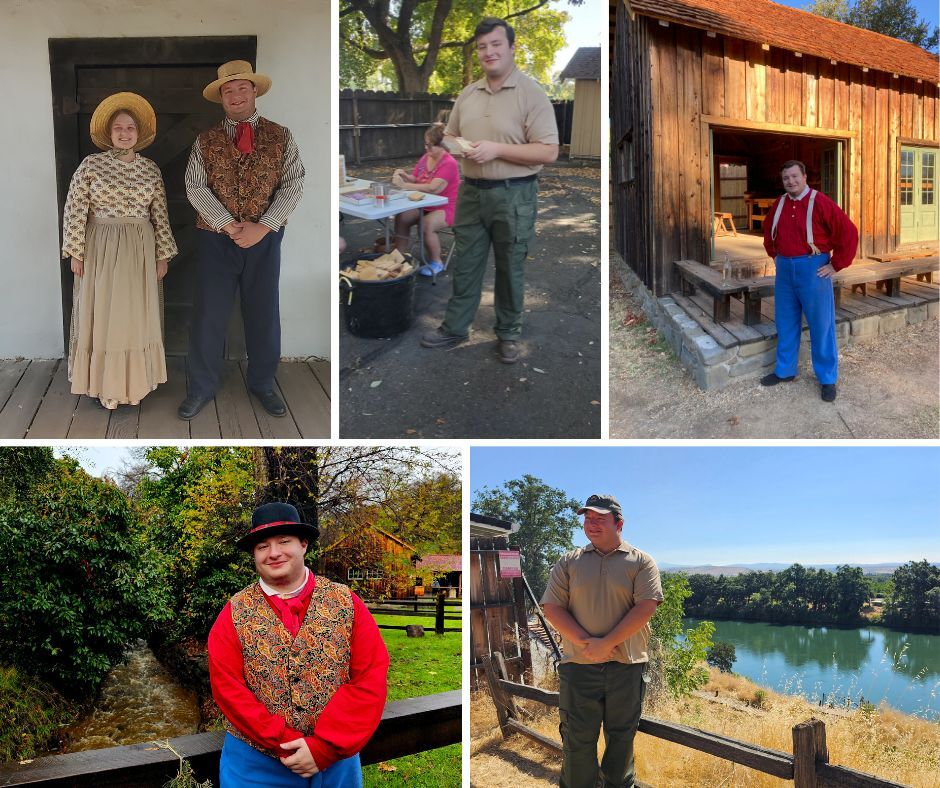 Michael Oliver during his time volunteering and interning at William B. Ide Adobe State Historic Park doing a variety of work.
In 2023, a job developer with the company Mains’l, Kimmy Wally, approached California State Parks with an opportunity to diversify the workforce of William B. Ide Adobe State Historic Park (SHP). Kimmy reached out to the Northern Buttes District Interpreter Jennifer Pooley and said she had a client, Michael Oliver, who was very interested in history and interpretation. Since 1989, Mains’l has been a leader in offering support to people with varying abilities. Mains’l partners with like-minded agencies to establish work experiences that benefit agency work and their clients. With the help of District Services Manager Jared Zucker, a proud partnership began to take shape.
This was a new partnership for the Northern Buttes District and took a year to work out all the details. During the interim, Michael waited patiently and even volunteered at park events. His patience paid off, and in July 2024, the William B. Ide Adobe SHP interpretive team welcomed Michael to be part of our team.
Michael’s interests made him a natural fit for the park. His experience as a Civil War reenactor made him eager to dress in 1850s clothing and represent the past. He talks about history in a way that engages visitors because they sense his excitement and dedication to the subject. His enthusiasm is contagious. Michael’s positive attitude boosted us all, making our outlook on work more positive as well. He is always excited to learn new skills and is willing to try any task.
His one-year internship was nearing its end in June. The employees at the historic park weren’t ready to say goodbye and knew that another year of internship would benefit both Michael and the park. Mains’l extended his internship at the park for another year.
This partnership has already shown success and Michael will have more opportunities in the upcoming year to broaden his skillset. We are so grateful for this partnership and have gained so much from having Michael as part of our State Park team. He is a shining star on our interpretive team.
California Boating and Waterways Commission to Host Tour and Meeting in Humboldt County
Story from: Kevin Murphy, Communications and Marketing Division
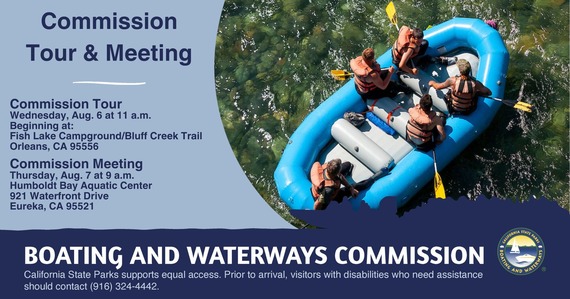 The California Boating and Waterways Commission will host a tour of several sites and its quarterly meeting next week – Aug. 6 and 7. Members of the public can join commissioners for the tour on Wednesday, Aug. 6, at 11 a.m., beginning at Fish Lake Non-Motorized Boat Launch, Fish Lake Campground/Bluff Creek Trail in Orleans. The tour will also include visits to the Arcata Non-Motorized Boat Launch and Humboldt Bay Aquatic Center in Eureka. The tour is expected to end at 5 p.m.
The Commission meeting follows on Thursday, Aug. 7, at 9 a.m. at the Humboldt Bay Aquatic Center in Eureka. The agenda includes advice and comment on a grant for the Fish Lake Non-Motorized Boat Launch Facility and updates on the aquatic center grant programs offered by the Division of Boating and Waterways. Join commissioners at the meeting in person or participate virtually via Zoom or CAL-SPAN.
Agendas and additional information for both the tour and meeting are available at parks.ca.gov/PublicNotices. Registration links to join the Commission meeting virtually are also available on the website. For more information about the California Boating and Waterways Commission, visit the Commission webpage. California State Parks supports equal access. Prior to arrival, visitors with disabilities who need assistance should contact (916) 324-4442.
Properties in San Francisco and Los Angeles Among those to be Considered for National Register Nomination by State Historical Resources Commission
Story from: Kevin Murphy, Communications and Marketing Division
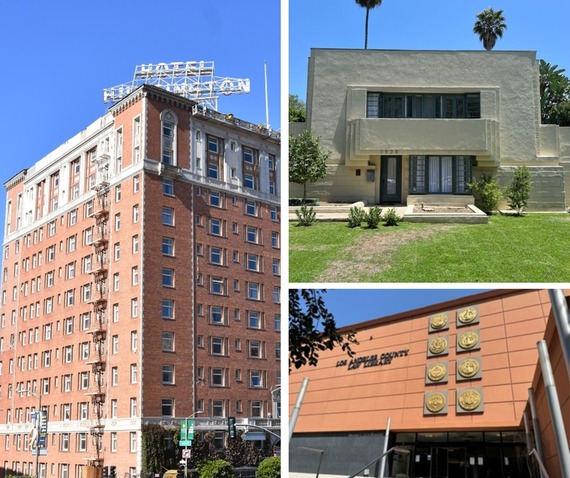 Properties nominated to the National Register of Historic Places include (clockwise, from left): the Huntington Hotel, located on Nob Hill in San Francisco, constructed in 1924 (photo courtesy of Jennifer Hembree and Jason Wright); the Henry O. Bollman House in Los Angeles, designed by Lloyd Wright, son of architect Frank Lloyd Wright, built in 1923 (photo courtesy of Timothy Penich); and the Los Angeles County Law Library, one of a grouping of Late Moderne-style buildings completed in 1953 (photo courtesy of Teresa Grimes).
A hotel on San Francisco’s Nob Hill and a home designed by Lloyd Wright, son of architect Frank Lloyd Wright, are included on a list of properties being considered for nomination to the National Register of Historic Places. The State Historical Resources Commission will review these and other nominations during its quarterly meeting on Friday, Aug. 8, in Sacramento. The Commission will also host a workshop to provide an overview of the National Register of Historic Places Multiple Property Submissions (MPS) process and highlight several of the approved MPS contexts for California. MPS contexts can be used to nominate and register thematically related properties or to evaluate the National Register of Historic Places eligibility of related properties. The workshop will be held Thursday, Aug. 7.
The Huntington Hotel, located on Nob Hill in San Francisco, was constructed in 1924. The hotel was originally intended as a furnished apartment hotel, an example of the "Palace Hotel" style of residential hotels, but its use evolved to include rooms for travelers. The Henry O. Bollman House in Los Angeles, the fourth house designed by Lloyd Wright, was built in 1923. The house is one of the first, if not the first, building to utilize the knit-block system he developed, which incorporates steel bars to tie together concrete blocks. Another property being considered is the Los Angeles County Law Library, one of a grouping of Late Moderne-style buildings completed in 1953. Founded in 1891, the library is the largest county law library in California. Nominations approved by the Commission will be forwarded to the National Park Service for final consideration. Full details of all properties nominated may be found on the pending nominations webpage.
Participants may attend the meeting in person or virtually. Visit State Parks’ Public Notices for meeting details, including how to register in advance. California State Parks supports equal access. If you are in need of a reasonable modification or special accommodation at the meeting or in accessing the agendas or submitting comments, please contact the Office of Historic Preservation at (916) 445-7000 or email calshpo.shrc@parks.ca.gov.
 PARTNER NEWS
Parks California Celebrates, Reflects on its Fifth Year
Story from: Parks California
 Parks California helps make state parks more welcoming, accessible and resilient. Marking our five-year milestone, we are proud to present our 2024 Annual Report. It shares how our partnerships with local communities, tribal nations, nonprofits and state parks staff have strengthened the role of state parks for people and habitats — and what comes next.
You will read about students connecting with nature through fully-funded field trips, interns gaining new skills and connecting with mentors through our Career Pathways program and tribal partners working hand-in-hand to shape park experiences. As California's state parks face increasing challenges, like growing visitor demands, effects from rising temperatures and increasing threats to ecosystems, Parks California will be ready to scale innovative programs to enhance the resiliency of parks.
Read the report and see how this partnership makes a welcoming and thriving park system now and for generations to come.
|