California State Parks Returns Washoe Name to Features in Ed Z'berg Sugar Pine Point State Park
Story from: Kaytlen Jackson, Sierra District
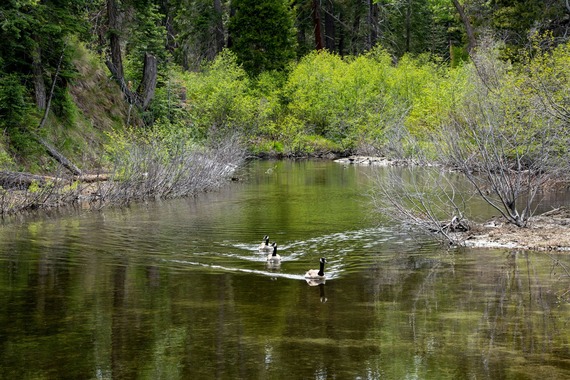 The Washoe name dukMéʔem wáťa is under a formal request for a name change to this creek at Ed Z'berg Sugar Pine Point State Park. Photo from California State Parks.
California State Parks is returning the names of features and facilities within Ed Z’berg Sugar Pine Point State Park to their traditional Washoe name, dukMéʔem wáťa, which means “Wave Creek,” beginning this summer.
In 2024, State Parks received a request from the Washoe Tribe of Nevada and California to return the name dukMéʔem wáťa to the creek that runs through the park and to change the names of features and facilities that are attributed to the historic figure "General" Phipps: General Creek Campground and General Creek Loop Trail. In response, State Parks Director Armando Quintero signed a Director’s Action Request in October 2024, officially changing the names of the facilities to dukMéʔem wáťa Campground and dukMéʔem wáťa Loop Trail.
“The return of the traditional Washoe name to this creek honors the history and presence of the Washoe people in the Lake Tahoe Basin,” said Director Quintero. “This connection reinforces the cultural insight carried through generations and allows State Parks, as co-stewards of these lands, to interpret and share Washoe lifeways with greater respect. It exemplifies the goals of the Reexamining Our Past Initiative — creating a more inclusive and accurate understanding of place.”
Washoe elders, who were consulted on the name return, discussed how this area has experienced large waves. A story shared by elders with Tribal Chairman Serrell Smokey, is “a Wá∙šiw (Washoe) man with wegeléyu (special powers) had a vision of a tidal wave generating from the north shore of Tahoe going across the lake to the south. In his vision, there is a large boulder on a ledge under the water a few hundred feet and there will be an earthquake that will make it fall and cause this to happen.”
Archaeological evidence and traditional ecological knowledge held by the tribe suggest that the traditional name commemorates a historical seiche (lake tsunami) wave event that may correlate with the McKinney Bay Landslide that occurred 12,000 to 20,000 years ago.
Previously, these features and facilities were attributed to “General” William Phipps, who arrived in the Lake Tahoe Basin in the 1850s and received a land grant on July 1, 1869. Little is known of Phipps’ life prior to his arrival in California; however, archival research indicates he was not a U.S. general and there is no record of his military service. A history of the Tahoe area published in 1957 describes Phipps murdering a man called One-Eyed John (likely a Washoe ancestor), stealing his beaded footwear and leaving his body to be eaten by wolves. Tribal oral history confirms that Washoe people stayed away from Phipps’ land during his lifetime, even though they visited and worked for his neighbors to the north and south.
The California Advisory Committee on Geographic Names has made a formal request to the U.S. Board of Geographical Names (BGN) to return the name dukMéʔem wáťa to the topographical feature of the creek. The request is currently on the agenda of the BGN. You can find the press release on the name return here.
Outstanding Investigative Work Leads to Recovery of Stolen Religious Artifacts
Story from: Katharine Wilson, Channel Coast District
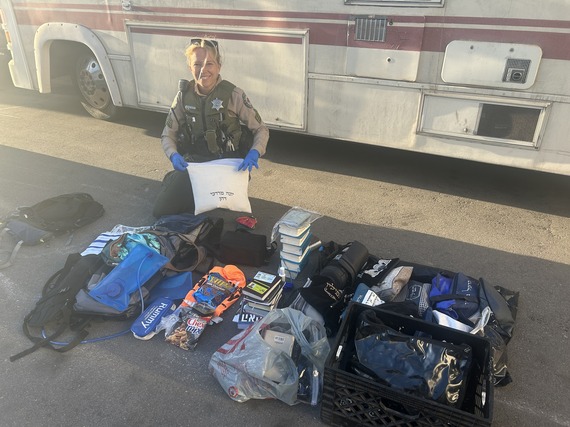 Sergeant Haley Del Castillo conducts an inventory of recovered items stolen from a group of young Israeli campers at Emma Wood State Beach. Photo from Dave Wilson, Channel Coast District.
Channel Coast District is proud to recognize the exceptional work of its law enforcement staff this past week in response to a significant theft at Emma Wood State Beach’s group campground. On the morning of Tuesday, July 8, a visiting group of students from Israel reported multiple items stolen from their campsite overnight. Among the missing items were camp backpacks, an Israeli passport, wallets containing over $800 in cash and, most heartbreakingly, 17 sacred religious artifacts totaling $30,000. These irreplaceable heirlooms held deep sentimental value and their loss was devastating for the group.
Thanks to quick thinking and excellent coordination, a State Parks team led by Sergeant Haley Del Castillo and Captain Dave Wilson sprang into action. When it was discovered one of the stolen items contained an Apple AirTag, staff used the signal to begin tracking its possible location. State park peace officers R. Fitzgerald and R. Carey joined the initial search effort near the entrance to the park.
As the AirTag location began to shift, Wilson joined the search. He quickly noticed vehicles being towed from just outside the park by a local tow company and soon after, the AirTag signal pointed to a nearby tow yard. Trusting their instincts and training, the team investigated further. Through a plain view search conducted while standing on the tailgate of their truck, Del Castillo and Wilson spotted items matching the reported stolen property inside a motorhome at the tow yard.
With remarkable speed and professionalism, Del Castillo drafted a search warrant and got it signed by a judge. The same day, the warrant was served and nearly 90% of the stolen items were successfully recovered.
The team returned the recovered belongings to the group that night. The relief and joy on their faces as their treasured heirlooms were returned said it all. As the team continues to investigate, the district extends its sincere appreciation and congratulations to all involved. This is a shining example of diligent, compassionate policing that truly makes a difference.
Off-Highway Vehicle Law Enforcement Officers Provide Safety Along the Rubicon Trail
Story and photos from: Roger Salazar, Off-Highway Motor Vehicle Recreation Commission
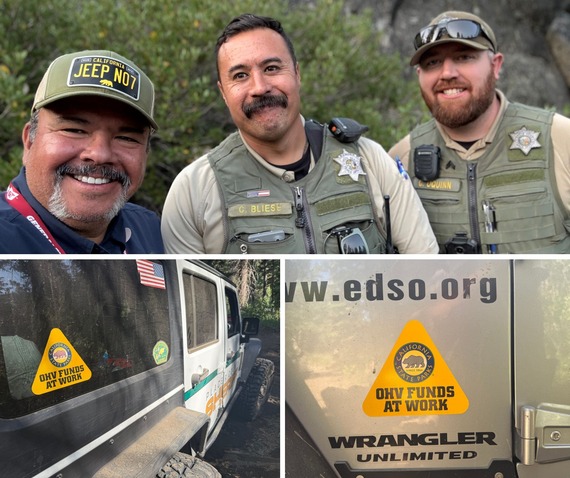 Top: Roger Salazar, chairman of the California Off-Highway Motor Vehicle Recreation (OHMVR) Commission, takes a selfie with OHMVR Division state park peace officers (SPPOs) Colin Bliese and Cameron O’Quinn along the Rubicon Trail during Jeep Jamboree USA. SPPOs often provide support and ensure the safety of participants during off-highway vehicle events. Bottom: Stickers on equipment used by the Placer County and El Dorado County sheriff’s offices identify equipment funded through grants provided by the OHMVR Division.
As chairman of the Off Highway Motor Vehicle Recreation (OHMVR) Commission, I recently had the pleasure of running the Rubicon Trail as part of the Jeep Jamboree USA event held July 11-13. In addition to seeing our division’s grant funds working to maintain facilities along the trail, I was also able to interact with our incredible law enforcement officers who were patrolling during the weekend jamboree. I met with state park peace officers Colin Bliese and Cameron O'Quinn in Rubicon Springs and I got to "inspect" their customized Jeep Wrangler. What a beauty!
On the way off the Rubicon Trail, I was fortuitously positioned between two county sheriff off-highway vehicles (OHVs) and rode behind deputies Matteo Paganini and Stephen Wunschel from the El Dorado County Sheriff's OHV Unit and ahead of deputies Nathan Byrom and Christian Jabri from the Placer County Sheriff's OHV Unit. These law enforcement officers are great at what they do, good people, and are impressive off-roaders. Not only that, but the universal opinion and feedback I received from the participants of the Jeep Jamboree was that these officers are a very welcome presence out on the trails. I, for one, am glad they are all out there doing what they do.
Ed. Note: Following Chairman Salazar's meeting with deputies from the Placer County Sheriff's Office's OHV Unit, the vehicle, purchased with the assistance of OHMVR Division grant funds, responded to a difficult rescue. In an article describing the rescue, the agency thanked State Parks saying, "Thanks to a grant from California State Parks, our Tahoe Station is equipped with a Jeep Wrangler designed for off-road rescues — and this week, it made all the difference.” Read the full the article.
Recovery and Resilience: State Park and Recreation Commission, Members of the Public Tour Parks Affected by Palisades Fire
Story from: Kevin Murphy, Communications and Marketing Division
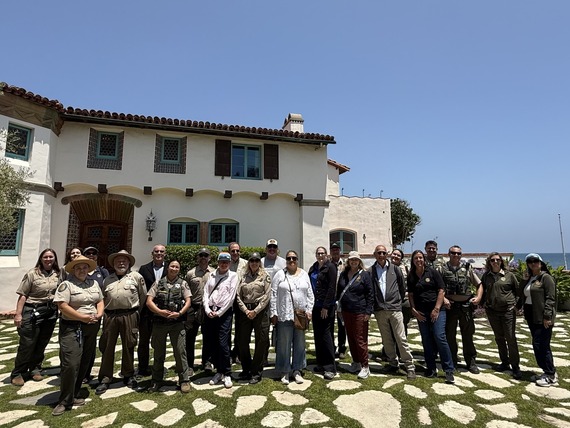 State Parks staff and volunteers from Angeles District, along with headquarters staff, pose in front of the historic Adamson House in Malibu after wrapping up a day of hosting a public tour of parks recovering from January’s Palisades Fire. Photo from Cassandra Chavez, Angeles District.
Nature is making a comeback but other losses that occurred during the Palisades Fire in January continue to pose questions about the futures of Will Rogers State Historic Park (SHP) and Topanga State Park (SP). With assistance from Angeles District staff members, the State Park and Recreation Commission recently hosted a public tour of areas still off limits at both parks in addition to the historic Adamson House.
On Jan. 7, shortly after 10 a.m., the Palisades Fire sparked and burned over 23,000 acres over 24 days. Over a third of the acreage was State Parks property. Today, residents are still returning to their homes and property, with utilities only about 70% restored. Meanwhile, work continues to reopen Will Rogers SHP and expand newly opened areas and trails within Topanga SP.
Tour participants included local residents and 36 high school students and instructors from Anawakalmekak, a school in East Los Angeles chartered by the Gabrielino-Shoshone Nation, participating in a summer learning program. After a welcome by State Parks Director Armando Quintero and Angeles District Superintendent Richard Fink, District Cultural Resources Program Manager Barbara Tejada led participants to the remains of the Will Rogers home. Tejada shared the story of park staff evacuating irreplaceable artifacts as flames approached the historic site.
District Natural Resources Manager Noa Rishe led the group to the former stables to share how State Parks is working with the U.S. Army Corps of Engineers (USACE) and contractors to identify damaged trees in the park for removal. So far, over 300 trees have been removed. Further away, attendees observed USACE contractors processing concrete removed from areas damaged by the fire. The concrete is crushed in a process mitigated by spraying water to suppress dust, screens protecting the ground, and ongoing air testing to verify particulate matter ratings do not exceed maximum limits. As these operations wind down, Will Rogers SHP is looking to reopen on a limited basis to the public by the fall 2025.
Participants then traveled to the former site of the Topanga Ranch Motel, at the edge of Topanga SP, via Highway 1, which reopened to nonresident traffic on May 23. After the buildings of the complex were lost during the Palisades Fire, the property served as a site for the collection of hazardous items from nearby properties that were transported to be safely processed, sorted and packaged following all state and federal environmental, health and safety standards.
Close to the former motel complex, participants enjoyed lunch and tours of the historic Adamson House, nestled along the Pacific Ocean and left untouched by the Palisades Fire. Now that Highway 1 is fully reopened, the district expects an increase in demand for tours provided by volunteers and State Parks staff, including those displaced from Will Rogers SHP and Topanga SP and await their reopening.
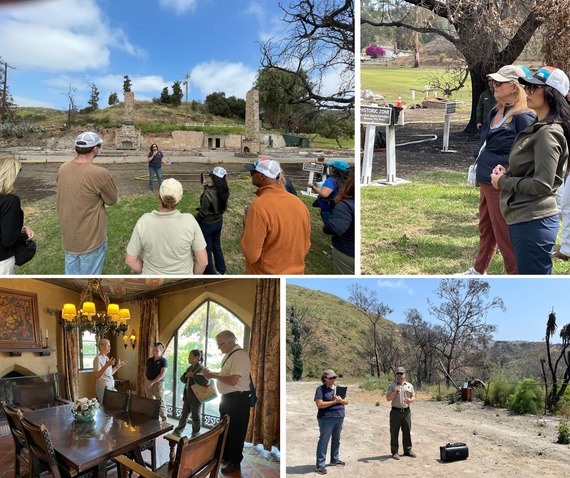 Clockwise from top left: Angeles District Cultural Resources Manager Barbara Tejada shares the history of Will Rogers SHP in front of the remains of the entertainer’s home. Commissioners Christina Jaromay and Assemblymember Gail Pellerin listen as Tejada describes the extraordinary efforts of district staff to evacuate artifacts during the fire. Tejada and Angeles District Superintendent Richard Fink share State Parks’ previous vision for the Topanga Ranch Motel complex. Volunteer Cindy Palmer (left) provides details about the Adamson House dining room to State Parks staff members Miranda Sorrentino (left) and Alondra Cervantes (center) and Commissioner Tom Huntington (right).
Orange County Fire Authority Partners with State Parks for Interpretive and Recruitment Event at Doheny State Beach
Story from: Nick Milward, Orange Coast District
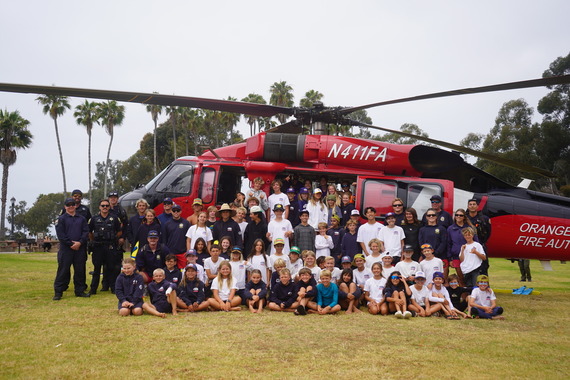 Junior lifeguards pose with State Parks staff and members of the Orange County Fire Authority in front of a Firehawk helicopter at Doheny State Beach. Photo from Nick Milward and Lola Vasquez, Orange Coast District.
The inaugural Orange County Fire Authority (OCFA) Interpretive and Recruitment Event at Doheny State Beach (SB) was a resounding success, captivating Doheny junior lifeguards and highlighting the strong collaboration between public safety agencies. The centerpiece of the event was OCFA’s S-70 Firehawk helicopter, a modified Black Hawk helicopter designed to carry massive water loads for aerial firefighting.
Under a bright Southern California sun, junior lifeguards gathered on the expansive grass lawn at Doheny SB, eager to explore the world of first responders. This joint effort between OCFA and State Parks aimed to deliver an engaging educational experience, connecting with the lifeguard program while sparking interest in future OCFA recruits.
The event’s success was driven by OCFA Captain Robert Bucho and his dedicated flight crew, who delivered a compelling presentation. They covered critical topics such as coastal cable hoist rescues, in-flight medical aid and advanced wildfire suppression techniques, offering a clear view into the vital roles of OCFA’s air operations team.
The arrival of the Firehawk helicopter was a highlight, demonstrating its ability to carry up to 1,000 gallons of water for firefighting missions. OCFA personnel provided detailed insights into the aircraft’s advanced features and its critical role in protecting Orange County from wildfires. “Seeing the Firehawk up close and learning how it supports our community was truly inspiring for these kids,” said a state park peace officer lifeguard. “It opened their eyes to the diverse world of public safety.”
The event also emphasized the seamless partnership between lifeguards and fire departments. Interactive demonstrations showcased how these agencies work together on water rescues and land-based emergencies, highlighting their shared commitment to saving lives.
Organizers were thrilled with the turnout and the enthusiastic feedback from attendees. By combining education, inspiration and hands-on engagement, the event fostered a deeper appreciation for the dedication of first responders. The Firehawk’s impressive debut and the junior lifeguards’ enthusiasm laid a strong foundation for future.
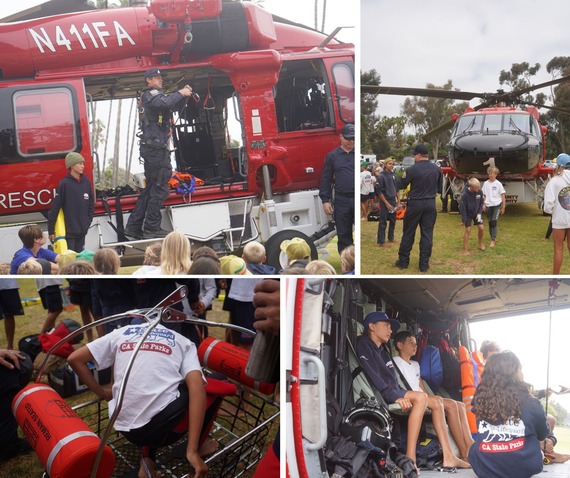 Clockwise, from top left: An Orange County Fire Authority medic demonstrates the hoist on the Firehawk helicopter. Junior lifeguards appear focused listening about fire operations. The pilot answers questions from junior lifeguards. A junior lifeguard tries the rescue basket on for size. Photos from Nick Milward and Lola Vasquez, Orange Coast District.
State Parks Collaborates in Off-Shore Training with U.S. Coast Guard
Story and photos from: Angeles District Lifeguards
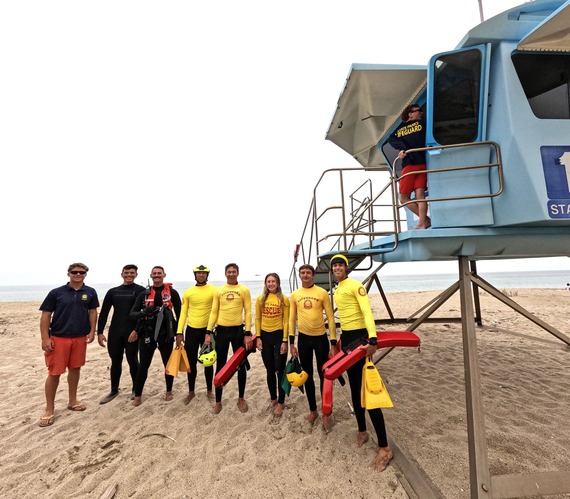 Lifeguards from Angeles District recently participated in an off-shore rescue training exercise with members of the U.S. Coast Guard. Pictured (left to right): Lifeguard II Finn Kelly, representatives from the U.S. Coast Guard, Lifeguard II Jared Hughes, Lifeguard I Max Holdorf, Lifeguard II Carolyn Kahlberg, Lifeguard I Lukas Conrad, Lifeguard I Ranger Murphree and Lifeguard I Jake Roth (on tower).
In a collaborative training effort, State Parks' Angeles District lifeguards recently joined the U.S. Coast Guard offshore of Point Mugu State Park for a specialized basket rescue drill. The goal of the exercise was to prepare lifeguards and emergency personnel for real-life ocean rescue scenarios involving helicopter evacuations.
State Parks lifeguards, equipped with wetsuits and flotation gear, swam out to a U.S. Coast Guard helicopter hovering just above the surface of the water. Once in position, each lifeguard took turns being hoisted into the aircraft using a rescue basket, an essential tool in ocean extractions, used when vessels or swimmers cannot return to shore safely. This hands-on practice allowed the lifeguards not only to observe the operation up close, but also to experience what it feels like to be the person rescued. Understanding the physical and psychological aspects of being hoisted helps rescuers better support distressed individuals during actual emergencies.
The joint training session emphasized interagency coordination, safety and rapid response, key components in improving rescue outcomes. Both the U.S. Coast Guard and State Parks praised the operation as a valuable experience that strengthens readiness for emergencies along the coast.
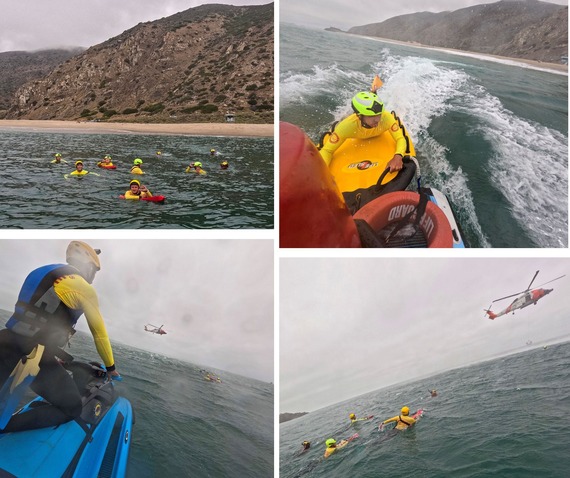 Clockwise from top left: Lifeguards in the water awaiting the arrival of a U.S. Coast Guard helicopter to begin the exercise. Lifeguard II Jared Hughes hitches a ride. Lifeguards swim toward the arriving helicopter. State Park Peace Office (Lifeguard) Gabe del Castillo oversees safety from a jet ski on the water.
Celebrating Community and Culture at Crystal Cove State Park
Story from: Winter Bonnin, Orange Coast District
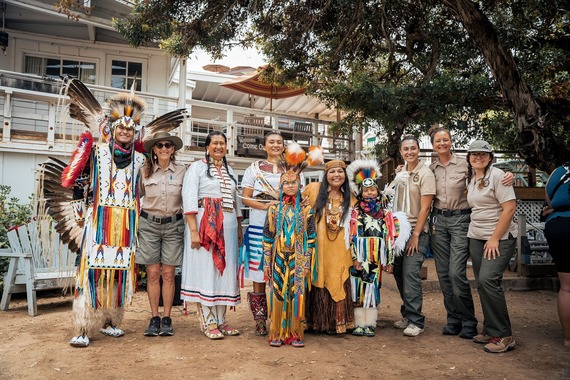 Dancers from RedBoy Productions pose with Orange Coast District Staff during California State Parks Week at Crystal Cove State Park. From left to right: Ba’ac Garcia, State Park Interpreter II Winter Bonnin, Lupe Lopez, Nanabah Kadenehii, Joseph Camacho, Jacque Nunez, Mike Camacho, Senior Park Aide Tori Krantz, State Parks Interpreter I Alex Anderson and Senior Park Aide Eryn Oelstrom.
The Celebrating Community and Culture event for last month's California State Parks Week was a wonderful success; From basket weaving with Journeys to the Past, to abalone necklace making hosted by nonprofit Native Pathways, to the replica items used by the Acjachemen people and expertly crafted by Domingo Belardes from the Blas Aguilar Adobe Foundation. But the event was really sparked by the jaw-dropping and impressive dancing from Indigenous family-led RedBoy Productions, which wowed the crowd with some dynamic moves.
With a talent pool of four Native American dancers, who performed solo and as a troupe, and their matriarch, who served as emcee and shared information about their culture and purpose behind each dance, the audience was mesmerized. The Eagle Dance, expertly performed by Ba'ac Garcia dressed in an elaborate outfit, mimicked the motion of the sacred name-sake bird. Nanabah Kadeniihii, an award-winning Hoop Dancer, stunned the crowd with her skill and grace. I learned that the hoops represent the never-ending circle of life and that each hoop added by the dancer represents elements, including humans, animals, wind, water and seasons. Words don’t do justice to the electrifying performances. Be sure to check out RedBoy Productions’ impressive video gallery.
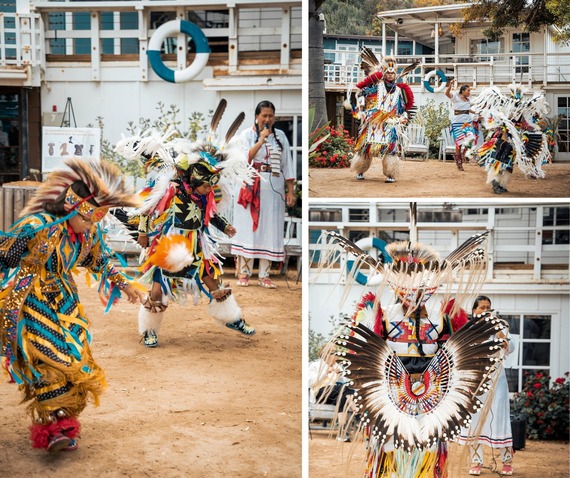 Clockwise from left: Joseph Camacho, Mike Camacho and Lupe Lopez. Ba’ac Garcia, Nanabah Kadenehii and Mike Camacho. Ba’ac Garcia shows the intricate work of his outfit.
Craig Saddle Boat-in Campground Reopens at Lake Oroville State Recreation Area
Story from: Caitin Dalby, Northern Buttes District
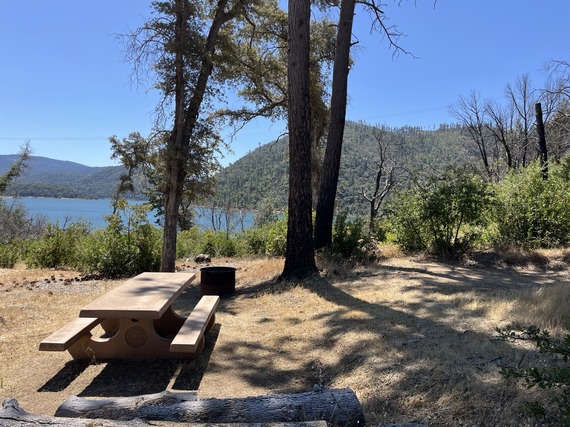 Craig Saddle Boat-in Campground Site 18 facing east. Photo from Caitlin Dalby, Northern Buttes District.
Northern Buttes District is excited to announce the reopening of Craig Saddle Boat-in Campground at Lake Oroville State Recreation Area (SRA). Nearly five years ago, the deadly North Complex Fire burned more than 318,000 acres in Plumas and Butte counties. Multiple communities sustained catastrophic damage and the landscape across much of the east side of Lake Oroville, including the Craig Recreation Area of Lake Oroville SRA, experienced high-severity wildfire. In 2022, State Parks developed the Craig Saddle Fuel Reduction and Restoration Project, and work began in spring 2023.
The objectives of the project have been to rehabilitate the landscape adjacent to Craig Access Road within the SRA boundaries and restore the boat-in campground area through removal of dead, burned trees and vegetation and to rehabilitate the post-fire landscape to encourage wildfire resilience. Approximately 7.7 acres of the boat-in campground will continue to be treated for long-term restoration to reestablish native trees, shrubs and grasses to enhance habitat and improve watershed function.
Now, two years into project implementation, State Parks is ready to officially welcome the public back to enjoy the campground once again. Though the landscape looks different, the campground still offers serene views, beautiful wildlife, cool breezes and amazing swimming. Please be aware that restoration efforts are still ongoing and State Parks asks everyone respects the healing of the natural space that the campground occupies.
This work was made possible by the California State Parks Cannabis Watershed Protection Program, funded by Proposition 64. State Parks is excited to welcome the community back to the Craig Saddle Boat-in Campground and have campers once again enjoy this beautiful area. Visit the park website for more information about exciting opportunities for camping around the lake and for local updates.
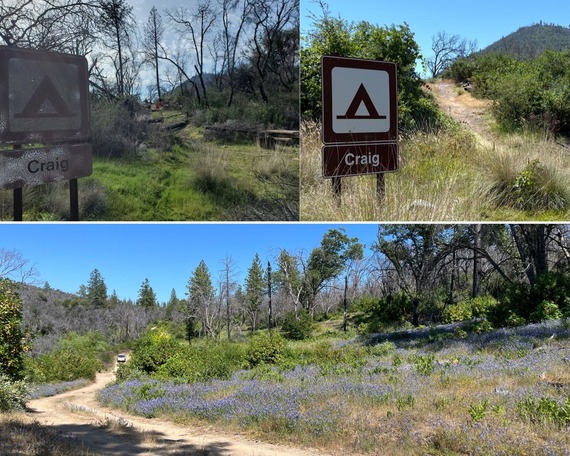 Top left and right: the Craig Saddle Boat-in Campground sign before and after the project. Photos from Steven Hall, Natural Resources Division, and Caitlin Dalby, Northern Buttes District. Bottom: Craig Access Road with fields of lupine. Photo from Caitlin Dalby, Northern Buttes District.
Camp Hosts Ted and Mimi Coulton Receive Medallion Award
Story from: Rob Colligan, San Luis Obispo Coast District
 Camp Host Coordinator Taylor Riis (right) presenting campground host Ted Coulton with the Medallion Award. Photo from Jim Oliphant, State Parks volunteer.
Ted and Mimi Coulton were recently awarded the Medallion Award for their 20 years’ service as camp hosts. I recently had a discussion with Ted about his 20 years with California State Parks as a volunteer.
Q: What initially led you to want to be a camp host for State Parks?
Ted: Prior to becoming a host, we were traveling for several years. A friend of ours (...) was hosting in Morro Bay and called to let me know that the park needed a sign host. I didn’t know what that really meant at the time but knew it was a 4-month commitment so we decided to try it. We tried it, we liked it and here we are 20 years later.
Q: What has been the most interesting day or something that stands out in your mind from the time you have been hosting?
Ted: There’s one thing that happened 5 or 6 years ago. There was a guy that was frantically looking for his wife and his wife had dementia. She went into a restroom at Morro Bay State Park and he never saw her come out. He went into the restroom and she was not there. I got the description and went around the campground to assist. I decided to go the marina and went down towards the water as her husband thought that she could be near the estuary. As I was coming back towards the Bayside Cafe, I saw a woman that could be her but the clothing description didn’t quite match. I stopped and spoke to her and found out it was her. I asked her if she was ok coming with me and found her husband and got them reunited. I know the rangers were looking for her but I ended up finding her. That was the most memorable thing that I can think of.
Q: What’s your next for you and Mimi?
Ted: Well, we’d like to host for as long as we’re physically able or as long as you guys will continue to have us. I really don’t want to stop hosting as I wouldn’t know what to do. I like to keep busy.
Q: Any final words or thoughts?
Ted: It has been a great 20 years. The people that we work with are like family. When Mimi got sick, I was very overwhelmed with the outpouring of support that we received. We really work with a very good group of people. Another thing that is great on morning rounds in the campground is the smell of campers cooking breakfast. That’s always nice. But seriously, hosting has given us an opportunity to give back and try to give campers the best experience possible.
Interested in volunteering as a camp host or in other role with California State Parks? Check out the Volunteers in Parks Program.

|