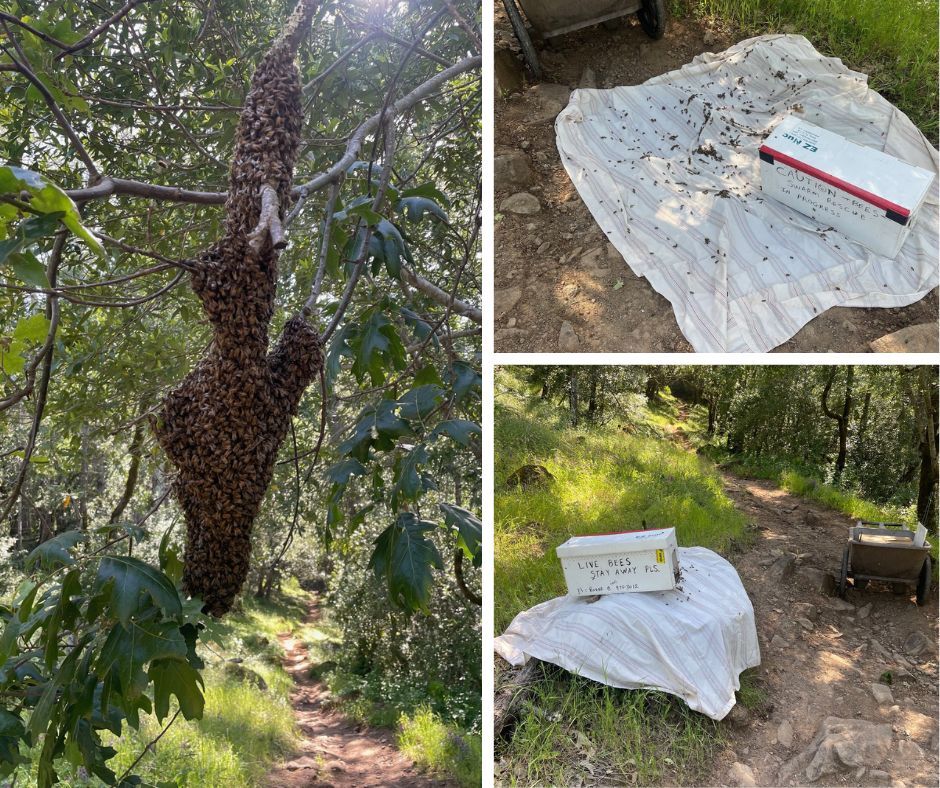
Boats Head Back into Water at Folsom Lake After Completing 30-day Quarantine for Golden Mussel Prevention
Story from: Adeline Yee, Communications and Marketing Division
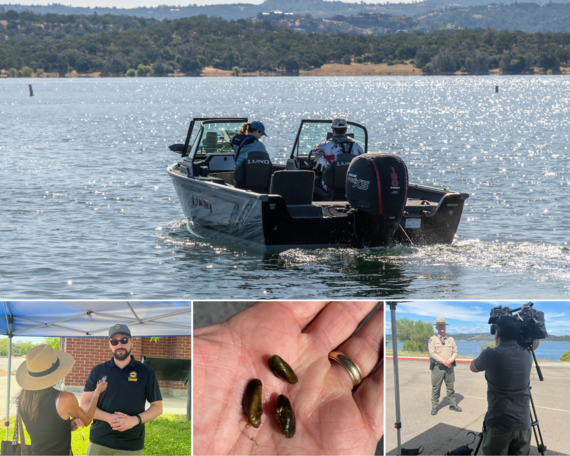 Top: Boaters head back into Folsom Lake on May 14 after completing the 30-day quarantine to prevent golden mussels. Bottom left: Division of Boating and Waterways Environmental Scientist Michael Rodriguez is interviewed by the Folsom Telegraph during a media availability event on May 14. Bottom middle: Shot of golden mussels found at Beals Point at Folsom Lake State Recreation Area (SRA) on May 6 during an inspection by State Parks staff. Bottom right: Folsom Lake SRA Superintendent Mike Howard interviewed by ABC10. Photos from Brian Baer and Adeline Yee, Communications and Marketing Division, and Mike Howard, Gold Fields District.
The first boats that underwent an inspection for the new golden mussel prevention plan at Folsom Lake State Recreation Area (SRA) were allowed back into the water this Wednesday, May 14, after completing a 30-day quarantine. To date, more than 5,500 boats have been inspected and tagged with the red quarantine seal since the program began on April 14, at the request of the Bureau of Reclamation. Just last week, State Parks staff found a boat infested with golden mussels during an inspection at Beals Point at Folsom Lake SRA. Fortunately, the boat did not go into the water and the lake is currently not infested with golden mussels.
Gold Fields District staff have been working long hours to inspect these boats to prevent the invasive species from entering Folsom Lake and Lake Clementine at Auburn SRA. Golden mussels were first discovered in North America at Rough and Ready Island, just west of the Port of Stockton, last October. Not only do they pose a significant threat to the ecological health of the Delta and all waters of the state, water conveyance systems, infrastructure and water quality, but they can also cause significant damage to boats by attaching to hulls and by clogging engines, which will lead to increased costs for boat owners.
As more boats complete the 30-day quarantine, Folsom Lake is anticipated to see more boaters head back into the water this coming weekend and Memorial Day weekend. Once boaters exit the lake, staff will verify the vessel is dry and apply a green seal. As long as that green seal is still intact, the boat can launch again at Folsom Lake or Lake Clementine. If not, the vessel will have to undergo another 30-day quarantine.
At this time, State Parks is working with the Bureau of Reclamation to authorize private businesses to perform vessel decontaminations. More on that to come as agreements are worked out.
Visitors should be aware that because the Folsom Lake water level is near capacity, three of the large parking lots at Granite Bay and Browns Ravine are under water. This has reduced parking capacity substantially. Even if boats have completed the 30-day quarantine, there may not be enough parking, especially on weekends and holidays.
We thank the public for their continued patience and understanding as State Parks staff are working diligently to keep people on the water while preventing the spread of golden mussels. Without them and these inspections, boat launching would not be possible at all this summer. For the latest updates on the inspection program and FAQs, please visit parks.ca.gov/FolsomLakeGoldenMussels.
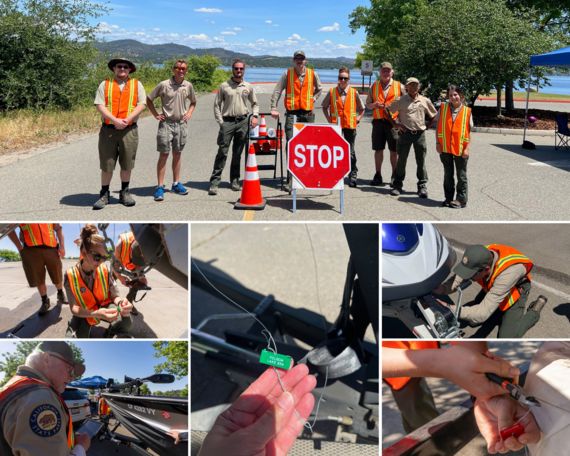 Gold Fields District staff have inspected more than 5,500 boats since the 30-day quarantine program began on April 14. Beginning May 14, Parks staff began putting the green band on boats exiting Folsom Lake to allow them to launch again as long as they don't visit another body of water. Top (left to right): Park Aide Nickolas Brown, Senior Park Aide Andrew Craft, Interpreter I Zakary Adams, Park Aides Drew Spencer, Ariel Solorzano, and Randy Chafin, Senior Park Aide Horacio Porath, and Park Aide April Paul. Photos from Brian Baer and Adeline Yee, Communications and Marketing Division.
Monastery State Beach Lifeguards Save Man During Dangerous Ocean Conditions
Story from: James Nothhelfer, Monterey District
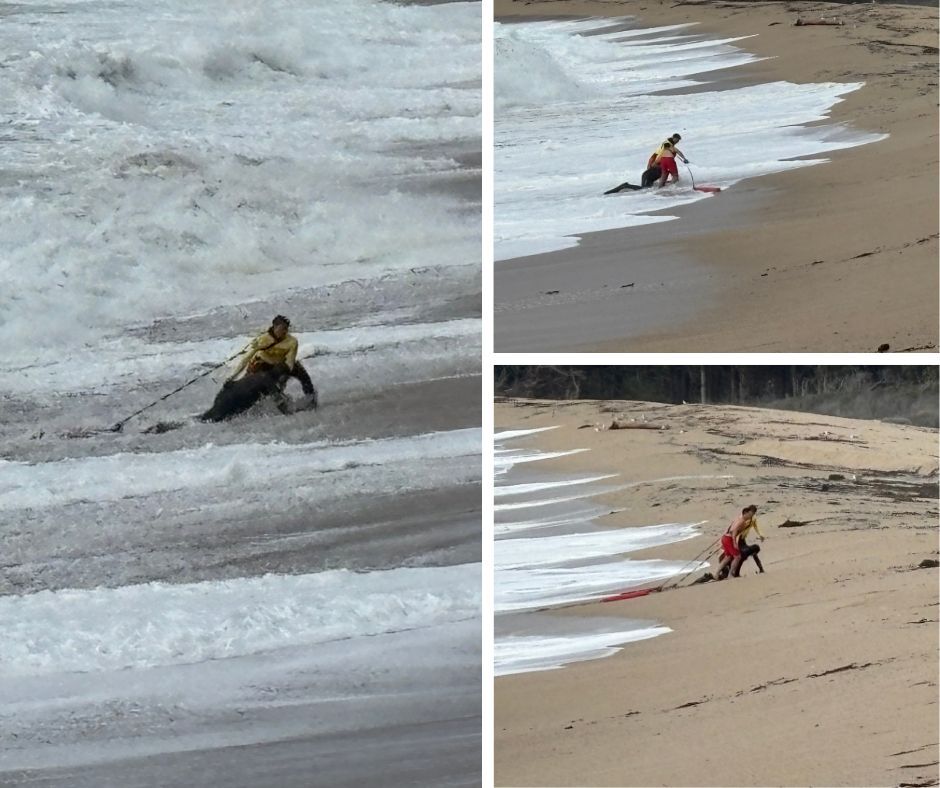 Lifeguards Gavin Delbianco and Noah Ryan captured rescuing a beachgoer in distress at Monastery State Beach on May 3. Photos from Rich Larsen, Carmel resident.
After overnight northwest winds of 20 knots, Monastery State Beach (SB) had significant swell and dangerous conditions on May 3. Lifeguards Gavin Delbianco and Noah Ryan were on duty at Monastery SB that Saturday. As Noah was on patrol, Gavin made a preventive safety contact with an individual who had arrived at the beach with a freediving wetsuit, fins, personal buoy and intentions of entering the water. Noah and Gavin spoke with the diver and advised him to not enter the water due to hazardous conditions. However, the diver insisted on going out and went anyway.
After roughly 30 minutes of snorkeling, the diver attempted to exit the water in the middle of Monastery Beach, the most extreme and hazardous section of the beach. The 6-8-foot shore break quickly took the diver by surprise and repeatedly battered him. Gavin worked his way into the impact zone to instruct the diver to swim offshore and wait for him. As Gavin tried to enter the water, a large set rolled through, forcing him to wait to time his entry safely. The diver was being pummeled by waves, and after a few brief hold-downs, the situation was quickly escalating. The last of a four-wave set pushed the diver up the beach a couple feet from Gavin, who was able to grab his belt so that he wouldn’t be sucked back into the ocean.
Noah also entered the water with his rescue buoy, while Gavin was holding on to the diver. Noah was able to secure a hold on the diver’s belt as another wave rushed up the beach. Noah and Gavin were able to keep their footing and hold on as anchor points for the diver, while the last wave receded. The lifeguards were able to quickly drag the diver up the berm and away from the impact zone.
The diver thanked Noah and Gavin for saving his life and he was able to go home safely shortly after the incident. Thank you to Noah and Gavin for your support in saving this man’s life.
Boating and Waterways Commission Tours, Provides Advice and Comment for Grant Projects to Improve Waterway Access
Story and photos from: Kevin Murphy, Communications and Marketing Division
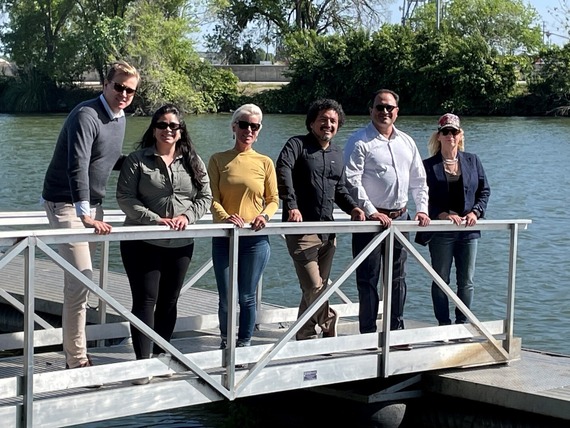 Members of the California Boating and Waterways Commission pose on a boat dock at Stockton’s Louis Park during their tour of three grant sites in Northern California. Pictured (left to right): Hampus Idsater, Maricela Rosales, Katie Hawkins, José González, Gonzalo Medina and Maggie Hallahan.
The California Boating and Waterways Commission visited boat launches and ramps on San Pablo Bay in Marin County, Lake Berryessa in Napa County, and along the San Joaquin River near the Port of Stockton on May 7. In one whirlwind day, commissioners and staff from the Division of Boating and Waterways (DBW) met representatives from the three agencies that applied for grant funding for these projects through the Waterways Connections Initiative. The initiative provides funds to expand inland waterway-related outdoor access in regions with communities of populations with more than 2,500 located near a river or other inland waterway. Funding can be used for improvements for both motorized and non-motorized boating access.
Commissioners and staff started at Bucks Landing, adjacent to China Camp State Park, in Marin County. Once the site of a brick factory that contributed to the rebuilding of San Francisco and other Bay Area cities following the 1906 earthquake and later served as a private boat launch and community gathering spot, the property where Gallinas Creek meets San Pablo Bay was eventually acquired by Marin County Parks. The local agency applied for a $600,000 grant for improvements expected to increase average annual launches from about 500 per year to approximately 7,500, as determined by a feasibility study commissioned last year. The improvements are anticipated to make the facility a Bay Water Trailhead to be used by waterfowl hunters, kayakers and other recreational users.
Commissioners and DBW staff next visited Capell Cove Launch Ramp on Lake Berryessa. Managed by the Bureau of Reclamation (Reclamation), a grant request of $250,000 would assist in planning future improvements, including accessible restrooms and the addition of a second boarding float to increase and streamline motorized launches. While the facility will remain closed in 2025 due to funding, Reclamation staff hope the facility, the least expensive ramp on Lake Berryessa at $10 per launch, will increase access to the lake for local boaters unable to pay higher rates at other locations along the lakeshore.
The last stop was Louis Park Boat Launch in Stockton, which received DBW funding in 2003 to improve access for motorized vessels, but the city would now like to add accessible improvements for non-motorized boat users, which would include a low-profile non-motorized dock, boater restroom and enhanced lighting that will provide increased access to a growing number of sculling boats and rowers in the region.
In addition to providing its advice and comment for DBW staff to proceed with these grants during its meeting on May 8, the Commission received several division program reports, from the Marine Law Enforcement Training Program, Boating Accident Reporting Program, Boating Infrastructure Grant Program and Sewage Management Grant Program. A recording of the meeting is available at CAL-SPAN. The next commission tour and meeting are scheduled for August 6-7 in Humboldt County.
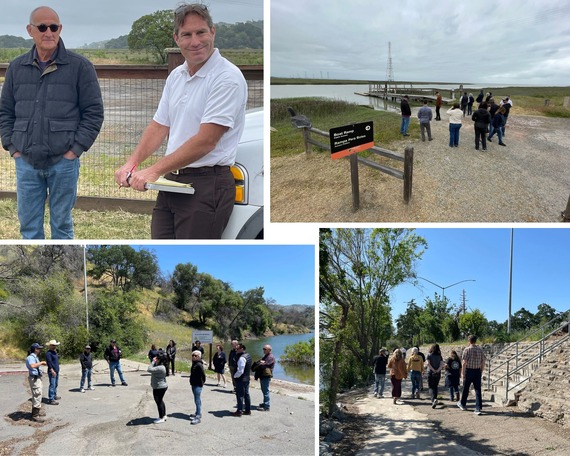 Clockwise from top left: State Parks Director Armando Quintero (left) and Marin County Parks Director Chris Chamberlain listen to a description of the grant application for Bucks Landing near China Camp State Park. Members of the California Boating and Waterways Commission and DBW staff view the current condition of Bucks Landing. Tour participants walk along an uneven pathway to the non-motorized boat launch at Louis Park in Stockton. Bureau of Reclamation staff brief commissioners and State Parks staff on the importance of Capell Cove Boat Launch on Lake Berryessa.
State Historical Resources Commission Hosts Listening Session During California Preservation Foundation Conference
Story from: Kevin Murphy, Communications and Marketing Division
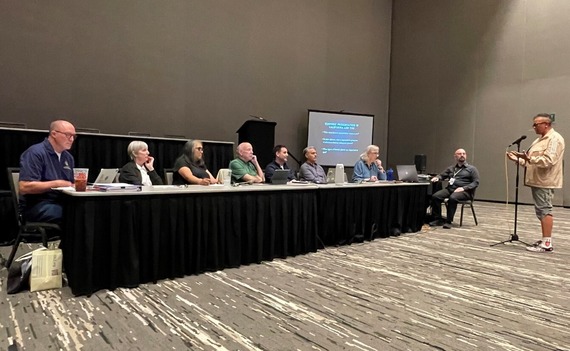 Members of the State Historical Resources Commission and staff from the Office of Historic Preservation listen to comments by Rita Cofield, a trustee of the California Preservation Foundation, during a special workshop dedicated to the California Statewide Historic Preservation Plan. Photo from Kevin Murphy, Communications and Marketing Division.
Engaging preservation professionals from throughout California, the State Historical Resources Commission hosted a listening session in Sacramento on May 8 during the California Preservation Foundation’s annual conference. The session was one of the first steps toward an update for the California Statewide Historic Preservation Plan. As a requirement for the grant each state receives from the federal Historic Preservation Fund, the plan is intended to guide the activities and priorities of agencies, organizations and the public involved in preservation in California for the years 2028-2033.
About two dozen participants joined the three-hour afternoon session to provide comments and feedback from questions posed by commissioners and Office of Historic Preservation (OHP) staff about the state’s historic preservation plan. Additional public presentations will be scheduled as the OHP and the Commission build the plan update.
The following day, commissioners met to review eight nominations to be forwarded to the Keeper of the National Register of Historic Places, an official within the National Park Service (NPS). Properties approved by the Commission to be forwarded to the NPS include the Trujillo Adobe in Riverside County, Westphal House and Placer County Administrative Center (both in Placer County), North Star House in Nevada County and the administrative building for University High School in Los Angeles.
Several participants traveled from El Dorado County to speak on behalf of the Coloma Community Hall, a property adjacent to Marshall Gold Discovery State Historic Park. Coloma Community Hall is a 1926 social hall constructed for the Coloma Grange, also known as Gold Trail Grange #452 Hall. The property is significant as a clubhouse and community hall in Coloma. In addition to the building itself, one feature of the historic property is a carronade, manufactured between 1790 and 1820, which, according to accounts documented by the Gold Trail Grange, was purchased by John Sutter from Fort Ross in 1841, and subsequently installed at Sutter's Fort.
A recording of this and previous meetings of the Commission is available through CAL-SPAN.
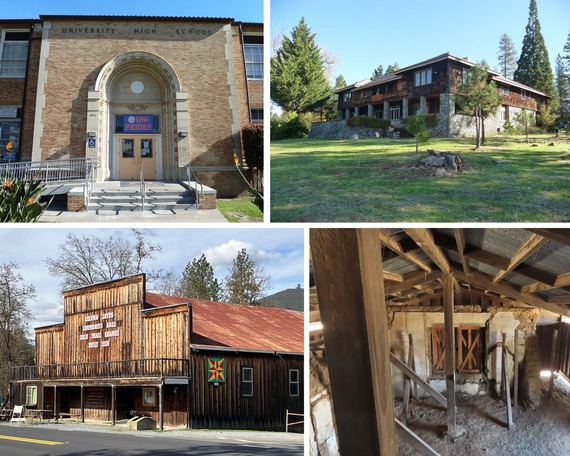 Clockwise from top left: The administrative building at University High School in Los Angeles. North Star House in Nevada County. The interior of Trujillo Adobe, built around 1862, in Riverside County. Coloma Community Hall, just across Highway 49 from the visitors center at Marshall Gold Discovery State Historic Park. Photos from the Office of Historic Preservation.
Injured Baby Seal Found in February at Point Mugu State Park Now Recovering
Story and photos from: Hannah Eaton, Angeles District
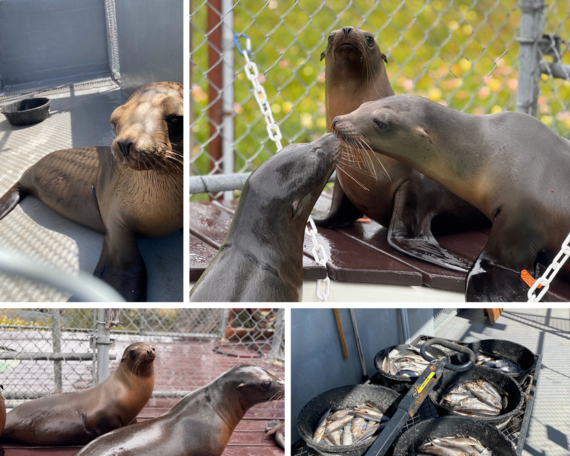 The injured seal found in February at Point Mugu State Park is recovering at the Channel Islands Marine and Wildlife Institute.
I had a thrilling tour at the Channel Islands Marine and Wildlife Institute (CIMWI) in Gaviota. Not only did I see the amazing progress of a baby seal known as “#14” that was rescued by CIMWI and park employees at Point Mugu State Park on Feb. 13, but I also had a chance to connect with the volunteers at this facility. I had the opportunity to hear how they are coping with the influx of patients due to the domoic acid (DA) neurotoxin and learned so much from these devoted individuals, from how to hold a board to block a 300-pound seal to hand-feeding elephant seals pups.
Baby seal #14 was found stranded on a beach picnic table at Sycamore Cove with lesions along his side. It has been three months since this yearling survived his 11-toothed shark bite and was assessed by CIMWI. Volunteers and their large-animal veterinarian believe that a juvenile shark practiced their bite on #14. His large wound has healed and he has gained weight, continuing to thrive with his cohorts by showing off his natural instincts of being very vocal and competitive for fish. He was just recently moved into pre-release conditioning pools, where maturing sea lions prepare for their future release back into the wild. He will eventually be returned to the ocean from the Channel Islands along with the other patients at CIMWI experiencing DA and along with weening elephant seal pups.
During my visit, volunteers expressed their concerns about the severity of DA. They expressed the importance of communicating with the public best practices when encountering animals experiencing DA symptoms. They hope individuals can understand that these marine mammals are very unpredictable, with symptoms ranging from lethargy, disorientation, staring into space, head bobbing/weaving, foaming at the mouth, vomiting, bulging eyes, involuntary spasms, erratic behavior, inability to move/get out of the tidal zone, seizures and death. While in recovery on the shoreline, it is recommended to keep your distance from these animals for your safety and to allow the distressed animal to remain calm. This includes keeping dogs on leashes and not intervening with the animals' current state. The public is advised to contact their local marine mammal rescues, so they can evaluate the animals' condition for rescue.
We hope #14 makes a full recovery soon so that he can enjoy his journey in the open ocean.
Capital District Fellowship Program Empowers Emerging Professionals
Story and photos from: Melanie Tran, Capital District
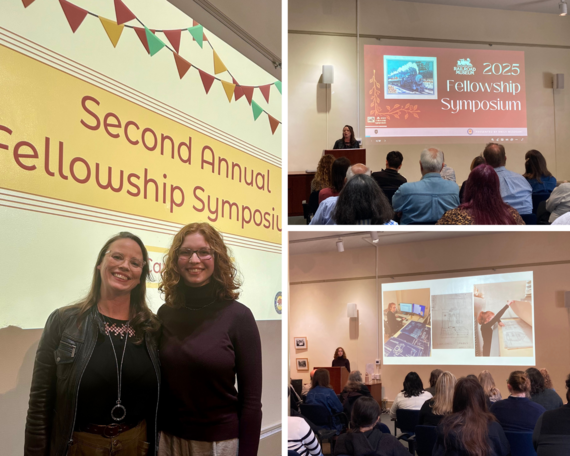 Left photo: Archive Fellows Emily Mizokami (left) and Tyler Gibson celebrate completing their fellowship. Top right: Emily presents her work on the R&LHS Graphic Arts Collection. Bottom right: Tyler presents on her work with the technical drawings collection.
The Capital District Fellowship Program offers emerging professionals a substantial learning experience. Fellows hone their skills, discover their career path and challenge their preconceptions about museum, library and archives work. For the California State Railroad Museum (CSRM), it is an opportunity to nurture advocates and push the boundaries of traditional museum work.
Making up the second cohort of the program, Archives Fellows Tyler Gibson and Emily Mizokami worked closely with CSRM library and archives staff to complete complex projects and build a professional network. Together they made over 4,600 records accessible to the public for the first time. Fellows engaged in informational chats about career paths, toured local archives and contributed to curatorial team projects throughout State Parks. Tyler and Emily completed the fellowship by presenting on their work at a symposium attended by Capital District staff and CSRM partners.

Collaboration Key in Reimagining State Parks After Fire
Story and photo from: Parks California
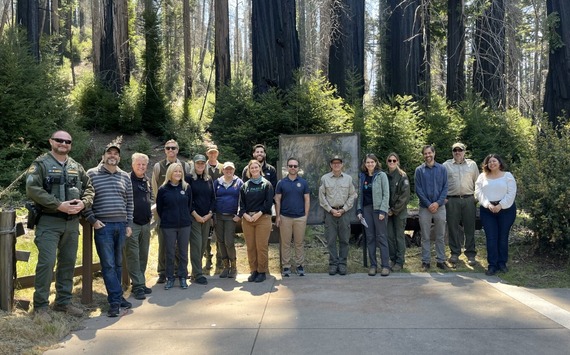 Parks California team members with California State Parks staff from Santa Cruz and Angeles districts.
At 6 p.m. on Aug. 18, 2020, staff from the Santa Cruz District were evacuating campers under a sky lit by advancing flames. The CZU Lightning Complex Fire ultimately burned more than 86,000 acres across Big Basin Redwoods, Butano and other state parks and the surrounding Santa Cruz Mountains. The destruction was swift, closing California’s oldest state park and changing it forever. In the years since, the Santa Cruz District team has led an extraordinary effort to reimagine what’s possible after wildfire. Their work has been grounded in deep planning, hard-earned lessons and partnerships that are starting to bring both people and wildlife back to the redwoods.
This spring, their story became a source of hope and inspiration for another region facing recovery. In the wake of the January 2025 Palisades Fire, the Angeles District team is beginning its own journey to assess damage and chart a path forward for Will Rogers State Historic Park and Topanga State Park (SP). To support that effort, a group from the Angeles District traveled north to meet with colleagues at Big Basin Redwoods SP and see firsthand what reimagining a fire-impacted park can look like.
“The trip to Big Basin means so much to the Angeles team,” said Angeles District Superintendent Richard Fink II. “Not only are the connections and information invaluable, but hearing from another district that has experienced such a loss is an important part of our recovery.”
Coordinated by Parks California to support cross-district learning, the visit included tours of restored trails, discussions about resilient infrastructure and updates on how the Santa Cruz District is rebuilding with an eye toward the future by incorporating fire-adaptive design in everything from staff housing to shuttle services and traffic flow.
“Recovering Big Basin has been a collaborative effort from the start, one that’s required listening, learning and leaning on each other,” said Santa Cruz District Superintendent Chris Spohrer. “We’ve learned a lot over the past few years, and it’s an honor to share those lessons with colleagues facing similar challenges. This kind of peer connection not only strengthens our work, it strengthens our parks.”
While every park’s path to recovery is different, the trip underscored a common theme: recovery is a shared effort. And through collaboration, creativity and community, new beginnings are already taking root.
Renew LA Fire Fund Launched
Story and photo from: Parks California
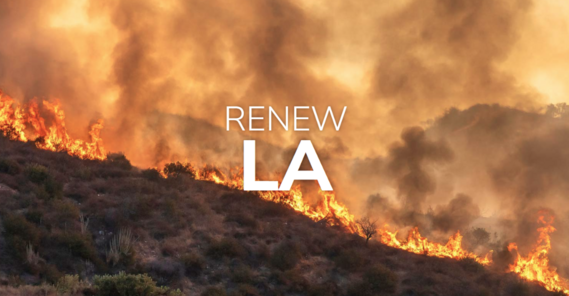 Parks California recently launched a $5M Renew LA fundraising effort in April to support Angeles District in planning and reopening Will Rogers State Historic Park and Topanga State Park after the January Palisades Fire. Funds raised will augment state investments and allow State Parks flexibility to accelerate natural renewal in our state parks and revitalize Los Angeles' storied landscapes.
Parks California is now encouraging those who loved to visit these parks to share their memories from past visits to either park.
|