California Citrus State Historic Park Celebrates the Legacy of Black Californians in the Citrus Industry
Story and photos from: Garrett Fuhrman, Inland Empire District
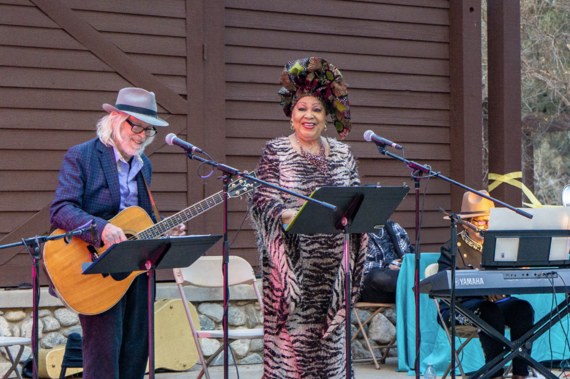 Performers, including (from left to right) Robert "Bobcat" Fraley, Joyce Warhop (Lady Danger) and Marilyn Ashton, on the keyboard, take the stage.
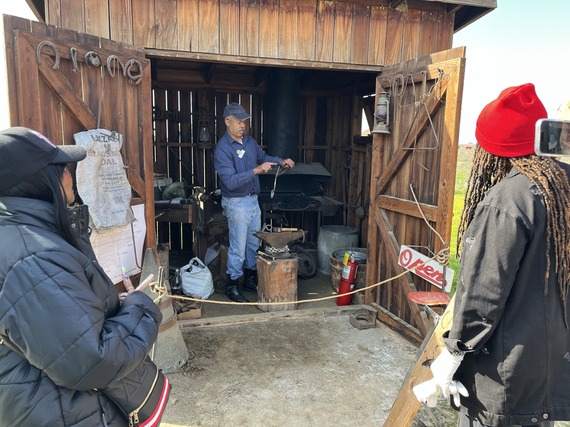
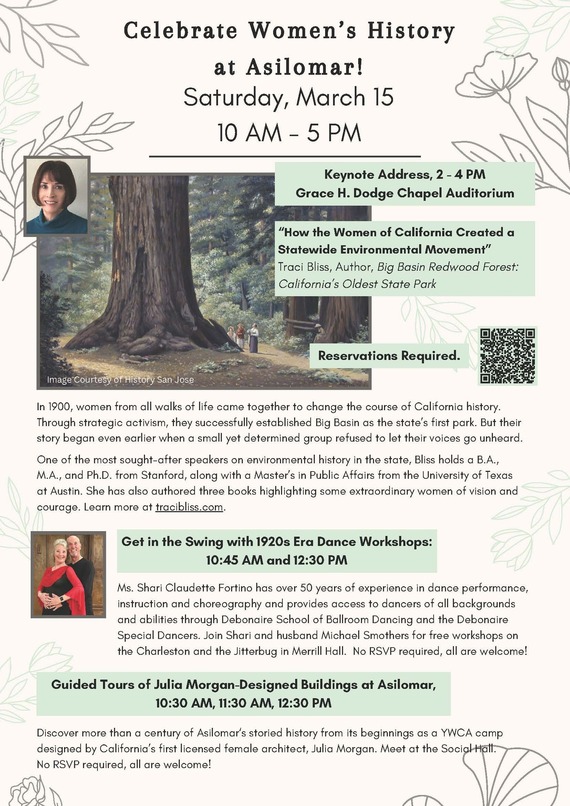
California Citrus State Historic Park kicked off Black History Month with an incredible celebration of heritage and unity on Feb. 8. Guests gathered at sunset for an unforgettable evening of music, storytelling, and interactive art. Joyce Warhop, better known as Lady Danger, and Robert "Bobcat" Fraley took the stage, honoring the rich heritage of the Inland Empire through powerful performances that wove history into song and story.
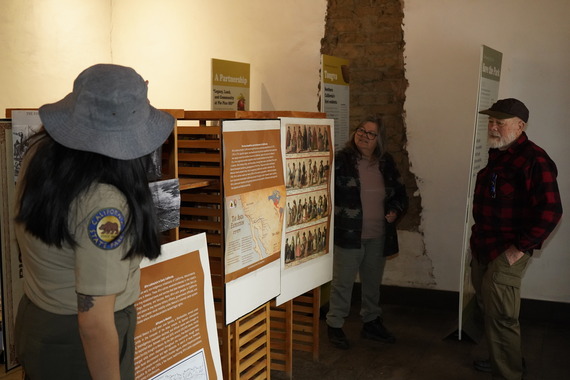
Attendees also explored the immersive media installation of the Relevancy and History Project—a partnership between the University of California, Riverside, and California State Parks—featuring sounds and images contributed by local families and descendants of Black Californians who played a vital role in the rise of the citrus industry. For those who could not join in person, the event was live streamed on Instagram and Facebook Live, allowing even more people to celebrate with us from afar. It was a meaningful and inspiring evening, bringing together people of all ages to learn, reflect and celebrate Black history.
Nature’s Resilient Regrowth After Wildfires
Story from: Cassandra Chavez, Angeles District
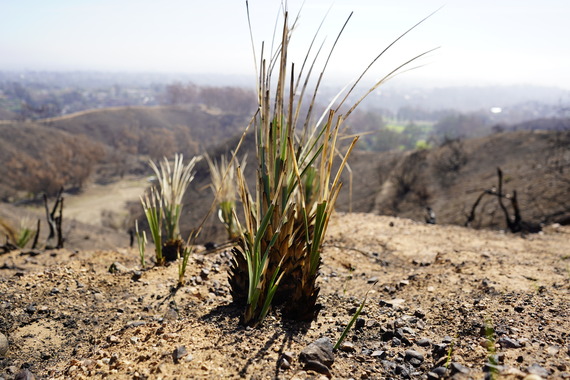 Yucca grows at Inspiration Point in Will Rogers State Historic Park following the Palisades Fire in January. Photo from Angeles District.
Wildfires, while destructive, often trigger nature’s remarkable ability to regenerate. Certain plants, known as fire followers, thrive in the aftermath of fires. These species have adapted to fire-prone environments and actually benefit from fire, which helps with seed germination, reduces competition and stimulates regrowth from roots. Examples of fire-following plants include soap plant, spikemoss, wild cucumber, lupines, foothill needlegrass and giant wild rye. These plants quickly take advantage of the nutrient-rich soil left behind by fire, playing a critical role in stabilizing the soil and providing habitat for wildlife.
The Los Angeles County region is considered a fire-adaptive, not fire-dependent, regime. This means while plants can tolerate fire and benefit from it, they are not entirely reliant on it for survival. However, as fire frequency increases, it may affect the ability of these plants to recover. This fact emphasizes the need for careful management of fire-affected areas, ensuring these ecosystems have time to heal.
Rushing into recently burned areas can disrupt delicate regrowth, damage fragile vegetation, and even increase soil erosion. It is vital to allow time for natural recovery. By doing so, we support the long-term survival of fire-following plants, helping preserve these resilient ecosystems for future generations. Nature’s regeneration is extraordinary—let’s give it the time it deserves.
 Spikemoss (left) and giant wild rye (top right) are two examples of plants that appear after fires. Bottom right: Emerging plant life proves the regenerative power of nature after wildfires. Photos from Noa Rishe, Angeles District.
Civicorps Members Train with State Parks in Window Restoration at Benicia Capitol State Historic Park
Story and photos from: Joseph Starr, Diablo Range District
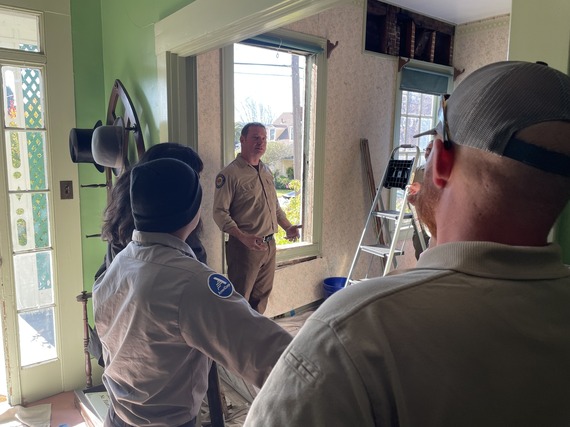 Capital District Restoration Supervisor Tim White demonstrates the removal of windows from the Fischer-Hanlon House.
State Parks recently teamed up with Civicorps with the goal of training and preparing youth from underserved communities for careers in the department. Based in Oakland, Civicorps has partnered with State Parks on a wide range of successful projects, including completing much needed work on trails, forestry projects and facilities repairs throughout the Contra Solano Sector.
This two-weeklong training involved the removal of 170-year-old windows from the historic Fischer-Hanlon House at Benicia Capitol State Historic Park and transporting them to the maintenance shop at Benicia State Recreation Area, where each participant was assigned a window to repair. Ten of the worst windows—20 sashes—were removed from the building and are now in the process of being restored. Products used in this training, like linseed oil paint, require more time to dry than modern materials so it will be several weeks before the window sashes are put back in the building. Once all the sashes are ready, Civicorps members will return to complete the installation of the windows.
A big thank you to Diablo Range District Cultural Resources Program Manager Amanda Blosser for organizing the class and to Capital District Restoration Supervisor Tim White for driving down from Sacramento each day to pass on his precious knowledge to the next generation. Thanks also to Park Maintenance Worker I Dan Carmichael for hosting everyone in his shop and putting up with our shenanigans. Finally, congratulations Civicorps Crew Leader Tommy Kaufman, who won the National Corpsperson of the Year Award. We look forward to continuing this partnership and providing employment opportunities to Civicorps members.
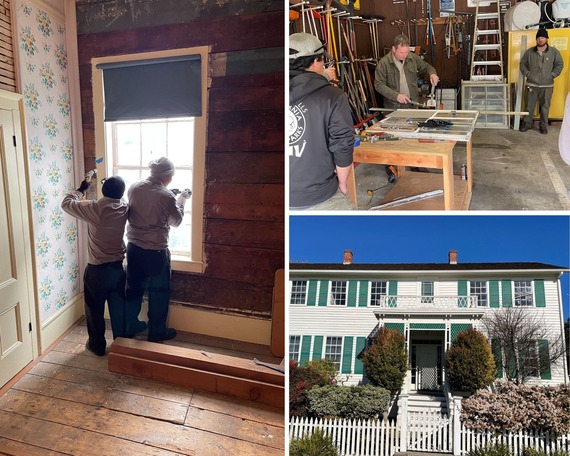 Clockwise from left: Civicorps members remove window trim. Tim White demonstrates how to use an infrared heat lamp to remove old paint and putty from window sashes in order to pull out window glass. An exterior view of the Fischer-Hanlon House.
District Maintenance Skills Training Class Replaces Walkway at Salton Sea State Recreation Area
Story and photos from: Ricky Roldan, Training Section
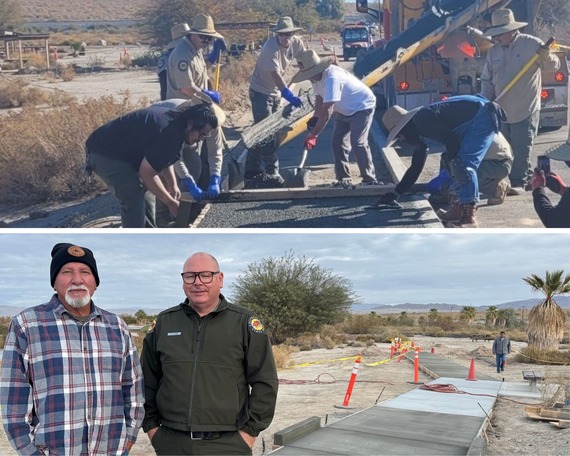
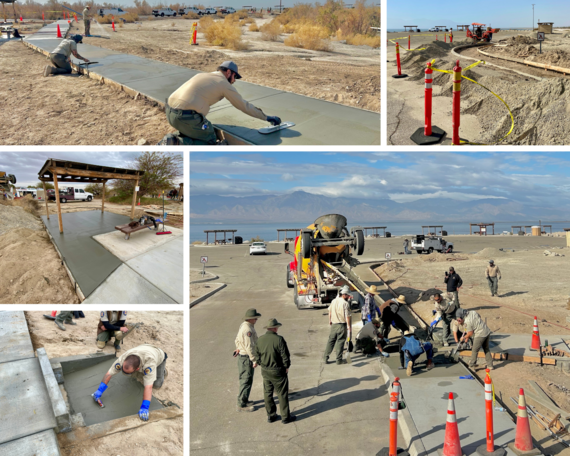 Clockwise from top left: Training class participant Armado Macias smoothing out the concrete pour for the pedestrian walkway. Demo and forms set ready for the concrete truck. Training class participants spreading the pour from a cement truck chute. Participant Michael Rooney smoothing out freshly poured concrete for the wastewater drainage. Finished concrete under a ramada.
The Training Section’s District Maintenance Skills Training Class visited Salton Sea State Recreation Area (SRA) in February to remove and replace 600-800 feet of deteriorating concrete sidewalk and pedestrian walkway. Instructors and staff from around the state worked on the project.
The project began in January 2025, with Heavy Equipment Operator Dan Christianson demolishing a long stretch of the concrete walkway. During the week of Feb. 3-7, Lead Instructor Joe Lechuga, along with assistant instructors and participants, set up and built forms for the first 100-foot concrete pour.
On Feb. 10, Ocotillo Wells District Park Maintenance Chief (PMC) III/Pedestrian Walkway Project Manager Alfredo Jacobo introduced the Masonry Class Walkway Project. Training Specialist/PMC I Ricky Roldan, San Diego District PMC III Jodi Whelchel, Channel Coast District PMC III Richard Barry and Lechuga lectured and answered questions from the class.
From Feb. 11-14, the district maintenance skills class built forms for the ramadas and drainage culverts. Concrete was poured from a cement truck through the pumper truck’s hoses to spread it. Students then used trowels, Fresno scrapers and bow floats to smooth out the concrete surfaces of the pedestrian walkway.
Salton Sea SRA State Park Interpreter Brandielle Gibson spoke to participants about the history of the park. The Salton Sea Basin has existed for millions of years, filled intermittently by the Colorado River with a series of natural lakes, most recently in 1891. As a terminal lake system, the Salton Sea grows saltier each year and is now more than twice as salty as the Pacific Ocean. It no longer supports the previous fish populations. The recreation area currently offers camping, birding and access to the Salton Sea.
The Training Section appreciates the hard work put into organizing this masonry class. Participants worked diligently to learn the skills necessary to build long-lasting park infrastructure. A big thank you goes out to Jacobo, Christianson, the outside district maintenance participants and the Colorado Desert District maintenance staff for hosting and contributing to the success of the Salton Sea Pedestrian Walkway Project. Please check the FOCUS calendar for updates on spring and fall 2025 maintenance classes. Classes fill quickly. For questions, email me at ricky.roldan@parks.ca.gov.
 PARTNER NEWS
Hop on Board the Leprechaun Lounge Pub Train: A Lucky Ride for Adults
Story from: Traci Rockefeller Cusack, T-Rock Communications
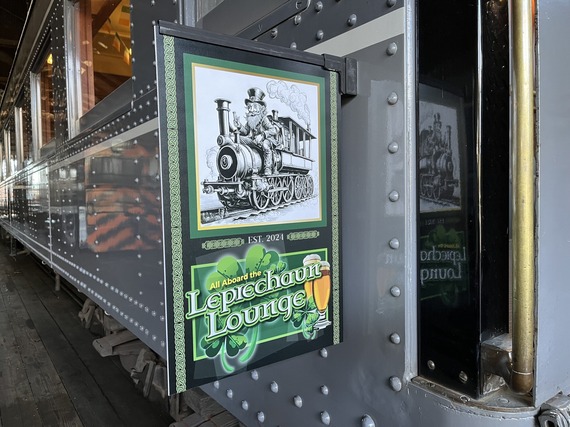 Leprechaun Lounge Pub Train flyer. Photo from Kevin Hecteman, California State Railroad Museum Foundation.
Get ready for the luckiest ride in town! The California State Railroad Museum and California State Railroad Museum Foundation are bringing back their popular Leprechaun Lounge Pub Train for two exciting days of fun, festive spirits and scenic views. After its successful debut in 2024, this one of a kind experience returns March 15-16, offering adults over 21 years of age a chance to enjoy St. Patrick's Day weekend like never before.
Hop aboard the luxurious El Dorado first-class car, which will be transformed into a lively Irish pub, complete with delicious drinks and festive snacks. This 45-minute train ride, pulled by a historic diesel locomotive, will take you on a scenic journey along the Sacramento Southern Railroad, offering beautiful views of the Sacramento River.
With limited space available, the Leprechaun Lounge Pub Train offers three rides on Saturday (11:30 a.m., 1 p.m., and 2:30 p.m.) and two on Sunday (1 p.m. and 2:30 p.m.). Tickets are just $45 per person ($40 for members of the California State Railroad Museum Foundation) and include two drink tokens (with both alcoholic and non-alcoholic options available), snacks and a limited-edition can cooler.
Don’t miss out on this unique St. Patrick’s Day experience! Tickets are available online, and same-day tickets may be purchased at the Central Pacific Passenger Station if still available. Secure your spot today and make it a weekend to remember!
For more details or to purchase tickets, visit the California State Railroad Museum Foundation website.
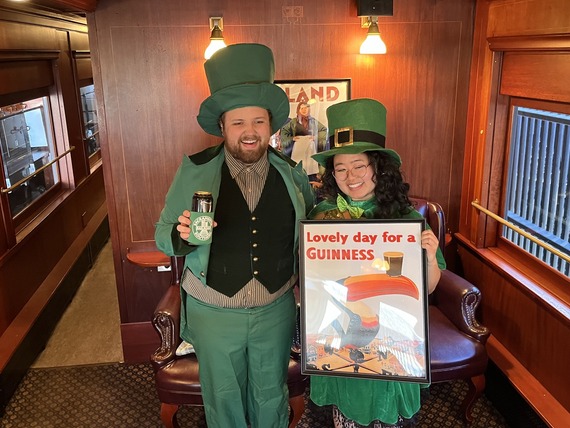 Sean Putzier and Lex Mark from the California State Railroad Museum Foundation dress as leprechauns to help promote last year's pub train. Photo from Kevin Hecteman, California State Railroad Museum Foundation.
  Please submit your photos HERE. Please send questions to WeeklyDigest@parks.ca.gov.
State Parks Mourns the Loss of Kate Green
Story from: Communications and Marketing Division
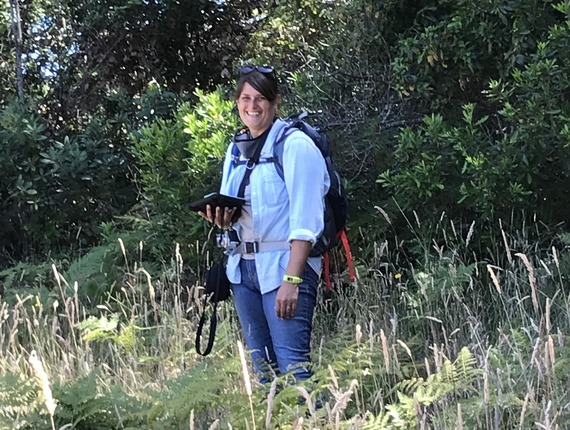 Kate Green at Tomales Bay State Park. Photo from Bay Area District.
Kate Green, an associate state archeologist for the Bay Area District, died earlier this month after a two-year battle with appendiceal cancer. Kate was a dedicated public servant, mentor and nature lover who worked for State Parks since 2017. She was passionate about parks and the special places they preserve. Her commitment to fostering partnerships and collaboration with California's Native American tribes was the inspiration for the new Tribal Partnership Director's Award, which will be presented for the first time later this spring.
"I join in mourning Kate with her family, friends and colleagues," said State Parks Director Armando Quintero. "Kate was a singular force who had a profound impact on our department as a tireless steward of our state's precious cultural resources. She created an incredible legacy of engagement and respect with tribes State Parks that will influence myself, her colleagues and generations to come."
For more on Kate's life and legacy, please read her obituary.
|