Asilomar State Beach and Conference Grounds Hosts Film Screening in Honor of Native American Heritage Month
Story from: Jenifer Lienau Thompson, Monterey District
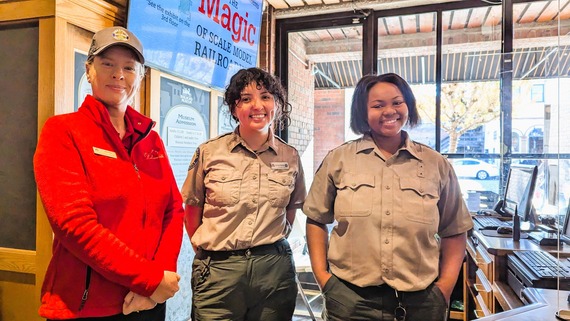
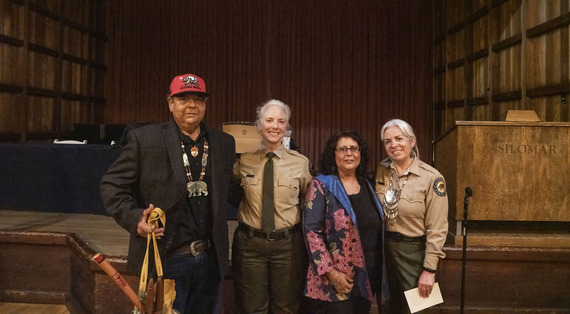 From left to right: Tribal Chairman of the Esselen Tribe of Monterey County Tom Little Bear Nason, State Park Interpreter I Jenifer Lienau Thompson, filmmaker and photographer Kirti Bassendine, and State Park Interpreter I Violet Smith—Indigenous Programs, Monterey District. Photo from Kirti Bassendine.
Over 200 visitors packed the historic Grace Dodge Chapel Auditorium at Asilomar State Beach and Conference Grounds on Nov. 16 to learn about regional tribal communities and their perspectives on climate change, traditional stewardship, and access to traditional foods and materials.
In honor of Native American Heritage Month, Asilomar hosted a screening of “Contemporary Indigenous Voices of California’s South Coast Range,” a series of interviews with regional Indigenous leaders from tribal communities in the South Coast Range, which spans from the San Francisco Peninsula, through the Santa Cruz Mountains, and into the lower Salinan Valley. The films explore cultural practices and personal stories of local and regional Indigenous community members. Following the screenings, artist/filmmaker Kirti Bassendine and local Indigenous leaders Tom Little Bear Nason, tribal chairman of the Esselen Tribe of Monterey County, and Rumsen Ohlone Tribal Community Leader Linda Yamane shared personal perspectives with the audience.
Guests were inspired by the Indigenous leaders featured in the films and by the lively discussion afterward. As the audience filed out at the end of the event many of them thanked State Parks for providing the opportunity to learn from local Indigenous leaders.
Visitors took lessons home with them—both from the films and from the panel discussion. Valentin Lopez, chairman of the Amah Mutsun Tribal Band, talked about science and traditional stewardship: “We worked a lot with university [scientists] on research, [which] we recognize as validation. [Scientists] were validating that the way our ancestors lived, the way they took care of Mother Earth.” Lopez added, “If we are going to survive climate change, if we are going to find a way to go forward, it must be Indigenous-led. That means that people need to learn from the tribal people about how to take care of Mother Earth.”
Tom Little Bear Nason, chairman of the Esselen Tribe of Monterey County, reminded the audience: “We, as the original ‘red people,’ are the ones that will teach the other people about caretakership of the Earth, about how to live with the Earth as one, how to steward the land. Climate change is affecting our tribe greatly. We must act together; we must work together. We must listen to the Indigenous People.”
In speaking with local radio station KAZU, Bassendine explained how and why she got involved in this project. “It is so important for us to give acknowledgement and respect to [those] in whose land we are living,” Bassendine said. "We have a responsibility to understand the tribal history. Healing and repair cannot be done unless we educate ourselves about the people here and what happened to them.... All they want is for it to be recognized that they’ve always been here.”
Click here to view a trailer for “Contemporary Indigenous Voices of California’s South Coast Range.”
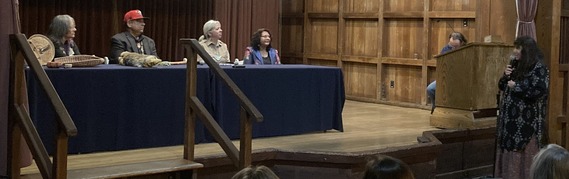 The panelists, from left to right: Rumsen Ohlone Tribal Community Leader Linda Yamane, Tom Little Bear Nason, Violet Smith, Kirti Bassendine, and Tribal Vice Chair of the Esselen Tribe of Monterey County Cari Herthel (singing). Photo from Jenifer Lienau Thompson, Monterey District.
Ocotillo Wells State Vehicular Recreation Area Hosts Tread Lightly Day for OHV Safety Week
Story from: Taylour Unzicker and Cassandra Van Dyne, Ocotillo Wells District
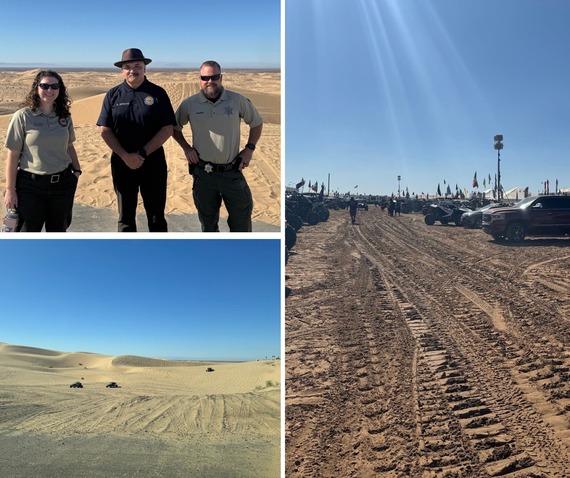
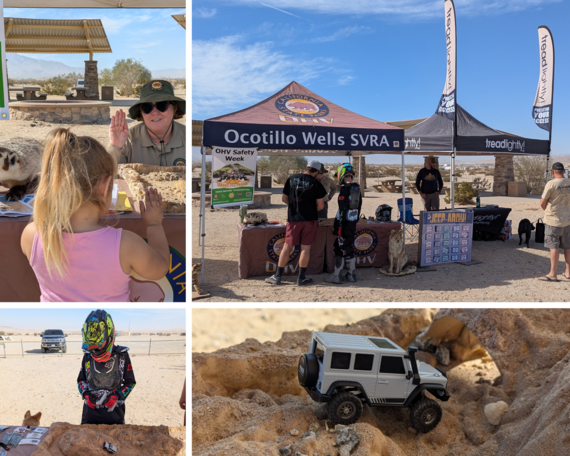 Top left: State Park Interpreter I Cassandra Van Dyne swears in the newest Junior Ranger. Top right: A family stops by Tread Lightly! Day to learn about the free Off-Highway Vehicle (OHV) free safety classes available to the public. Bottom left and right: A park visitor tries out the new 1:43 scale Tabletop RC Crawler course while learning about OHV safety. Photos from Taylour Unzicker, Ocotillo Wells District
Ocotillo Wells State Vehicular Recreation Area (SVRA) hosted Tread Lightly! Day California to promote Off-Highway Vehicle (OHV) Safety Week. Tread Lightly! and California State Parks worked together to promote OHV safety and sustainable recreation in SVRAs. It was a great opportunity to discuss safety with park visitors.
Park staff were able to direct visitors to the California Outdoor Recreation Foundation website to learn about all the upcoming free OHV safety courses available. Youth were able to test out the new Tabletop RC Crawler course while learning about desert OHV safety. In addition, some new Junior Rangers were added to the team after participating in some OHV-focused Junior Ranger activities.
Ocotillo Wells SVRA enjoyed a fun OHV Safety week and is looking forward to an enjoyable riding season.
Celebrate the Holidays at Hearst Castle
Story and photos from: Carmen Aurrecoechea, San Luis Obispo Coast District
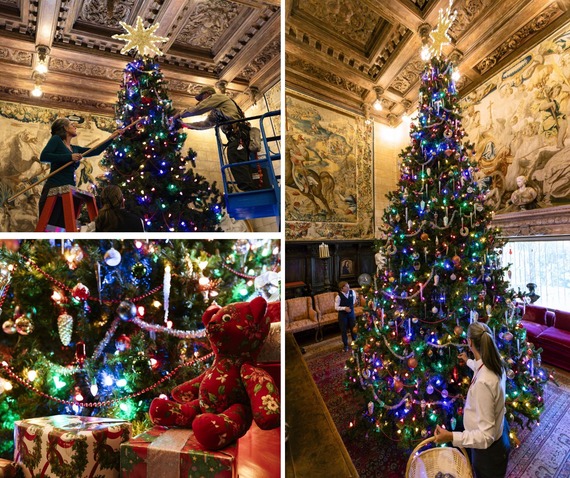 Clockwise from top left: From left to right, guides Suzanne Dean and Mary Johnson and Restoration Work Specialist Marc Cremarosa work together on the top of a tree. Guides Kay Brynildson and Kim Silva place ornaments throughout the lower tiers of a tree in the assembly room. Prop gifts are staged at the base of the assembly room trees, similar to how they would have looked during a celebration at William Randolph Hearst’s time.
The halls and grounds of Hearst Castle at Hearst San Simeon State Historical Monument have been decked!
From garlands to blooms, staff members take great care to emulate the decorations and plantings on display in historic photographs and described in oral histories. The assembly room of Casa Grande houses the tallest trees on display: two 18-foot-tall trees stand on either side of the room. They are encircled with prop replicas of the popular gifts of the age.
Erecting and decorating the assembly room trees requires a scissor lift, ladders, long reaching hooks, and quite a few of Santa’s helpers. In all, five staff members from collections, 27 guides, and a few historic restoration staff members lent their hands in the efforts. Even with all the helpers, decorations take time to set up. It took about two full weeks of work: 12 days of decorating, a few days of prep work, and a couple more days afterwards to tie up loose ends.
A dozen trees can be seen in the refectory alone. There are six 4-foot tabletop trees in the refectory and two 8-foot trees in the musician’s loft above the dining area. But the work isn't contained inside. Seasonal varieties of plants and colors continue outdoors. A grand thank you to all staff who participated in and supported decorating efforts this year.
Holiday Twilight Tours are available now through the end of the year. Be sure to book your tour in advance to join in on the sparkle, warmth, and gratitude of this holiday season and delight in the stories of Christmas past. An accessible tour is also available and designed for visitors in a wheelchair or who have difficulty climbing or descending stairs or who cannot stand or walk for lengths of time.
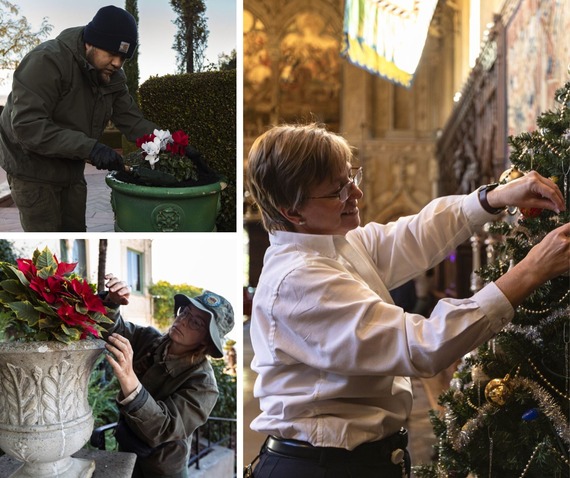 Top left: Senior Maintenance Aide Bryan Loredo plants fresh red and white blooms. Bottom left: Park Landscape Maintenance Technician Shannon Melendy plants and arranges a poinsettia in a garden pot. Right: Guide Deborah Ivy delicately places ornaments on a table-top tree in the refectory.
Thank You, Partner Dockwalkers!
Story from: Vivian Matuk, Division of Boating and Waterways and California Coastal Commission
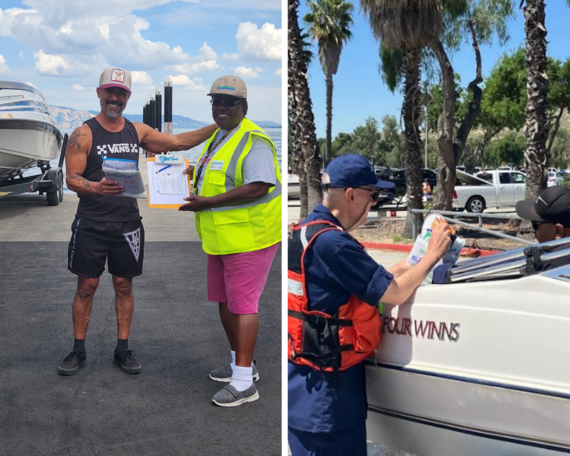 Left: Partner Dockwalker Elizabeth Moses shares clean boating information and distributing the California boater kit in Clearlake. Photo from City of Clearlake. Right: U.S. Coast Guard Auxiliary member and Dockwalker Peter Rosen conducts a vessel examination in Los Angeles County. Photo from U.S. Coast Guard Auxiliary.
This was another great year, thanks to the outstanding work from Dockwalkers.
Dockwalkers are partners and environmental educators, trained to provide face-to-face boater education about clean boating practices and to distribute California boater kits. They perform these duties while visiting boating facilities, boat launch ramps, and boat shows and events, as well as through presentations at yacht clubs or by simply talking to boaters when the opportunity arises. Boaters receive a boater kit after completing and signing a questionnaire and pledge to adopt clean boater practices. The questionnaire helps to improve future education efforts in the Dockwalker program and to identify where boaters live who have received clean boating information from partner Dockwalkers and staff.
The Division of Boating and Waterways' and the California Coastal Commission’s Boating Clean and Green Program as well as The Bay Foundation would like to express their deepest gratitude to all partners and organizations that supported the Dockwalker program this year.
In 2024, the program partners worked together with the U.S. Coast Guard Auxiliary, U.S. Power Squadrons, Lake Berryessa Partnership, Lake County, marinas and yacht clubs, and many more organizations. The previous year, 270 partners participated in 14 virtual and three in-person Dockwalker trainings and refresher classes. Dockwalkers distributed 6,500 boater kits across the state that provided boaters with the know-how and tools to reduce their environmental impact. Boater kits include information on clean boating practices, an oil absorbent pillow, an oil absorbent sheet, a fuel bib, and information about local pollution prevention services.
Working together with these dedicated partners made this year another success. Click here to see which Dockwalkers administered and returned the highest number of surveys and joined the ranks in the Dockwalker Hall of Fame.
Thanks to our partners, the following awards were provided to the Hall of Fame recipients:
- Trader Joe’s products
- Klean Kanteen products
- Gift cards to Starbucks, Sprouts Farmers Market
- California State Parks annual passes
- Life jackets
- Photos from the California Amateur Photo Contest
Next year, program partners will continue to offer more virtual trainings and in-person trainings. The 2025 trainings will be featured on the Dockwalker website in January 2025. Check out these videos to learn what other Dockwalkers are saying about the program. To learn more about the Dockwalker program, visit the Boating Clean and Green Program webpage or contact Vivian Matuk at vmatuk@coastal.ca.gov.
Thank you Dockwalkers for all you do in providing clean boating education and improving the health of our waters.
Meet the Commissioner: Lee Adams III from the State Historical Resources Commission
Story from: Kevin Murphy, Communications and Marketing Division
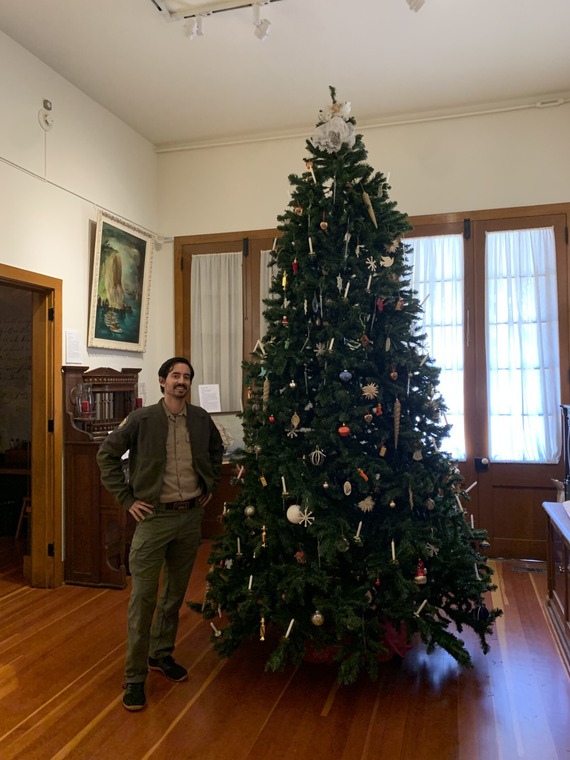
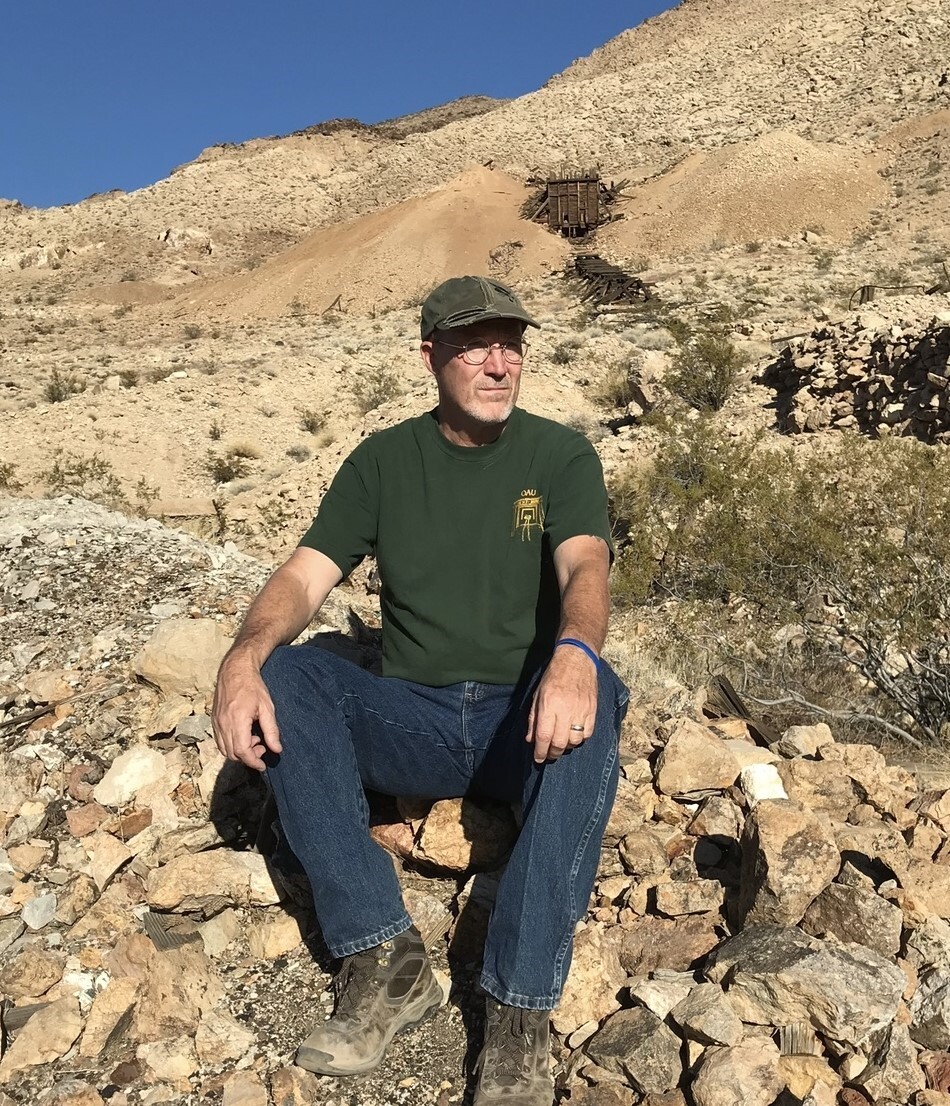 Lee Adams III, a member of the State Historical Resources Commission, outside a mining ruin in the Mojave Desert. Photo from Lee Adams III.
Meet the Commissioner, an occasional series in the Weekly Digest, continues with a profile of Lee Adams III. Commissioner Adams serves on the State Historical Resources Commission. The Commission is a nine-member state review board appointed by the Governor with responsibilities for the identification, registration, and preservation of California's cultural heritage.
Commissioner Adams, from Downieville, was appointed to the Commission in July 2018. He also serves as a member of the Commission on State Mandates and has represented the First District on the Sierra County Board of Supervisors since 2009. He was sheriff and coroner for Sierra County from 1988 to 2007. He received a degree in criminal justice from California State University, Sacramento in 1978.
Adams is treasurer of the Downieville Museum, a member and treasurer of Downieville Parlor No. 92 – Native Sons of the Golden West, a docent at Leland Stanford State Historic Park (SHP), and a lifetime member of the Death Valley Natural History Association. He also sits on the board of directors of the Native Sons of the Golden West's Historic Preservation Foundation. We asked Commissioner Adams five questions to learn more about him:
1. Why did you apply for the Commission? The unique California bronze bear historic landmark plaques are etched into my earliest childhood memories and I just about drove my parents crazy begging to stop at everyone we passed near. As an adult living in a gold rush community, I was able to be involved in making such an application and that gave me a closer look at the Commission and the awesome work it does.
2. Since joining the Commission, what’s one thing that has surprised you? I serve with an incredible and diverse group of people. My fellow commissioners and the staff of the Office of Historic Preservation continue to wow me with their thoughtfulness of interpreting and preserving the unique and broad spectrum that California and its history represents.
3. Why do you think it is essential for the public to engage with the Commission? The geography that is today the State of California has a rich history prior to the date of Sept. 9, 1850, and hearing from our diverse constituency makes sure we are better about telling the complete story of these special grounds. The Commission does best when it represents the whole of California and the timeline of what we preserve, protect, and interpret goes far beyond the date of statehood.
4. What is your favorite form of recreation, and do you have a favorite state park to visit? As a Jeep Wrangler owner, I especially like going to those obscure historic sites that force you on to a dirt road, and then perhaps a bit of hiking as well to find. Three favorite state parks are Bodie SHP, the California State Railroad Museum, and Leland Stanford Mansion SHP where I am a volunteer docent.
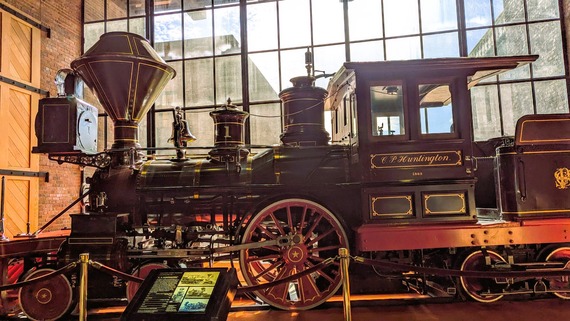
5. What would someone be surprised to learn about you? That I have a tattoo of the Central Pacific Railroad’s Jupiter on my right shoulder. The engine that pulled Leland Stanford’s private railroad car to the Golden Spike event in 1869 is my personal tribute to a big day in California history.
In addition to the State Historical Resources Commission, three other commissions under State Parks provide guidance to the department director and staff, including the State Park and Recreation Commission, California Boating and Waterways Commission, and the California Off-Highway Motor Vehicle Commission.
AT&T Removes Six Miles of Submerged Cables from D.L. Bliss and Emerald Bay State Parks
Story from: Lindsay Cline, Sierra District
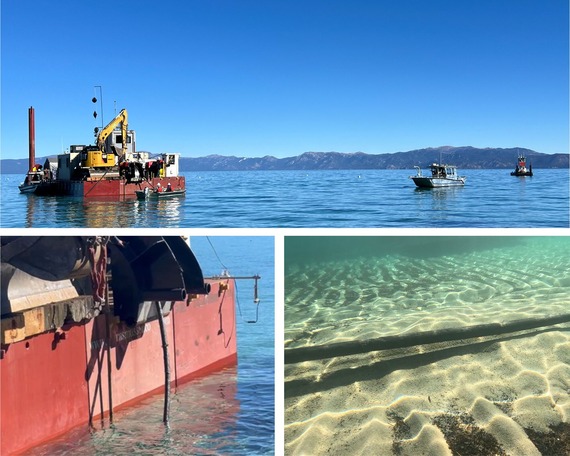 Operations to remove unused telecommunications cables from Lake Tahoe took place above and below the water. Photos from Evan Dreyer, Tahoe Lead Removal Project.
Telecommunications company AT&T completed the removal of approximately 6 miles of discontinued cables submerged in Lake Tahoe along the shorelines of D.L. Bliss and Emerald Bay state parks. These lead-containing cables, initially installed decades ago by Pacific Telephone and Telegraph Company (now AT&T), are no longer used, in various states of degradation, and have been abandoned for some time.
“One sample of biofilm (i.e., algae) on the cables showed lead at 67,000 times more concentrated than a reference biofilm sample taken from a rock. These biofilms are a food source for fish, and the lead can be biomagnified as it travels up the food chain,” said Sudeep Chandra, Professor of Limnology and director of the Global Water Center, University of Nevada, Reno.
The Sierra District fully supported AT&T’s commitment to remove the cables from these State Parks underwater areas. Each foot of the lead-clad cables contained approximately 3.39 pounds of lead and this removal project eliminated approximately 107,000 pounds from Lake Tahoe. A future interpretive panel is planned that will highlight the important cultural history of the cables and their role in early telecommunication in the Lake Tahoe region.
 PARTNER NEWS
Parks California Holding Online Auction
Story from: Michael Bridges, Parks California
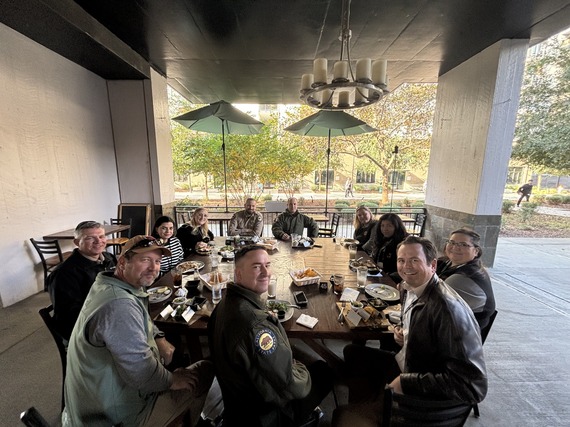
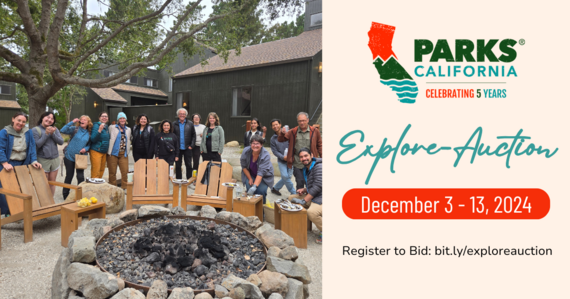 Parks California’s annual retreat, which took place at the Lodge at Marconi on Tomales Bay at Marconi Conference Center State Historic Park. A stay at this beautiful spot is part of the Explore Tomales Bay package. Photo from Parks California.
When I was a kid, we played "hide and seek" in our yards. At the outset of each round, the key player yelled, in a sing-song voice, “Ready or not, here I come!” As an adult, I sometimes think the month of December should be required to make this same proclamation for all to hear. Alas, months cannot speak, and suddenly, here we are.
Surprised by its emergence or not, I love the month of December. Cool weather, family, friends, twinkle lights, soft scarves, holiday parties, and the spirit of giving. In that spirit, I want to let you know that the Parks California Explore-Auction launched this week and runs until noon on Friday, Dec. 13.
What is the Explore-Auction? It’s a chance for you to support parks and people in California and possibly score, along the way, some really amazing items or experiences you can enjoy with your friends and family, or that you can gift to loved ones this season. Choose from artwork, experiences like wine tasting, hiking, or kayaking, beautiful nature-related books, painting workshops for your private group of six, or even professional tennis lessons for those making certain New Year’s resolutions. Have a look and see what you might like for yourself or someone you care about. Your spirit of giving will be enlivened by the knowledge that your auction bid supports California’s 280 state parks and may enable another young person to take a step toward a lifelong connection with nature. Place your winning bids here.
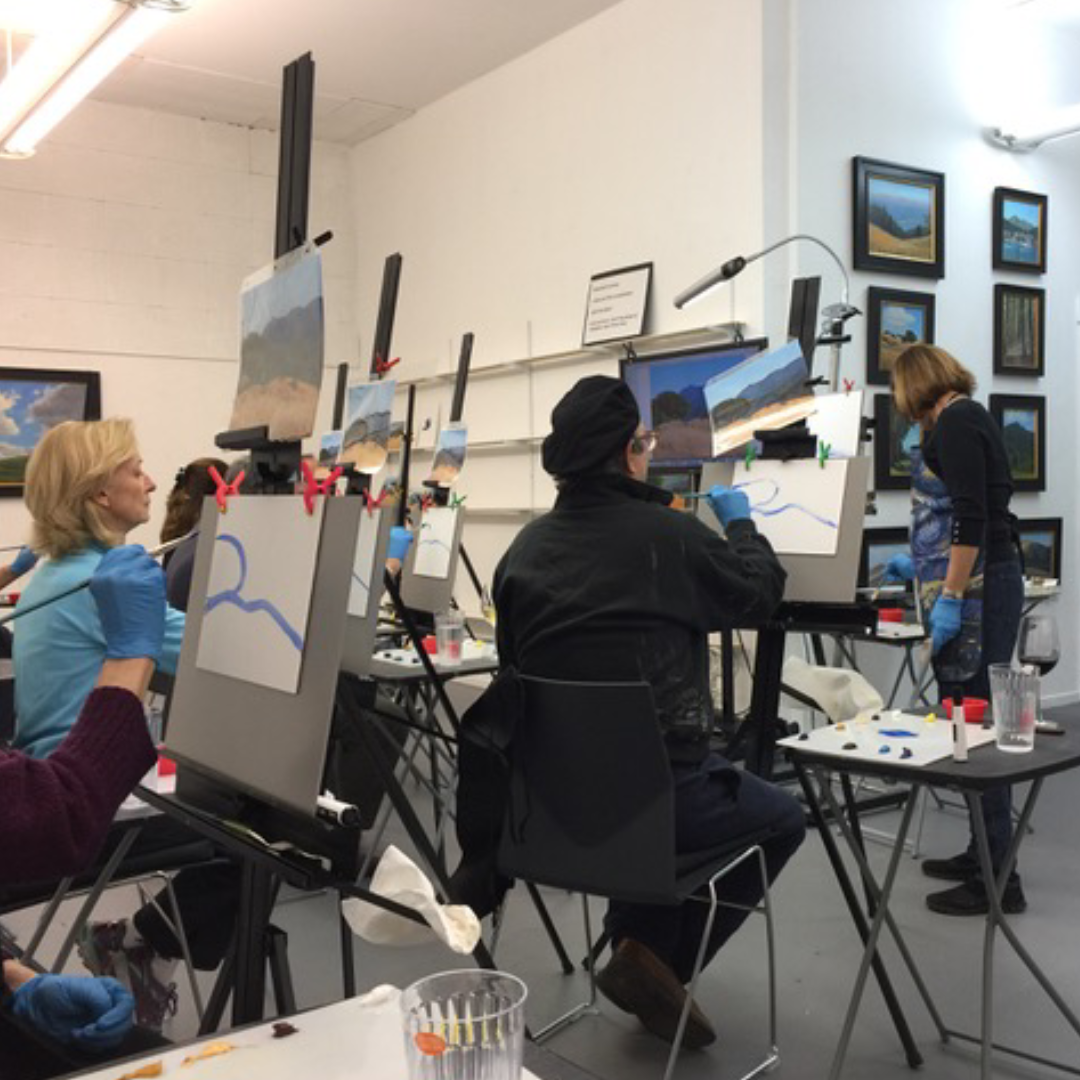 Paint and sip experience hosted by renowned artist Sherrill Miller in her charming Marin studio. Photo from Parks California.
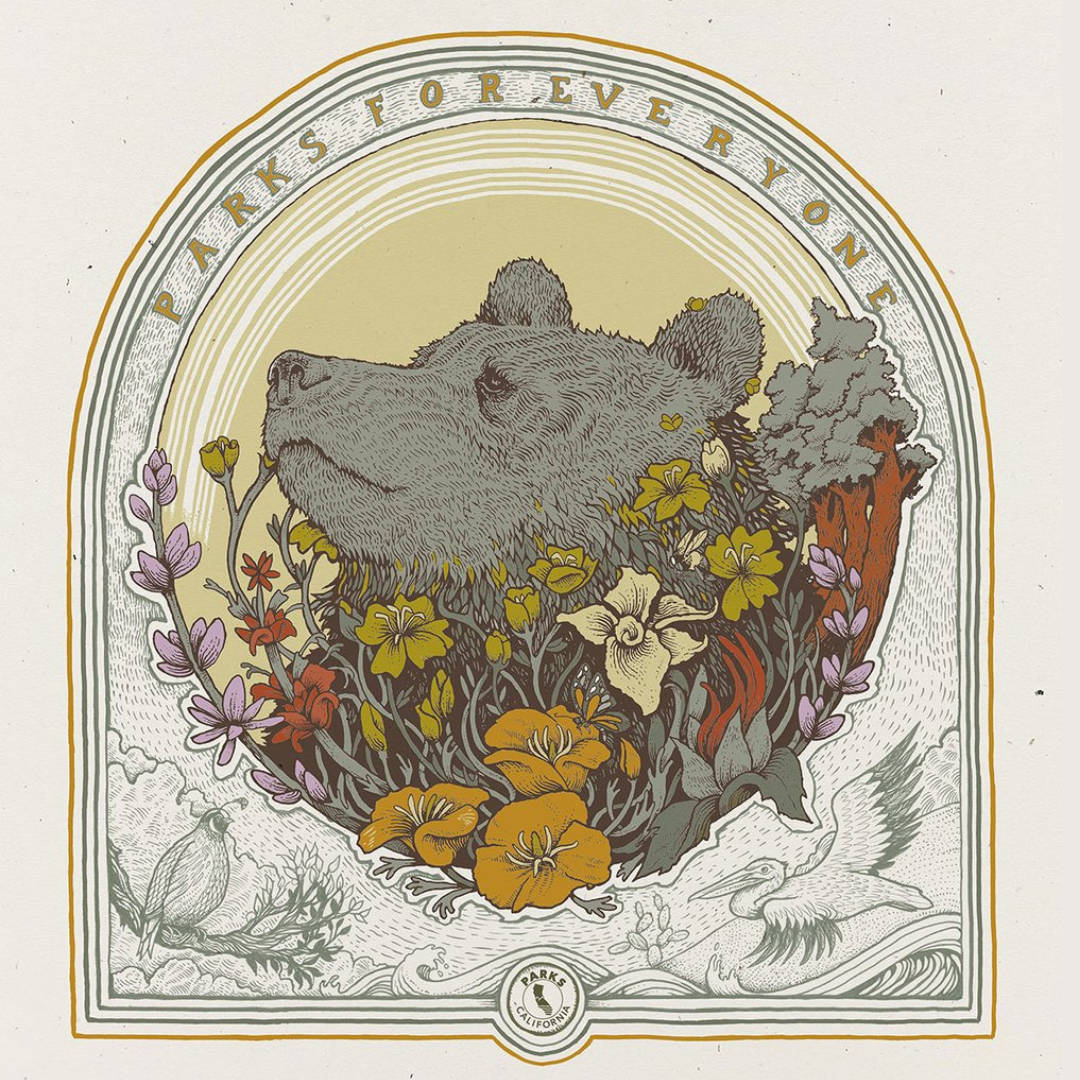 Stunning print of hand-drawn art by Jeremy Collins highlighting the iconic California grizzly bear. Photo from Parks California.
 Email photos to the WeeklyDigest@parks.ca.gov.
|