Celebrating Heroic Actions: Lifeguard Ben Sweet Honored with Multiple Awards
Story from: Kate Wilson, Channel Coast District
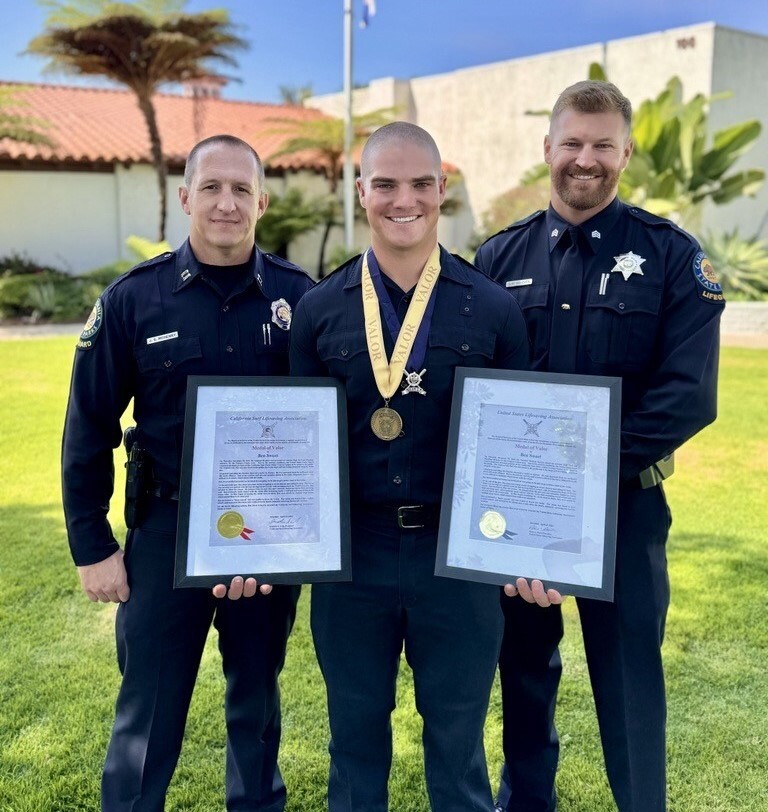 Lifeguard II (Seasonal) Ben Sweet (in the middle), Superintendent II Justin McHenry (left), and, State Park Peace Officer (Lifeguard) Greg Shaneron (right), at a ceremony honoring Ben for his rescue of a surfer in Ventura County on Dec. 28, 2023. Photo from Ryan Gates, Orange Coast District.
We are thrilled to recognize State Parks Lifeguard II (seasonal) Ben Sweet for his extraordinary courage and commitment to saving lives. Ben's heroic actions during a dangerous ocean rescue in Ventura County on Dec. 28, 2023, earned him multiple prestigious awards for his bravery and quick thinking under extreme conditions.
On that day, under an extreme high surf advisory, Ben spotted a surfer in distress near Ventura Pier. Despite treacherous waves and debris, he made the selfless decision to jump off the pier and swim through the hazardous conditions to reach the victim. After a grueling half-mile swim and facing powerful waves, Ben managed to secure the victim to a rescue buoy. Though separated during the rescue, the victim was safely brought ashore, thanks to Ben's swift actions and unwavering dedication.
For his extraordinary bravery and lifesaving efforts, Ben was honored with several awards in 2024:
- California State Park Rangers Association – Medal of Valor
- California Surf Lifesaving Association – Medal of Valor
- United States Lifesaving Association – Medal of Valor
- Park Rangers Association of California – Medal of Valor
- California State Parks – Director's Award for Special Act/Service
These accolades are testaments to Ben’s exceptional bravery, showcasing the dedication and strength State Parks lifeguards represent. We congratulate Ben on his well-deserved recognition and thank him for his outstanding service to our parks and public safety.
Longtime Volunteer Recognized for Fundraising Efforts at Colonel Allensworth State Historic Park
Story from: Steven Ptomey, Great Basin District
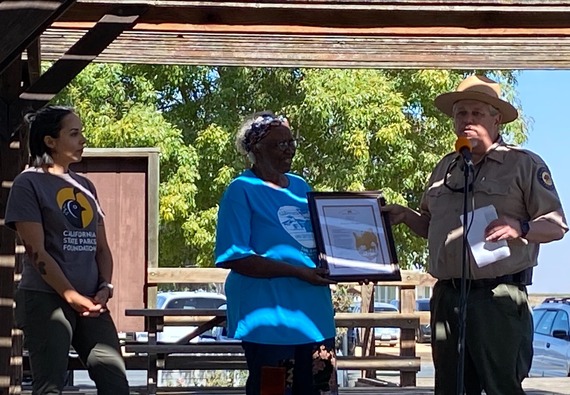 Dorothy Benjamin was recognized with a Golden Bear Award during Colonel Allensworth State Historic Park's annual rededication ceremony on Oct. 12. Left to right: Haley Gonzales, community partnership and impact manager for California State Parks Foundation, Dorothy Benjamin, and Steven Ptomey, Great Basin District cultural resources program supervisor. Photo from Lori Wear, Great Basin District.
When the centennial celebration for Colonel Allensworth State Historic Park (SHP) was being planned in 2008, Dorothy Benjamin, an Allensworth descendant, reached out to State Parks about organizing a 5k run/walk fundraiser, with all funds going directly to the park’s interpretive program. That was over 15 years ago, and the Colonel Allensworth 5K Run/Walk for Health is still alive and stronger than ever.
With Dorothy raising over $50,000 for the park since that first year, it was time to make sure she received recognition for her steadfast and unwavering commitment to Allensworth SHP. Working closely with Haley Gonzales from the California State Parks Foundation, Great Basin District staff wrote a compelling nomination for her to receive a Golden Bear Award. At the most recent State Park and Recreation Commission meeting in San Diego, that award was presented to Dorothy by the Commission.
With Dorothy’s family roots in Allensworth (she attended classes in the historic Allensworth schoolhouse), the district and Friends of Allensworth President Sasha Biscoe, wanted to acknowledge the award publicly at the park’s annual rededication event (held every second Saturday in October). I was honored to present the award to her, having worked closely with Dorothy since 2008, alongside Gonzales.
Just a few of the projects funded by the Colonel Allensworth 5K Run Walk for Health include:
- New interpretive signage in front of all buildings
- A cellphone tour
- A guided horse-drawn buggy tour
- Projectors and screens for on- and off-site presentations
- A Colonel Allensworth coloring book
- A portable park display for off-site outreach and presentations
- Period attire/reproduction clothing for staff and volunteers
- Two portable public address systems
- Upgraded lighting in the park’s visitor center
- Two period-style bicycles for use by park staff for interpretive programs
Congratulations, Dorothy! Thanks for the amazing efforts you continue to make on behalf of Colonel Allensworth SHP!
Silverwood Lake State Recreation Area’s Annual Apple Fest: A Celebration of Fall, Art and Community
Story and photos from: Garrett Fuhrman, Inland Empire District
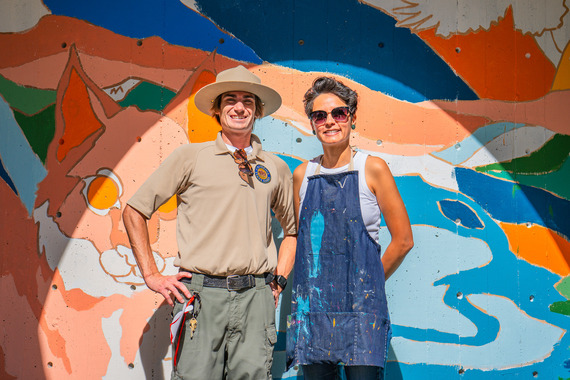 Silverwood Lake State Recreation Area's Interpreter I Caden McWilliam and mural artist Vanessa Gomez.
Each October, Silverwood Lake State Recreation Area hosts its annual Apple Fest, celebrating the harvest of the historic Cedar Springs Apple Orchard with fresh cider tastings, orchard tours, and family-friendly activities, made possible by the Mojave River Natural History Association.
This year, alongside the traditional festivities, visitors were invited to contribute to our new Nature Center mural, designed and facilitated by artist Vanessa Gomez. Made possible by Parks California’s Arts in California Parks grant, this beautiful art installation showcases local wildlife such as black bears, bobcats, red-tailed hawks, and western bluebirds, alongside depictions of the historic apple orchard and the park’s iconic vista point scenery.
Nearly 300 parkgoers joined in the festivities, enjoying fresh apple cider while adding their own creative touches to the new Nature Center mural. A heartfelt thank you to everyone who celebrated with us and contributed to the mural. We also extend our gratitude to our dedicated State Parks staff, volunteers, and cooperating association, whose efforts made this year’s Apple Fest a success. We look forward to unveiling the completed mural soon, and we can’t wait to celebrate again next year!
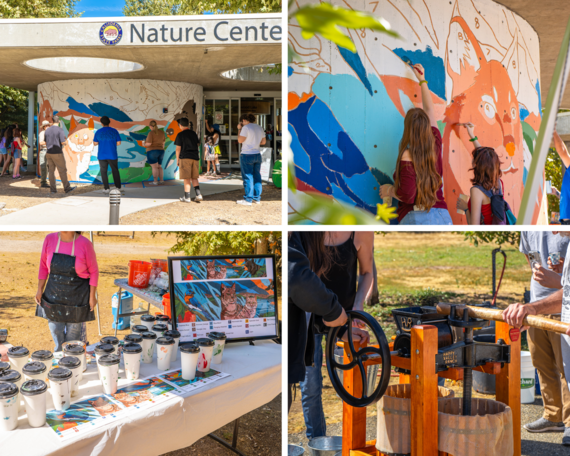 Top left: Apple Fest participants adding their own creative touches to the new Nature Center mural. Top right: Two visitors reaching high to paint the mural’s bobcat. Bottom left: Check-in stand for visitors seeking to participate in the community mural with a picture of the mural design as a painting guide. Bottom right: Park visitors using an apple press to make fresh cider.
Ocotillo Wells District Hosts 16th Annual Desert Lifeguard Preseason Training
Story from: Andrew Ahlberg, Ocotillo Wells District
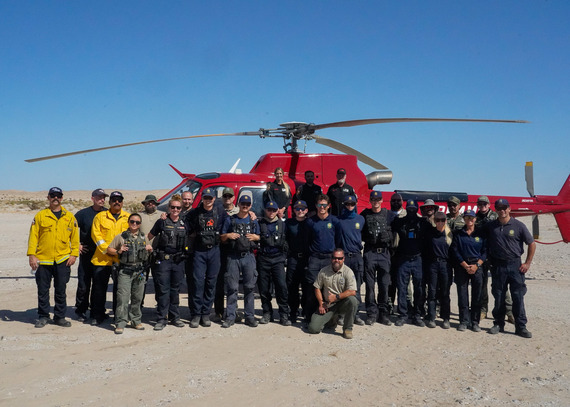 Participants in the 2024 Desert Lifeguard Preseason Training Program. Photo from: Giselle Lewis, Training Section.
As summer comes to a close, many units in the State Park System start to slow down and get a break from the hundreds of thousands of visitors enjoying the coast, mountains, inland reservoirs, and rivers. Ocotillo Wells District, on the other hand, begins to come out of its slower time of the year when temperatures can, and often do, reach upwards of 120 degrees. In preparation for the increase in visitation, Ocotillo Wells State Vehicular Recreation Area (SVRA) recently hosted the 16th annual Desert Lifeguard Preseason Training, home to the original Desert Lifeguard Program.
When the Desert Lifeguard Program started, it was relatively small with only a few lifeguards coming to the desert from the coast on the busiest winter holidays to help provide care if someone became injured. In 2007, the program became more organized and expanded. The current program is well known and appreciated by members of the public who recreate in the desert and who sometimes are still confused by the concept of lifeguards in the desert. These lifeguards play a vital role in responding to emergencies, being able to quickly locate the incidents and provide treatment, while requesting the appropriate resources to help.
This year’s preseason training weekend was warm, with each day over 100 degrees. The first day was spent getting the desert lifeguards through the Recreational Off-Highway Vehicle Association’s recreational off-highway vehicle (ROV) course so they were able to safely patrol and respond in Polaris Razor ROVs. Once the course was done, the afternoon was spent completing check rides and verifying that everybody could safely and responsibly operate these vehicles. The second day involved learning local operations, radio etiquette, tabletop exercises, and reviewing local protocols. The third day was for skills practice and mini-scenarios, followed up by the multi-casualty incident (MCI) scenario on the final day of the training.
The MCI scenario involved two ROVs that had supposedly collided causing major injuries. While the new desert lifeguards were out in Ocotillo Wells SVRA learning to navigate the trails, a simulated emergency call for service was broadcast. The desert lifeguards and state park peace officers (SPPOs) participating in the training responded to the scene and began to triage the incident, requesting appropriate additional responses from our local fire station and medical airships. The staff participating in the training handled everything from patient care to ordering additional responders to beginning a traffic accident investigation. All these activities occurred under the watchful eye of supervisors and emergency medical services instructors, who coached and evaluated the team.
This year’s desert lifeguards and SPPOs performed amazingly, working hand in hand with CAL FIRE Station 61, REACH Air Medical Services, and Mercy Air to assess the patients, treat them, package them, and load them for transport to the nearest emergency facility. As temperatures continue to cool down, off-road enthusiasts are already starting to visit their favorite off-road recreation areas. I am confident visitors to the desert this year will be in good hands with staff ready, willing, and practiced at providing care.
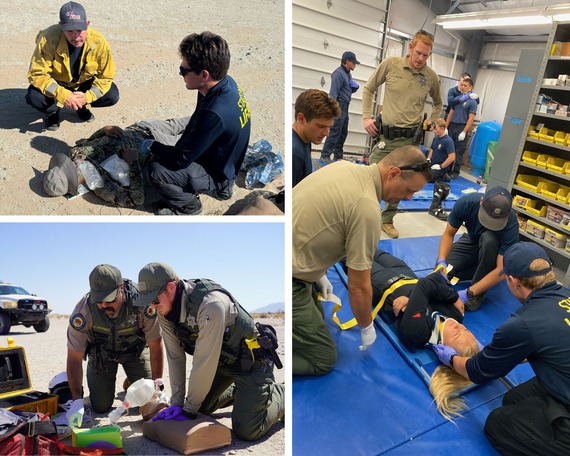 Clockwise from top left: CAL FIRE Paramedic Shaun Ferris and Desert Lifeguard Joshua Penton evaluate a patient. Desert Lifeguard Caitlin Woodmansee plays the the patient during a c-spine exercise with (left to right) SPPO Mike Dye, Desert Lifeguard Joshua Penton, SPPO Jeremy Black, and Desert Lifeguards Aaron Cox and J.J. Hoss. SPPOs Colin Bliese and Jeremy Black practice CPR. Photos from Giselle Lewis, Training Section.
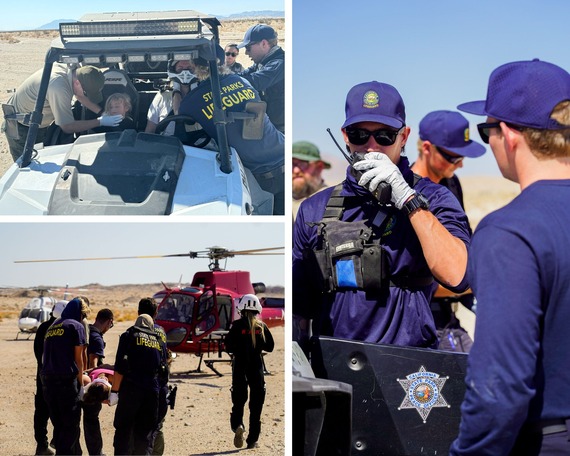 Clockwise from top left: Role players Sierra and Shannon Champieux (inside ROV) provide realism as Mike Dye, Desert Lifeguard James Durney, SPPO Caroline Obayashi, and Desert Lifeguard Thomas Elliott treat their injuries. Photo from Andrew Ahlberg, Ocotillo Wells District. SPPO Todd Friedman and Desert Lifeguards Anthony Nassar, Eli Bensen, and J.J. Hoss evaluate and order resources. James Durney, Mike Dye, Aaron Cox, role player Shannon Champieux, Caroline Obayashi, Joshua Penton, and Thomas Elliott are assisted by the REACH Air flight crew members. Photos from Giselle Lewis, Training Section.
Sierra District Helps Restore Cold Creek from a Century of Infrastructure Development
Story from: Adeline Yee, Communications and Marketing Division
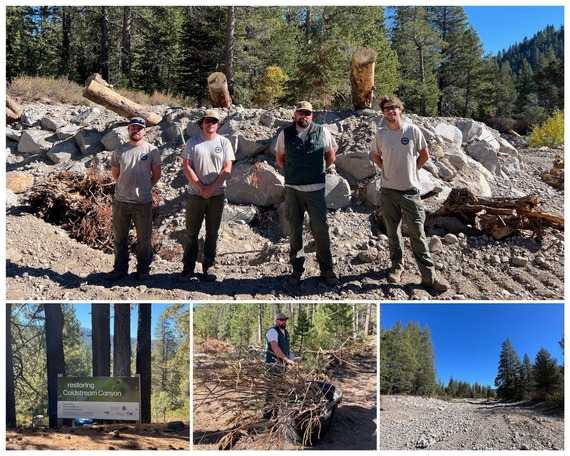 Top (left to right): Forestry Aide Matt Risso, Skilled Laborer Adrian Lemke, Environmental Scientists Nathan Shasha and Jason Porteur are part of the team that worked on the Cold Creek restoration project at Donner Lake Memorial State Park. Bottom left: Restoration project sign. Bottom middle: Shasha shows willow cuttings that will be planted to help restore the vegetation and wildlife in the riverbed. Bottom right: The newly restored Cold Creek that will be filled with snowmelt runoff next spring. Photos from Adeline Yee, Communications and Marketing Division.
The discovery of gold in California and the building of the Transcontinental Railroad sparked a huge influx of people from around the world, hoping to strike it rich and start a new life in the Golden State. Then came the invention of the automobile and the creation of the interstate system, including Interstate 80 (I-80) through Truckee. To construct I-80, streambed gravel was used to build the highway, pushing Cold Creek, which flows with Sierra snowmelt throughout the spring and summer before connecting to the Truckee River, to one side of the valley and altering the natural course of the stream channel.
All this construction came at a cost to the environment, and conditions around Cold Creek progressively got worse. After more than 150 years of infrastructure development and erosion, State Parks along with the Truckee River Watershed Council are doing their part to restore a portion of Cold Creek in Donner Memorial State Park within the Sierra District as part of watershed-wide effort to reduce these historical impacts.
Thanks to a $4 million grant from the Wildlife Conservation Board and the State Water Resources Board, the Coldstream Canyon restoration project constructed by Hanford ARC is restoring the habitat and ecology along a one-mile stretch of the degraded stream and reconnecting 22 acres of floodplain. The goals are to improve water quality in the stream, raise the groundwater elevation, restore the riparian vegetation for fish and other wildlife in the creek, and prevent further erosion when the winter snowmelt runoff rushes down Cold Creek each spring.
Earlier this week, Environmental Scientist Nathan Shasha showed members of the Communications team the work that he and his team did from late July to mid-October along Cold Creek at Donner Lake Memorial State Park. This involved creating huge groins (pronounced: "grow-ins;" these are boulder structures with tree logs inside), planting willow, cottonwood, and alder cuttings along the newly restored channel and raising the level of the creek channel by 2-3 feet so the entire ecosystem is better connected and the floodwater can flow at a gentler speed.
The rocky ground where Shasha and the Communications team stood during the tour is expected to be filled with river water come next spring. By then, Shasha hopes to see the fruits of his and his team’s labor, with vegetation and trees growing, fish returning, and the creek flowing more like how it used to flow over a century ago.
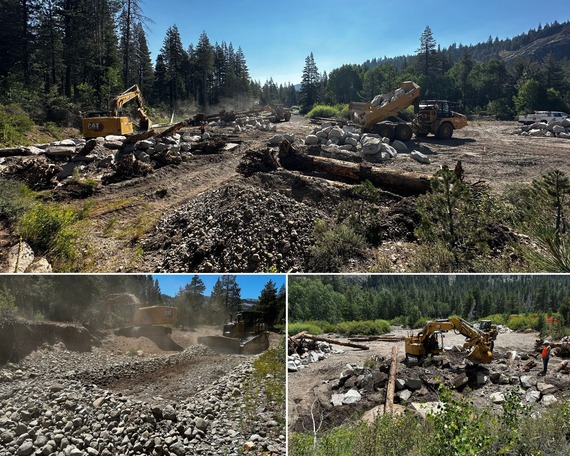 Images of the start of the restoration project at Cold Creek in late July. Photos from Nathan Shasha, Sierra District.
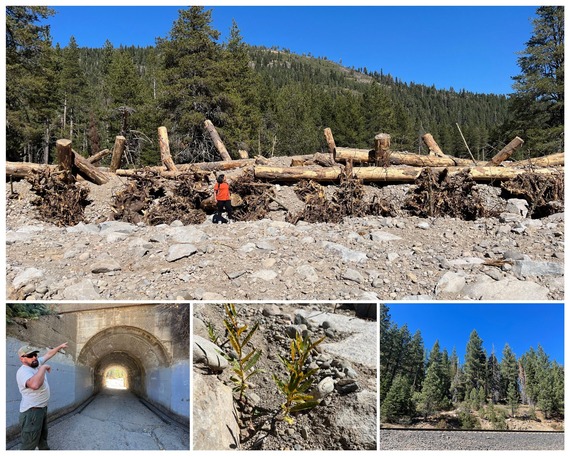 Top: Information Officer Jo Biswas stands next to one of the large groins constructed to slow and direct the river flow. Bottom left: Environmental Scientist Nathan Shasha shows the "mouse hole" that will be filled with snowmelt runoff next spring. Bottom middle: New vegetation growing in the riverbed. Bottom right: Train tracks near Cold Creek. Photos from Jorge Moreno and Adeline Yee, Communications and Marketing Division.
Chino Hills State Park Celebrates a Decade of Discovery
Story and photos from: Garrett Fuhrman, Inland Empire District
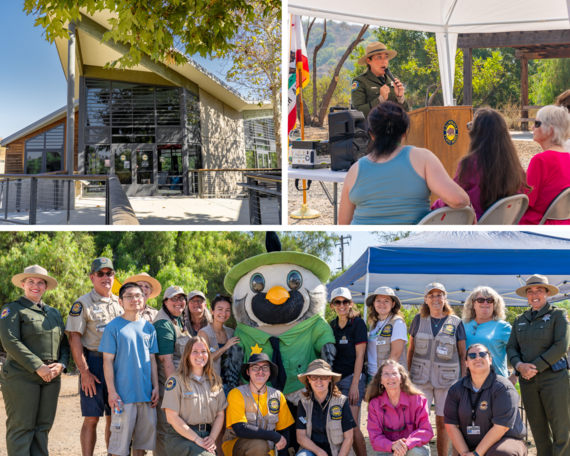 Top left: The Discovery Center entrance. Top right: Inland Empire District Superintendent Kelly Elliott commemorating the park's 10-year milestone. Bottom: Chino Hills State Park staff and volunteers pose for a group photo with Cali the Quail.
Chino Hills State Park (SP) marked a significant milestone on Oct. 5: The 10-year anniversary of the Discovery Center. The celebration brought together community leaders, park staff, and visitors of all ages for a day filled with excitement and exploration.
The event commenced with a special ceremony featuring notable speakers such as Chino Hills City Councilmember Ray Marquez, former Hills for Everyone Director Claire Schlotterbeck, Brea Mayor Christine Marick, Inland Empire District Superintendent Kelly Elliott, former Chino Hills SP Environmental Scientist Alissa Ing, and Sheen Sidhu, a representative from the office of California state Sen. Josh Newman. Their speeches highlighted the importance of the Discovery Center and the ongoing efforts to expand environmental conservation in the region. The ceremony concluded with a special visit from California State Parks' very own Cali the Quail.
Following the ceremony, guests enjoyed an open house of the Discovery Center, where they could explore exhibits that showcase the diverse ecosystems of the park. The day continued with guided hikes, family-friendly activities, and educational booths run by dedicated Chino Hills SP volunteers. This incredible milestone highlights the importance of ongoing outdoor education to foster a deeper connection with nature and promote a shared commitment to conservation.
‘Junior Rangers Give Back!’ at Torrey Pines State Natural Reserve
Story and photos from: Zuzana Volny, San Diego Coast District
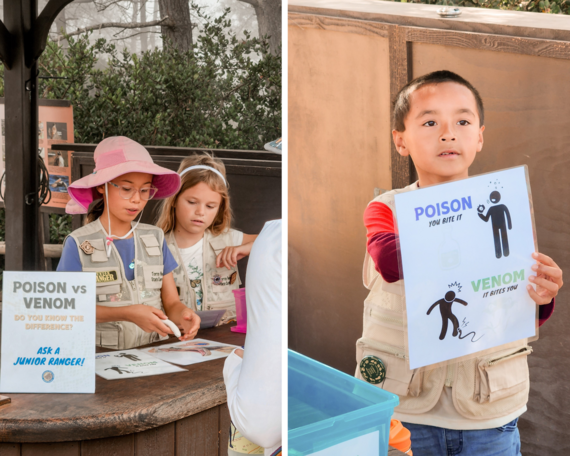 Junior Rangers Lexi and Allison (left) and Isaiah (right) explaining the easy-to-remember difference between venom and poison to visitors.
At Torrey Pines State Natural Reserve (SNR), many of our visitors are locals and repeat visitors. While we certainly welcome guests from out of town, a large portion of our Junior Rangers Program are local. In fact, about 25% of our Junior Rangers return to the program again and again, which means we need to keep things fresh and engaging for them.
Creating new lessons constantly can be a challenge, so I’ve developed a special program called “Junior Rangers Give Back!” This new expansion offers our seasoned Junior Rangers more opportunities to not only continue learning but also contribute to the park and the community. Whether it is practicing public speaking or assisting with beach cleanups, these Junior Rangers are discovering how to give back in meaningful ways.
Over the past few weekends, I had our Junior Rangers join us at the Trailhead Information Kiosk, where they spoke to visitors about the difference between venom and poison. As many of you know, even adults often don’t know the distinction, so I thought this was a great opportunity to empower the kids by letting them teach adults.
Preparation for the program began at home. I sent each Junior Ranger a letter explaining what we would be doing and why, along with a two-page worksheet. The worksheet included a link to a kid-friendly video explaining the difference between venom and poison, as well as some fun facts about venomous and non-venomous snakes specifically related to Torrey Pines SNR.
Some of my Junior Rangers are naturally shy, but when given the chance to talk about something they are passionate about, they absolutely light up. They spent an hour at the kiosk, and every single one was disappointed when the time ended—they all asked to either continue or come back and do it again.
The “Junior Rangers Give Back!” program is a way to foster confidence, leadership, and a deepened connection to the natural world. By giving children the chance to take on responsibilities and share their knowledge, we are helping them grow into the next generation of stewards for our parks. These experiences not only leave a lasting impression on the Junior Rangers but also on the visitors they interact with, creating a ripple effect of learning and inspiration.
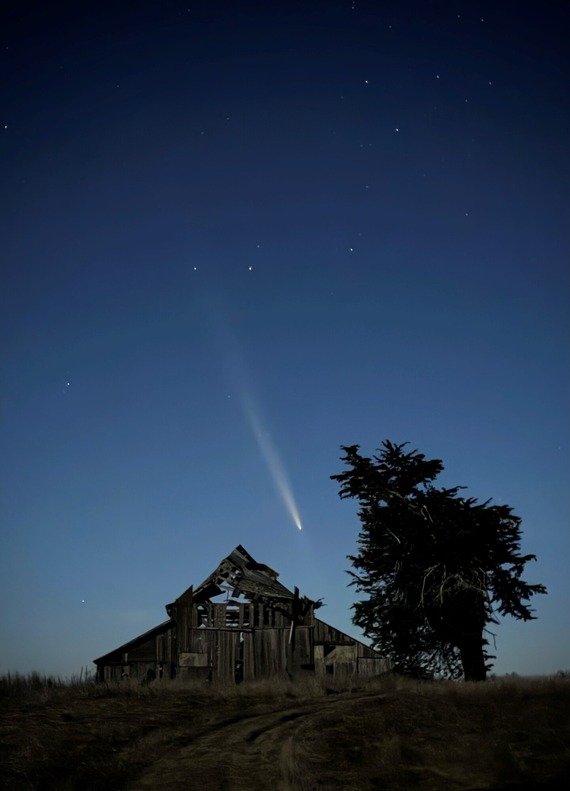
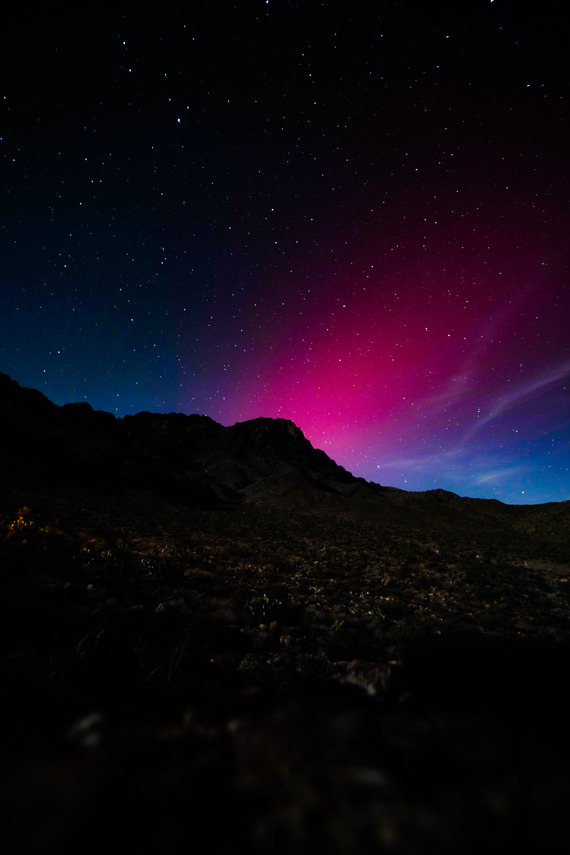
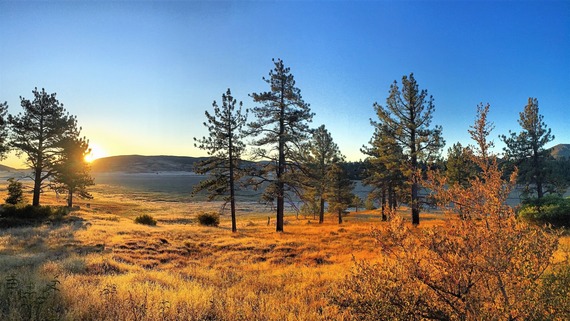
  Email photos to the WeeklyDigest@parks.ca.gov.
|