|
 Sept. 27, 2024
|
|
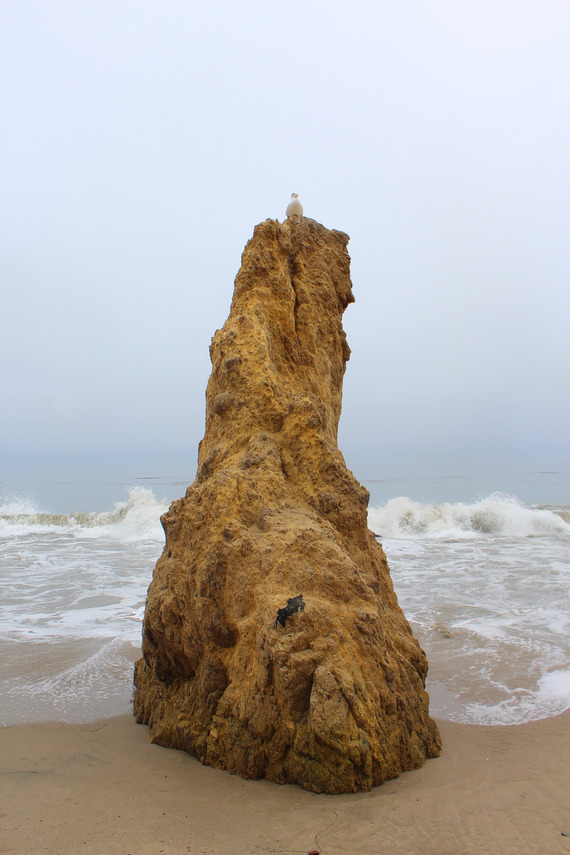 Robert H. Meyer Memorial State Beach
Seagull enjoying the misty morning air.
Photo from Cassandra Chavez, Angeles District

|
|
California Leaders Announce Advisory Panel for New Southeast LA Cultural Center to Foster Arts and Community Empowerment
Story from: Communications and Marketing Division
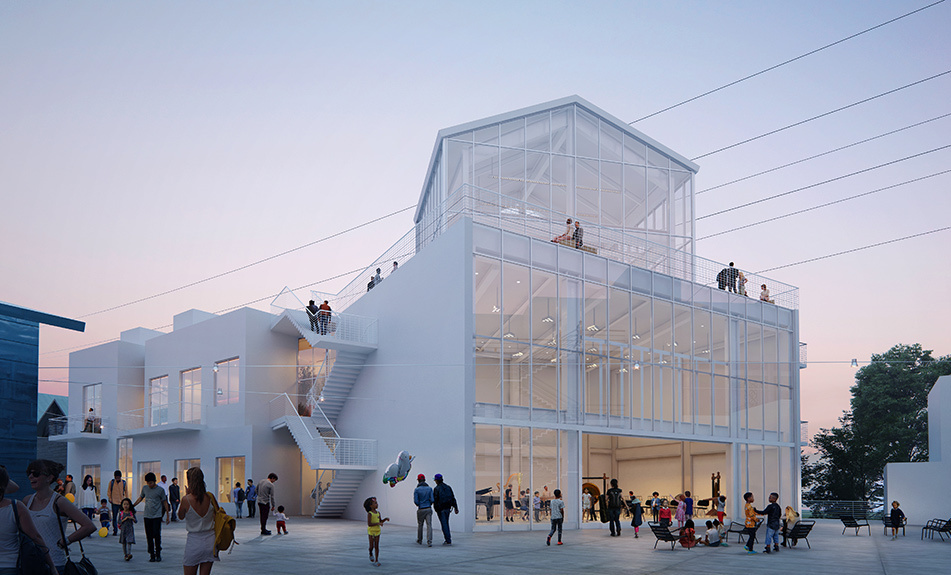 SELA Cultural Center project rendering. Photo Courtesy of San Gabriel and Lower Los Angeles Rivers and Mountains Conservancy.
In the spirit of Latino Heritage Month, the California Natural Resources Agency (CNRA), California State Parks, the San Gabriel and Lower Los Angeles Rivers and Mountains Conservancy (RMC), California Assembly Speaker Emeritus Anthony Rendon, and Los Angeles County Supervisor Janice Hahn this week announced the appointment of nine members to the advisory panel for the Southeast Los Angeles (SELA) Cultural Center, a proposed multi-arts facility designed to support and uplift the local community. The panel, co-chaired by State Parks Director Armando Quintero and Supervisor Hahn, will guide the center’s development as a vibrant cultural hub for artistic expression, education and community engagement.
“Congratulations to the remarkable leaders who will serve on the SELA Advisory Panel,” said CNRA Secretary Wade Crowfoot. “This announcement brings us one step closer to realizing this transformational cultural center, which will nurture and showcase the creative expression within the Southeast Los Angeles community for generations to come.”
Located near the confluence of the Los Angeles River and Río Hondo, the SELA Cultural Center will help address longstanding inequities in access to the arts, as well as improve access to open space and natural landscapes for the predominantly Latino Southeast Los Angeles community, which includes the cities of Bell, Bell Gardens, Cudahy, Commerce, Huntington Park, Lynwood, Maywood, South Gate and parts of East Los Angeles.
“This project is about more than a community center; it's about creating performance and activity spaces that connect the people of Southeast Los Angeles to the arts – including music, performance, visual, film and media arts, youth and family programs and more,” said Director Quintero. “At State Parks, we pride ourselves on improving equitable access to such transformative and healing spaces that focus on people, culture and nature. I look forward to working with this panel and helping this center thrive as a cultural heartbeat of the community.”
The SELA Cultural Center will be a gathering place where residents can experience, learn, and participate in a variety of artistic and cultural expressions. The center’s roughly 85,000-square-foot complex will consist of multiple structures, including a performance hall, a music education space, recording studios, a dance theater, a cafe, workshops and galleries. Plans also call for a plaza, gardens and a parking lot. California State Parks will provide its expertise in programming and operations for the center.
ICYMI: Preserving California’s Unique Vernal Pool Landscapes and Species
Story from: Communications and Marketing Division
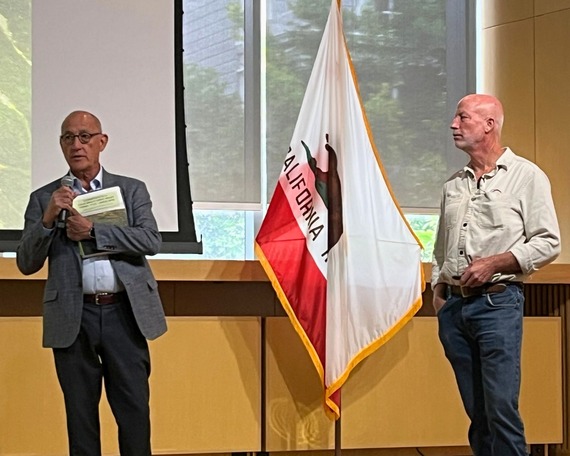
If you were unable to attend or watch State Parks Director Armando Quintero during the Sept. 16 Campus Connect Series on preserving California’s vernal pool landscapes and species, you can catch the series here. Director Quintero was joined by John Vollmar, a senior vegetation ecologist and aquatic wildlife biologist with more than 30 years of experience, who talked about the importance of vernal pools. Watch the video to learn more!
Employee Spotlight: Juan Villarino
Story from: Jo Biswas, Communications and Marketing Division
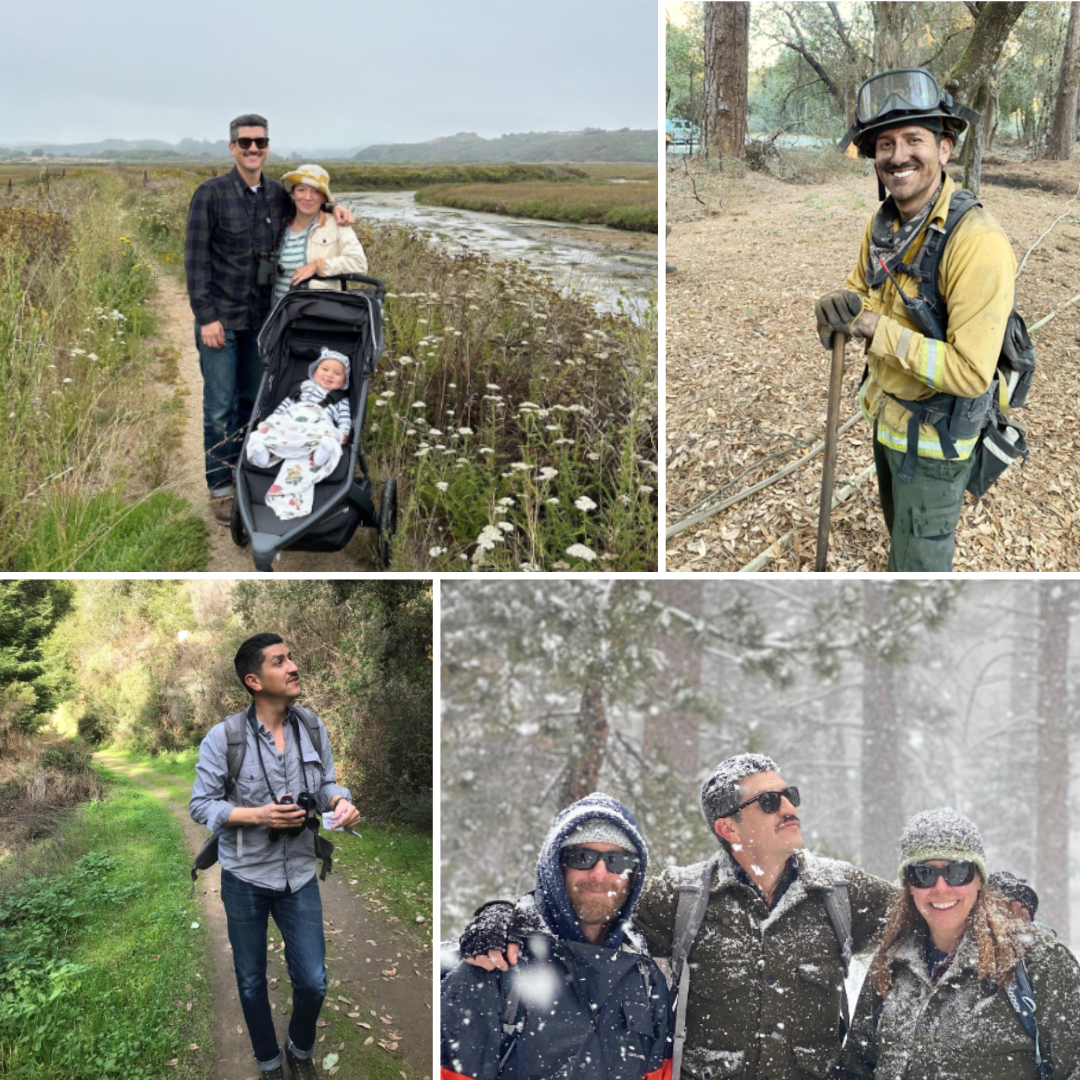 Clockwise from top left: Juan with his wife Lilia and baby boy Arroyo at Pescadero State Beach. Mopping up dirt after prescribed fire burns at Henry Cowell Redwoods State Park (SP). With teammates Lori Turner and Brian Young, snowshoeing during a snowstorm at the top of Mount San Jacinto SP. Birdwatching at the Elkhorn Slough Reserve. Photos from Juan Villarino, Santa Cruz District.
We’re celebrating another outstanding State Parks employee — Juan Villarino, former Park Maintenance Chief II at Santa Cruz District, recently promoted to district administrative chief. Juan’s journey began, quite literally, in the dirt — his passion for trail work blossomed during his time with the California Conservation Corps' Backcountry Trails Program. Since joining the department 15 years ago, he has become known for his extraordinary leadership, teamwork, and dedication. His colleagues say he is the kind of leader who lifts everyone around him. He leads by example, always looking out for his team and helping them achieve their full potential. Congratulations on the well-deserved promotion, Juan!
Read below to learn more about Juan.
Q: Can you share a project or accomplishment you are particularly proud of?
A: The reopening of Big Basin Redwoods State Park in July 2022, two years after the devastating CZU Lightning Complex Fire, was a truly monumental effort. There were countless moving parts — from burning slash piles and crafting split rails from salvaged redwood to milling lumber, installing gates and new interpretive panels, and setting up a temporary welcome center. But what made it all possible was the incredible teamwork. Everyone brought their A-game. It was a massive undertaking that pushed me to my limits, but the outcome was something we can all be proud of.
Q: Do you have any advice for new employees or those looking to excel in their careers?
A: There is absolutely no replacement for hard work: there is no silver bullet to accomplish a task, just effort and consistency. That said, I think the best thing any member of a team can do is assume agency and ownership of their work. Similarly, using situational awareness, identify areas where there are voids and be the person to fill that void. By doing so, you prove yourself a critical thinker, valuable asset and team player. You will make a fruitful career by being that role player who takes on tasks unprompted.
Q: What are your favorite hobbies outside of work?
A: When I’m not working, I enjoy collecting vinyl records and listening to music, watching and playing basketball (Go Hoopers!), backpacking and car camping, birdwatching, and raising my baby boy Arroyo with my wife Lilia.
Q: Do you have any hidden talents that your colleagues might not know about?
A: I see potential everywhere.
Diving and Conservation at California's Underwater State Parks
Story from: Sierra District, and Communications and Marketing Division
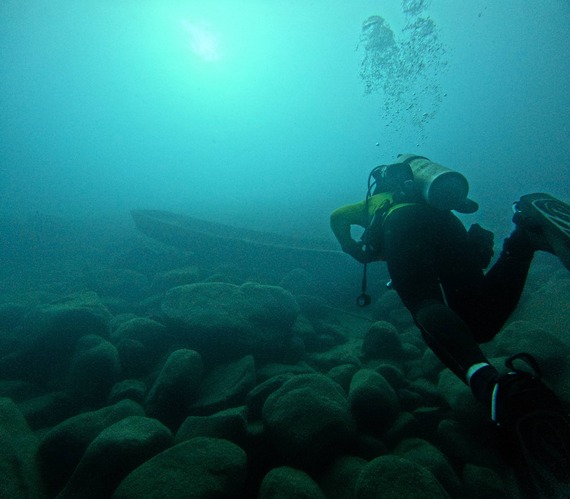 SIerra District Supervising Ranger and California State Parks Dive Team member Taylor Jackson approaches submerged wooden vessel “Tamarac” as part of the scuba dive training session at Emerald Bay State Park Boat Camp. Photo from Jeremy Lin, Sierra District.
The California State Parks System offers some of the most unforgettable underwater recreational experiences on the West Coast — from diverse marine life to historical shipwrecks and unique underwater trails. Click here to read the latest post on the California State Parks blog listing our top five picks for scuba diving and snorkelling enthusiasts.
The California State Parks Dive Team doesn’t just explore these underwater wonders — they help protect and study them too.
Earlier this month, our Dive Program teamed up with the UC Davis Dive Program at Lake Tahoe's Emerald Bay State Park Boat Camp for a special scuba dive training session. Together, they completed surveys of submerged cultural resource sites and monitored both native and invasive species. Divers also earned certifications in High Altitude Diving, Nitrox, and Underwater Archaeology, ensuring they’re even better equipped to care for these precious underwater resources. The Sierra District Dive Team, working closely with UC Davis divers, played a key role in this collaboration. This partnership not only boosts our efforts to protect California’s underwater cultural and natural treasures but also enhances the skills and safety of our dive teams for future conservation work.
  ADVENTURE OF THE MONTH
Petaluma Adobe State Historic Park Keeps California's Mexican Period Alive
Story from: Andreas Agocs, Communications and Marketing Division
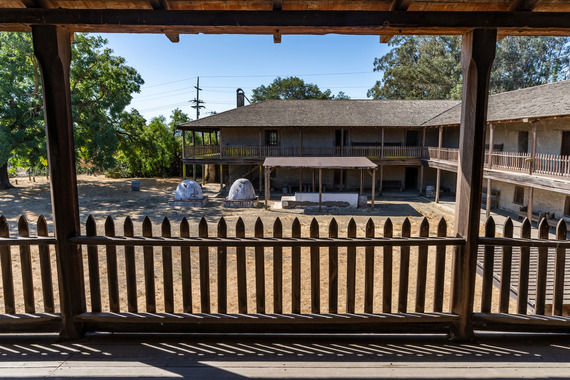 View from the servants' quarters on the second floor of the courtyard with its dome-shaped “hornos.” Only half of the original adobe was preserved. Photo from Brian Baer, Communications and Marketing Division.
Petaluma Adobe State Historic Park (SHP) “is one of the few parks that focuses on the Mexican period,” said State Park Interpreter Jennifer Hanson. As State Parks and the California Natural Resources Agency celebrate Latino Heritage Month, visitors interested in daily life in Mexican California almost two centuries ago should make the scenic park on a hill between Sonoma and Petaluma their destination.
The park preserves the remaining section of the two-story Rancho Petaluma Adobe, the working headquarters of General Mariano Guadalupe Vallejo’s rancho or cattle ranch. Vallejo received a land grant of 66,000 acres, territory traditionally inhabited by the Coast Miwok people, to create the northernmost Mexican frontier outpost at a time when California was coveted by several other powers, including Russia and the United States.
Exhibits in the visitor center and museum on the ground floor provide context of the period’s history and explain the rancho economy and lifestyle. Mexican rancho society was dominated by powerful families ruling over cattle ranches, trading hides and tallow (cow fat), and relying largely on Native Californian labor. Vallejo brought Natives — along with four Hawaiian architects — to build the adobe in 1836. Jennifer points out unique features, such as its redwood shingle roof and chamfered support posts.
The adobe’s ground floor shows examples of the rancho’s self-sufficient agricultural and manufacturing operations, including a granary and weaving room, where wool of over 3,000 sheep was spun into textiles and carpets. Much of the adobe’s daily life took place in the enclosed courtyard with its dome-shaped ovens (hornos). The foundation stones of the collapsed eastern wall are still visible under the grass. No longer enclosed, the now quiet courtyard, where turkey vultures and red-tailed hawks circle the black walnut trees, once bustled with activity and noise.
Cattle products were at the heart of the rancho economy, and “cowhides were known as California bank notes,” said Jennifer. This could make the leather workroom, where cowhides were stacked to the ceiling, the rancho’s “bank.” The rancho’s leather produced not only saddles and boots but also supplied machinery belts for the burgeoning Industrial Revolution in faraway Europe. Tallow was processed into soap and candles, an essential product in this pre-electrified mid-19th-century world.
The rancho period also left a cultural legacy of Spanish words like lazo (lasso) and charqui (jerky) that made it into the English language. And contrary to the image in Western movies, the original cowboys were mostly Native American vaqueros with masterful horse skills.
Stairs on both sides of the adobe lead to the living quarters of the Vallejo family and their workers. The rooms offer a glimpse into a society shaped by family, hospitality, and status differences between masters and mostly Native workers and servants. While unskilled workers and unmarried servants slept on simple mats on the floor, Vallejo’s family quarters featured beds framed with cowhides, a finished wood ceiling, and angled window and door frames to let in more light.
The dining parlor, where Vallejo entertained guests and trading partners, had amenities like mirrors and elaborate decorations. Rancho Petaluma Adobe was a frontier outpost with sparse comforts, but its inhabitants also enjoyed regular fandangos, the music and dance celebrations at the end of the harvest and slaughter season in fall.
Like California’s history in general, the rancho period had its bright and dark sides. Despite high ideals, “the Mexican Republic inherited the oppressive structures of the Spanish Empire in California,” said Cultural Resources Program Supervisor Eric Brand. It included the dispossession of Indian lands, raids of Native settlements, and the use of forced Native labor, which also at least partly contributed to the construction of Petaluma Adobe. “We want to tell the truth,” said Bay Area Cultural Resources Program Supervisor Noah Stewart. In keeping with the Department’s Reexamining Our Past initiative, the district tries to “tell a more complete story” of the Mexican period that includes the Native Californian viewpoint, which "has been left out of the historical narrative for far too long.”
School programs at Petaluma Adobe SHP vary from class tours to Environmental Studies programs that include hands-on activities like candle-making and preparing lunch on the adobe’s outdoor stove. The park no longer keeps any sheep on its grounds, but it still hosts, in partnership with the local nonprofit Flat Broke Farm, the popular annual sheep-shearing event each spring. Visitors who want to catch a glimpse into daily life in Mexican California — like the curious black phoebe listening in to our conversation through the window of the servants’ quarters — should visit Petaluma Adobe SHP at any time of the year.
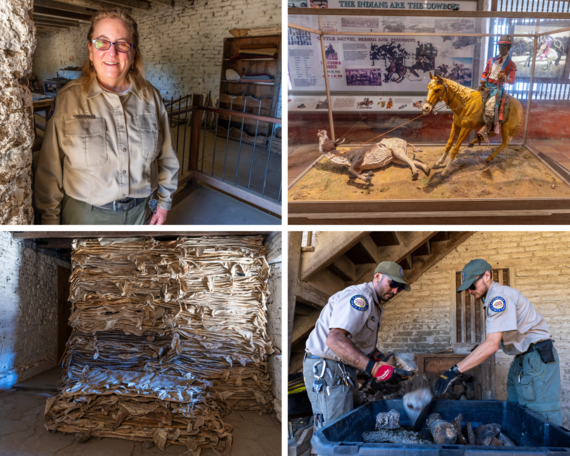 Top left: State Park Interpreter I Jennifer Hanson. Top right: display of a vaquero in the park's museum; the original cowboys didn't look like John Wayne. Bottom left: The leather workroom with a (fake) stack of cowhides. Bottom right: Petaluma Adobe could not be preserved without the work of staff like Maintenance Mechanic Eric Pando (left) and Senior Maintenance Aide Luke Wuopio. Photos from Brian Baer, Communications and Marketing Division.
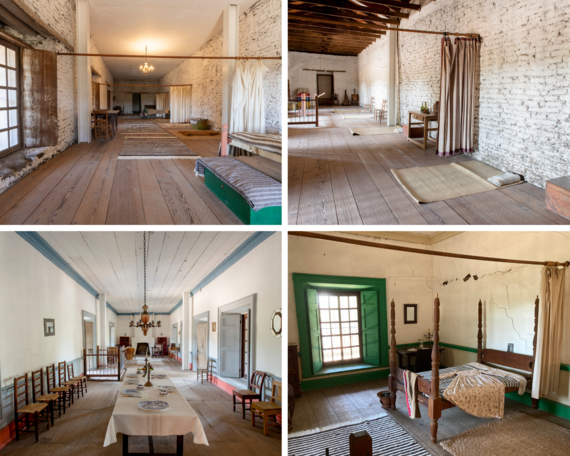 The living quarters on the adobe's second floor. Top left: The married servants quarters. Top right: The unmarried servants quarters, with its unfinished ceiling and mats for sleeping, also served for fandango dances. Bottom left: The dining parlor where Vallejo received guests, including ship captains who traded along the Pacific coast. Photos from Brian Baer, Communications and Marketing Division. Bottom right: The Vallejo family quarters. Photo from Andreas Agocs, Communications and Marketing Division.
|
|
California State Parks Welcomes Ukrainian National Parks Delegation
Story from: Adrien Contreras, Park Operations Division
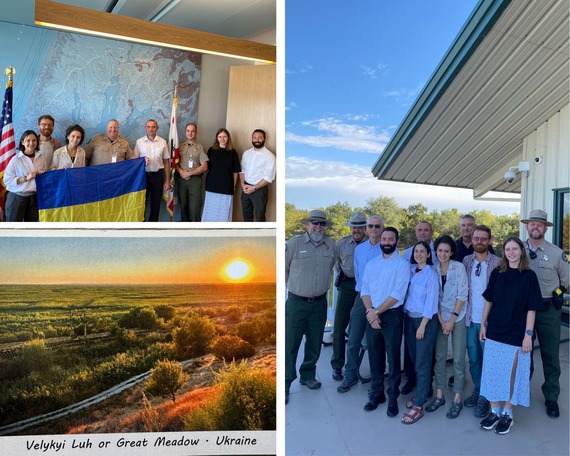 A delegation from Ukraine's National Park Service and supporting partners visited State Parks headquarters in Sacramento and Lake Natoma in Folsom Lake State Recreation Area. Participants included (from left to right) Steve Hilton, Barry Smith, Jim Michaels, Adrien Contreras, Hannah Kuzo, Sergei Kubrakov, Valeria Kolodezhna, Brian Dulgar, Mykhailo Drebet, Natalia Brusentsova, and Mike Howard. Photo from Ariadna Reida.
California State Parks had the privilege of welcoming a delegation from Ukrainian National Parks on Sept.19. The group included the director of Desnyansko-Starohutsky National Nature Park, also known as Desna-Stara Huta National Nature Park; the heads of science and research from Podilski Tovtry Natural Nature Park and Tuzly Estuaries National Nature Park; and representatives from partner organizations supporting Ukraine’s conservation efforts. The visit was not just a routine exchange – it was a powerful reminder of the resilience and dedication required to protect the natural world in the face of unimaginable challenges.
The day began at the California Natural Resources Agency headquarters in Sacramento, where the Ukrainian team met with State Parks Director Armando Quintero and park operations staff to discuss California’s approach to managing its diverse landscapes. Topics ranged from how to address climate-driven wildfire threats through prescribed burns – many in collaboration with Indigenous tribal groups – to how to train rangers to serve as both protectors of the environment and sworn peace officers. The conversation touched on some of the extreme climate-related emergencies state parks have faced in recent years and how California State Parks addresses these events.
In the afternoon, the delegation traveled to Lake Natoma at Folsom Lake State Recreation Area, where they connected with managers from the Gold Fields District and the Sacramento State Aquatic Center. The focus of the visit was to highlight how State Parks works with a wide array of partners to enhance services for visitors while preserving natural and cultural resources. This collaboration is at the heart of what makes our work possible, but as the Ukrainian team shared, their circumstances demand a different kind of collaboration – one focused on survival and rebuilding in the midst of war.
An important point in the visit came when the Ukrainian delegation gave a presentation on the devastating impact of the war on their parks. Bombings and landmines have ravaged many of the natural areas they manage in parks bordering the conflict zone, including Velkyki Luh – known as the “Floodplain Forest” in Great Meadow National Nature Park. Once home to one of the largest natural forests in Ukraine, much of it was flooded in 1956 when the Kakhovka Dam was built to support hydroelectric power generation and irrigation in the region. The building of the dam created the Kakhovka Reservoir, which covered more than 832 square miles. For comparison, the city of Los Angeles is approximately 500 square miles. The dam was bombed in 2023, causing extensive flooding and dozens of deaths of residents living below it. Within weeks the Kakhovka Reservoir had significantly dried up, and in the months that followed, the area was again transformed as native vegetation began to reclaim the newly exposed lakebed. This renewed growth has led to debate over whether the dam and reservoir should be reconstructed or whether the area should be preserved as a new protected zone, symbolizing the resilience of nature and people alike.
Hearing firsthand how these Ukrainian park stewards continue their work under such extreme conditions was humbling and inspirational. Despite the destruction of their parks, and with the constant threat of violence, they remain committed to conserving their natural treasures and creating spaces for outdoor recreation. Their determination serves as a reminder of the privilege we have in California to protect our incredible landscapes in relative safety, and the immense strength it takes to carry on when that safety is taken away. The visit left us not only inspired by their perseverance but also reminded of our own responsibility to look beyond borders and conflicts and find ways to support those who fight to protect the world’s most precious places, even in the most challenging of times.
Capturing the Power of Wind, Horses and Steam Using Art and Artifacts
Story from: Michael Flanagan, Northern Buttes District
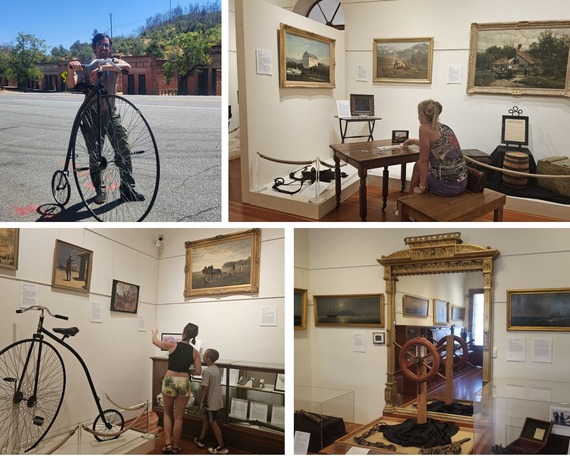 Clockwise from top left: Senior Park Aide Alec Knapp transports a replicant Boneshaker HiWheel Bicycle from the Litsch Store Museum into Williamson Lyncoya Smith Gallery. Photo from Mike Flanagan, Northern Buttes District. One of many interactive aspects has visitors assemble a puzzle made from 1883 art of Thaddeus Welch titled Salem Mills. Photo from Jennifer Pooley, Northern Buttes District. The east side of the Williamson Lyncoya Smith Gallery focuses on sea transportation of the 1800s. Photo from Mike Flanagan. Guests explore historic forms of land transportation in the West Room. Photo from Jennifer Pooley.
Each year, Williamson Lyncoya Smith Gallery, only permanent art gallery in a California state park, adopts a new theme. Northern Buttes District Interpretation Program Manager Jennifer Pooley, State Park Interpreter I Jonathan Sutliff, and the Shasta State Historic Park (SHP) team sort through the extensive, 150-year-old Mae Helene Bacon Boggs Collection to find the next pieces to display. “Capturing the Power of Wind, Horses & Steam: 100 Years of the Art of Travel by Land and Sea” not only incorporates works from the Boggs collection, it includes artifacts from other California state parks units helping to provide guests with an immersive trip back in time.
“We believe early California Fine Art illustrates points in time, giving guests insight into historic transportation. Adding actual artifacts shifts their minds into another gear of discovery,” said Pooley.
The unique exhibit features one gallery dedicated to land and another to sea. Anyone unable to visit the exhibit in person is just one click away via the interactive Kuula 365-degree exhibit created by Shasta SHP Senior Park Aide Alec Knapp.
Artists with works on display include early American impressionist Euphemia Charlton Fortune, renowned California landscape painter Thaddeus Welch, and Charles Rollo Peters, famous for his quiet, peaceful tonalist nocturnes. Visitors are often amazed to discover such significant paintings in the tiny town of Shasta and many are unaware that pieces from Shasta SHP’s collection are always in demand and periodically loaned to major museums.
The de Young Museum in San Francisco had hoped to be the permanent home to the collection, but Boggs opted to donate her paintings to Shasta SHP. She reportedly told the park’s first curator, “Nothing is too good for Shasta.”
California State Parks Archivists and Librarians to Participate in the 14th Annual Sacramento Archives Crawl
Story and photo from: Rebecca Crowther, Cultural Resources Division
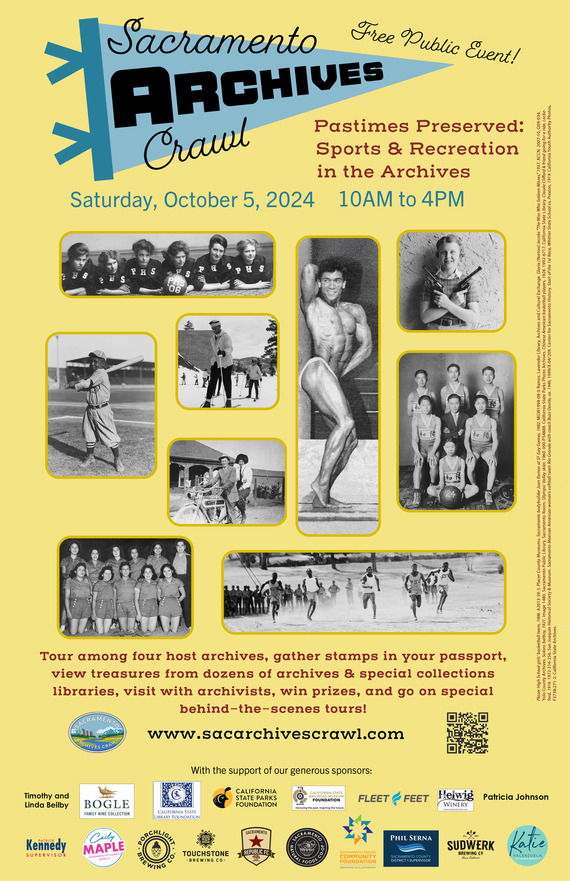 2024 Sacramento Archives Crawl event poster. Design by Rebecca Crowther, California State Parks Photo Archivist.
California State Parks archivists and librarians are excited to participate in the 14th annual Sacramento Archives Crawl, a free event celebrating the region's rich history through archival collections. This year’s theme, “Pastimes Preserved: Sports and Recreation in the Archives,” highlights the role of recreation in shaping Sacramento and California culture — a perfect fit for State Parks enthusiasts.
The event will be held on Saturday, Oct. 5, from 10 a.m. to 4 p.m., across four major venues: the California State Archives, California State Library, Sacramento Public Library Main Branch, and the Center for Sacramento History. More than 20 repositories are featured, with over 1,000 attendees expected to explore a treasure trove of historical materials.
State Parks staff from the California State Railroad Museum Library and Archives, State Parks Archives and Photo Archives, and the Marshall Gold Discovery State Historic Park’s Gold Rush Research Library will offer a glimpse into the history of recreation in state parks. Visitors can enjoy rare photographs, documents, and ephemera from university special collections, regional libraries, and community archives that tell the stories of outdoor leisure and sporting activities.
Attendees can take a shuttle between locations, participate in a scavenger hunt, and enjoy behind-the-scenes tours. This year’s event also features guest speaker Tom Crisp, who will present on the history of baseball in Sacramento. Special archival film screenings will showcase rare footage, including Buffalo Field’s 1920 opening day, Sacramento weightlifting legend Tommy Kono, and highlights from the inaugural season of the Sacramento Kings.
The Sacramento Archives Crawl offers a family-friendly, engaging experience with history and emphasizes the importance of preserving community stories and our cultural heritage.
To learn more, visit Sacramento Archives Crawl.
Fundraiser for Outdoor Music Nonprofit Held at Ed Z’berg Sugar Pine Point State Park
Story and photos from: Elizabeth McMillan, Sierra District
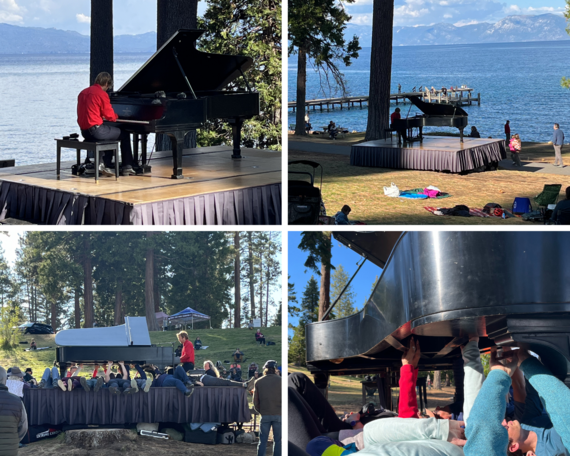 Top left: Pianist Hunter Noack and his 1912 Steinway Model D grand piano. Top right: Guests wandering the pier while listening to the outdoor concert. Bottom left and right: Guests were encouraged to "feel" the music by placing their hands under the piano.
“IN A LANDSCAPE: Classical Music in the Wild” was invited to Ed Z’berg Sugar Pine Point State Park on Sept. 19 for a Sierra State Parks Foundation fundraiser. IN A LANDSCAPE is a nonprofit outdoor concert series featuring Hunter Noack and a 1912 Steinway Model D concert grand piano traveling to awe-inspiring natural landscapes across the West, from state and national parks to urban oasis.
Guests are encouraged to wander and explore the surrounding environment while listening to the music through wireless headphones, creating an immersive and intimate experience that fosters a connection with the music, nature, and one another. Think silent disco in nature with live classical music!
Guests were also invited to wander the surrounding grounds of Pine Lodge and out to the pier, as well as feel the music by placing their hands under the piano. Thank you to our partners and the public for attending this successful fundraiser on a such lovely fall day.
Restoring Monarchs’ Winter Homes With Native Plants
Story from: Natural Resources team, Angeles District
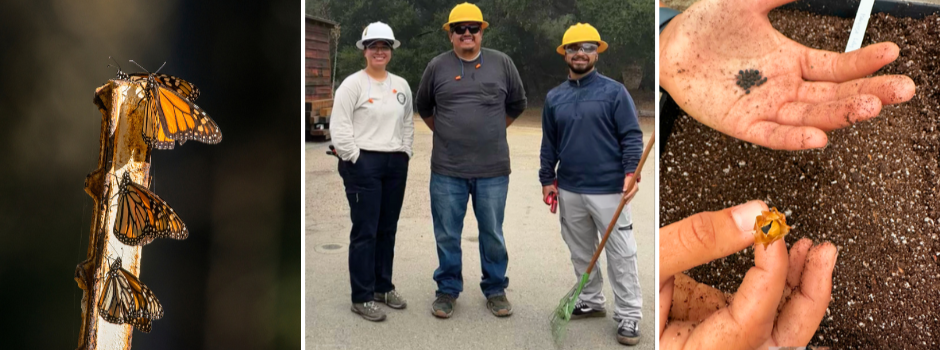 From left: Monarch butterflies. Photo from California State Parks. The Angeles District Natural Resources team. Native plant seeds that the team will plant. Photos from Cassandra Chavez, Angeles District.
Every year, monarch butterflies embark on an extraordinary journey, traveling thousands of miles to coastal California to overwinter, seeking a safe and warm environment to survive the cold. Unfortunately, these critical overwintering habitats are disappearing. One of the important projects that the Angeles District Natural Resources team is currently working on aims to restore some of these monarch overwintering habitats. One of their best tools? Native plants.
Native plants are not only beautiful but essential to California’s ecosystems. They play a crucial role in restoring disturbed habitats, including the overwintering sites of monarch butterflies. Having evolved alongside local wildlife, fungi, and microbes, these plants create a rich, interconnected ecosystem where monarchs and other species can feed, grow, and thrive.
That’s why field biologists from the Angeles District Natural Resources team are busy planting, growing, and monitoring native species such as Native milkweed (Asclepias fascicularis), Coyote Brush (Baccharis pilularis), and Golden Rod (Solidago velutina) in nurseries, then replanting them in parks to help build resilient, healthy habitats. With every native plant, the team comes closer to helping secure a future where monarchs and other wildlife can thrive.
California Boating and Waterways Commission to Meet in Colusa County, Tuesday, Oct. 1
Story from: Kevin Murphy, Communications and Marketing Division
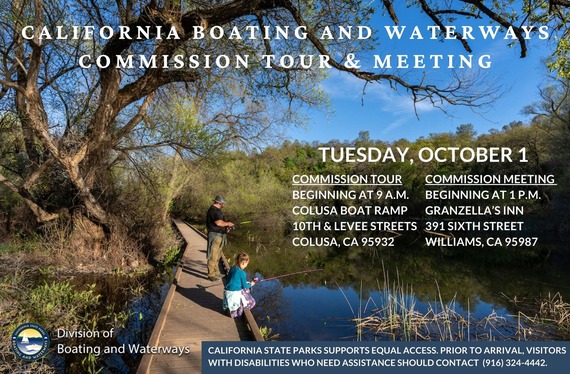 The California Boating and Waterways Commission will meet in Williams at 1 p.m. on Tuesday, Oct. 1. During the meeting, the Commission will hear reports about the California Boating Clean and Green Program, safe boating education and outreach programs, and the Aquatic Center Grant Program. A tour of sites related to the agenda, including the Colusa Boat Launch Facility and the East Park Reservoir Boat Launch Facility in Colusa, will precede the meeting beginning at 9 a.m. The tour will last approximately two hours. The agenda and additional details are available at parks.ca.gov/PublicNotices. Registration links to join the meeting virtually are also available.
For more information about the California Boating and Waterways Commission, visit the Commission webpage. California State Parks supports equal access. Prior to arrival, visitors with disabilities who need assistance should contact (916) 324-4442.
Desert Lifeguard Training Held at Hungry Valley State Vehicular Recreation Area
Story from: Kevin Overduin, Great Basin District
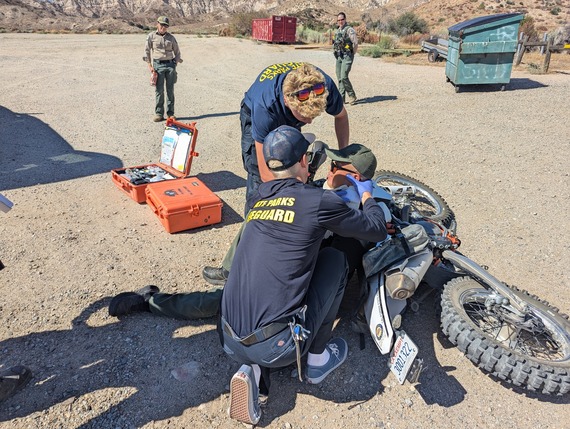 Desert Lifeguards T. Sturgeon and H. Veloz treat an injured T. Lao during a training scenario at Hungry Valley State Vehicular Recreation Area. Photo from Kevin Overduin, Great Basin District.
“What’s a lifeguard doing in the desert?” An understandable question to be sure, as the vast expanses of open desert in the Mojave are not known for their pristine beaches so much as their Pleistocene beaches. While these two biomes have many differences, they share two things in common: sand and high-quality outdoor recreation. The answer to the question of what lifeguards are doing in the desert is simple. It’s what they have always done: assisting state park visitors in any medical emergencies they may face.
The Great Basin Desert Lifeguard Program ramped up for the 2024/25 season by hosting a training weekend for a new batch of lifeguards. These accomplished guards are recruited from state beaches, equipped with state vehicular recreation area (SVRA)-specific training, and sent out to help the public.
Desert lifeguards must participate in training and scenarios tailored to the challenges of providing high-quality medical care in the varied and inconsistent conditions the rugged desert parks offer. These lifeguards must be capable of operating in the heat and cold, in diverse terrain types, and with a variety of new agencies and equipment. The challenges and the skills to overcome them were discussed over two long days of training. Rangers from the Great Basin District were heavily involved in the training to ensure operational compatibility and effectiveness.
The State Parks lifeguards in attendance met the challenge head on and successfully completed the program. The visitors of Hungry Valley SVRA and Eastern Kern County Onyx Ranch SVRA can recreate with peace of mind knowing that the Desert lifeguards are there to help if they should need it.
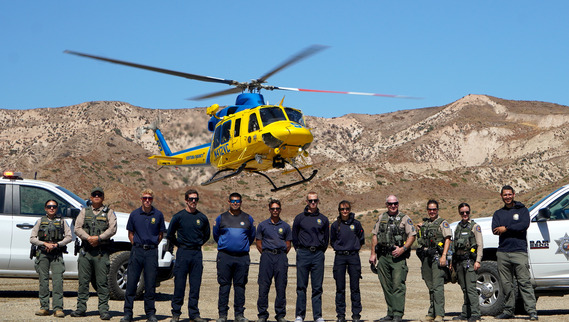 A Ventura County helicopter hovers over Desert lifeguards staff. Left to right: Ranger R. Martinez, Ranger T. Lao, Desert Lifeguard T. Sturgeon, Training Section Supervisor S. Scoggins, Desert Lifeguard R. Saldana, Desert Lifeguard R. Sompura, Desert Lifeguard H. Veloz, Desert Lifeguard C. Chittenden, Supervising Ranger C. Verrigni, Ranger M. Butymhill, Ranger C. Dulaney, Ranger K. Overduin. Photo from Matthew Williams, Great Basin District.
 PARTNER NEWS
Parks California’s 2024 Artist Collaboration Features Andrea Campos
Story from: Elizabeth Kubey, Parks California
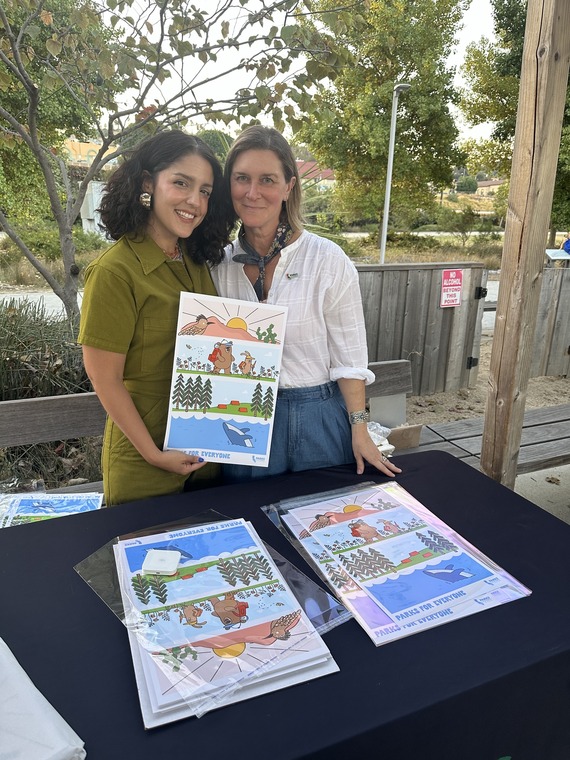 Left to right: Artist Andrea Campos and President and CEO of Parks California Kindley Walsh Lawlor pose for a photo with Andrea's art titled "Parks for Everyone." Photo from Parks California.
Parks California collaborated with Los Angeles artist Andrea Campos to raise funds and awareness for Parks California’s work to support California State Parks. In celebration of Latino Heritage Month, a 2024 art piece titled "Parks for Everyone" was released at a reception on Sept. 11 at Los Angeles State Historic Park. More than 100 people gathered to meet Andrea and had an opportunity to purchase a limited-edition print for $75. A portion of all sales of this print will be donated to support the work of Parks California.
Guests were welcomed by Parks California board member José Gonzalez and President and CEO Kindley Walsh Lawlor, and California Natural Resources Agency Deputy Secretary for Access Gloria Sandoval, and entertained by the State Parks Community Engagement Coordinator Luis Rincon on the “Wheels of Steel” at the DJ booth. Andrea shared stories of her journey as an artist and her experience with and love of California state parks.
In her greeting, Sandoval shared, “Partners such as Parks California and Kindley and her team are making sure that everybody, all Californians, have access to the outdoors and that they feel welcome, they feel safe, that they can enjoy them."
There is still time to secure one of these lovely prints for yourself or someone you know who loves the parks. You can get one online, while supplies last, here, and know that 50% of your purchase price will support the statewide work of Parks California to strengthen all of California’s state parks. Learn more here.
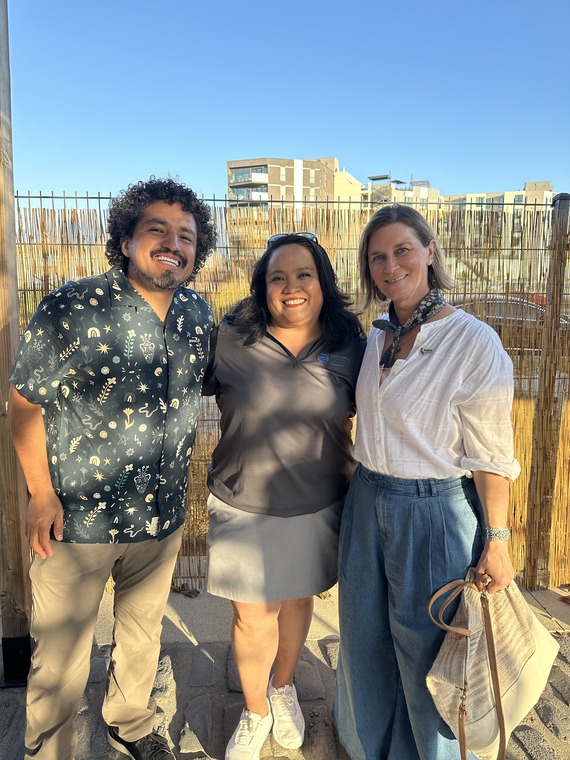 Left to right: Parks California board member José Gonzalez, California Natural Resources Agency Deputy Secretary for Access Gloria Sandoval, and President and CEO of Parks California Kindley Walsh Lawlor pose for a group photo. Photo from Parks California.
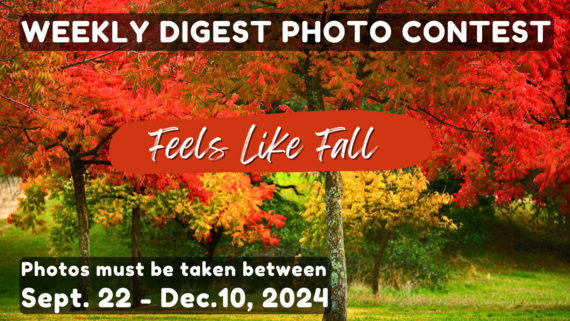 Email photos to the WeeklyDigest@parks.ca.gov.
|
|
|
To view current job openings within California State Parks, please visit our jobs webpage at www.LiveTheParksLife.com.
State Parks Job Spotlights and Open Exams
 JOB SPOTLIGHTS
Associate Governmental Program Analyst – Apply by 9/28/2024: Park Operations in Sacramento, CA is looking for a detail-oriented and organized individual to join their team. In this dynamic role, you will be at the forefront of managing contracts, from preparing solicitation packages to conducting bid openings and evaluating bid documents. You’ll play a key part in preparing contract documents for successful bidders and ensuring all necessary approvals are processed efficiently. Click here to view opportunities and to apply.
Senior Maintenance Aides (Seasonal- Diablo Range District) – Apply by 9/30/2024: Kickstart your career in a fantastic higher-level entry position in the Diablo Range District! In this position, you will play a vital part in maintaining public health and safety standards by performing essential maintenance and housekeeping tasks. Join us in preserving the beauty of our parks while making a positive impact on the community. Don’t miss out on this opportunity to grow and learn in a rewarding environment! Click here to view opportunities and to apply.
Park Interpretive Specialist (Seasonal) – Apply by 10/29/2024: Old Town State Historic Park/San Diego Coast District is seeking a dedicated Park Interpretive Specialist to join their team under the direction of the Interpretation and Education Manager. In this role, you will conduct research and communicate the history of early San Diego and its inhabitants, along with related historical topics. You will engage various audiences, including K-12 students and the general public, through in-person presentations, written materials, digital platforms, and social media. Click here for more information and to apply.
District Superintendent II– Until Filled: The Oceano Dunes District is on the lookout for a District Superintendent II to lead its vibrant operations. In this role, you will be responsible for planning and organizing to directing and overseeing a variety of off-highway vehicle activities at Oceano Dunes SVRA, as well as managing traditional park functions at Pismo State Beach, including the Pismo Dunes Natural Preserve and Pismo Lake property. This is an opportunity you do not want to miss, if you are ready to take on your next adventure. Click here to view this opportunity and to apply.
EXAM SPOTLIGHTS
Park Maintenance Assistant (9/30/2024): As a Park Maintenance Assistant, you will manage routine cleanup and maintenance tasks at a state park, including facility cleaning and trail upkeep. You'll lead seasonal workers, oversee trash removal, and assist with vegetation care and minor vehicle maintenance. Additional duties include supporting complex maintenance projects and answering public inquiries. Click here for more information.
Park Maintenance Chief I (9/30/2024): In this leadership role, you'll oversee the upkeep of buildings, electrical, and plumbing systems. You'll plan and supervise repairs, manage staff and contractors, and ensure compliance with health and safety regulations. Your role includes project planning, cost estimation, and public works contracts, along with implementing advanced technologies like solar heating. Click here for more information.
Park Maintenance Chief II (9/30/2024): The next level in the Maintenance Chief series, you'll lead the maintenance of buildings, electrical systems, and more, ensuring efficient operations. You'll manage and mentor staff, oversee project planning, and drive the implementation of advanced technologies like solar heating. Your leadership will extend to evaluating performance, preparing cost estimates, and coordinating with health and environmental agencies. Click here for more information
Water and Sewage Plant Supervisor (9/30/2024): In this role you'll lead the operations of water and sewage treatment facilities, overseeing daily tests and performing detailed analyses to ensure optimal performance. You'll manage the repair and adjustment of essential equipment like pumps and chlorinators, and keep systems running smoothly, including incinerators and swimming pools. Step in as a relief operator when needed and guide a dedicated team while handling diverse tasks. This role offers a rewarding blend of technical expertise and leadership in a vital field. Click here for more information.
If you have any questions regarding these opportunities, connect with us at Recruiting@parks.ca.gov. We’re happy to help!
Interested in more jobs and exams like this? Explore www.LiveTheParksLife.com to discover the possibilities.
Join the Parks Jobs mailing list here. We can send you updates on jobs and exams that interest you!
|
|
|
Style time! Here are this week's tips to help spread the word about our departmentwide style guidelines:
-
bird-watching: Hyphenate.
-
Coho salmon: "Coho" should be uppercase.
-
day use: No hyphen, unless used as an adjective.
Keeping a consistent writing style ensures the Weekly Digest looks and sounds its best. Each week, the Communications and Marketing Division reviews submitted articles for proper grammar and punctuation and style consistency––from capitalization and hyphenation to proper acronyms and active/passive voice usage. In general, we follow the Associated Press style and Merriam-Webster, but at times we use our own department-specific style.
We always welcome your feedback on how to “Live the Parks Life” in (writing) style. Connect with us via email at weeklydigest@parks.ca.gov.
|
|
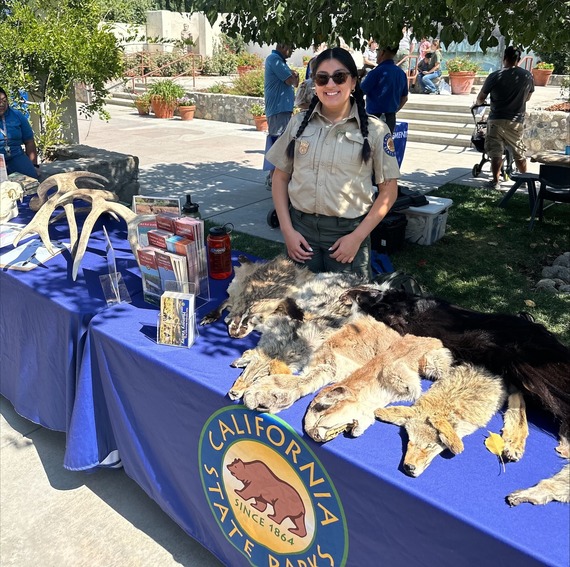 César E. Chávez National Monument, Keene
Senior park aides Julia Medina and Harrison Katz (not pictured) from Tule Elk State Natural Reserve (SNR) joined other local organizations in celebrating Latino Conservation Week and Latino Heritage Month at an event hosted by César E. Chávez National Monument in Keene on Sept. 14. The Conexion Verde Conservation Fair included information from Tule Elk SNR and other displays by conservation groups from the southern San Joaquin Valley.
Photo from Harrison Katz, Great Basin District
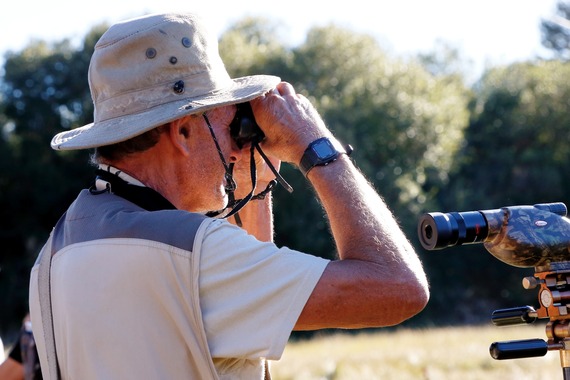 Cuyamaca Rancho State Park
Environmental scientist John Lovio searching for birds as he leads a bird walk during Biodiversity Day. His group identified 48 bird species on the walk.
Photo from Michele Hernandez, Colorado Desert District
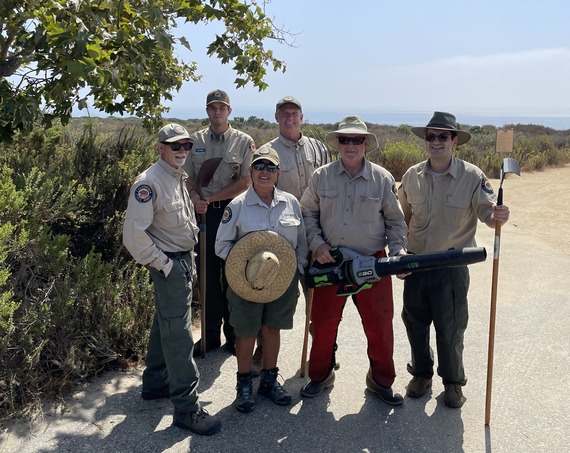 Crystal Cove State Park
Seasonal maintenance aides Randy Bichler, Dan Morgan, Sandra Briesca-Grey, Dave Giddings, Rex Mechling, and Michael Ljungh just finished prepping for the annual Crystal Cove Conservancy Soiree, an outdoor fundraising event that provides much needed resources for the restoration of historic cottages within Crystal Cove’s Historic District. Projects like this are always a pleasure for our great team.
Photo from Marty Kansriddle, Orange Coast District
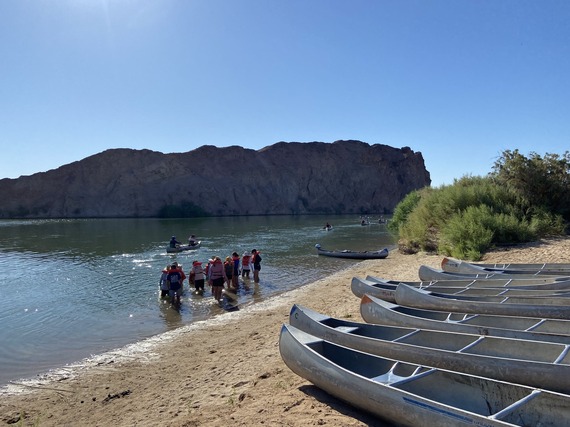 Picacho State Recreation Area
Visitors enjoying the Colorado River.
Photo from Eric Kung, Ocotillo Wells District
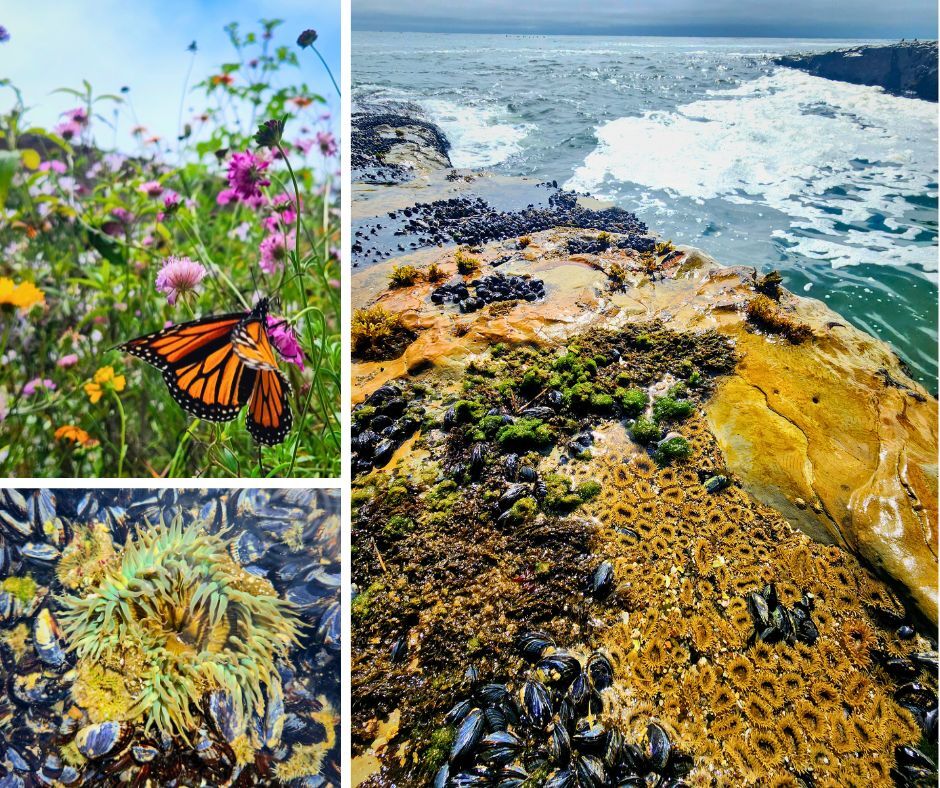 Natural Bridges State Beach
One of my favorite things about being a campground host is being able to visit my neighboring parks. These pictures are of the tidepools and an incoming migrating monarch butterfly. Everyone should visit.... there could be thousands of the butterflies migrating in over the next couple of months.
Photo from Braid Kopling, campground host
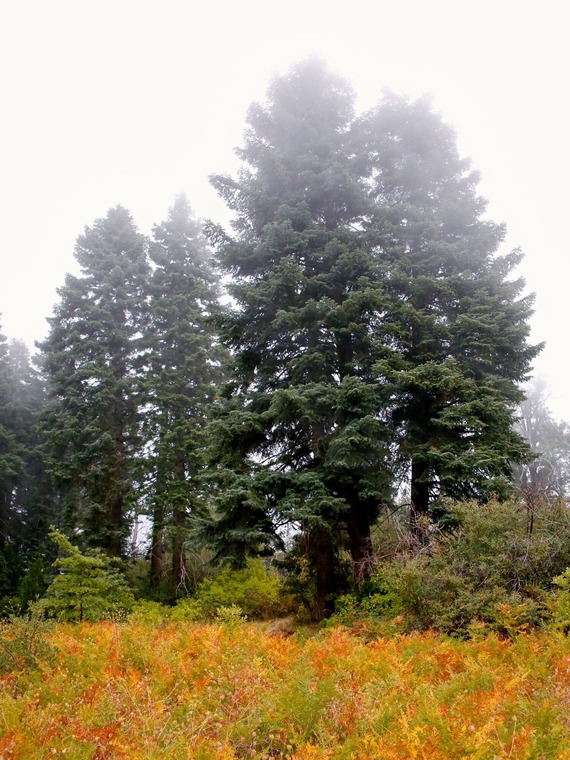 Palomar Mountain State Park
Fog rolling into the park by the Silvercrest parking. It’s beginning to look like fall in Palomar.
Photo from Michele Hernandez, Colorado Desert District
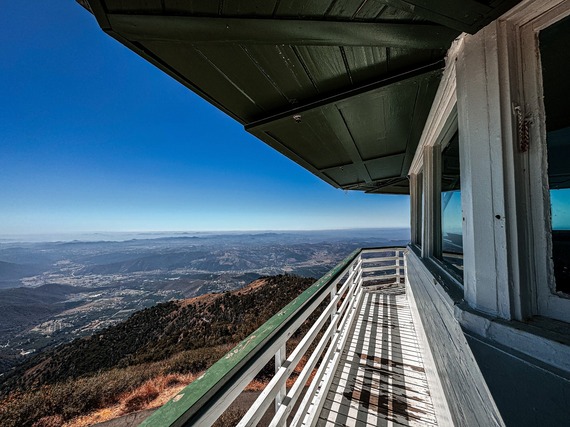 Palomar Mountain State Park
Beautiful views observed from the historic Boucher Hill Fire Lookout sitting at 5,437 feet.
Photo from Brooke Sheridan, Natural Resources Division
 Email photos to the WeeklyDigest@parks.ca.gov.
|
|
|
Here are some upcoming State Parks events. For a list of more upcoming events, please visit www.parks.ca.gov/events.
Saturday, Sept. 28
-
First Hike of Autumn — Chino Hills State Park, 9 a.m.: Come say hello to autumn with the first weekend hike of the season. We will talk about the season, what to expect in the park, what changes to plants and animals to see, and set intentions for autumn. Location: Chino Hills Discovery Center, 4500 Carbon Canyon Rd., Brea, CA 92823.
Sunday, Sept. 29
-
Floodplain Photography — Dos Rios, 8-10 a.m.: Ready, set, click! Bring your camera and head out to the backcountry of Dos Rios floodplain with a State Parks Interpreter. Discover the perfect photo opportunities in this wild landscape. Enjoy birds, water, fauna, and flora while learning about Dos Rios and its history. The walking tour is not recommended for children under the age of 6 or those with health or walking limitations. The walking tour is not ADA-accessible. No stroller or pets are allowed on the walking tour. Register here.
Friday, Oct. 4
-
Discovering Connections – A Focus on Birding in the San Jose Creek Natural Preserve — Ishxenta State Park, 9:30 a.m.-12:30 p.m.: Birders (and everyone else) are welcome on this hike along the vibrant San Jose Creek trail within Ishxenta State Park. Coast chaparral, Monterey Pine Forest, and riparian habitats create an exceptional birding experience at this site! This easy-paced, 2-mile round-trip hike affords multiple opportunities for observation of plants, wildlife, and BIRDS. Expect to see hummingbirds, raptors, warblers, sparrows and quail. California State Park interpreters will lead participants along a designated trail with terrain that is mostly flat with some moderate incline along the way. The trail surface is hardpacked but uneven, winding through both sunny and shaded areas. There are no benches or other seating along the way. Potential hazards include poison oak and ticks. Participants are encouraged to wear long pants, bring hats, water, and their own binoculars. There are a few sets of binoculars available to borrow if you do not have your own. Tickets: Register on Eventbrite: https://www.eventbrite.com/e/a-focus-on-birding-hike-in-the-san-jose-creek-natural-preserve-tickets-853194927997?aff=erellivmlt. 72 hours in advance cancellation. Tickets are transferable at any time.
-
Arts in California Parks: Sylvan Sounds’ Movie Night — Armstrong Redwoods State Natural Reserve, 6:15-8 p.m. Visit the Redwood Forest Theater to watch a screening of "Giants Rising," a 2023 documentary about the majestic redwoods. The event will begin with a Q&A with natural resource professionals at 6:15 p.m, and the 80-minute film starting at 6:45 p.m. Follow @stewardsofcr on Instagram or visit https://stewardscr.org/events/movie-night-october-4-at-the-forest-theater/ to learn more.
Also note this upcoming CNRA-sponsored event celebrating Latino Heritage Month:
Monday, Sept. 30
-
Career Panel: Helping Shape California with a Unique Perspective — Virtual Event, noon to 1 p.m.: We are helping shape California by making sure the Latino voice is heard in the workplace, including in the Natural Resources Agency. Join us for a career panel to learn how Latinos experience and knowledge is adding perspective to different agencies within CNRA. Registration: https://ca-water-gov.zoom.us/webinar/register/WN_ZDrwi9quTcO85d7C8C50BQ.
|
|
|
Sept. 23, 2024
Sept. 25, 2024
|
|
|
The postcard of a tule elk in the Sept. 20 issue was taken at Pacheco State Park, not Tule Elk State Natural Reserve.
The Weekly Digest includes a collection of news articles related to the
California Department of Parks and Recreation. The views expressed and opinions do not always reflect that of the department.
To view this week's News Clips, please visit www.parks.ca.gov/NewsClips.
 Weekly Digest Article and Photo Submissions
If you have an article or photo you would like to submit for the Weekly Digest, please send your entries via email to WeeklyDigest@parks.ca.gov.
For an article submission, please include:
- Author’s name and division/district.
- All relevant information (e.g., headline, park name, dates, name of event, individuals’ full names and titles, etc.).
Articles should be no longer than 300 words.
For photos, please include:
- Photo credit info and captions.
- Photo release forms should be kept on file for non-employees or volunteers.
Unless otherwise noted, all photos included in the Weekly Digest are courtesy of the California Department of Parks and Recreation.
The deadline for Weekly Digest submissions is close of business Thursday. For more information, email WeeklyDigest@parks.ca.gov.
|
|
|
|
|