It Has a Nice Ring to It: Mechoopda Bell Returned to Tribe After 66 Years
Story from: Brian Walsh and Ursula Filice, Northern Buttes District
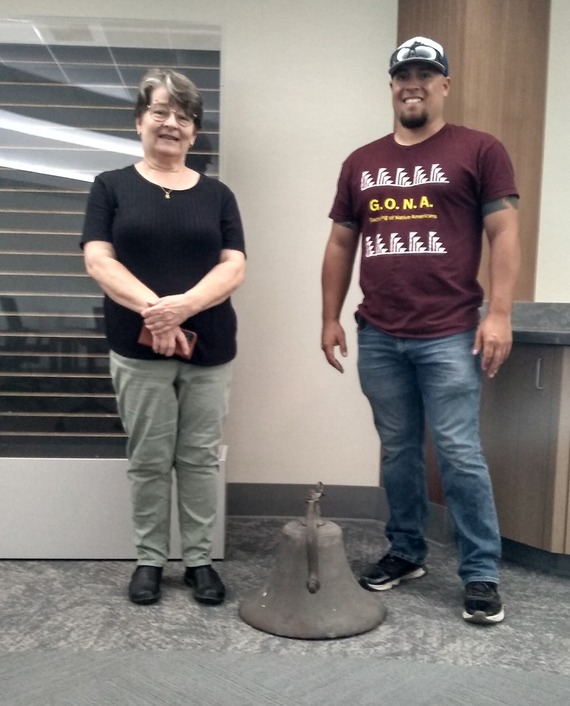 Mechoopda Tribal Historic Preservation Officer Kyle McHenry (right) and California State Park Northern Buttes District Museum Curator Ursula Filice during the bell exchange on Aug. 28. Photo from Brian Walsh, Northern Buttes District.
The bell is back where it belongs. In collaboration with Mechoopda Tribal Historic Preservation Officer Kyle McHenry and State Parks, a 129-year-old bell was returned to the Mechoopda people on Aug. 28.
The story of this bell begins around 1877, when activist and amateur botanist Annie Bidwell had a church built for the Mechoopda Indian Tribe of Chico Rancheria. This church was built on land that would become the California State University, Chico (CSUC) campus, just south of the Chico Rancheria. Originally known as the second Presbyterian Church of Chico, the church was relocated to the Rancheria half-mile west of the Bidwell Mansion.
Shortly after being relocated in 1895, the Mechoopda people purchased a cast-iron bell for the church steeple. The bell was installed in the church steeple and rang for the first time on March 31, 1895. According to news articles, the churchgoers celebrated with song and music and the service was opened by Bidwell. This event is also mentioned in her diary.
Contention between traditional Mechoopda ceremonies and Bidwell’s Presbyterian services persisted until 1906 when the Mechoopda chief, Holsi Lafonso, died. As can be seen in the photograph below, the church and the tribe’s ceremonial roundhouse were situated next to each other. According to Mr. McHenry, it is tradition to abandon the roundhouse after the chief dies, destroy it, and build a new one. He states that lineal decent decides a new chief, but that never happened in this case and a new roundhouse at the site was never built. With the loss of the roundhouse after 1906, the ceremonial traditions of the tribe were disrupted; however, the Mechoopda church remained.
In 1958, the Mechoopda bell was stolen from the church steeple. It is unclear whether the perpetrators were ever apprehended or punished, but the bell eventually ended up with the Chico police department. In 1961, the church burned down under unknown circumstances. Then, in January 1966, the bell was gifted by the Chico police to Bidwell Mansion State Historic Park.
Since 1966, the bell had been stored in a safe and secure location at the park. In 2022, the idea to return the bell to the Mechoopda people was raised as it was acknowledged that this is the last remaining part of the Mechoopda church. Through the hard work and continued determination of the Mechoopda Tribe and State Parks, the bell was returned after 66 years and is truly back where it belongs.
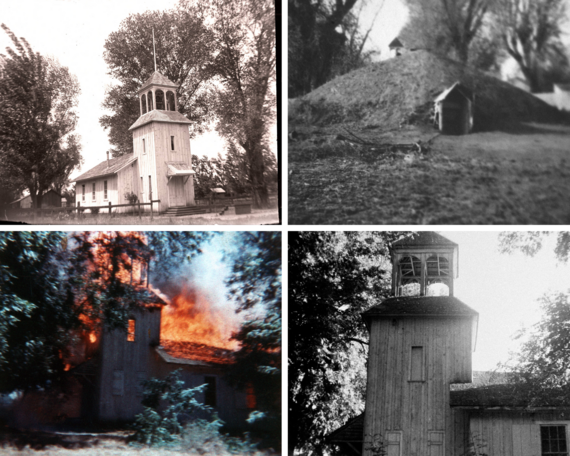 Clockwise from top left: The Mechoopda church with bell, ca. 1895. Mechoopda roundhouse with church steeple in background, pre-1906. The Mechoopda church without bell, ca. 1958. The Mechoopda church burning, 1961. Photos from Meriam Library Special Collections Department, California State University, Chico.
Leading the Way: Lindsey Phillips Becomes First State Parks Graduate of Sherman Block Supervisor Leadership Institute Program
Story and photos from: Jason Smith, Training Section
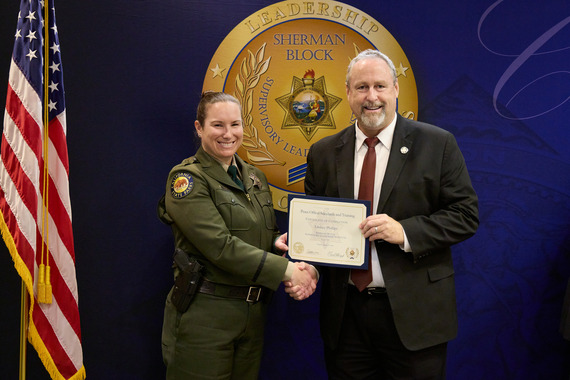 State Parks Peace Officer Supervisor Lindsey Phillips receives her certificate completion of the Sherman Block Supervisory Leadership Institute program from POST Assistant Executive Director Jim Grottkau.
A total of 15 books read, 19 writing assignments completed, training three days per month for eight months, and State Parks Peace Officer Supervisor Lindsey Phillips became the first State Parks employee to graduate the Peace Officer Standards and Training (POST) Sherman Block Supervisor Leadership Institute (SBSLI) program.
On Sept. 13, Lindsey and her classmates from Class 531 graduated POST’s intensive leadership training designed to stimulate personal growth, leadership, and ethical decision-making in California law enforcement front-line supervisors. The curriculum takes students through an analysis of management (planning, organizing, directing, etc.) and leadership (inspiring, challenging, developing, etc.) and how each discipline complements the other. The course progresses from self-evaluation, to interpersonal evaluation, to organizational relationships.
When asked what her biggest takeaway from the program was, Lindsey responded, “I learned that leadership is more than just a concept in a book. It is a way of approaching relationships both at work and at home that ultimately serves everyone in a healthy and productive way.”
Northern Division Chief Jason DeWall, Law Enforcement and Emergency Services Chief Scott Bayne, and I were privileged to be present when POST presented Lindsey with her acknowledgement for completing SBSLI. Lindsey was an ambassador for State Parks and set the standard for future staff who are willing to go above and beyond in their everyday work.
SBSLI is open to all peace officer supervisors and dispatch supervisors who meet eligibility requirements set by POST. A successful student is one that is willing to learn, open to new ideas, and able to engage in deep self-examination of values and beliefs. The curriculum provides a forum for personal growth and development of qualities necessary for effective public safety leadership. Thank you, Lindsey, for completing this program and showing others that they too can become amazing leaders.
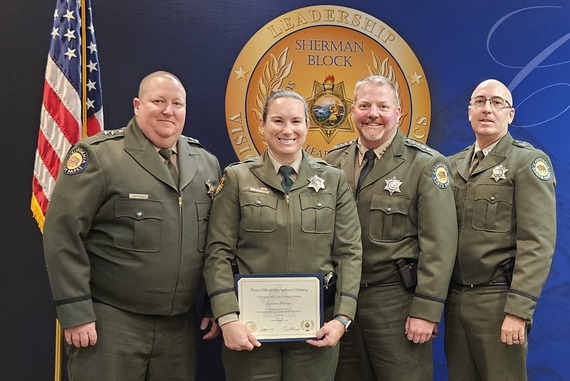 Left to right: Chief Scott Bayne, Lindsey Phillips, Chief Jason DeWall, and Superintendent Jason Smith take a group photo after the graduation ceremony.
California Biodiversity Day Results Are In: Monterey District Parks Lead with Most Observations Recorded
Story and photos from: Leah Gardner, Natural Resources Division, and Erika Delemarre, Interpretation and Education Division
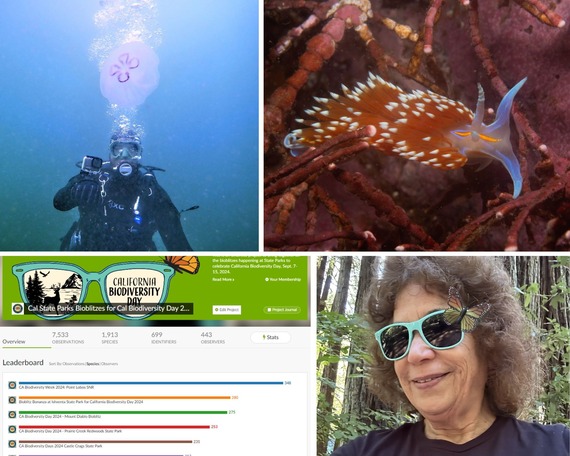 Top left: A diver photographs a moon jelly during the underwater bioblitz at Point Lobos State Natural Reserve (SNR). Top right: An opalescent nudibranch, one of the many amazing ocean dwellers photographed in the Point Lobos SNR. Bottom left: The leaderboard on the iNaturalist page for the umbrella project of State Parks bioblitzes showing the top 10 parks for number of species observed. Bottom right: Natural Resources Division's Leah Gardner takes time out from bioblitzing to show off the California Biodiversity Day logo sunglasses at Samuel P. Taylor State Park.
Parks across the state celebrated California Biodiversity Day with special events, nature walks, and bioblitzes from September 7 through 15. More than 30 parks competed to see which would observe and document the highest number of unique species. After much anticipation, the results are in.
Congratulations to Monterey District for emerging as the shining star in our bioblitz competition earning the top two spots. Point Lobos State Natural Reserve (SNR) took first place recording 349 unique species, and Ixshenta State Park (SP) came in second with 280 species observed. Close behind in third place was Mount Diablo SP with 275 species.
Monterey District hosted a total of 13 events across multiple park locations, including biobltizes, plant walks, bird walks, butterfly walks, and broom bashes. State Parks Dive Team members Interpreter I Ashley Wemp and Senior Environmental Scientist Madison DaSilva organized a special scuba diving event where divers photographed species underwater in Whalers Cove in the Point Lobos State Marine Reserve. Interpreter I Violet Smith and Environmental Scientist Sam Winter hosted the first ever bioblitz in Ishxenta SP and they noted how exciting it was to see how much biodiversity could be found within each of its three distinct regions.
Sam explained his enthusiasm over the results of the Point Lobos bioblitz. “For me the highlight of our work at Point Lobos SNR this year was seeing how everyone involved brought their different interests and expertise together to document biodiversity in the reserve,” Sam said. “Different park staff and volunteers really zoomed in on birds, plants, marine life, etc., to help us round out our species list. We also had a dedicated group of volunteers going above and beyond to help accurately identify observations. I'm proud of how much public and staff participation we had this year.”
Honorable mention also goes to this year’s top observers who captured photos of different species and uploaded them into iNaturalist. Natural Resources Division’s Senior Environmental Scientist Leah Gardner recorded 296 species, bioblitzing at four parks during the week: Mono Lake Tufa SNR, Samuel P. Taylor SP, Tomales Bay SP, and Calaveras Big Trees SP. Sam Winter had the second highest number of observations with 220 species. San Diego District’s Ingo Renner, a docent with Torrey Pines Docent Society, came in third with 146 species recorded during the bioblitz at Torrey Pines SNR.
You can see the results of all the State Parks bioblitzes by clicking into each project and peruse the photos of species observed here. If you’re a lover of sea life, you’ll be especially captivated by the underwater photos taken at Point Lobos SNR.
State Park Interpreters also hosted PORTS (Parks Online Resources for Teachers and Students)® Program virtual events to help connect K-12 students across the state with California’s biodiverse wonders. A total of 3,530 students and members of the public tuned in to 15 different PORTScasts. The most popular PORTScast viewed by 867 students was “Sea Otters are Biodiversity Superheroes!” which was hosted in partnership with the California Department of Fish and Wildlife at the Elkhorn Slough Reserve. Great work for the PORTS interpreters at Asilomar (469 attendees), San Elijo State Beach (360 attendees), and Redwood National and State Parks (359 attendees).
A huge thanks to all staff who helped organize more than 100 events in parks for this year’s California Biodiversity Day! Statewide, we collected over 7,500 observations documenting more than 1,900 species. The events, held annually the week of September 7, are a great opportunity to collect data and increase awareness of the importance of our mission to “preserve the state’s extraordinary biological diversity.”
Salton Sea State Recreation Area Hosts Bombay Beach Nature Club for California Biodiversity Day
Story from: Taylour Unzicker, Ocotillo Wells District
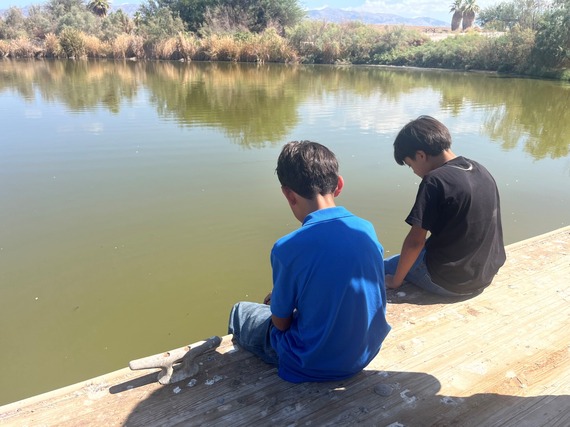 Students from Bombay Beach Nature Club observe Varner Harbor during California Biodiversity Day at Salton Sea State Recreation Area. Photo from: Paedrin Fusco, Bombay Beach Nature Club.
Despite the September heat, the Salton Sea State Recreation Area (SRA) interpretation team was excited to host several guided bioblitz walks to celebrate California's amazing biodiversity.
One especially exciting offering was with the Bombay Beach Nature Club. Staff at Salton Sea SRA first interacted with the Bombay Beach community group after a Parks California Route to Parks grant submission. The grant has allowed State Parks and the Bombay Beach youth to form a strong relationship. State Park Interpreter I Cassandra Van Dyne has led them through multiple programs over the past year. For Biodiversity Day, they were guided on how to use the iNaturalist app and submit observations of the plant and animal life all around them.
In addition to the exciting interactions with local youth, staff were able to lead guided walks with visitors from West Virginia, Connecticut, and even Germany. Salton Sea SRA regularly welcomes visitors from all over the world, and it is always a pleasure to share the area’s robust history and biodiversity.
Archaeologists Complete Post Fire Survey at Hungry Valley State Vehicular Recreation Area
Story from: Steve Ptomey, Great Basin District
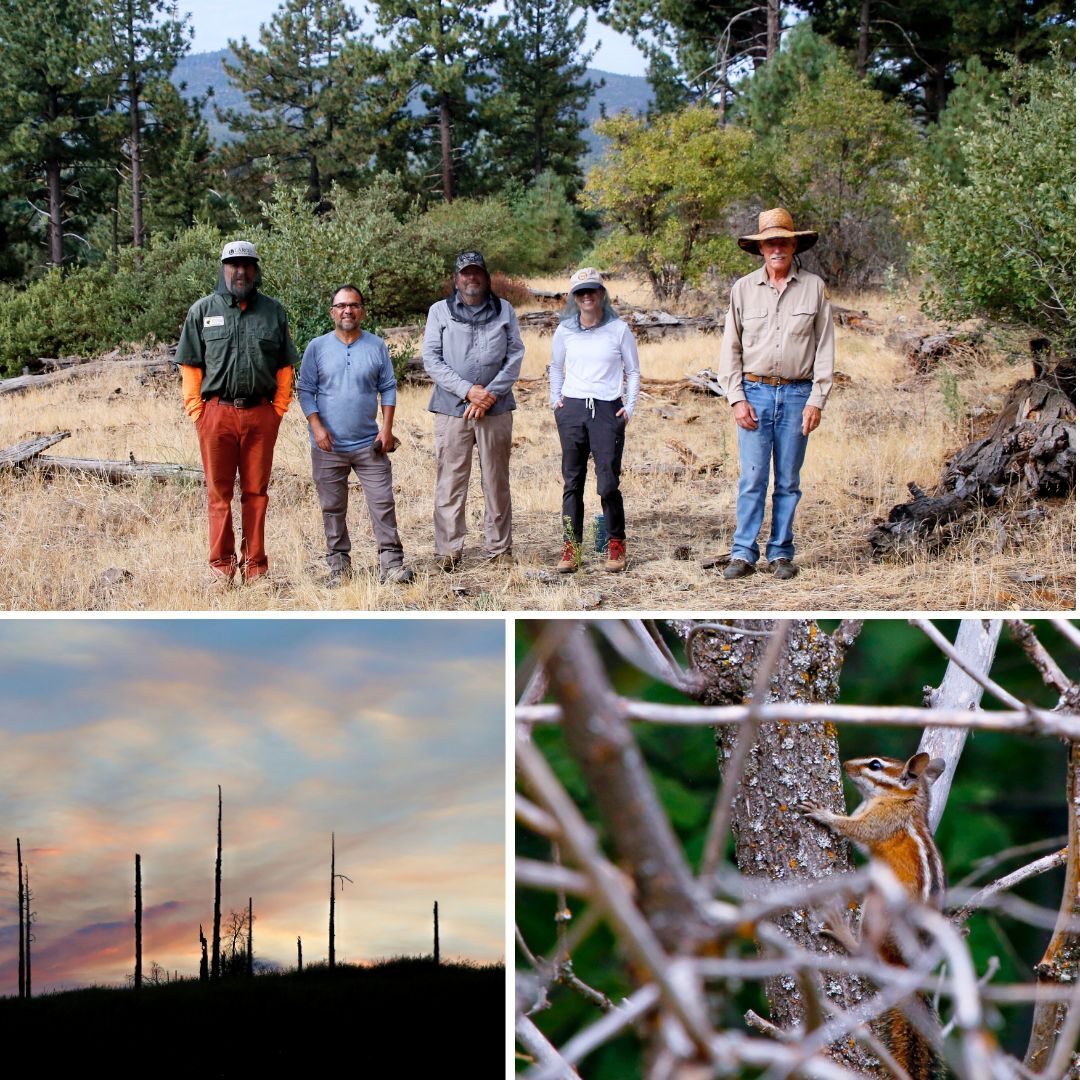
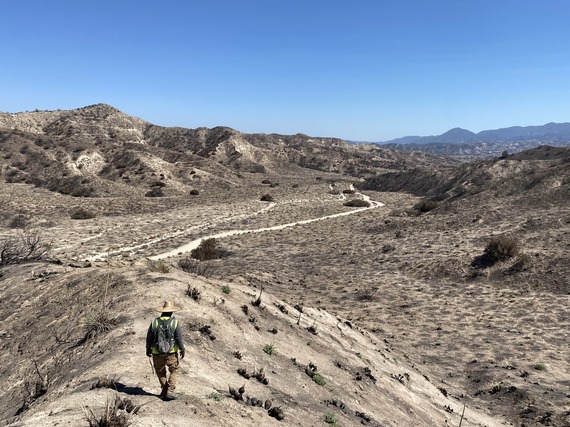
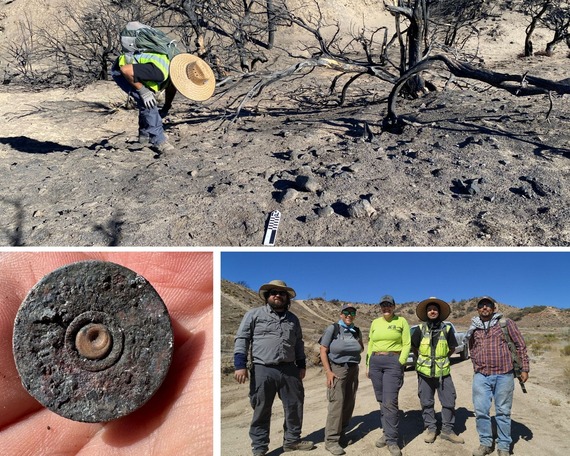 Top: Adam Gonzales, tribal monitor from Fernandeño Tataviam Band of Mission Indians (FTBMI), inspects the burn area at Hungry Valley State Vehicular Recreation Area. Bottom right (left to right): Associate State Archaeologists Erik Allen, Cultural Resource Division, Ann Stansell, Angeles District, Jessica Borges, Cultural Resources Division, Tribal Monitor Adam Gonzales, FTBMI, and Associate State Archaeologist Jairo Avila, Great Basin District. Bottom left: a shotgun case head from the Great Depression era. Photos from Steve Ptomey and Jairo Avila, Great Basin District.
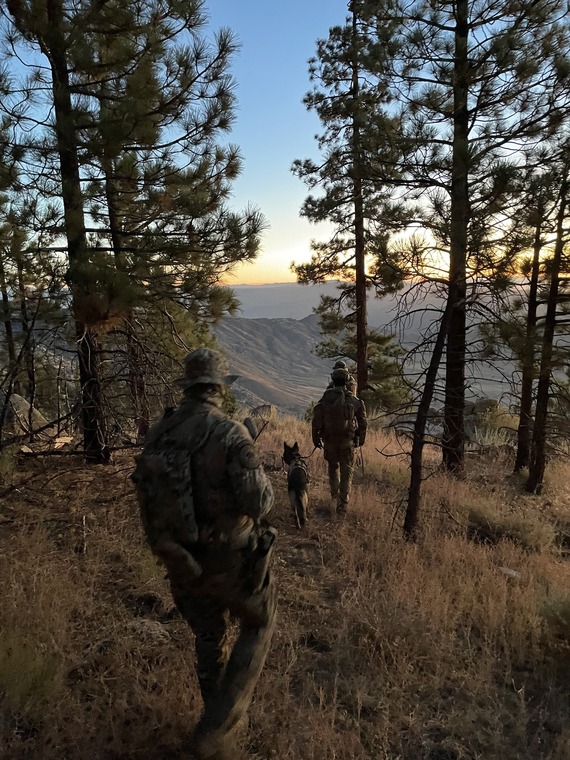
State Park archeologists concluded the field portion of an archaeological survey at Hungry Valley State Vehicular Recreation Area (SVRA) this past month. Completing a week ahead of schedule, the crew made up of archaeologists from across the State Park System conducted an inventory to see if fire suppression activities like dozer and hand lines had damaged any archaeological sites in the park. To assess the burn effects, park specialists walked the dozer and hand lines that were constructed during the fire, looking for impacts to any cultural deposits.
Other important and sensitive areas that were burned were also inspected for damage by the intense wind-whipped wildfire. This effort included two cultural preserves (Gorman Cultural Preserve and Freeman Cultural Preserve) that have enhanced protection under park regulations, and which had not been visited by professional archaeologists since 2002. No sites were damaged by the fire suppression activities, and five previously unknown sites (three historic and two prehistoric) were discovered during the survey. The historic sites consist of trash pits containing glass and oil cans, and two prehistoric sites consist of lithic materials. All resources were well documented and will remain in place unless there is concern of damage.
The crew consisted of archaeologists from the Great Basin and Angeles districts, the Cannabis Watershed Protection Program’s cultural resources team and Cultural Resources Division. The crew also included a Native American monitor from the Fernandeño Tataviam Band of Mission Indians, who have a memorandum of understanding with the Great Basin and Angeles districts.
The Great Basin District wants to acknowledge the support from the Off-Highway Motor Vehicle Recreation Division and Cultural Resources Division in completing this urgently needed inventory. Not only was it required, but it also allows the district to move forward with restoration and the reopening of the park unit to the public.
A Night of Awe: Stargazing at Candlestick Point State Recreation Area Reveals Saturn’s Splendor
Story from: Lisa Whitmer, Bay Area District
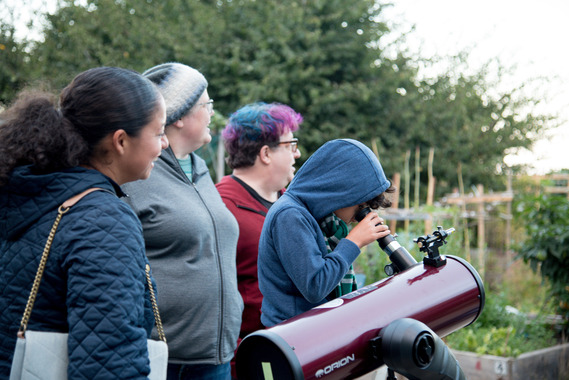 A young boy gets a close-up view of the moon with support from the San Francisco Amateur Astronomers. Photo from Veronica Silva Miranda, Parks California.
We heard a collective gasp and a “Saturn is out” when the fog parted. The community members gathered at Candlestick Point State Recreation Area (SRA) for Astronomy Night huddled closely around four large telescopes and were rewarded with a rare glimpse of the ringed planet.
Thanks to Parks California’s generous support, five members of the San Francisco Amateur Astronomers came out to the park on Saturday, Sept. 14, to share their expertise and powerful telescopes with the community. With easy-to-understand metaphors, they helped everyone understand what we were looking at – from our moon’s seas, craters, lunar rays, and mountain ranges to the glowing speck that was Titan, Saturn’s largest moon.
Surrounded by garden plots brimming with a late summer harvest, we took turns marveling at the cosmos as dusk turned to dark. A hush fell over those gathered.
According to recent scientific research by U.C. Berkeley’s Dacher Keltner and others, experiencing awe is one of the keys to human well-being. These studies show that awe fosters a feeling of interconnectedness, decreases a focus on self, and heightens a sense of meaning. Given the joyful conversation that bubbled up among the diverse group of strangers gathered at Candlestick Point’s Astronomy Night, the power of awe was palpable.
How lucky we are as park stewards to be able to foster these experiences of awe for our communities. Big thanks to Dan Smiley of San Francisco Amateur Astronomers and Veronica Silva Miranda of Parks California for making this out-of-this-world night possible.
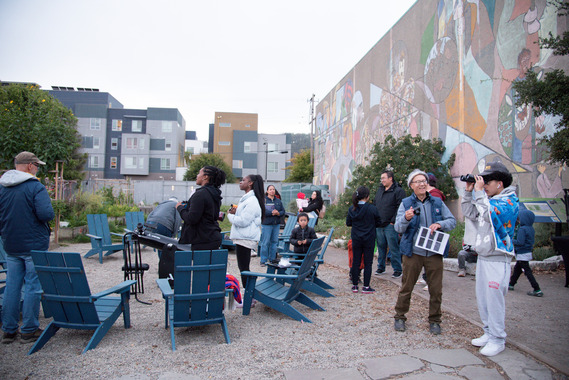 Candlestick Point SRA Astronomy Night in action. Photo from Veronica Silva Miranda, Parks California.
State Parks And Recreation Commissioners View Environmental Challenges During Tour of Border Field State Park and Silver Strand State Beach
Story and photos from: Kevin Murphy, Communications and Marketing Division
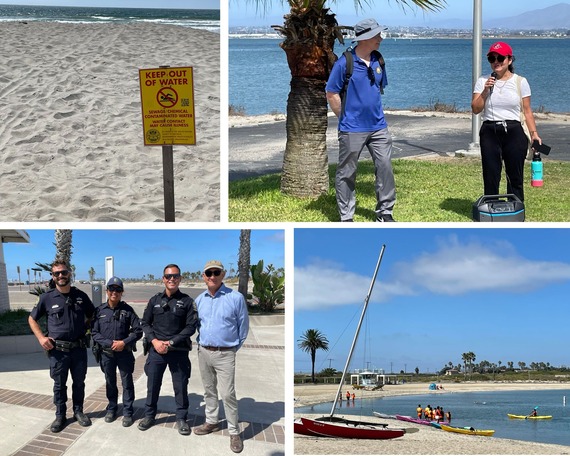 Top left: Wastewater, drifting north from the Tijuana River National Estuarine Research Reserve, has impacted several beaches to the north leading to several recent closures, including Silver Strand State Beach (SB). Top right: Senior Landscape Architect Bob Patterson and Myrian Solis Coronel, director of community engagement for Parks California, describe current and future efforts to provide recreational activities for visitors. Bottom right: The bayside area of the park has not been affected by wastewater, with aquatic activities for youth on display provided by local nonprofit Outdoor Outreach. Bottom left: State Park Peace Officers (Lifeguards) Joel Puckett, Britney Sanchez, and Michael Lawrence and State Parks Director Armando Quintero.
The State Park and Recreation Commission (Commission) hosted its most recent public tour and meeting in San Diego County on Sept. 11 and 12. With assistance from San Diego Coast District and Strategic Planning and Recreation Services Division staffs, 50 participants, including commissioners and the public, received a tour that began at the fences along the border between the United States and Mexico.
Border Field State Park (SP), which includes the Tijuana River National Estuarine Research Reserve, and both locations have been heavily impacted by cross-border contamination for years with the most significant challenges over the past year. Border Field SP has been closed since in August 2023. Since then, contaminated stormwater, wastewater, solid waste, and sediment have continued to impact the ecology of the park and the reserve via the Tijuana River and several tributaries. The contamination is a result of storm-related impacts as well as infrastructure failures. The contamination has also led to several water contact closures of beaches further north, including Silver Strand State Beach (SB).
Climate-related and man-made effects on the environment are also impacting access to the park for recreational and cultural opportunities in the border community. State Parks is in the process of a major project for a realignment of the road at Border Field SP, which will eliminate access issues caused by flooding once the project is completed.
In addition to environmental and recreational challenges, tour participants also asked questions about law enforcement and first responder activities. San Diego Coast District Chief Ranger Nicole Van Doren explained that many local, state, and federal agencies work in cooperation in responding to public safety and aquatic emergencies in the area. This includes providing lifesaving assistance to people trying to enter the United States via the ocean throughout the San Diego Coast District park units.
A visit to Silver Strand SB provided the opportunity to see this unique park, which has day use and camping along with access to the Pacific Ocean and San Diego Bay. While the park’s oceanside beach is frequently closed due to wastewater contamination, the bay side typically remains open to water contact and offers protected water recreation. During the tour, participants observed an aquatics program for youth organized by Outdoor Outreach, a San Diego-based nonprofit that utilizes the outdoors to inspire youth to see possibility and opportunity in their lives.
During the Commission’s formal meeting on Sept. 12 in San Diego, the Strategic Planning and Recreation Services Division provided updates on several high-profile projects. These included the classification process for the Alameda-Tesla Property, which will now be folded into the general plan process. The website outlining the classification and planning process for the Alameda-Tesla property has been updated. Additionally, a general plan amendment process for Los Angeles State Historic Park (SHP) to review and consider the proposed Los Angeles Aerial Rapid Transit Project has been initiated. More information about the general plan amendment process for Los Angeles SHP is available at LAStateHistoricParkGPA.com.
The Commission was also able to recognize recipients of the Golden Bear Award, including Dorothy Benjamin, who attended the meeting in person. Dorothy was recognized for her efforts to organize the Colonel Allensworth 5K Run Walk for Health, which has been an event at Colonel Allensworth SHP since 2008 and supported the park’s interpretive programs. This year’s event is scheduled for Oct. 12. Other awardees included Park Maintenance Chief I Rick Matsuo from the Angeles District, Juan Carlo Mendoza, a volunteer with the Angeles District Mountain Bike Unit, Viktor Patiño from the Office of Grants and Local Assistance, and the Sierra State Parks Foundation. The Commission also received additional staff reports on recruiting, partnerships, and the Reexamining Our Past Initiative. A report on the future of park access for electric vehicles was also provided.
A video recording of the meeting is available through Cal-Span.org. For more information about the State Park and Recreation Commission, please visit the Commission website.
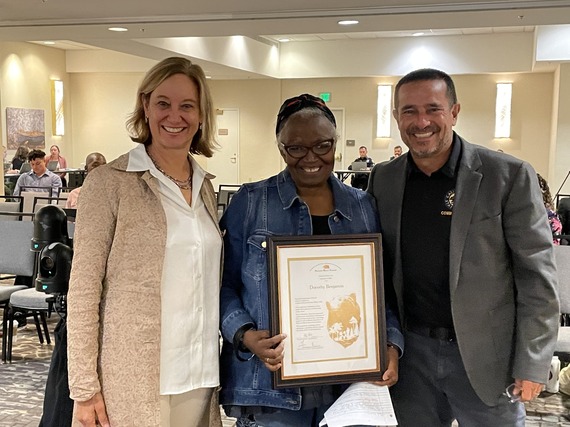 Dorothy Benjamin accepts a 2023 Golden Bear Award for her work at Colonel Allensworth SHP with Commissioners Francesca Vietor and Phil Ginsburg.
Restoration in Progress: Training Course Revives Historic Hellman-Erman Mansion
Story and photos from: Ricky Roldan, Training Section
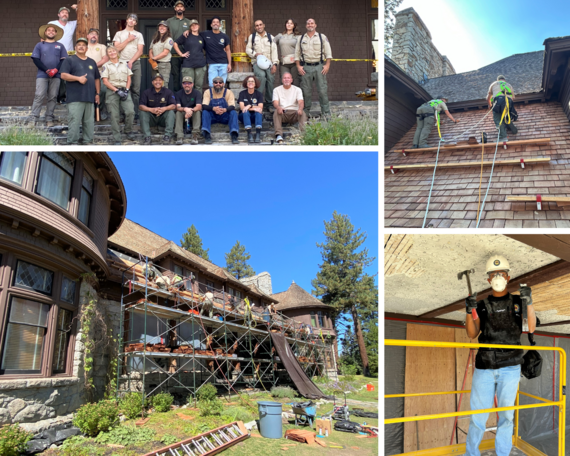 Top left: The District Maintenance Skills Training Section 8 group pose for a photo in front of the Helllman-Erman Mansion. Top right: District Maintenance Skills Group attendees set new cedar shingles on the roof of the mansion. Bottom left: The Hellman-Erman Mansion gets worked on by District Maintenance Skills Group. Bottom right: Maintenance Instructor Elisha Lechuga removes the ceiling plaster from the Pine Lodge roof at the Hellman-Erman Mansion.
The District Maintenance Skills Training Section 8, a course offered by State Parks' Training Section, focused on replacing the historic wooden shingle roof and ceiling plaster of the Hellman-Erman Mansion at Ed Z'Berg Sugar Pine Point State Park. This mansion provides a stunning view of Lake Tahoe from its location.
Built in 1903, the Hellman-Erman Mansion has been the subject of ongoing efforts by the Sierra District to replace the ceiling plaster above the Pine Lodge porch. Unfortunately, these efforts have seen little interest from local or statewide contractors through the bidding process. Alexandra Neeb, the Sierra District cultural resources program manager, reached out to me to explore the possibility of incorporating the project into a training program.
After a couple of visits with the Sierra District, Alexandra, Lead Instructor Joe Lechuga, and I collaborated with skilled maintenance carpentry instructors to guide employees through the restoration work. The first day of class included an overview of the project scope, safety instructions, and a walkthrough of the job site. Participants began removing the old wooden shingles above the porch and replacing them with newly purchased cedar shingles. The team of instructors set up scaffolding that reached up to three stories high, training staff on how to safely secure their harnesses to the building. Together, they started tearing out the old wooden shingle roof above the Pine Lodge porch, which involved removing weathered plywood, old felt, rusted nails, and staples.
During the second week of training, the first group laid out and set the new cedar roof shingles on the mansion’s roof, while the second group and instructors removed the plaster from the ceiling above the Pine Lodge porch.
The district maintenance skills training will continue from Sept. 30 to Oct. 14. Participants will replace and add new shingle ridge caps to the Hellman-Erman Mansion roof and install new pebble dash plaster on the ceiling of the Pine Lodge.
The Training Section would like to extend a big Thank You to the Sierra District staff Alexandra Neeb, Tamera Bjorklund Seals, Shaun Owen, Melinda Meyer, and Fernando Lopez, for their hard work in hosting, preparing, and making the onsite Hellman-Erman Mansion Skills Project a success.
Please check the FOCUS calendar for Fall of 2024 and Spring of 2025 for upcoming maintenance classes and updates. Classes fill quickly. If you have any questions, please email ricky.roldan@parks.ca.gov.
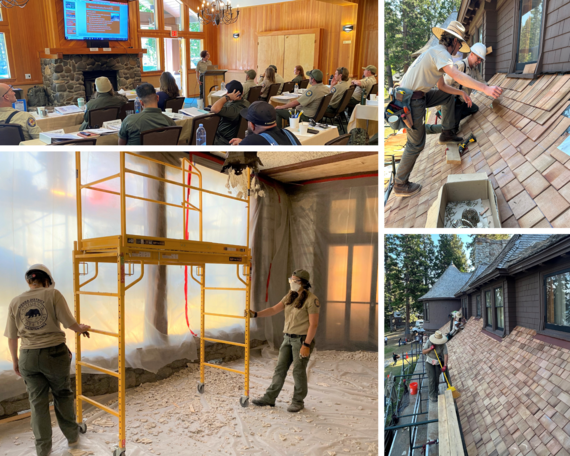 Top left: San Diego District Chief III Jodi Whelchel addresses the group on their first day of class. Top right: Training participants John Sachs (left) and Cobin Schuppert (right) set new cedar shingles to the roof of the Hellman-Ehrman Mansion. Bottom left: Training participants Denise Cox (left) and Nichole Jigarjian (right) remove plaster on the Pine Lodge porch. Bottom right: The new shingles are swept after being placed.

BayWood Artists 27th Annual Show to Benefit Parks California
Story and photo from: Elizabeth Kubey, Parks California
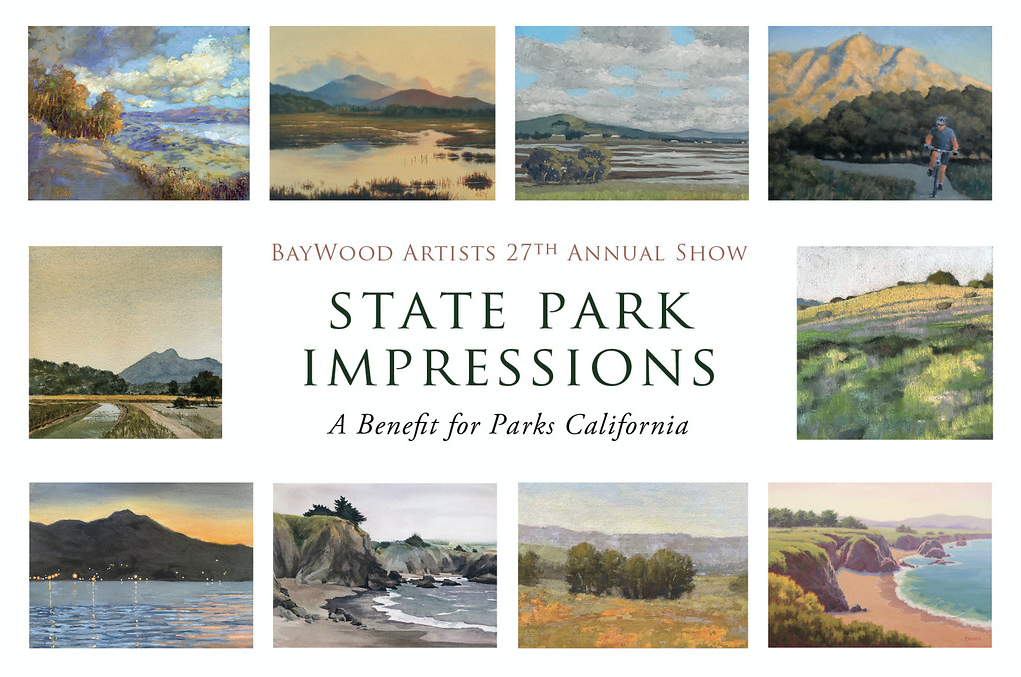 Parks California and the BayWood Artists are excited to once again present over 100 new paintings inspired by the beauty of California’s state parks on Friday, Sept. 27, in Ross. Join us for the opening reception and explore these unique artworks. Sales benefit the work of Parks California. Free to attend.
Opening Reception: Sept. 27, 6 - 8 p.m.
Show: Sept. 28 - 29, 10 a.m. - 4 p.m.
Location: The Studio Gallery Marin Art & Garden Center, Ross.
The BayWood Artists are a small group of professional landscape painters. Artist members of 2024 are Christin Coy, Laura Culver, Jon Francis, Robert Frank, Michael Friedland, Sherrill Miller, Lissa Nicolaus, Jean Sanchirico, Robert Steele, and guest artist James Morgan.
The mission of the BayWood Artists is to protect and preserve the landscape by raising awareness of and making donations to environmental causes through fine art exhibitions and sales, and by promoting the tradition of plein air painting in California. For more information, visit Baywoodartists.org.
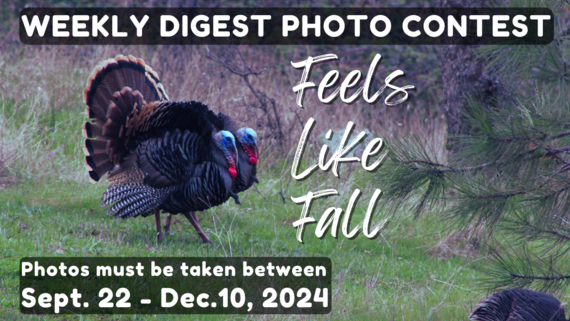 Email photos to the WeeklyDigest@parks.ca.gov.
|