Cal State Surf Racing Team Completes Another Successful Season
Story from: Ryan Gates, Orange Coast District
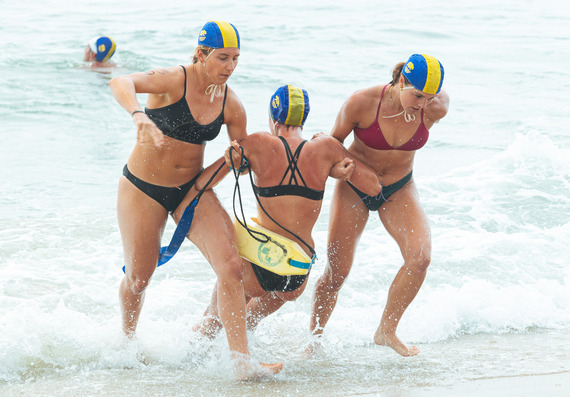 Tea KalPakoff (Lifeguard, Oceano Dunes) and Katherine Bolitho (Lifeguard, San Diego Coast) carry teammate Taylor Barfield (Lifeguard, San Diego Coast) up the berm for a third-place finish during the rescue race at Dockweiler State Beach. Photo by James Burgess, photographer.
The California State Parks Lifeguard Competition Team completed the racing season at the United States Lifesaving Association National Championships, held Aug. 6-9 in South Padre Island, Texas. The State Parks Team, "Cal State Surf Racing," had 23 current and former state park lifeguards competing over three days against the nation’s top lifeguard agencies. Cal State Surf Racing finished in fourth place while Sussex County, NJ, finished in first place.
During the competition, points were scored in the Open and Master’s events to combine for an overall team ranking. Top Open Division scorers for Cal State Surf Racing were Brandi White (Lifeguard II, Orange Coast), Rylee Nakayama (Lifeguard I, Orange Coast), Roman Higgins (Lifeguard I, Channel Coast), and Ben Butler (Lifeguard I, Channel Coast).
In July, our team defeated Los Angeles County Lifeguards during the Southwest Regional Lifeguard Championships at Dockweiler State Beach (SB). Cal State Surf Racing has won the regional championships every year since 2013.
Each lifesaving competition race resembles basic skills used by lifeguards every day: swimming, running, paddling, ocean knowledge, rescue techniques, spotting/responding to rescues, and teamwork. The sport promotes aquatic safety and awareness through public outreach, health and fitness within the lifeguard community, and challenges even the toughest lifeguards to become better athletes and rescuers. At competitions, we interact and network with other lifeguards from all over the United States, often recruiting lifeguards to work for State Parks the following season.
Congratulations, California State Parks lifeguards for another great season, representing our department and motivating our lifeguard staff to be the best versions of themselves!
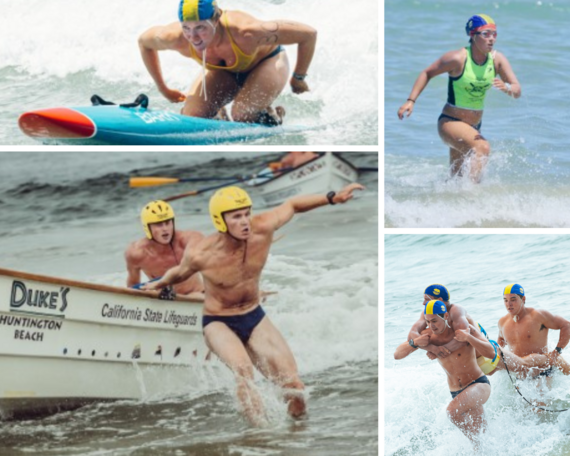 Top left: Lifeguard Kaitlyn Tolin (Oceano Dunes District) completes the paddleboard leg of the American Ironwoman Race at Dockweiler SB. Kaitlyn finished second in the Open Division. Bottom left: Lifeguard Roland Mantecon (Orange Coast District) jumps out of the dory boat during the men’s surf boat race while Lifeguard Jack McLaughlin (Orange Coast District) steadies the boat at Dockweiler SB. Photos by James Burgess, photographer. Top right: Lifeguard Rylee Nakayama (Orange Coast District) exits the water at South Padre Island, Texas, during the International Ironwoman Final. Photo By Skip Prosser, Long Beach Lifeguards. Bottom right: Lifeguards Kekoa Wheeler and Bhodi Yohn (both San Diego Coast District) carry teammate Emory Campbell (Oceano Dunes District) up the berm during the Rescue Race. Photo by James Burgess, photographer.
Visually Impaired Volunteer at Tijuana River National Estuarine Research Reserve Featured on San Diego Public Televison
Story from: Communications and Marketing Division
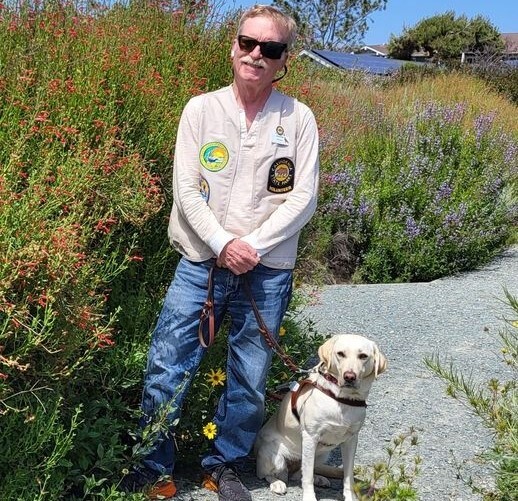
Volunteer docent Ron Peterson. Photo from California State Parks staff.
KPBS, the PBS member television station in San Diego, featured a story about a unique tour experience in California’s State Park System. The story, published on Aug. 15, featured volunteer docent Ron Peterson, who guides visitors on nature walks through the Tijuana Estuary.
Peterson, a longtime volunteer at the Tijuana River National Estuarine Research Reserve, lost his vision to glaucoma, a slow-moving disease that causes damage to the optic nerve, five years ago. He cannot see the wetlands anymore but has learned how to navigate the estuary and recognize nearly 40 native plants by touch, smell, and sound.
With the help of staff members, the retired Navy scientist and engineer began developing a new kind of tour. His special nature walk is called “The Eye-Opening Experience Without Sight” and teaches visitors to experience the estuary through other senses. Peterson now leads his tour every month. He takes visitors around the northern end of the estuary and introduces them to more than a dozen native plants.
Peterson said leading these tours has helped him move forward from losing his vision and he is proud to be connecting visitors to the estuary with native plants, which he sees as part of their broader mission of protecting the planet. Read the full story and watch a video of Ron's story produced by KPBS here.
Nonprofit Stewardship Makes Tolowa Dunes State Park Move and Bloom Again
Story from: Kyle Buchanan, North Coast Redwoods District
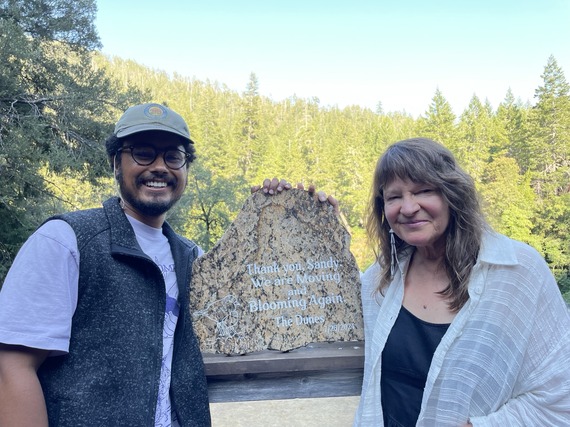 State Parks Interpreter I Kyle Buchanan (left) and Sandra (Sandy) Jerabek, director of Tolowa Dunes Stewards, posing with a stone engraved with a "thank you note" from the dunes for the restoration of natural processes at Tolowa Dunes State Park and Lake Earl Wildlife Area. Photo from Elizabeth McKisson, North Coast Redwoods District.
Throughout the past 21 years, Tolowa Dunes Stewards (TDS), a restoration-based nonprofit, has been dedicated to environmental stewardship, protection, and education at the 12,000-acre complex of Tolowa Dunes State Park (SP) and Lake Earl Wildlife Area. With this mission, TDS has been organizing volunteer and paid crews to remove invasive plant species within the complex. While considering this mission, one of the most tenacious targets is the removal of European beachgrass.
This aggressive, invasive grass species has virtually engulfed the dunes' habitat, restricting the ability of native plants to grow within their home range. Without these native plant populations, our pollinators will struggle for food sources and ultimately this issue will trickle up the food chain. Considering this location is a major stop for bird migration on the Pacific Flyway, disturbance of the food chain is then amplified. Birds traveling anywhere from Alaska to South America rely on a functioning ecosystem for refuge during their yearly journeys.
Furthermore, the European beachgrass has stabilized the foredune, restricting dune/sand movement. This places the habitat at an increased risk of disappearing because of climate change and rising sea levels. Removing the beachgrass liberates the sand, allowing for the beach and dune to travel inland with onshore winds.
Largely due to the work TDS has been able to accomplish in the past 21 years, we have already been able to see positive results regarding the native flora and fauna. This year marks:
- The second successful year of western snowy plover fledglings at this location for the first time in over 40 years. This is well celebrated due to the threatened status of this species under the Endangered Species Act.
- The quantitative increase of native plants within the restoration areas, such as silvery phacelia (phacelia argentea), a federally threatened plant species, which has made the jump from only eight to over 600 known plant locations within the TDS project area.
- Restoring 30 acres of Big Dune habitat by volunteers only.
- Restoring 50 acres of habitat at South Lake Tolowa, in partnership with the California Wildlife Conservation Board, Whale Tail License Plates, California Department of Fish and Wildlife, and State Parks.
- Nineteen years of Environmental Education enjoyed by many hundreds of local and visiting public, thanks to Susan Calla, Rick Hiser, and support from Redwood Parks Conservancy.
- Twenty-one years of reporting illegal vehicle trespassing and property damage.
- A cumulative total of volunteer hours valued at $1.7 million over the past 21 years.
- And 21 years of TDS harnessing an environmentally minded community in Del Norte County. This is the longest-lived volunteer group in the North Coast Redwoods District.
Stories like these inspire hope in restoration and stewardship towards the ecosystems that support our existence. Immense gratitude goes out to all the volunteers, TDS, and all the grant-funding programs and sponsors. Special thanks to Friends of the Dunes and Redwood Parks Conservancy for providing fiscal sponsorship. Through partnership, all is possible!
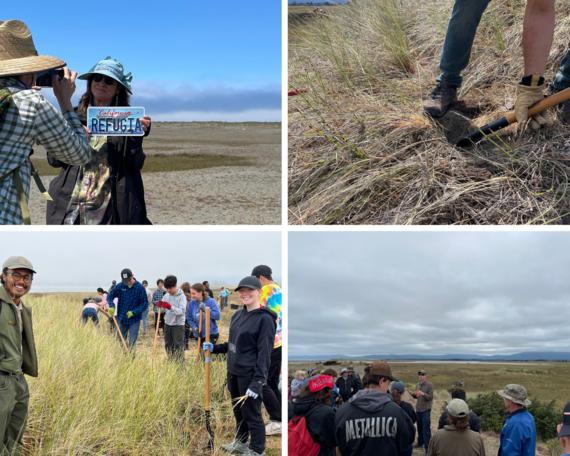 Top left: TDS Director Sandra Jerabek posing with a whale tail license plate. Top right: Hardworking volunteers removing European beachgrass. Bottom right: TDS staff member Jacob Bear instructing volunteer groups. Photos by Kyle Buchanan, North Coast Redwoods District. Bottom left: State Park Interpreter Kyle Buchanan working alongside Sierra Service volunteers. Photo by Elizabeth McKisson, North Coast Redwoods District.
San Diego Coast District Hosts Maintenance Training
Story and photos from Jodi R. Whelchel, San Diego Coast District
 Participants in San Diego Coast District's recent maintenance training installed French drains at the North Sector Office to protect adobe walls and prevent erosion.
In May 2023, San Diego Coast District (SDCD) hosted a training through the Mott Training Section, which repaired and reconstructed roughly over 4,500 square feet of adobe wall at the district’s North Sector Office (NSO), returning it to its former glory with fresh mud plaster and lime paint. Students from throughout the state participated in the training.
In August 2024, SDCD hosted a second training, also through the Mott Training Section. This time, the training was limited to SDCD employees, in addition to two employees from Orange Coast District and three trainers from outside State Parks. The training was called NSO Adobe Wall Phase 11 – French Drain and Drought Resistant/Maintenance Friendly Landscaping.
The main goal of the training was to install a French drain on both the interior and exterior of the adobe walls to keep rainwater from settling at the base of the adobe wall and creating basal erosion. A second goal was to leave the courtyard landscape maintenance friendly. We hit a few obstacles along the way but, in true State Parks fashion, we figured out how to pivot and keep on working.
The class was a great success. Not only did we accomplish the original scope of work, but we were also able to make repairs to areas of the adobe wall that were damaged during the aftermath of Hurricane Hilary in August 2023.
If districts have any projects that would be a good fit to turn into a training class, either a large statewide training or a smaller inner-district training, I highly recommend reaching out to Park Maintenance Chief Ricky Roldan, Training Section, at Ricky.Roldan@parks.ca.gov. This is the fourth successful class SDCD has completed by partnering with the Training Section and I look forward to the next. Special thanks to Creston Adams for taking the lead on this project and the NSO staff members for their support!
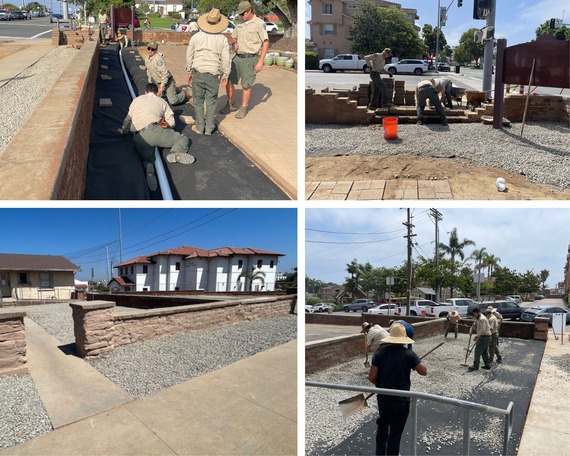 Clockwise from top left: students from two districts install a French drain during the maintenance training project at SDCD's North Sector Office. Students rebuild the adobe wall and spread gravel over the newly installed drain. The completed project protects the adobe wall from rainwater and maintains drought-resistant landscaping.
State Historical Resources Commission, Office of Historic Preservation Staff Tour Sacramento Shops
Story and photos from William Burg, Office of Historic Preservation
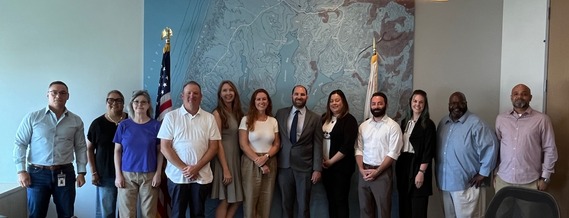
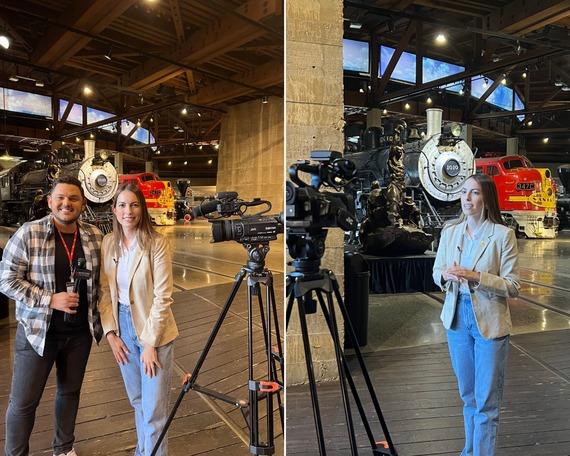
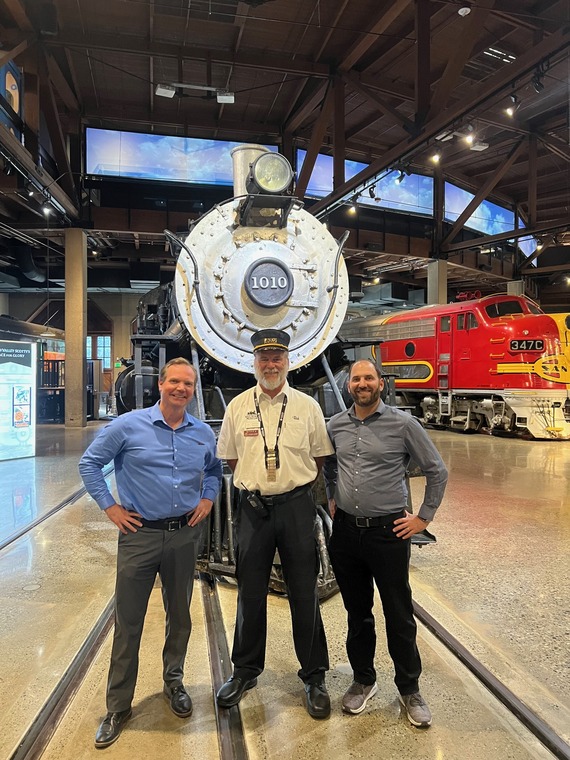
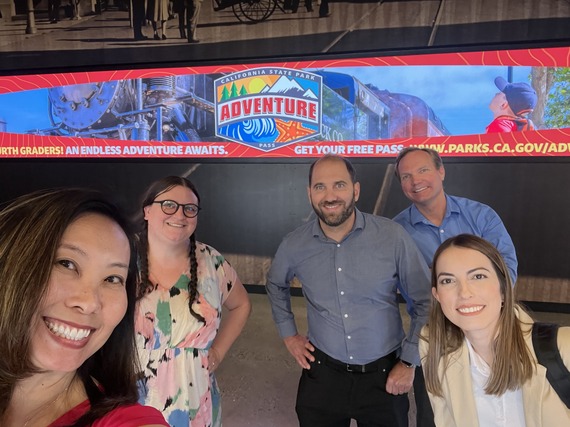
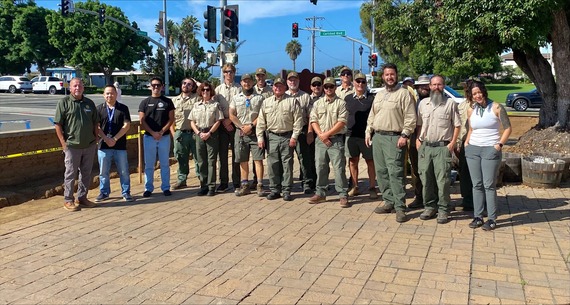
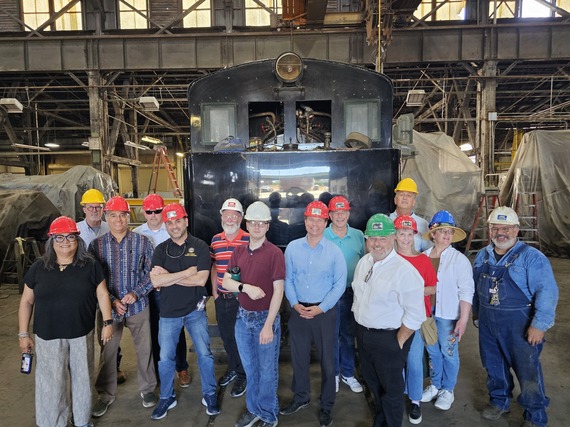 State Historical Resources Commissioners, State Parks staff from the Office of Historic Preservation, California State Railroad Museum staff and volunteers, and Capital District staff strike a pose in the historic Sacramento Shops, now listed in the National Register of Historic Places.
On August 1, members of the State Historical Resources Commission and staff from the Office of Historic Preservation toured two of the historic Sacramento Shops buildings, listed in the National Register of Historic Places earlier this year. Both buildings are used by the California State Railroad Museum (CSRM) to store many locomotives and cars that are part of the museum’s collection, carry out restoration and repairs of that equipment, and house an extensive collection of tools and equipment used by museum staff and docent volunteers to maintain the Sacramento Southern Railroad, its motive power, and rolling stock. Commissioners and staff were guided by Museum Director Ty Smith, Capital District Superintendent John Fraser, and museum volunteers. While the Sacramento Shops buildings appear vacant and dilapidated on the outside, they have been in active use by the museum for decades and are expected to be rehabilitated and repaired as part of an expanded museum in the near future.
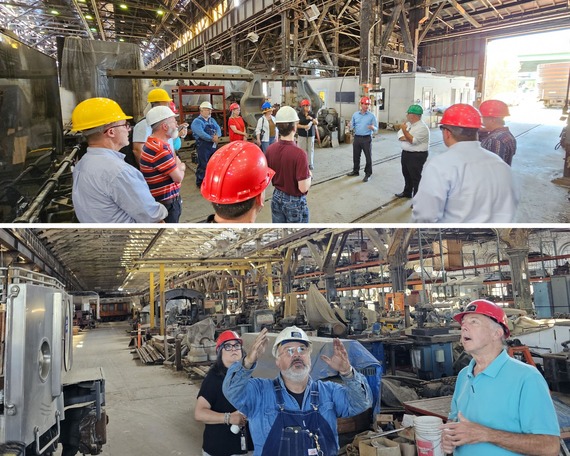 Top: Capital District Superintendent John Fraser and CSRM Director Ty Smith talk about the future of the historic Sacramento Shops. Bottom: Restoration and Maintenance Lead Worker Al Di Paolo (center) provides information to State Historic Preservation Officer Julianne Polanco and State Historical Resources Commissioner Alan Hess.
Capital District Workshop Builds Skills to Enhance Collections Care
Story and photos from Melanie Tran, Capital District
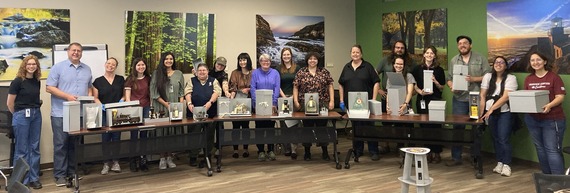 The Capital District Cultural Resources team (left to right) Tyler Gibson, Chris Rockwell, Emily Mizomaki, Madisyn Swengel, Jazmin Deol, Maria Baggett, Theresa LaRose, Ursula Hebert, Claire Phillips, Gretchen Underwood, Léo Rivera, Marion Millin, Nathan Wentz, Bethann Watson, Sienna Weldon, Robert Hennecke, Miranda Bello, and Alison Blecman display the custom collections object boxes they made during the workshop.
Developing hand skills is important when you are responsible for the care and livelihood of museum, library, and archive collections. Recently, collections managers, assistants, interns, and fellows who make up the Capital District Cultural Resources team met for a hands-on skill building workshop.
The workshop was led by museum curators Melanie Tran, Vanessa Cantú, and Taylor Moore. Nineteen team members built an archival custom box enclosure to house an object from the California State Railroad Museum (CSRM) collection.
Topics discussed during the workshop included how to measure, lay out a plan, use scoring and cutting tools, types of boxes, and assembling a box. Custom box enclosures ensure safe storage, transport, and access to collections materials. The skills learned at this workshop will benefit the care of collections across Capital District units like the CSRM, California State Capitol Museum, California Indian Heritage Center, Leland Stanford Mansion State Historic Park (SHP), and Sutter’s Fort SHP.
California State Railroad Museum Curators ‘Left No Surface Untouched’ While Cleaning Historic Sleeper Car
Story from: Ileana Maestas and Vanessa Cantù, Capital District
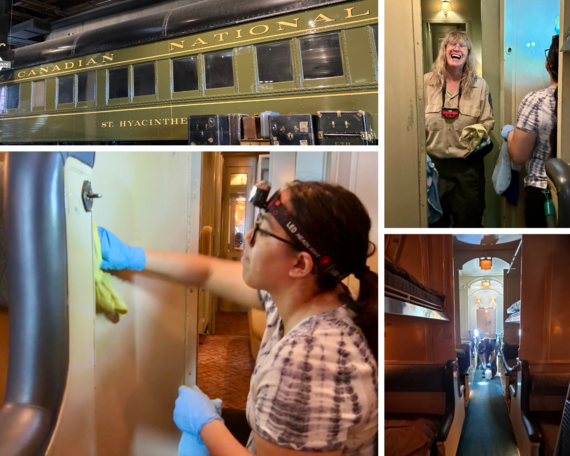 Clockwise from top left: The exterior of the historic Canadian National Railways Sleeping Car St. Hyacinthe. Museum Custodian Sheila Aldrich and Park Interpretive Specialist Miranda Bello share a laugh. The St. Hyacinthe's interior. Park Interpretive Specialist Miranda Bello polishes off fingerprints and grime. Photos from Vanessa Cantù, Capital District.
Curatorial staff at the California State Railroad Museum (CSRM) cleaned the interior of the Canadian National Railways Sleeping Car No. 1683 St. Hyacinthe over two days in July. St. Hyacinthe is a typical sleeper car built to a standard Pullman design with ten open sections, one drawing room, and one compartment. Built in 1929 and retired in 1971, the St. Hyacinthe is one of the more popular exhibits at the CSRM because visitors can walk through it as it simulates a railroad car in motion.
Regular access to the St. Hyacinthe takes a toll on every surface. The sleeping car’s interior walls had surface grime in specific areas where visitors placed their hands to maintain balance as the car rocked. The linoleum and carpet flooring were dirty because of the oil and dirt from the bottom of visitors’ shoes. Soft surfaces, such as the upholstery on the bench seats were also stained and soiled from people sitting on them. Although the St. Hyacinthe receives weekly attention through vacuuming and dusting, staff was noticing more and consistent wear and tear as foot traffic increased this past year. This flux in traffic with close monitoring allotted curators and museum custodians the opportunity to reassess standards of care and provide a basis for maintaining the sleeping car moving forward.
No surface was left untouched. We cleaned, sanitized and treated every surface with preservation in mind. So, no caustic, abrasive, harmful solvents or chemicals were used.
Curators and museum custodians are tasked with documenting the life of each object to help determine the rate of deterioration. Taking factors such as environment, pests and access into account can help them better plan for its preservation. The CSRM is filled with accessible railroad cars and engines that are essentially museum objects; each piece of rolling stock on display has a museum accession number, object file and standard of care. This project provided more insight into maintaining and preserving some of the larger objects in California State Parks’ museum collections.
  Email photos to the WeeklyDigest@parks.ca.gov.
|