|
Cannabis Watershed Protection Program Continues to Clean Up Illegal Grow Sites Across the State
Story from: Doug Johnson, Law Enforcement and Emergency Services Division
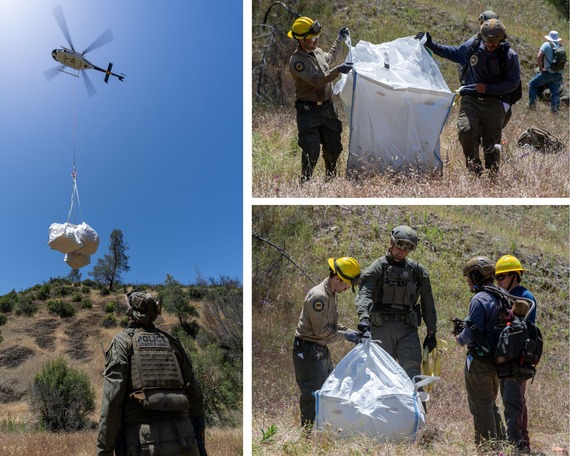 Left: A helicopter lifts super sacks filled with waste from former grow site at Henry W. Coe State Park (SP). Right: Cannabis Watershed Protection Program staff load waste into super sacks to be airlifted out of Henry W. Coe SP. Photos from Brian Baer, Communications and Marketing Division.
State Parks’ Cannabis Watershed Protection Program (CWPP) has been busy continuing its critical mission of cleaning up illegal cannabis grow sites across California. This past spring the program focused on remediation efforts at four park units, removing dangerous pesticides, trash, and fertilizer.
Staff remediated sites at Malibu Creek State Park (SP), Topanga SP, Cuyamaca Rancho SP, and Henry W. Coe SP. Over 6,000 pounds of waste were removed across all four park units.
“They had kitchen gardens out here, they had multiple campsites. They had huge pits in the ground where they were storing fertilizers and pesticides, things like carbofuran, a pesticide so awful it’s banned in the United States,” State Park Peace Officer Supervisor Alex Tabone, who is a part of CWPP’s Special Enforcement Team (SET), said of the Henry W. Coe SP site. He and other SET members initially raided that site in 2020. “On day one, the priority is getting rid of the plants, getting rid of all the contraband, getting rid of all the firearms, and getting [out] all the hazardous materials.”
While most of the hazmat materials were removed in 2020, the rest of the waste remained due to the remote locations and rugged terrain surrounding the sites. But this spring, the remaining waste was airlifted out with assistance from a helicopter.
“These are just so far back, that it’s really hard to bag up and hike out the waste,” said CWPP Safety Engineer Nate Tucker.
“This has been over a four-year process, this whole remediation,” said CWPP Environmental Scientist Brandon Nguyen, who works in the Diablo Range District. "This is the culmination of everyone’s hard work, which brings us a great feeling of accomplishment.”
Nguyen says these cleanup efforts create a safer environment for both wildlife and park visitors, because they prevent further contamination of the watershed and improve habitat. These efforts were made possible by the creation of the CWPP in 2019 with Cannabis Tax Fund support through the passage of Proposition 64 (the legalization of recreational cannabis in California).
“Prop 64 came about, with it came funding and the opportunity to start doing remediation and restoration projects,” said Diablo Range District Environmental Scientist Nicolas Somilleda. Before, these grow sites "were pretty much just pinpoints on a paper map on a wall. So, when the funding came through, the work could finally start.”
Statewide, the CWPP has documented over 400 illicit grow sites on State Parks property. To date, the program has fully remediated 84 former cannabis grow sites. This has resulted in the removal of more than 29,000 pounds of waste, 32,500 cannabis plants, 360 pounds of fertilizer, 200 hazardous waste items, and more than 6 miles of irrigation tubing. But the work is far from over.
“The next step [here at Henry W. Coe SP] is restoration, which I’m really looking forward to,” said Nguyen. “To restore the environment back to how it was before, or even better. That’s our next mission.”
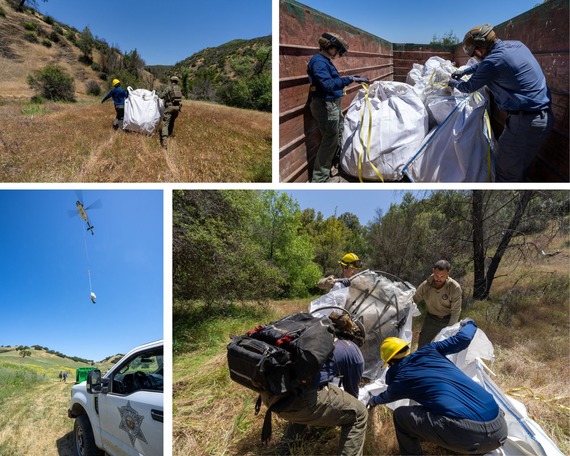 Top left: CWPP staff move a super sack into position to be airlifted out. Top right: CWPP staff secure super sacks in a dumpster. Bottom left: A helicopter lifts super sacks filled with waste to area more accessible by road. Bottom right: CWPP staff load waste into super sacks to be airlifted out of Henry W. Coe SP. Photos from Brian Baer, Communications and Marketing Division.
Angeles District Shares Heat Safety Tips
Story and photos from: Cassandra Chavez, Angeles District
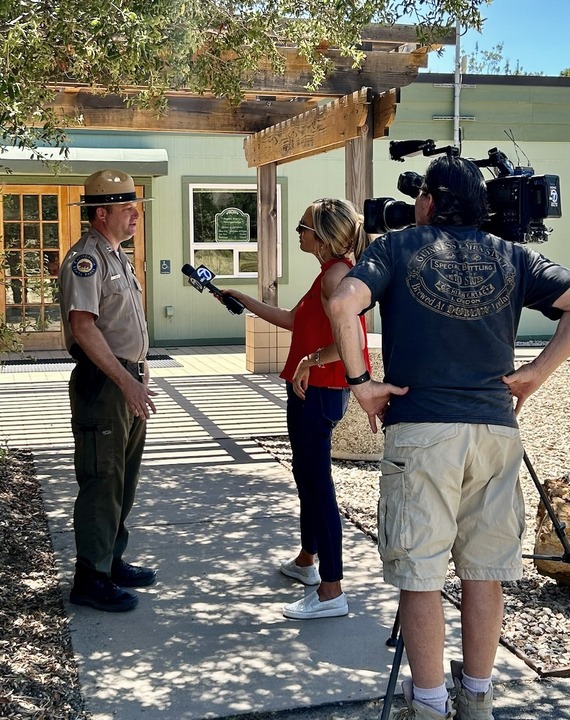 State Park Superintendent II Jeffrey Langley participates in an interview with ABC7 reporter Shayla Girardin and Shawn McCarthy regarding heat safety at Malibu Creek State Park.
A scorching heat wave gripped most of California Fourth of July week, bringing unprecedented temperatures of up to 110 degrees Fahrenheit. Media outlets have ramped up heat wave coverage to ensure public safety. A reporter from ABC7 Los Angeles, one of the leading news channels in California, visited Malibu Creek State Park (SP) on July 3 and interviewed State Park Superintendent II Jeffrey Langley, who shared different ways to enjoy the outdoors safely during the heat wave.
Langley advised adventurers to start outdoor activities early in the morning to avoid peak temperatures that usually occur between noon and 2:30 p.m. Langley also stressed the importance of staying hydrated by bringing enough water, never going out alone, and exercising sun protection by using sunscreen, wearing a hat, and taking breaks in shaded areas as needed. Langley also recommended to check the fire status and ask a ranger or park host on site for current conditions before heading out to a campsite.
The Fourth of July weekend is usually the busiest for parks like Malibu Creek SP, and with the intense heat, park staff are aware and prepared to continue the conversation about heat-warning safety and prevention of any heat-related emergencies.
State Parks makes it a priority to inform the public about proactive measures outdoor enthusiasts can take to prepare for the hotter weather. For more information about heat preparedness, read Governor Newsom’s California prepares for dangerous heatwave ahead of Fourth of July news release and visit the California State Parks website for weather updates.
New Surfwatch Vessel Gets a Smashing Welcome into Orange Coast's Rescue Fleet
Story and photos from: Michelle Figueroa, Orange Coast District
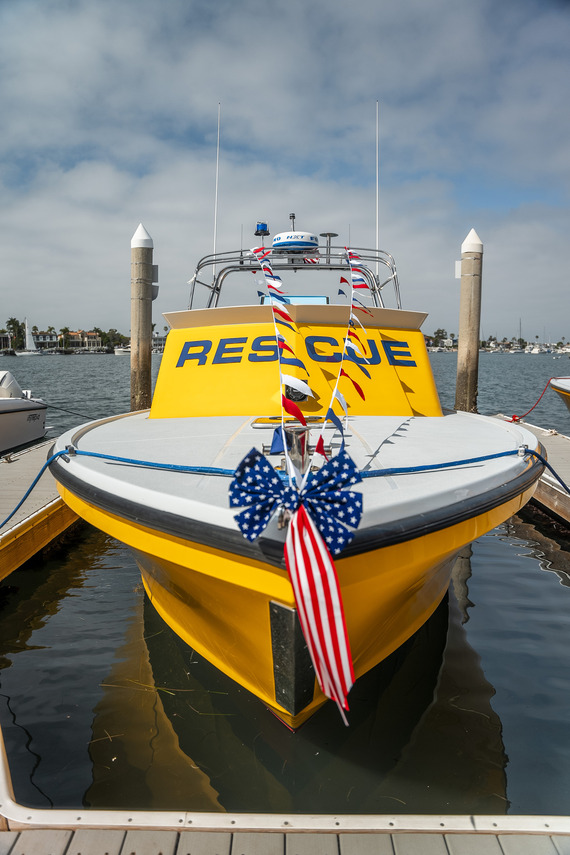 Meet the new Surfwatch IV, decorated in red, white, and blue.
Orange Coast District celebrated a momentous day on Friday, June 28, as the new Surfwatch IV vessel was christened and welcomed to the Surfwatch Rescue fleet near Corona del Mar State Beach. The new Surfwatch IV will replace a vessel that served the department since 1986. Surfwatch IV is one of four new boats that will eventually replace the entirety of the district's Surfwatch fleet.
The Surfwatch fleet is an indispensable tool used by state park lifeguards and peace officers to perform thousands of aquatic rescues every year. Equipped with the latest, cutting-edge technology, these vessels can help staff make quicker, extensive, and more efficient rescues. With millions of people from around the world visiting Orange County state beaches every summer, the Lifeguard program’s priority is maintaining public safety, and these vessels are crucial in achieving that goal.
During the event, guests were greeted by a touching speech from State Parks Director Armando Quintero and a toast from Chief Deputy Director Liz McGuirk before smashing a sugar glass bottle of champagne against the bow of the new vessel to symbolize its christening. The tradition of christening a new boat dates back centuries and is believed to bring forth good luck before it sets off on its maiden voyage, or first journey.
Thanks to the high spirits of all staff members and partners that attended, the new Surfwatch IV is sure to expect safe travels for years to come. Special thanks to our partners at PRJKT Restaurant Group for providing food and beverages for this event and to the Crystal Cove Conservancy for assisting with decoration.
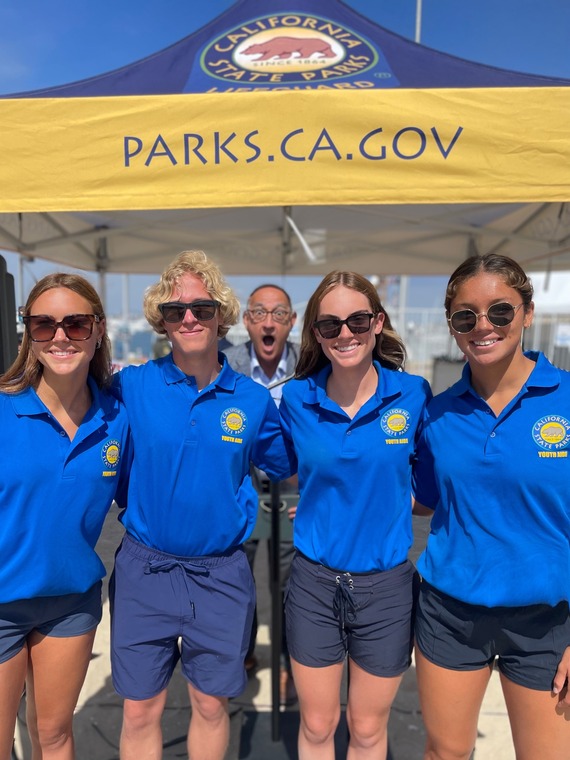 State Parks Director Armando Quintero "photobombs" a group photo of Junior Lifeguard Youth Aides (left to right) Grace Walker, Keegan Sanford, Teagan Shandrew-Pearsall, and Katherine O’Dea after a successful Surfwatch christening event.
Students Research Wildfire Impacts at Hungry Valley State Vehicular Recreation Area
Story and photos from: Luis De Vera, Great Basin District
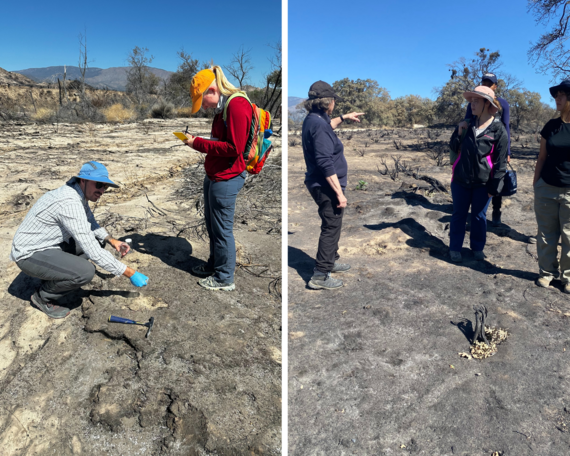 Left: California State University, Northridge (CSUN) geology students Taylor Trevino and Alex Sasich. Right: Geography professor Dr. Amalie Orme (left) with CSUN students.
Hungry Valley State Vehicular Recreation Area (SVRA) welcomed California State University, Northridge (CSUN) geology students and geography and environmental studies professor Dr. Amalie Orme to conduct research on wildfire impacts at the park from the Post Fire that burned approximately 10,000 acres of state land this past June.
Geology students Taylor Trevino and Alex Sasich collected soil ash samples to analyze any polycyclic aromatic hydrocarbons, which are carcinogenic compounds in the soil, to determine the soil quality in the riparian habitat. Dr. Orme directed students to identify areas that may have oil seepage in the soil so that students can analyze the soil profile of different areas of the park that may have high concentrations of mercury, lead, and heavy metals from the fire.
Hungry Valley SVRA is slowly recovering from the fire but with the collaboration from CSUN students and professors, we can proceed with understanding the impacts of wildfires. One student from the Department of Biological Sciences will be starting a small project to learn about the post-recovery succession of the oak trees that were also impacted by the fire and how they can recover over time. Another student will be utilizing remote sensing and Geographic Information System techniques to analyze the burn severity and mapping the vegetation and trees that were affected by the fire.
Hungry Valley SVRA is grateful for all the students and professors in supporting us throughout these trying times, and it’s with the collaboration of local universities that uplift our spirits here.
State Parks Joins the Resource Conservation District of the Santa Monica Mountains in the Search for Steelhead
Story from: R.J. Van Sant, Angeles District
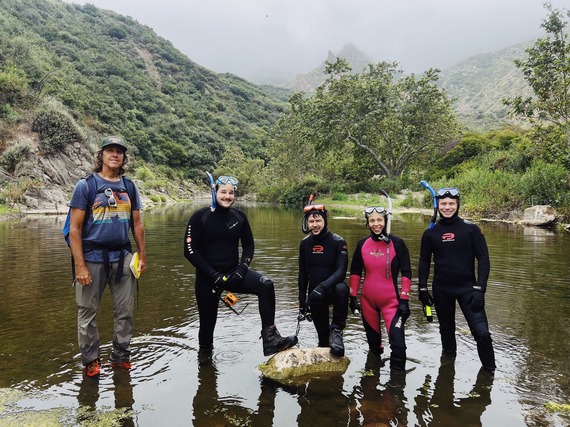 The Stream Team Crew, including members from State Parks and the Resource Conservation District (RCD) of the Santa Monic Mountains. From left to right: Steve Williams (RCD), Luke Benson (RCD), Bernard Yin, Rebecca Ramirez, and R.J. Van Sant (State Parks). Photo from the RCD Stream Team Crew.
Southern California steelhead (Oncorhynchus mykiss) used to be abundant throughout Southern California, but their numbers have dwindled precipitously over the past 50 years due to urbanization, water diversions, construction of dams and roads, and invasive species. They are only found in a few historic watersheds, including several within state parks.
Fortunately, restoration projects are occurring throughout the state to improve habitat and access to high water quality streams. One such restoration project is the Malibu Creek Ecosystem Restoration Project (MCERP), which includes the removal of the 100-foot tall Rindge Dam on Malibu Creek and remediation of seven to eight barriers upstream of the dam. The restoration project, located in Malibu Creek State Park and led by the Angeles District, will open 15 miles of stream habitat for steelhead and other species that have been blocked for 100 years. Part of the restoration process involves documenting baseline conditions, including the presence of Southern California steelhead and the quality of their habitat.
The Resource Conservation District (RCD) of the Santa Monica Mountains has been conducting steelhead snorkel surveys in Malibu Creek for nearly 20 years, and as part of the MCERP, continues to do so. MCERP Project Manager and Senior Environmental Scientist R.J. Van Sant joined the RCD crew for two days of snorkel surveys along Malibu Creek in the middle of June. The crew spent the first day snorkeling upstream of Malibu Lagoon, which was restored by the Angeles District and partners in 2012, and the second day snorkeling to the base of the dam and upstream of it. In addition to searching for steelhead, important stream data, such as stream pool depth, shelter value, and instream cover was also collected.
Unfortunately, no steelhead were observed during the surveys, but the southwestern pond turtle (Actinemys pallida) and arroyo chub (gila orcuttii) were documented. The hope is that steelhead will return once again and thrive in their newly restored habitat.
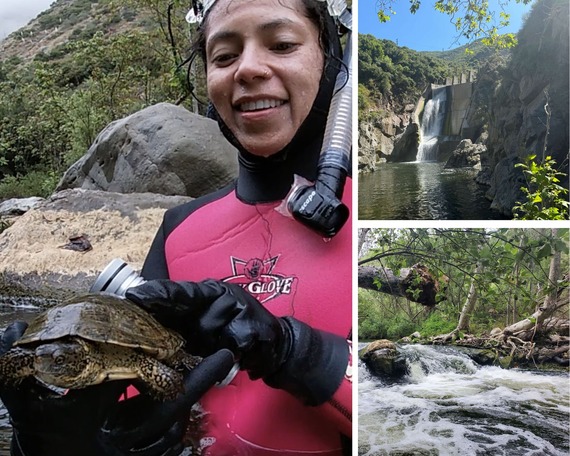 Left: State Parks' Rebecca Ramirez holds a southwestern pond turtle. Top right: View of Rindge Dam from Malibu Creek. Bottom right: A stream riffle and pool, a great place for fish to hide. Photos from the RCD Stream Team Crew.
*Editor's note: The diver in the photo holding the southwestern pond turtle is a qualified State Parks employee wearing gloves. Visitors or nonqualified park employees should never touch or handle wildlife in a park.
Sonoma-Mendocino Coast District Participates in Coast Police Activities League Fishing Clinic
Story and photos from: Brandon Burson, Sonoma-Mendocino Coast District
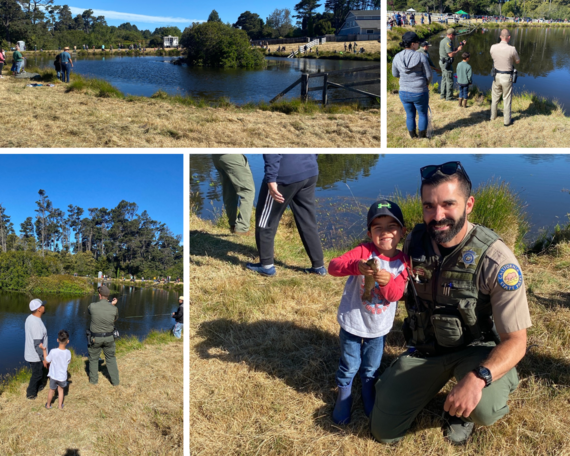 Clockwise from top left: The fishing clinic took place at Moura Pond. A California Department of Fish and Wildlife (CDFW) game warden and a California Highway Patrol Officer assist a family with trying to get their child on his first fish of the day. State Park Peace Officer (Ranger) Brandon Burson with Leo, who just caught his first trout. A CDFW game warden shows a young child how to cast.
The Coastal Police Activities League (PAL) hosted its annual fishing clinic at Moura Pond, a local privately owned family pond in Fort Bragg on Saturday, June 29. The fishing clinic has been running for nearly 15 years and is a great success each year. The clinic offers an opportunity for many local children to experience fishing for the first time and catch their first fish in a stocked pond, allowing them to gain confidence and interest in fishing. The event is part of community policing efforts and allows children to interact with law enforcement and other local first responders while recreating outdoors.
Members of the California Department of Fish and Wildlife, State Parks, Fort Bragg Police Department, Mendocino County Sheriff Department, CAL FIRE, U.S. Coast Guard, California Highway Patrol, and other local first responders attended the event. Officers and other first responders assisted the participants with different skills, such as tying knots, learning to cast, and unhooking their catch. All fishing poles and gear were provided free of charge at the event by PAL. Children were also given vouchers for a free hot dog, drink, and snacks. The family that owns the pond takes pride in hosting the event annually and plans to continue to do so for many more years.
Dirt Diggers North Motorcycle Club and State Parks Host 55th Annual Hangtown Motocross Classic at Prairie City State Vehicular Recreation Area
Story from: Parker Getz and Joleen Ossello, Gold Fields District
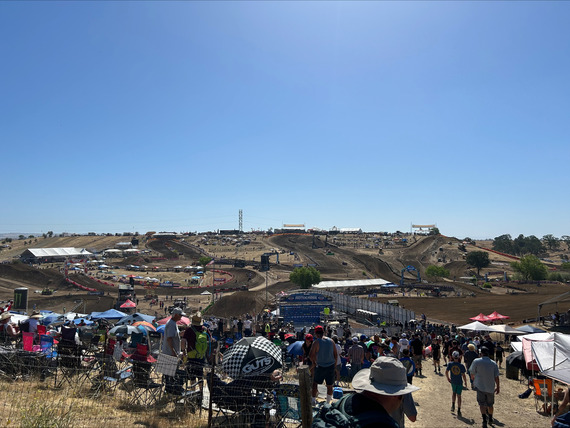 Crowds at the 55th annual Hangtown Motocross Classic national race at Prairie City State Vehicular Recreation Area. Photo from Taylor Espenshade, Gold Fields District.
The pressure is off and the 55th annual Hangtown Motocross Classic national race came to a fulfilling close at Prairie City State Vehicular Recreation Area (SVRA) on Sunday, June 1. The Dirt Diggers North Motorcycle Club, in collaboration with State Parks and many other agencies and organizations, made significant changes to the motocross track, created a lot of excitement, and made for some fantastic racing!
State Parks staff set up their booth along West Vendor Row, presenting new visuals in nature, crafts, and recreation. A new mount lent to us by Auburn State Recreation Area, widened the smiles of every kid that stopped by, despite its name, “Bummer Bear.” This year’s Hangtown Motocross Classic and Prairie City SVRA logo graphics gave visitors the chance to create their own State Parks and motocross (MX) memorabilia in the form of a button, keychain, or magnet. The booth proved fun for the whole family. Whether interested in brown bear natural history, crafting, vintage cycles, or RC Crawlers, everyone took home a memory of Prairie City SVRA at this thrilling event.
This year’s remote-controlled crawler course, built by volunteer Tyler Woodhull for his Eagle Scout project with Troop 380, had kids dragging their parents from all over the park to check out the new obstacles designed and built for the park. Among various obstacles, the course included a bridge, teeter totter, and rock crawling pyramid designed to allow kids to practice precise 4x4 skills while learning how to tread lightly among nature and other recreationists.
This year’s surprise off-highway vehicle (OHV) gem was a beautifully preserved 1970 Yamaha CT1 Enduro 175 motorcycle, a super clean classic lent to us by Park Maintenance Worker I Edward Santin. Stories abounded as elder riders walked by, slowly stopped, and spontaneously lamented their own riding history on that same model. The highlight from staff was witnessing Jessie Campion’s face when she realized she had won an OHV Vehicle Day Use Annual Pass, which was graciously donated by California Outdoor Recreation Foundation. The free raffle spanned from Friday to Saturday and was a big hit; not only did it give attention to OHV Annual Passes, but it also built up excitement and created followers online, as the winner was announced live on social media.
New and noteworthy to this year’s event was a jam-packed museum of historical Hangtown memorabilia showcasing the competition’s origins and evolution through photos of past winners, video, and event posters dating back to 1969. Included were action shots of Bobby Grossi, a legend of American motocross racing during the golden years of motocross (1970-1980) who won the 250cc class during the 1st Hangtown Motocross Classic.
A huge thank you to all the State Parks staff at Gold Fields District and OHMVR Division who came out to help the Prairie City Sector. You too, made this year an exciting, educational, and inspiring success. For race highlights, click here; it’s a worthy watch!
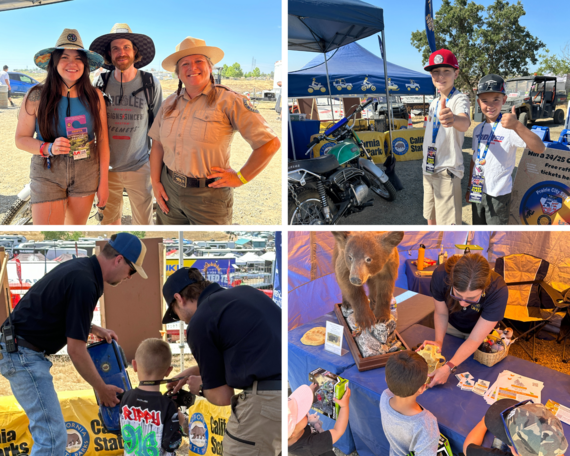 Clockwise from top left: OHV Vehicle Day Use Annual Pass winner Jessie Campion and her partner Justin Means with State Park Interpreter I Joleen Ossello. Photo from Taylor Espenshade. Young visitors and MX enthusiasts Chase Pilan and Jakob Hamilton. Environmental Scientist McKenzie Boring with young visitors and Bummer Bear. Prairie City Sector Manager Peter Jones and Senior Park Aide Parker Getz help a young child with Tread Lightly principles to complete the remote-controlled crawler course. Photos from Joleen Ossello.
Angel Island State Park Offers Diverse Habitats for Bird-Watching
Story from: Helen J. Doyle, Santa Cruz District, and Evan Weissman, Bay Area District
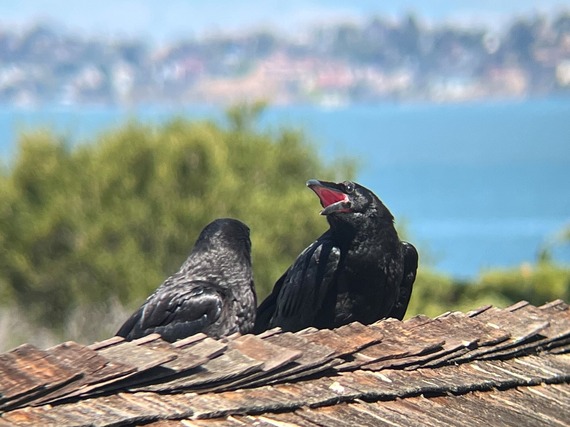 A juvenile common raven begs from its parent atop the historic U.S. Immigration Station detention barracks. Photo from Evan Weissman, Bay Area District.
Angel Island State Park (SP) is a unique and wonderful place for bird-watching. Angel Island has many distinct habitats for its avian life, packed into one square mile: oak woodland, coastal scrub/chaparral, Monterey pine and introduced eucalyptus, a small redwood grove, shoreline, and of course the surrounding bay waters and sky above. For both new and experienced birders, the island offers the chance to see a diversity of birds on easy walks through varied habitats—and don’t forget to bird from the ferry!
While none of these habitats are unique to the island, the type and number of birds differs from what you might see elsewhere. For example, the oaks appear to support more acorn woodpecker families than a similarly sized woodland would elsewhere, perhaps because the birds are not competing with squirrels, who don’t live on Angel Island. There are also spotted towhees, lots of pygmy nuthatches, and a single spotted sandpiper that is often seen near the docks doing its characteristic butt-pump.
Early summer is a great time to look for the fledged young of many species. Though typically as large as adults, these young birds can often be seen awkwardly exploring their surroundings and begging for food from their parents.
Whatever the season, birding on Angel Island offers many delights: the ferry ride, San Francisco’s skyline framed by nature, the close proximity of diverse habitats, and the many birds they support. Find more information about birding at Angel Island SP on the Golden Gate Bird Alliance blog.
Third Graders End Year at Sugarloaf Ridge State Park With Some Slithering Friends
Story and photo from: Dave Duplantier, Bay Area District
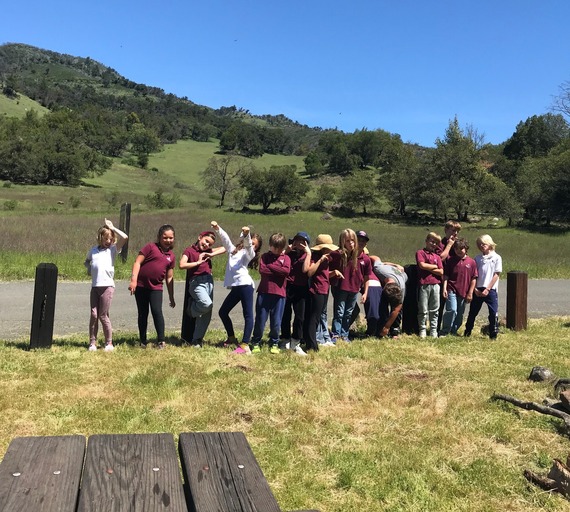 Presentation School third graders celebrating completion of their hike.
Third graders from Sonoma’s Presentation School completed the school term with an outing at Sugarloaf Ridge State Park (SP). The students were guided up the Quest Trail enjoying the beauty of the park that still had a bit of green remaining from an above average rain season.
On the hike, I had just got talking about the snakes that inhabit the area, when a student called out “Ranger Dave I think I just saw a rattlesnake!” Yes, it was indeed a juvenile Northern Pacific rattler making its way near the trail and into the tall grasses as the group remained at a safe distance away from our slithering friend. This was the first of two other snake sightings—a gopher snake and an adult rattlesnake were the others—on the hike, making for a memorable day for the kids.
After completing the hike, students enjoyed a well-deserved lunch in the picnic area and debrief, sharing their experiences of what they observed. We talked extensively about the snakes and what vital role they play in nature, as well has how to be safe with these and other wildlife living in the park and all around us.
After lunch, the group took a short walk down the visitor center to look at the animal exhibits and nature information. To complete their adventure and end-of-school-year celebration, each student was treated to an ice cream of their choice provided by Team Sugarloaf, the cooperating association that operates the park on behalf of State Parks, along with a Sugarloaf Ridge SP Quest Trail booklet to remind them of their day in nature and some adventure as well.
Living and Learning the Gold Rush with ‘By The Great Horn Spoon’ at William B. Ide Adobe State Historic Park
Story from: Veronica Lamoureaux and Heather Lee, Northern Buttes District
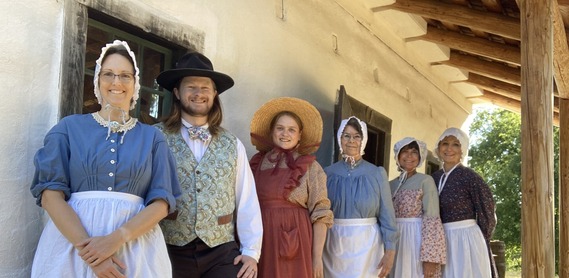 From left to right: Interpreter I Heather Lee, Senior Park Aide Wyatt Hein, Senior Park Aide, Veronica Lamoureaux, volunteers Pat Brown, Brenda Nelson, and Noel Hillestad. (Not pictured: Alison Calkins.) Photo from Heather Lee, Northern Buttes District.
Seventy students from the Tehama County Department of Education’s Safe Education and Recreation for Rural Families (SERRF) program in Red Bluff visited William B. Ide Adobe State Historic Park at the end of June to learn early settler skills as a part of the blended access Summer Learning Program. Our park’s connection to Gold Rush history made it perfect for their field trip, since the book they are reading this summer is "By the Great Horn Spoon” by Sid Fleischman.
Students were introduced to Gold Rush history and concepts with a virtual tour the week before their on-site visit. Here they learned about the diverse populations who migrated to California, and how they got here. Once on-site, students learned how to sew poke bags—where miners would have kept their coins—using the running stitch. They received a tour of the adobe house where they imagined how an entire family would have lived in a one-room home, how much work it was to haul water using a heavy wooden yoke, and to cook using Dutch ovens over a fireplace.
They stomped in the mud and learned the traditional art of making adobe bricks. They also toured the heritage garden, learning the settlers' gardening techniques and what varieties they planted. Last but not least, students cooled down in the water as they learned to wash clothes in a washtub with a washboard in the 1850s style. After hanging clothes on the line, students were to set to work with folding. After their labors, students were rewarded with a few quick games that helped to solidify key learning objects and then enjoyed a lovely lunch in the shady picnic area
The program was delivered by seasonal and permanent staff, with assistance from a team of long-term volunteers. Chaperones and SERRF program facilitators pitched in to help when stitches inevitably went awry, adobe mud clung to feet, or children lingered too long in the washtub. We would not have been able to do these without our wonderful helpers. Thank you!
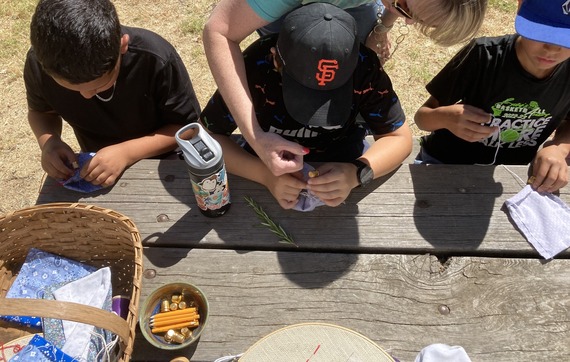 Summer SERRF program students sew poke bags with help from their program leader. Photo from Heather Lee, Northern Buttes District.
Bay Area District Hosts All-Hands Staff Meeting and Asks: What’s the Vision?
Story from: Peter Ostroskie, Bay Area District
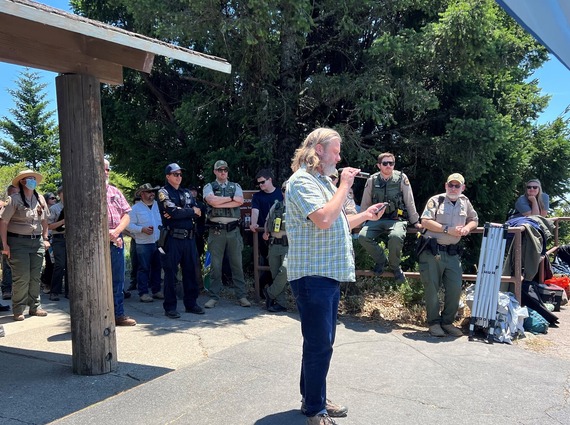 Cultural Resources Manager Noah Stewart addresses Bay Area District staff at a recent all-hands meeting at Mount Tamalpais State Park. Photo from Bay Area District.
Once a year, the Bay Area District gathers its staff for a highly anticipated all-hands staff meeting. This event provides a unique opportunity for team members to connect, share updates, and present their visions for the district's future. This year’s meeting was especially memorable, hosted at Mount Tamalpais’ scenic East Peak summit at Mount Tamalpais State Park.
In the weeks leading up to the meeting, core management teams were busy at work. Under the guidance of the district superintendent, teams developed vision statements for their respective areas. These statements aimed to reflect core values and align with State Parks' overarching mission.
Meeting day kicked off with a collaborative effort to coordinate food, led by Chief Ranger Vince Anibale and orchestrated by Supervising State Park Peace Officer Josh Heitzman and me. An impressive taco bar was prepared, with staff members contributing side dishes, beverages, and desserts based on the first letter of their last names. To add a dash of fun, a friendly competition was held to determine the best contributions in each category. Adding to the excitement, attendees participated in a photo scavenger hunt around the peak. The hunt included tasks such as:
- Taking a "mountain climber" pose photo with a bronze land marker
- Snapping a goofy picture with park colleagues at the overlook
- Taking a black-and-white model photo of a Sierra District staff member
- Displaying exhaustion on a trail
- Sneaking a selfie with the district superintendent unnoticed
- Posing with sad faces at a tire repair station
After reviewing the creative and hilarious entries, the San Francisco Sector/Angel Island Maintenance Team was announced as the overall winner.
Post-lunch, the core managers presented their vision statements, each delivering a unique perspective. Each vision statement sparked discussions on actionable steps and collaborative efforts needed to achieve these goals. By the end of the presentations, staff members felt invigorated and eager to support each other in turning these visions into reality. The Bay Area District is well on its way to an exciting and impactful future, thanks to the shared dedication and enthusiasm of its teams.
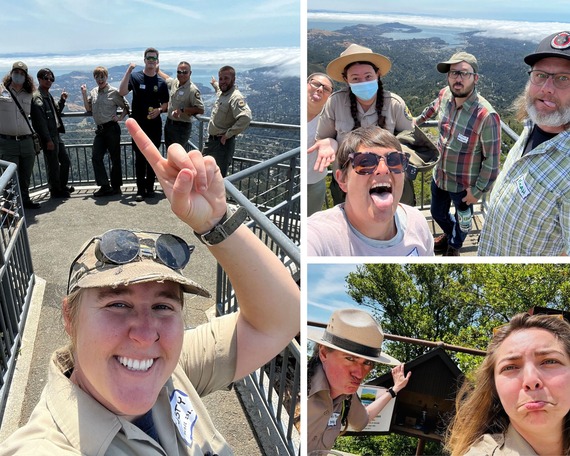 Left: Angel Island Maintenance Crew members strike a pose at a Mount Tamalpais overlook. Top right: Cultural resources staff also at an overlook. Back row (left to right): Interpreter III Christen Bechert, Interpreter II Casey Dexter-Lee, and Associate State Archaeologist Robert Watson. Front row (left to right): Associate State Archaeologist Kate Green and Cultural Resources Manager Noah Stewart. Bottom right: Interpreters Hillary Colyer and Kourtney Boone put on their best sad faces. Photos from: Bay Area District.
Working Hand-in-Hand in the Monterey District
Story and photos from: Carlos Ramos, Monterey District
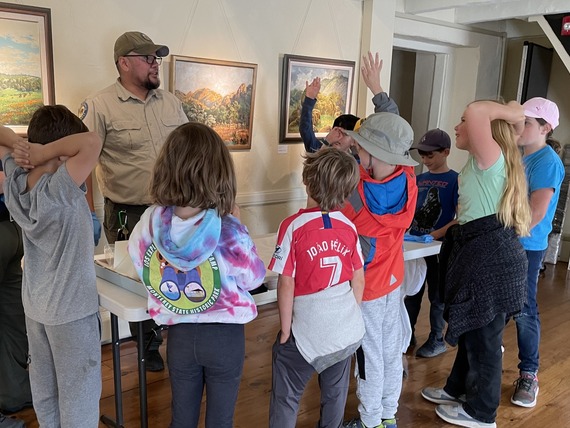 Museum Technician Carlos Ramos shares the importance of protecting museum collections with summer camp kids at Monterey State Historic Park.
On any given day, at any California state park, we as staff are seen by visitors completing our daily tasks in our silver tan shirts and green pants. To the public, our uniforms usually group us under the same umbrella, though we all have different classifications. From maintenance staff to peace officers, we all have our specialties and skillsets which allow us to thrive in our positions.
Despite our diverse skills, our goals are often the same. We are all performing our jobs as part of the larger effort to protect park resources and California’s cultural and natural heritage. Often, we get the opportunity to join other State Parks staff to make great things happen.
The past few summers at Monterey State Historic Park, interpretive staff have joined museum curators to host summer camps for kids. During these camps, museum curators teach children about the importance of museum collections and how to properly care for museum objects that are housed inside state historic buildings.
Campgoers also learn about State Parks careers like museum technicians, curators, and curatorial aides. With camps halfway completed for this summer, the reward so far is seeing young groups of eager stewards take an interest in protecting their state’s history and receiving experiences they can recall for years to come.
It is through a mutual respect for what each State Parks staff classification does that has made camps like these possible. In a large department with so many divisions, it is easy to get tunnel vision and focus solely on our own scope of work, forgetting there are others doing work just as impactful. Taking a step back can help us see the broader picture and come up with ways to collaborate to better serve the public.

Route to Parks Grants Program Now Accepting Applications
Story from: Parks California
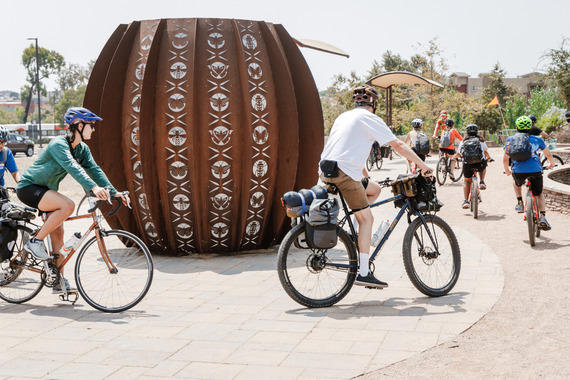 Route to Parks participants biking. Photo from City Heights Community Development Corporation.
Applications are now open for the Route to Parks grant program. Launched in 2020, the grant program was developed in partnership with California State Parks and community input. Route to Parks was designed to help ensure that all communities, including people who have been historically marginalized, have an opportunity to visit and enjoy state parks. We are accepting grant applications until Aug. 28, 2024, at 5 p.m. Visit our Route to Parks Grants Program webpage to learn more and apply.
Want to see what it’s like to go on a Route to Parks trip? We joined our Route to Parks grantee, Ventana Wildlife Society, along with Program Funder Judy de Freitas of PG&E, for one of their Teen Watershed Programs. Click here to see how students in these programs are growing from their connections to nature.
  Email photos to the WeeklyDigest@parks.ca.gov.
|