Office of Historic Preservation Recognizes and Celebrates May as Preservation Month
Story from: Diane Barclay, Office of Historic Preservation
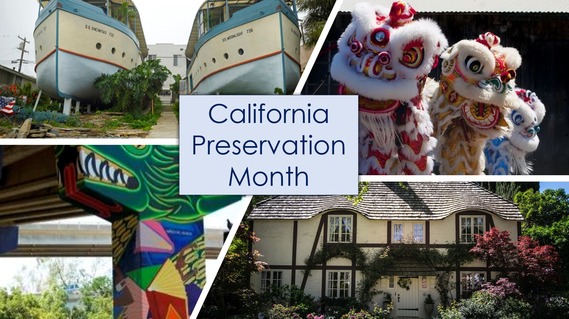 Clockwise from upper left: Encinitas Boat Houses, festival at China Camp State Park, historic home in Sacramento, and artwork of Chicano Park, San Diego. Photos from Office of Historic Preservation.
The month of May provides an opportunity each year to recognize and celebrate the work and mission of historic preservation and the many individuals, organizations, and communities engaged in efforts to preserve our collective California heritage. We invite you to learn more about historic preservation and the National Historic Preservation Act (NHPA) that helped to codify the identification, designation, and protection of historic resources.
The NHPA led to the establishment, among other things, of State Offices of Historic Preservation. Former State Parks Director William Penn Mott, Jr., was appointed as California's first State Historic Preservation Officer (SHPO) in 1967. Since then, there has been a succession of dedicated SHPOs and Office of Historic Preservation (OHP) staff shepherding the care of our state's richly diverse historic, archaeological, and cultural heritage. Learn more about the history and work of California's Office of Historic Preservation on the OHP website.
For a list of some of the local preservation activities taking place around the state, visit the OHP Preservation Month California! page, and consider joining in on the celebration of California’s heritage.
California Boating and Waterways Commission to Meet in Sacramento
Story from: Kevin Murphy, Communications and Marketing Division
 Join the California Boating and Waterways Commission meeting on Thursday, May 9, at 9 a.m. at the Stanford Gallery, located inside the California State Railroad Museum, 111 I Street, in Sacramento. Agenda items for the meeting will include updates on programs related to maritime law enforcement and grants for boating infrastructure for transient recreational boaters, sewage management, and a proposed grant to improve the Miller Park Boat Launch Facility in Sacramento. Information about grant and other programs offered through the Division of Boating and Waterways is available online.
The agenda and additional details are available at parks.ca.gov/PublicNotices. Registration links to join the meeting virtually are also available. For more information about the California Boating and Waterways Commission, visit the Commission webpage. California State Parks supports equal access. Prior to arrival, visitors with disabilities who need assistance should contact (916) 324-4442.
Diablo Range District Hosts State Parks Commissioners During Public Tour of Alameda-Tesla Property and Carnegie State Vehicular Recreation Area
Story and photos from: Kevin Murphy, Communications and Marketing Division
 Alexandra Stehl, deputy director for strategic planning and recreation, welcomes partners, stakeholders, and members of the public to Alameda-Tesla property in Alameda County.
Under a warm spring sun, commissioners from the State Park and Recreation Commission were joined by colleagues from the Off-Highway Motor Vehicle Recreation Commission on April 17 for a public tour of State Parks’ Alameda-Tesla property and Carnegie State Vehicular Recreation Area (SVRA). The tour, hosted by the Diablo Range District, was a first look at the property for commissioners who will consider a classification and general plan for the future California state park.
Over 100 participants, including partners, stakeholders, and State Parks staff, traveled in a caravan along narrow dirt roads that hugged the steep hills of the property. Several stops allowed for presentations by district staff and State Parks’ partners about the history, geology, and ecology of the property, which has been used for many purposes from Native American settlement to ranching. Dan Mosier, an author of several books on mining history, including the local mining communities of Tesla and Carnegie, spoke about the region’s rich coal mines as well as brick and terra cotta products manufactured from regional clay.
Nestled near the border of Alameda and San Joaquin counties, between the cities of Tracy and Livermore, the 3,100-acre Alameda-Tesla property was originally intended to provide an expansion for nearby Carnegie SVRA. That changed with state legislation in 2021 to create a separate park. Since that time, the department has engaged stakeholders and members of the public to assist in assigning the property a formal classification that will provide guidelines for a future general plan.
After a lunch break, participants were invited to join commissioners at nearby Carnegie SVRA in advance of a general plan update for the park expected to be presented to both commissions later this year. During the tour, park and district staff shared information while park visitors engaged in off-road activities. At a stop near the 110cc track, tour participants watched 4-year-old Gunner Martin and 5-year-old Waylynn Strong riding their off-road trail motorcycles.
Information is available online for the Alameda-Tesla Plan and the Carnegie SVRA general plan update.
 Clockwise from top left: Natural Resource Manager Reanna Trujillo, Acting District Superintendent Clint Elsholz, Thomas Kauffman and Steve Addison from Civicorps, and Supervisory Environmental Scientist Gina Benigno pose at the Alameda-Tesla property. Gunner Martin and Waylynn Strong take a break from riding their off-road trail motorcycles at Carnegie SVRA. Members of the State Park and Recreation Commission (SPRC) and Off-Highway Motor Vehicle Recreation (OHMVR) Commission at Carnegie SVRA (from left to right): Edward Patrovsky (OHMVR), Christina Jaromay (SPRC), Jeff Williams (SPRC), Phil Ginsburg (SPRC), Diane Ross-Leech (OHMVR), Tommy Randle (OHMVR), and Kat Anderson (OHMVR). State Park Interpreter I Fiona Catalano and Park Maintenance Supervisor Keith Griggs share the importance of interpretative programs for all visitors to Carnegie SVRA.
PORTS® Program Celebrates Earth Week With Immersive Virtual Experiences
Story from: Jennifer Langer, Interpretation and Education Division
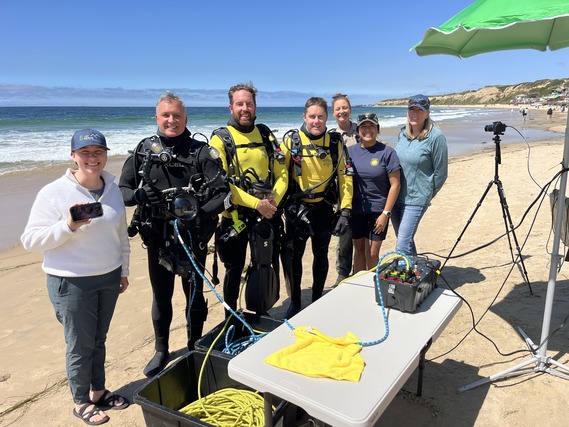 State Park Interpreter II Lydia Stinson, SPPO (Lifeguard) Jon Hernandez, SPPO (Lifeguard) Nick Milward, SPPO Supervisor (Lifeguard) Brian Staudenbaur, State Park Interpreter I Alex Anderson, State Park Interpreter II Kayla Jones, and State Park Interpreter II Jennifer Langer. Photo from Ken Kramer, Training Section.
California State Parks' PORTS (Parks Online Resources for Teachers and Students)® Program went all out for Earth Week this year, virtually connecting with approximately 6,000 K-12 students across the state. With the theme "Planet vs. Plastics," PORTS offered a robust lineup of live PORTScasts, taking students on a virtual journey to explore conservation, stewardship, and the ongoing battle against plastic pollution.
The weeklong adventure kicked off on Earth Day with a live underwater dive at Crystal Cove State Park, where students were immersed in an oasis of giant kelp and marine life. State Park divers provided an interactive experience, answering questions and showcasing beautiful marine creatures, including garibaldi fish, a horn shark, abalone, and a Spanish shawl nudibranch, just to name a few.
Throughout the week, PORTS visited a diverse array of natural, cultural, and historical sites, including beaches, rivers, deserts, and redwoods. Students even had the opportunity to learn from Chumash representatives at La Purísima Mission State Historic Park, gaining insights into their rich heritage.
To encourage student participation, PORTS hosted a logo design competition, inviting creative submissions from K-12 students. The winning logo, created by Monica M. from Woodland Hills Academy Humanities Magnet, became the official PORTS Earth Week logo, prominently displayed during all PORTScast programming throughout the week.
PORTS leadership team expressed their pride in the successful week: "Connecting students with our parks and providing memorable real-world experiences is the name of our game. If we can create a few more environmental stewards along the way, we've accomplished our goal and strengthened our pursuit to save our planet and protect our parks."
To relive these Earth Week adventures, visit the PORTS YouTube channel for recorded sessions. To see other winning logos created by students for Earth Week, visit our PORTS logo design competition landing page.
 Top: State Park Peace Officer (SPPO) (Lifeguard) Todd Shanklin showing a garibaldi fish as State Park Interpreter III Jeremy Lin holds the camera. Photo from Jon Hernandez, Orange Coast District. Bottom left, from left to right: Jeremy Lin, Jon Hernandez, and Todd Shanklin. Photo from Kayla Jones, Interpretation and Education Division. Bottom right: The official PORTS Earth Week logo, created by Monica M., depicting a California poppy being planted.
Weaverville Joss House State Historic Park Celebrates 150th Anniversary of the Cloud Forest Temple
Story from: Jack Frost, Northern Buttes District
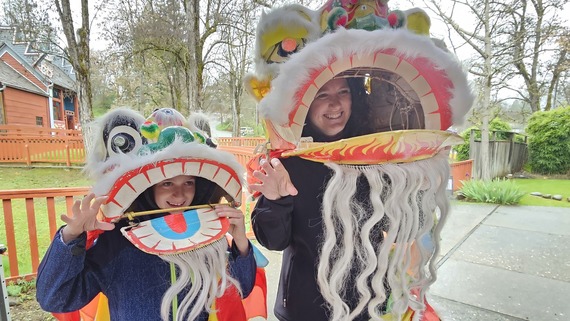 Interpretation and Education Division Chief Heather Holm with her son, Galen, showing fierce claws as they donned the lion head costumes. Photo from Jennifer Pooley, Northern Buttes District.
Weaverville Joss House State Historic Park (SHP), along with the Weaverville Joss House Association, celebrated the 150th anniversary of the Cloud Forest Temple on April 13, the third day of the third Chinese lunar month. The Cloud Forest Temple is the oldest Taoist Chinese temple in the United States.
The festivities marking the 150th anniversary of the temple were set to feature a captivating traditional Chinese lion and dragon dance, a spectacle presented by Eastern Ways of Martial Arts of Sacramento. A grand display of 80,000 firecrackers was also planned to kick off the celebration. However, the water god Bok Kai, whose birthday coincides with the third day of the third lunar month and is honored inside the temple, decided to bless us with rain for his birthday. Regrettably, the firecrackers and the lion dance had to be canceled at the last moment.
Despite the rain, Northern Buttes District Superintendent Matt Teague led the dedication ceremony, extending a warm welcome to all attendees and sharing the early history of the park’s development. Following the opening ceremony, guided tours of the temple were conducted throughout the day, with park staff enlightening visitors about the temple's rich history and its profound impact on our lives over the past 150 years. The current temple structure, officially known as the “Temple Amongst the Forest Beneath the Clouds,” was erected in 1874. It stands as the oldest continuously used Chinese temple in California and has been a state park since 1956.
Weaverville Joss House Association members shared their organization's history and how they have helped fund educational programs and events at the park for years. Neighboring National Park Service interpretive staff from Whiskeytown National Recreation Area shared the history of the Chinese miners in their area. Park staff and volunteers offered Chinese art projects to all ages in the visitor center, along with a Chinese history of tea presentation with tea tasting. Green tea ice cream and moon cookies were also available. Volunteers offered a story walk reading activity, and visitors of all ages completed a worksheet filling in the English words corresponding to the Chinese characters they found in the story pages. Everyone who completed the worksheet received a traditional Chinese Red Envelope containing a gold coin and this year’s Chinese fortune. Visitors came from afar, with many from the San Francisco Bay Area and even one couple that traveled from Michigan just for this event. The turnout was great, and the mood was festive.
In addition to 2024 being a milestone for the temple, it is also the Year of the Dragon according to the Chinese zodiac calendar. This system is based on a 12-year cycle, with each year represented by a different animal, such as the ox, tiger, and rabbit. The dragon is the only mythical creature among them, and it is traditionally associated with prosperity and good fortune. This also represented the general wishes of everyone attending the event for the future of the Cloud Forest Temple and Weaverville Joss House SHP.
 Top: State Parks volunteer and tea specialist Alison Calkins and Weaverville Joss House Association Secretary Shannon Frederick present tea tasting and history. Bottom left: Guide Jack Frost leading tours inside the Cloud Forest Temple. Photos from Jennifer Pooley. Bottom right: Superintendent Matt Teague welcoming guests and presenting the dedication. Photo from Diana Sheen, Weaverville Joss House Association.
State Parks K-9 Team Complete 2024 Annual Qualifications
Story and photos from: Mike Gleckler, Law Enforcement and Emergency Services Division
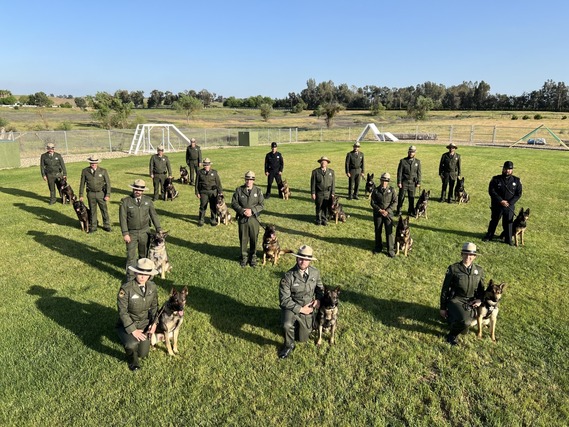 State Parks K-9 teams at this year's Annual Qualifications event.
California State Parks K-9 Program is now in its 55th year and it is one of the longest-running and largest K-9 programs in the state, with 19 teams currently on the roster.
The department’s K-9 teams met within Central Valley District for their annual qualifications on April 24-25. During qualifications, each K-9 team must demonstrate skills and abilities in obedience, patrol, searching, tracking, and detection. Each team performed at a high level and illustrated the time and dedication necessary to successfully pass all qualification requirements.
Each year, two K-9 teams are selected for either the Mike Callen Top Dog Team Award (Best Overall Performance at Qualifications) or the Dave Graham Achievement Award (for the K-9 team that has demonstrated year-round excellence). This year’s winners of the Top Dog Team Award are Matt Pasquarella and K-9 Hugo (Capital District). The Achievement Award went to David Gunn and K-9 Argo (Angeles District).
Are you interested in learning more about the K-9 Program, becoming a K-9 handler, or hosting a K-9 training within your district? If so, please reach out to Mike Gleckler at michael.gleckler@parks.ca.gov or Sasha Wessitsh at sasha.wessitsh@parks.ca.gov.
I would like to recognize the dedicated teams of the California State Parks K-9 Program:
- Andrew Bampton and K-9 Zuma, San Luis Obispo Coast District.
- Colin Bliese and K-9 Matyi, Ocotillo Wells District.
- Michael Cueto and K-9 Zehn, Special Enforcement Team.
- Thomas Cunningham and K-9 Doc, Central Valley District.
- David Elias and K-9 Aki, Channel Coast District.
- Benjamin Ellis and K-9 Jerry, San Luis Obispo Coast District.
- Briana Estes and K-9 Tyr, Capital District.
- Martin Gilbertson and K-9 Ivan, Sierra District.
- David Gunn and K-9 Argo, Angeles District.
- Aaron Hoff and K-9 Torq, Orange Coast District.
- Mark James and K-9 Yukon, Gold Fields District.
- Brian Lane and K-9 Chase, San Diego Coast District.
- Alexandra Lucero and K-9 Rex, Gold Fields District.
- Kyle Meza and K-9 Ghost, Central Valley District.
- Matt Pasquarella and K-9 Hugo, Capital District.
- Raymond Rathjen-Gonzales and K-9 Bak, Oceano Dunes District.
- Janessa Sederquist and K-9 Oz, Northern Buttes District.
- Angelica Stevens and K-9 Arrow, Orange Coast District.
- Brett Weber and K-9 Rino, Special Enforcement Team.
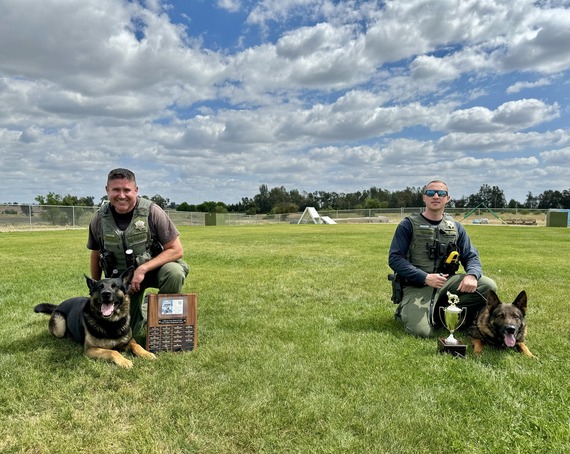 Achievement Award winners: David Gunn and K-9 Argo, Angeles District (left). Top Dog Team Award winners: Matt Pasquarella and K-9 Hugo, Capital District (right).
Sheep Lose Winter Coats for Sheep Shearing Day at Petaluma Adobe State Historic Park
Story and photos from: Carmen Vanni, Bay Area District
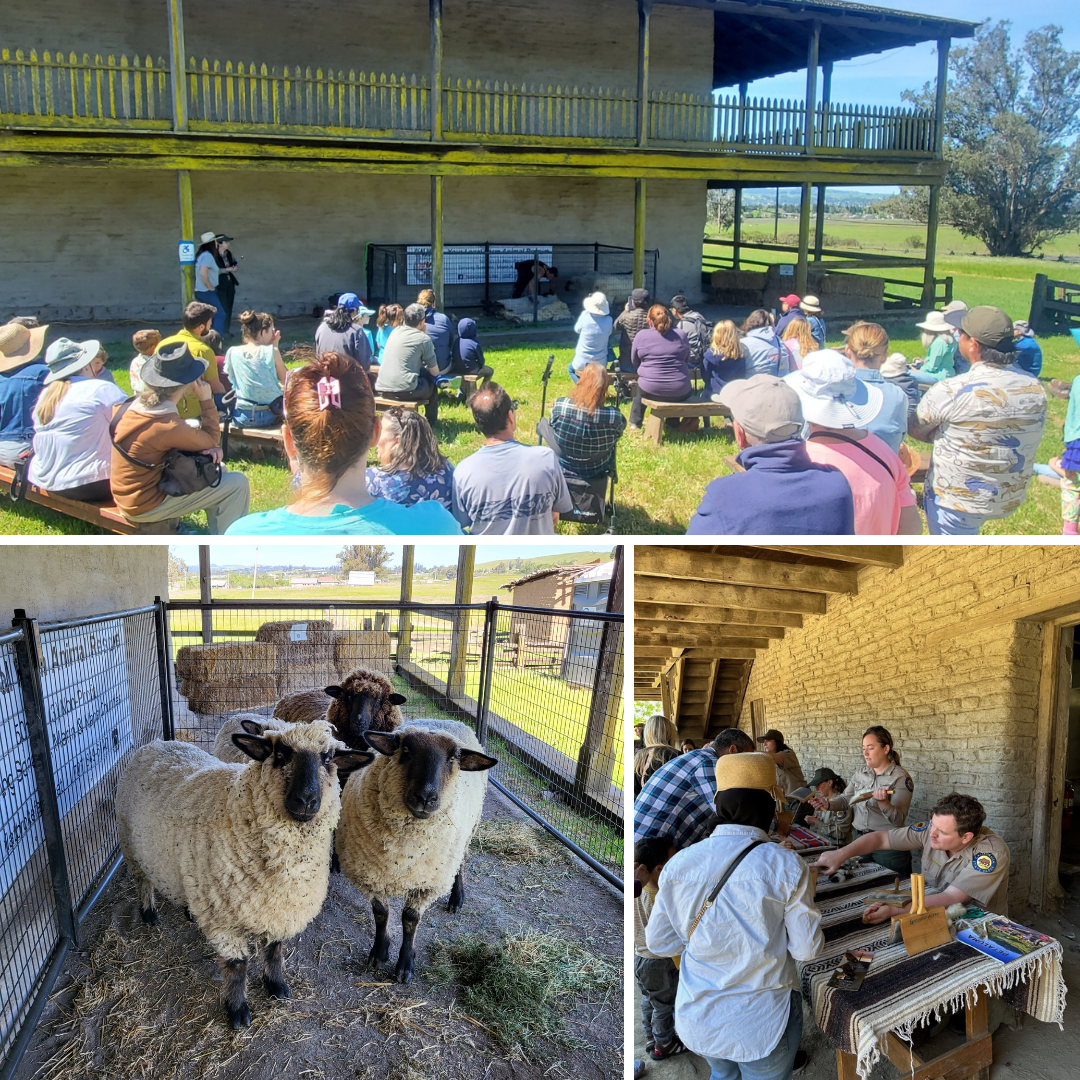 Top: Park visitors are watching local shearer John Sanchez shear a sheep provided by Flat Broke Farm. Bottom left: Adoptable sheep from Flat Broke Farm are showing off their winter coats. Bottom right: State Park Interpreter I Tyler Markley, State Park Interpreter I Kaylie Williams, and Senior Park Aide Dana Richards teach era-appropriate wool spinning and weaving techniques to park visitors.
Bay Area District staff and volunteers hosted Sheep Shearing Day at Petaluma Adobe State Historic Park (SHP) on Saturday, April 27. We hosted over 180 visitors who came to see four live sheep shearing demonstrations and practice wool spinning. The adoptable sheep were provided by Flat Broke Farm, a farm animal rescue organization located in Cotati. They were sheared by local shearer John Sanchez, a longtime volunteer shearer with Petaluma Adobe SHP.
Visitors discovered how wool is transformed from sheep to sweater. The wool is first sheared, washed, and then brushed with a set of carders. The wool can also be dyed with various natural sources. Next, the wool is spun into yarn using either a drop spindle or a twist stick. The yarn can be woven into various items such as blankets or clothes. Visitors also learned how sheep, wool, and textiles served a significant role in Mexican-era rancho operations.
This event could not have happened without the support of Sonoma Petaluma Parks, Inc., Flat Broke Farm, John Sanchez, and State Parks staff. I would also like to thank Jennifer Hanson for her exceptional professional support. Thank you all for a wonderful Sheep Shearing Day 2024!
Plumbing Skills Training Held in Henry Cowell Redwoods State Park
Story from: Ricky Roldan, Training Section
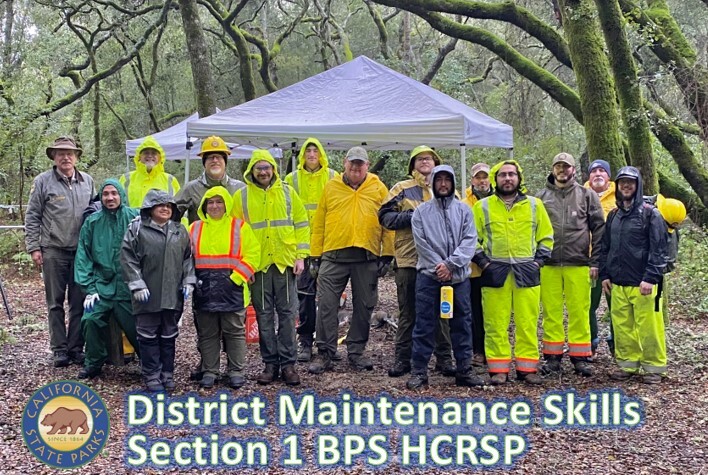 The Training Section implemented its new District Maintenance Skills Training series with a training focused on plumbing skills. Group #1 Basic Plumbing Skills was held in Henry Cowell Redwoods State Park (SP) to assist in preparing for the campground’s grand opening scheduled for April 1.
Participants began with class orientation and pretraining exam reviews at the Henry Cowell Redwoods SP maintenance office on Feb. 19. The lead instructors, Graham Payne and Joe Lechuga, introduced the scope of the project and safety. Park Maintenance Supervisor Ben Gonzalez spoke on the nature and purpose of the campground’s plumbing project. The Project Evaluation Form included the need to improve the water faucets, set new cement culverts, add new quarter turning shut off valves, and install new waterline and hose bibbs. At the end of the day, the participants were given a tour of the campground project site before splitting into groups.
Project Manager Matt McDonald broke the class labs into groups of four and five throughout the week of training. Participants were able to refresh their skills and acquire new ones in plumbing repairs, replacing old and new plumbing fixtures including valves, galvanized material, pipes, water bibbs, Christy box installations, etc. The class was also introduced to hand threading galvanized pipes. Participants were involved in learning the setting of forms, mixing of cement, and they were taught how to correctly pour a cement slab. The cement slab was set up for three American with Disabilities Act-accessible ramps and to redo the damaged walkways around the restroom areas. The campground plumbing project class concluded on February 23.
The Mott Training Center, part of the Training Section, and participants would like to thank Juan Villarino, Ben Gonzalez, Patrick Courtright, Matt McDonald, and the Henry Cowell Redwoods SP campground staff for their hard work in preparing and hosting the campground plumbing project.
Please check your FOCUS calendar for the Fall 2024 and the Spring 2025 Maintenance Classes and updates beginning in August 2024. Classes fill up quickly. If you have any questions, please email me at ricky.roldan@parks.ca.gov.
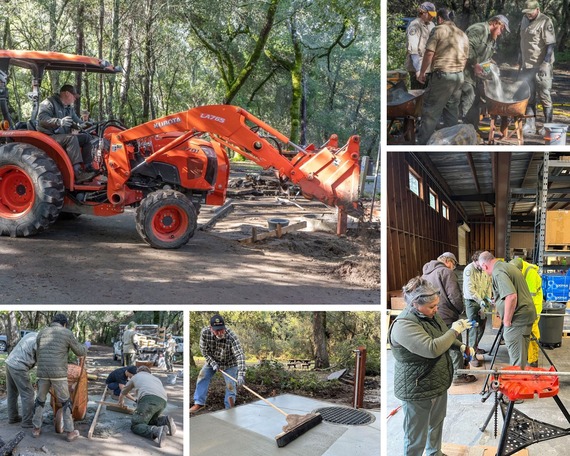 Top left: Project Manager Matt McDonald unloading gravel rock with the Kubota tractor. Photo from Kathleen Ventura, Training Section. Top right: Students mixing cement into wheelbarrows. Photo from Kathleen Ventura. Bottom left: Students pouring and spreading the cement within the forms. Photo from Kathleen Ventura. Bottom center: Joe Lechuga brush finishing new slab pour at the campground. Photo by Ricky Roldan. Bottom right: The class learning how to hand thread galvanized pipe. Photo by Ricky Roldan.
Baja SAE International Holds Event at Hungry Valley State Vehicular Recreation Area
Story from Steven Ptomey, Great Basin District
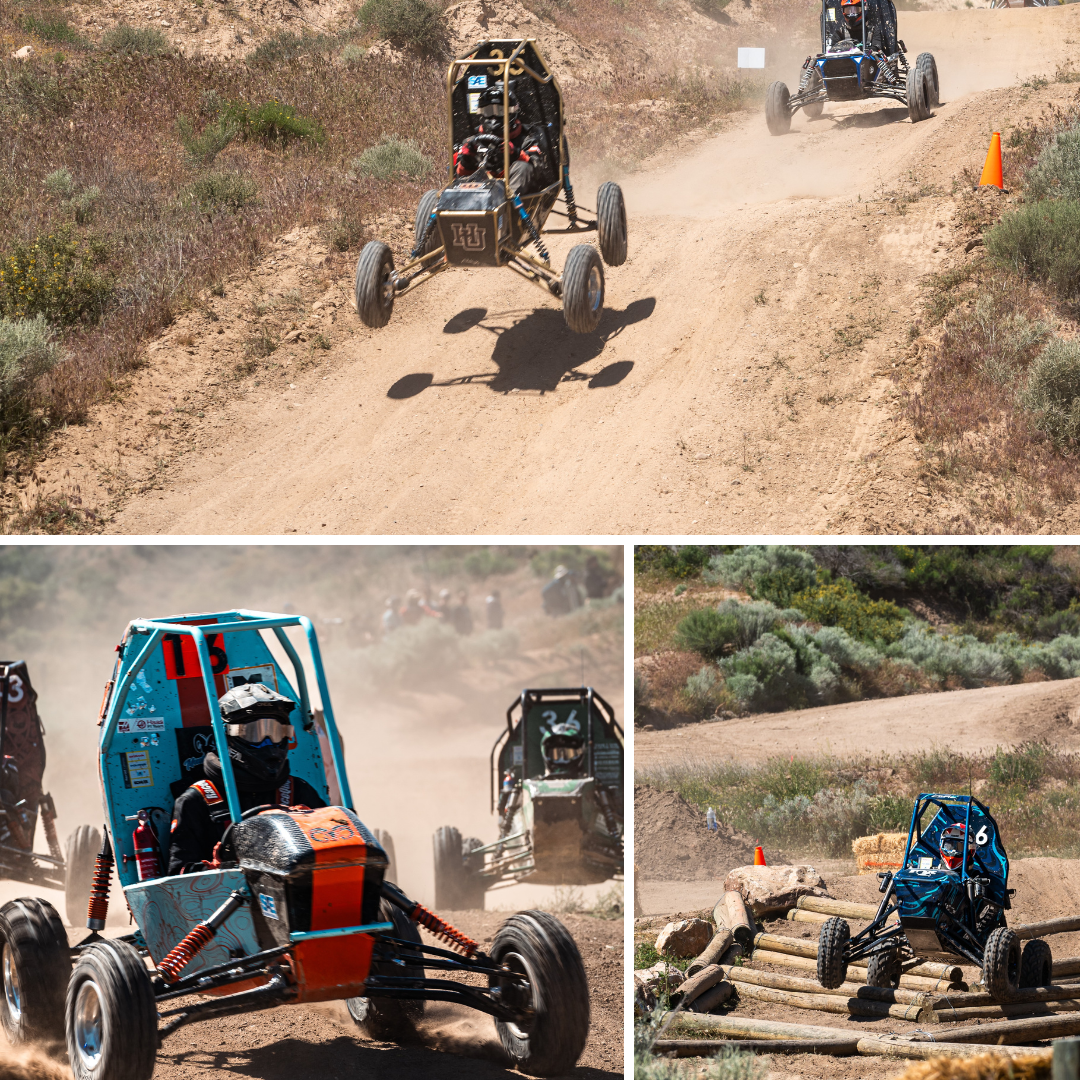 Clockwise from top: Car 35 Harding University on the track. Car 66 Case Western Reserve University. Car 16 ITESM - Campus Guadalajara on a flat turn. Photos by Bobby Scruggs, Great Basin District.
Over 75 student design teams from around the globe descended on Hungry Valley State Vehicular Recreation Area over the weekend, to compete in the Baja SAE competition. Baja SAE is a collegiate design series competition run by the Society of Automotive Engineers International (SAE International). Teams of engineering students from universities all over the world design and build small single seat off-road recreation vehicles intended for sale to the average off-roader (Baja buggies). Part of the design process is to test them against their fellow students’ designs. Every team uses the same 14hp Kohler Command Pro engine and has the same budget restrictions.
The goal in Baja SAE is to design, build and race off-road vehicles that can withstand the harshest elements of rough terrain. Baja SAE gives these student engineers the first-hand opportunity of pursuing their passion while managing real-life demands and priorities.
Areas of competition are hill climb, acceleration, suspension, maneuverability, and cost of the build. Of the international teams attending this competition, two were from colleges in Mexico, two from Canada and one from India. With an average daily attendance of around 1,500 persons, including competitors, faculty, and spectators, this was one of the smaller events in the Baja SAE lineup nationwide. Park staff assisted in the event by helping design the course, as well as providing operational support and monitors. Cornell University was first in the competition, accruing 954 points out of a possible 1,000.
Monterey District Hosts 'Bird Island Brunch' for Natural Resources Volunteer Program
Story from: Sam Winter, Monterey District
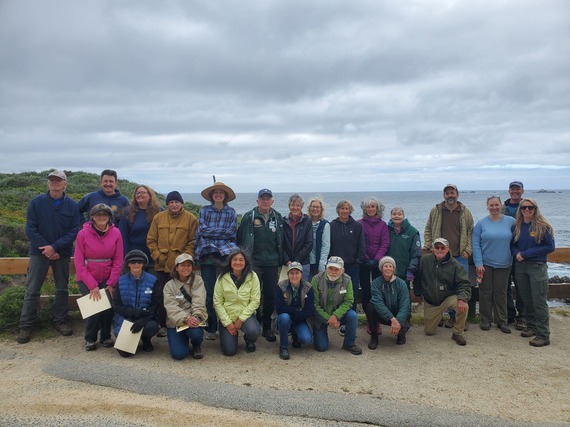 Back row (left to right): Volunteer Jon Hubbard, State Parks Environmental Scientists and Volunteer Coordinators Sam Winter and Esther Haile, Volunteers Skip Dubrin, Lainey Chatham, Pat Lovejoy, Mary Ellen Blakely, Nancy Pyzel, Mandy Salm, Katie Spitz, Mary Gale, David Neidel, Mike Todd, Matthew Todd, State Parks Environmental Scientist and Volunteer Coordinator Rosie Eisner. Front row (left to right): Volunteers Marcia Hulberg, Gail Beyatte, Yvonne Wright, Mary Yui, Helen Ogden, Rick McGarrity, Barbara Woyt, Ralph Lauer. Photo Credit: Melissa Potts, California State Parks Foundation.
Monterey District's natural resources volunteer program hosted a "Bird Island Brunch" at Point Lobos State Natural Reserve on Thursday, April 25, to celebrate the program's volunteers. In addition to delicious food and drink, volunteers received raffle prizes donated by local businesses and supporting partners, including the California State Parks Foundation, the Point Lobos Foundation, Rana Creek Preserve, and the California Native Plant Society.
Volunteer Yvonne Wright received a Monterey District Award for her role catalyzing the district's Snowy Plover Guardian Program, while volunteer David Neidel was recognized with a Poppy Award for his many years of service removing invasive plants at Garrapata State Park. After the event, volunteers and their guests were treated to a guided walk by interpreters Ashley Wemp and Isabella Brown.
Colonel Allensworth State Historic Park Hosts First Junior Archaeologist Day
Story and photos from: Steven Ptomey, Great Basin District
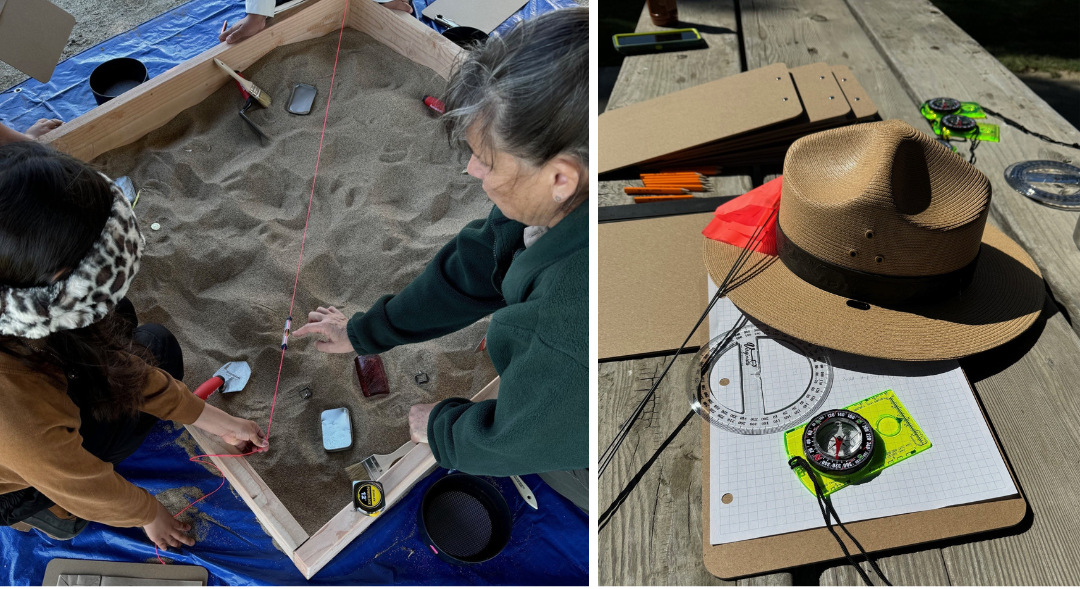 Left: State Park Interpreter I Jerelyn Oliveira shows a participant how to use a line level in the excavation station. Right: Old-school survey equipment: pin flags, compass, and graph--and hat.
Colonel Allensworth State Historic Park recently hosted their first ever Junior Archaeologist Day. District Interpreter Lori Wear, a former archaeologist, with input from the district’s cultural resources team, developed a three-station program to introduce school-age children to the world of archaeology as part of the Adventure Pass program.
The children were introduced to a range of techniques, from basic field survey—looking for a site—and mapping their find, to a mock excavation unit, to the final stage of cataloging their find, including “artifact” illustration. After mapping their finds on graph paper using the old-school method of a tape measure and compass, the participants moved onto the “dig” part of the program.
A small 2x2-meter frame was set up and filled with sand and “historic” objects: bottles, cans, buttons, and fake pirate gold coins to simulate a historic site. As they excavated and logged their finds, they were shown the proper technique in excavation as well as the reason why we do archaeology as a department and the ethics behind the process.
At the final stage, participants were taught how to measure with calipers, sketch the objects, and enter the information on catalog sheets. For some of the older participants, we also presented the pathway to become a professional archaeologist and explained how to achieve a position as State Parks archaeologist.
Bald Eaglet Rescue Operation at Folsom Lake State Recreation Area
Story and photos from: Gibson Elkins, Gold Fields District
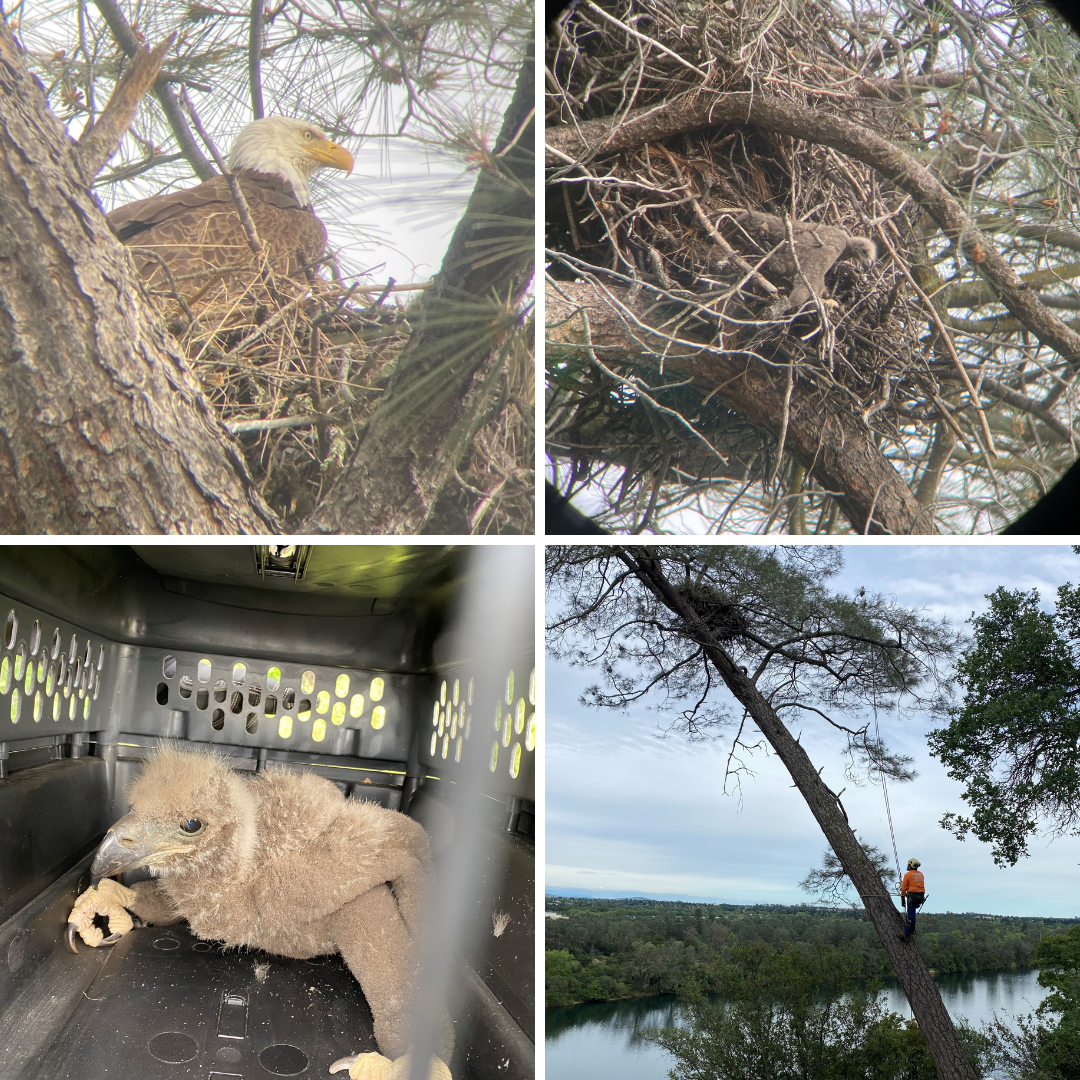 Clockwise from top left: The parent eagle. The eaglet holding onto the side of the nest. The arborist climbing the tree to rescue the eaglet. A close-up of the eaglet after it was rescued.
State Parks staff was alerted about a bald eagle nest near the Black Minors Bar day use area at Folsom Lake State Recreation Area on Saturday, April 27. One of the three eaglets had either fallen or been pushed out of the nest. The eaglet was holding onto some branches just underneath the nest. It was reported that the eaglet was there for over 18 hours. On scene, it was clear the eaglet was exhausted and did not have much energy.
The California Department of Fish and Wildlife (DFW) assumed command of the situation and contacted a private arborist who was able to climb the tree, which hung over a 400-foot bluff. The eaglet was successfully rescued and taken to a private, DFW-approved animal sanctuary where it will be nurtured and raised.
  Email photos to the WeeklyDigest@parks.ca.gov.
|