Meet the Commissioner: Roger Salazar, California
Off-Highway Motor Vehicle Recreation Commission
Story from: Kevin Murphy, Communications and Marketing Division
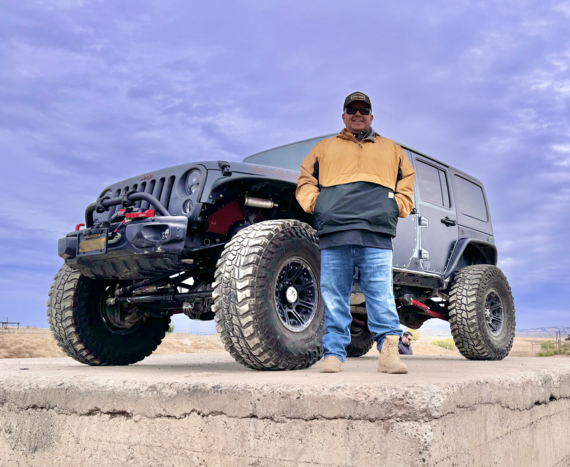 Roger Salazar poses with his Jeep at Prairie City SVRA. Photo from Roger Salazar, OHMVR Commission.
As we continue the “Meet the Commissioner” series, we are profiling those who serve on the four public commissions under the department: the California State Park and Recreation Commission, California Boating and Waterways Commission, California Off-Highway Motor Vehicle Recreation Commission and State Historical Resources Commission.
Today, you will learn more about Commissioner Roger Salazar, first appointed by Governor Gavin Newsom in 2020 to the California Off-Highway Motor Vehicle Recreation (OHMVR) Commission. The Commission provides guidance to OHMVR Division staff, reviews and approves plans for State Parks’ nine state vehicular recreation areas (SVRAs), and assists the department in its mission to provide for the health, inspiration and education of the people of California.
Salazar has been president of ALZA Strategies since 2014. He was managing director of Mercury Public Affairs from 2012 to 2014 and partner at Acosta Salazar LLC from 2004 to 2012. Salazar was press secretary and deputy press secretary in the Office of Governor Gray Davis from 2000 to 2002 and served in several roles in President Clinton’s Administration from 1995 to 2000. He earned a Bachelor of Arts degree in political science from the University of Redlands and a Master of Arts degree in political/media management from George Washington University.
To learn more about the Commissioner Salazar, we asked him five questions:
1. Why did you apply for the Commission?
I wanted to join the Commission to provide a balanced voice for the off-road community. Off-roading runs in my family. When my father was born, he was brought home in a 1946 Willys (Jeep). I have been riding around in Jeeps since I was a toddler. One of the concerns I have is that false notion that off-roaders “tear up the trail.” In my lifetime experience, off-roaders have always been stewards and conservationists. I was taught from an early age to leave no trace. The philosophy of groups like Tread Lightly! and others is where I believe real off-roaders are aligned.
2. Since joining the Commission, what is one thing that has surprised you?
I’ve been pleasantly surprised by the passion and intelligence of the user groups and the professionalism of OHMVR Division staff. The other thing that has surprised me is how much science commissioners must wrestle with during the average meeting. As a social science major, I’m not sure I was prepared for the volume of scientific analysis we have to read through to have a solid understanding of the issues before the Commission.
3. Why do you think it is essential for the public to engage with the Commission?
We are an outlet for the public on off-highway motor vehicle recreation. In some ways, we are the only outlet for the public to voice their concerns on issues they care deeply about. It is important for us as commissioners to hear their voices and provide a forum for differing sets of opinions to be aired. The more the public engages with the Commission, the better represented they are in OHMVR-related activities.
4. What is your favorite form of recreation and do you have a favorite state park to visit?
Clearly, off-roading in my Jeep is my favorite form of recreation. I’ve traveled all over the world, and I’ve been "4x4-ing" in mountains, deserts, tropical islands and on arctic glaciers. But I enjoy other outdoor activities. I am also an active scuba diver: anything from dry suit diving in 30-degree waters in the Silfra Fissure in Iceland, to tropical diving in the Great Barrier Reef. Also, up until my knee issues this year, my wife and I were active skiers for 25 years. My home SVRA is Prairie City, but my favorite state park unit has to be a tie between Calaveras Big Trees State Park (the first park I remember going to as a little kid) and Auburn State Recreation Area for its views and diversity of activities.
5. What would someone be surprised to learn about you?
Two things: One is that I once ran and completed a marathon. I ran the Marine Corps Marathon in Washington, DC, when I turned 30 years old. I’m pretty spry for a big guy. The second is that I’ve been to Antarctica. My wife and I traveled to Antarctica in 2019 on an expedition cruise through the Strait of Magellan, around Cape Horn and across the Drake Passage. We were able to hike and snowshoe on the continent; travel in Zodiac boats through icebergs; take a polar plunge in Antarctic waters; see penguins, whales and elephant seals; and assist scientists by collecting data for research. It was the trip of a lifetime.
PORTS: Parks Online Resources for Teachers and Students® Program Takes Over at Annual K-12 Education Event
Story from: PORTS: Parks Online Resources for Teachers and Students®
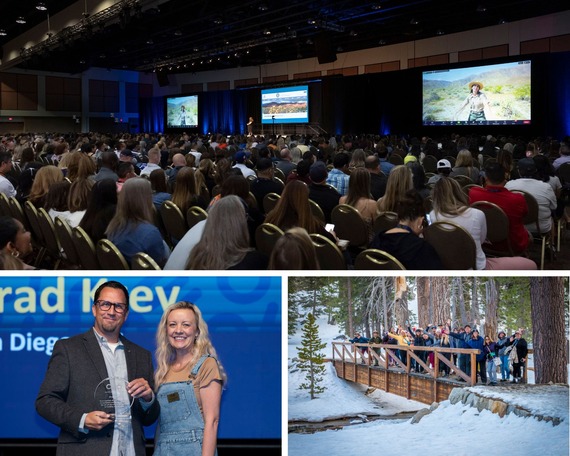 Top: Anza-Borrego Desert State Park Interpreter I Brianna Pinto in video presenting about big horn sheep in the "Battle of the Charismatic Megafauna," with Ann Kozma during “Teach Differently” keynote. Photo from CUE Inc. via SPN Photography. Bottom right: Teachers in the wild at Mount San Jacinto State Park. Photo from Paulette Donnellon, Anza-Borrego Foundation. Bottom left: CUE Advocate of the Year Award presented to Brad Krey, PORTS program manager by Laura Spencer, CUE board president. Photo from CUE Inc. via SPN Photography.
As technology continues to revolutionize education, innovative statewide programs like the PORTS: Parks Online Resources for Teachers and Students® Program are at the forefront, bridging the gap between classroom learning and real-world experiences.
The Spring CUE, or Computer Using Educators, conference, which the PORTS Team attended March 20-23, is an annual event that brings together educators, administrators, technology coordinators and other professionals in the field of K-12 education. The conference serves as a platform for attendees to explore the latest trends, tools and strategies in educational technology. It features a diverse range of sessions, workshops, keynote speeches and networking opportunities designed to inspire and empower educators to integrate technology effectively into their classrooms.
The PORTS Team descended upon Palm Springs, California, (and then ascended to Mount San Jacinto State Park) for a literal takeover of the conference that saw close to 4,000 in attendance. Among the highlights of our engagement was PORTS’ prominent role in Ann Kozma’s keynote address on “Teaching Differently.” Kozma, known for her pioneering work in educational technology, emphasized the importance of embracing diverse teaching methods to engage students effectively in the digital age. To showcase this, Ann brought four different California State Park PORTS Programs to life in front of an audience of over 3,000 of the attendees. During the keynote, parks—including Anza-Borrego Desert and Donner Memorial State Parks and Point Lobos State Natural Reserve—were featured in an interactive “Battle of the Charismatic Megafauna.” We even brought the classic “Cali the Quail” back to life on stage to provide a fun and entertaining way to engage the audience. Angel Island State Park brought home the power of bringing untold stories of California’s history into classrooms by taking the audience on a tour of the barracks at the U.S. Immigration Station and reciting one carved into the walls by a detainee, in both Cantonese and English.
The PORTS virtual campfire booth at the conference served as a hub of activity, drawing educators eager to explore our virtual and immersive field trips, interactive lessons and educational resources centered around California's diverse natural and cultural heritage. Educators had the opportunity to interact with State Parks staff, learn about State Parks programs such as the fourth grade California State Park Adventure Pass Program, and discover how they can integrate park experiences into their curriculum to enhance student learning. For the first time, educators were able to explore State Parks’ educational content through virtual reality headsets, including a narrated experience of elephant seals at Hearst San Simeon State Park, as well as an experience describing starry constellations as seen by the Kumeyaay people.
Thanks to the support of Parks California, we were able to bring over 100 attendees to Mount San Jacinto State Park via Palm Springs Aerial Tram, where Inland Empire District staff promoted local educational resources and provided guided hikes of the Long Valley Wilderness.
On the last day of the event, Brad Krey, PORTS program manager, was recognized as CUE’s Advocate of the Year for his dedication to advancing educational technology and advocacy through programs like PORTS. His commitment to empowering educators and students through technology serves as a testament to the transformative potential of innovative initiatives in education and through public lands.
The PORTS program's presence at the CUE conference underscored its commitment to providing accessible and engaging educational experiences for students and educators alike. By leveraging technology to bring the wonders of California's parks into classrooms across the state and beyond, PORTS continues to redefine traditional education paradigms and fosters a deeper connection to the natural and cultural world.
Trail Partially Closed at South Yuba River State Park Due to Landslide, Alternative Trails Available
Story from: Robert Griffith, Sierra District
 Map showing the Buttermilk Bend Trail closure.
During the peak of the wildflower-viewing season, there is an untimely partial trail closure along the Buttermilk Bend Trail at South Yuba River State Park due to a landslide on February 20, 2024, along the trail. We understand the disappointment this may cause to those who enjoy exploring the spectacular wildflower blooms along the Buttermilk Bend Trail each spring; however, given the significant safety hazard, we urge everyone to refrain from accessing the closed portion of the trail until further notice.
The landslide-damaged section of the trail is hazardous for all of the public until repaired, and the slide has severed access to much of the wheelchair-accessible portion of the trail. Beyond the slide, the Buttermilk Bend Trail remains passable, and so accessing that part of the trail on foot from the French Corral Fire Road—also known as the Pleasant Valley Service Road—is another option to get to some of the best wildflower-viewing areas. Access to that road is at the gate along Pleasant Valley Road, approximately a half mile north of the park’s northern parking lot. Unfortunately, the French Corral Fire Road connector to the rest of the Buttermilk Bend Trail beyond the slide is not wheelchair accessible.
Other alternative hiking trails in the area include the Virginia Turnpike Loop (easy); the 2.8-mile Point Defiance Loop at Bridgeport Crossing (moderate); the Hoyt Crossing Trail at Highway 49, east Independence Trail (upriver portion only); and the South Yuba River Recreation Trail connecting Purdon Crossing and Edwards Crossing.
We are committed to repairing the trail by making a wise investment to stabilize the trail long-term to ensure public safety and protection of the botanical and other resources that make the Buttermilk Bend Trail such a wonderful place to visit. Repairs are to be expected to be completed prior to next spring.
Railtown 1897 State Historic Park Celebrates Opening Weekend of Excursion Train Rides and Announces Expanded Season
Story from: Traci Rockefeller Cusack, T-Rock Communications
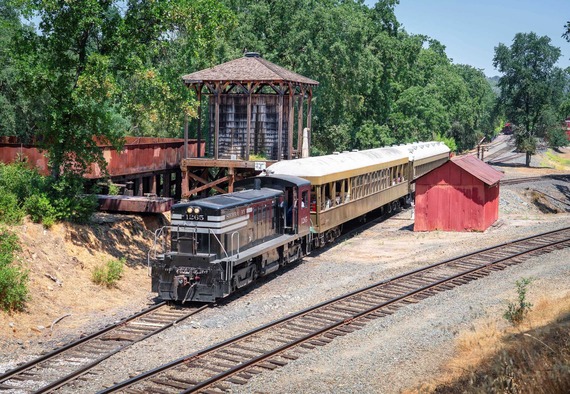 Railtown train 1265 and water tower. Photo from Kelly B. Huston, volunteer for the California State Railroad Museum Foundation.
Railtown 1897 State Historic Park (SHP) in Jamestown, California, in partnership with the California State Railroad Museum Foundation, will present a new and expanded season of weekend excursion train rides, starting April 6-7.
The historic No. 1265 diesel engine will be in operation all weekend, and excursion train ride departures for both days are scheduled for 10:30 a.m., noon, 1:30 p.m. and 3 p.m. New in 2024, the weekend train ride season has been extended through October to provide more opportunities for guests from near and far to enjoy the unique experience.
For opening weekend, vintage railroad equipment will be on display with several open to walk through, such as Sierra Railway coach cars No. 3, 5 and 6; these classic cars were featured in numerous movies and television programs, including "High Noon" and "Petticoat Junction." Park visitors also have the opportunity to meet many local rail and museum enthusiasts who have a wealth of information to share. Representatives from the California State Railroad Museum Foundation will be available to answer questions and highlight the many benefits of joining the membership program.
For more information, read the press release.
'Life in the 1850s' Environmental Studies Program Returns to William B. Ide Adobe State Historic Park
Story from: Heather Lee and Jennifer Pooley, Northern Buttes District
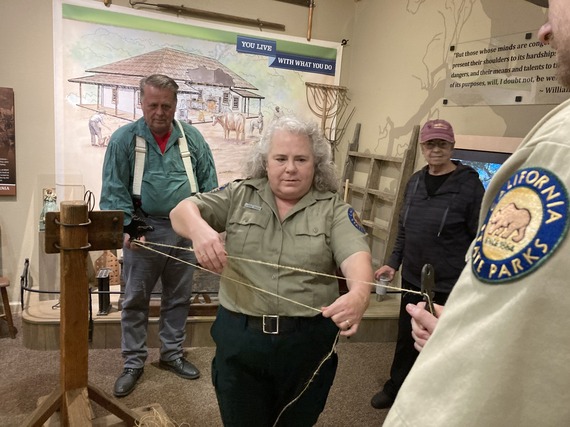 Volunteers Dan Drum and Pat Brown learn how to make rope from Interpreter III Jennifer Pooley and Park Aide Wyatt Hein. Photo from Heather Lee, Northern Buttes District.
At its core, the “Life in the 1850s” environmental studies program is an experiential program that offers fourth grade students the opportunity to visit William B. Ide Adobe State Historic Park (SHP) to learn skills they would need to survive as settlers in 1850s California. Students learn that “you live with what you do,” meaning their choices and efforts directly affect their lives and survival. Trained volunteers and staff in period attire guide students through hands-on activities to learn frontier skills, hear tall tales and histories, and play games of the era.
The first “Life in the 1850s” program was offered in 1979 and was intended to make history come alive. The program abruptly halted when the COVID-19 pandemic struck. For many years, it was a service-learning partnership between State Parks, Red Bluff Joint Union High School District, and the Ide Adobe Interpretive Association. High school docents were trained to present the program to fourth through sixth grade students. “Life in the 1850s” was a full-day program with docents receiving over 40 hours of training, offering many more activities. It was so popular that there was a lottery to get on the waiting list.
In restarting the program, staff updated content to meet current educational expectations, standards and volunteer levels. Our first new program was delivered to a school group on Thursday, March 7. The new version of the program includes a new half-day structure, a new blended-access model (virtual and in-person components) and increasing diverse and local historical representation of both people and places.
Adding local history that respectfully represented diverse experiences of African American and women's lives during the California Gold Rush has helped the program improve its ability to meet California Common Core K-12 standards for education. Stories about Alvin Coffey, Elizabeth Sherman Jackson and Captain Jane, allow fourth grade students to learn relevant history about real people who lived in and around Red Bluff during the Gold Rush. This helps students develop a connection to the park, their community and history in general. Next year, staff plans to incorporate Native American history to create a fuller experience for students.
In the future, we hope to reestablish a relationship with high school-aged docents and include a teacher/student post-program evaluation. We have just completed about half of our on-site programs. Watching students' brains get activated to history is a joy to see, and we look forward to continuing to offer this new version of the program.
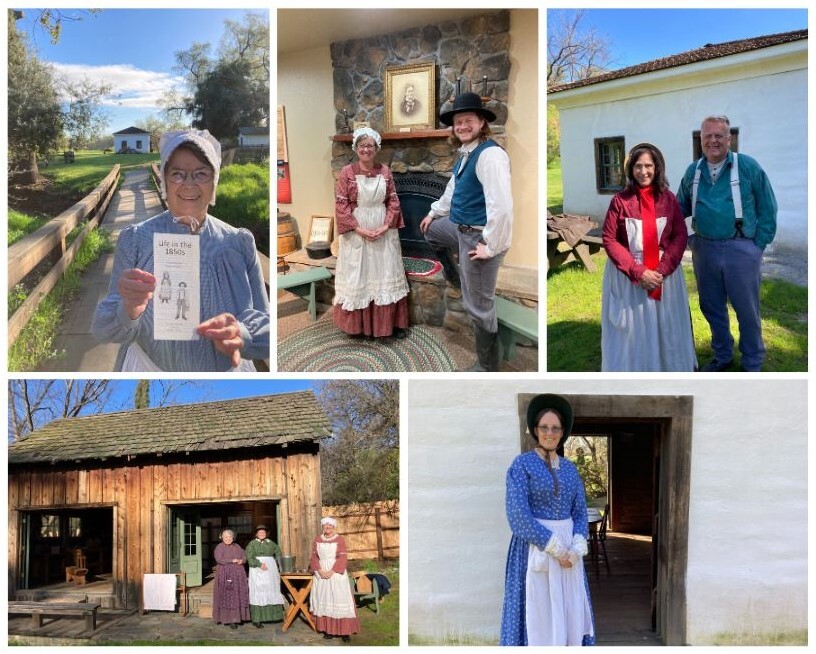 Top left: Volunteer Pat Brown. Photo from Heather Lee, Northern Buttes District. Top middle: Volunteer Lisa Hardwick with Park Aide Wyatt Hein. Photo from Heather Lee. Top right: Volunteers Maru and Dan Drum. Photo from Heather Lee. Bottom right: Interpreter I Heather Lee. Photo from Veronica Lamoureaux, Northern Buttes District. Bottom left: Interpreter III Jennifer Pooley with Senior Park Aide Veronica Lamoureaux and volunteer Lisa Hardwick. Photo from Heather Lee.
State Parks Team Takes on Baker to Vegas Law Enforcement Relay Race
Story from: Goodwin Pompa, San Diego Coast District
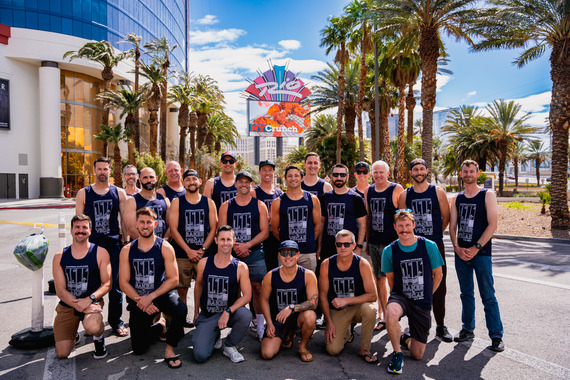 Top row (left to right): Chris Larkin, Dan Kraft, Aaron Wright, Erik Burgan, Daniel Valenzuela, Andres Mendoza, Joseph Kurtz, Chris Gobell, Gabe DelCastillo, Ben Jensen, Don Crouthamel, Timothy Schulte, Bill Wolcott, Travis Bjorndal and David Wilson. Bottom row (left to right): Goodwin Pompa, Makar Kazmin, Jake Pflepsen, Michael Lawrence, Darrell Readyhoff and Ryan Petersen. Not pictured: Eric Palmer, Darby Fultz and Bobby Scruggs. Photo from Bobby Scruggs, San Diego Coast District.
Team California State Parks recently participated in Baker to Vegas, a 120-mile, all-law-enforcement relay race that goes from Baker, California, to Las Vegas, Nevada. During this year’s race, which was held March 23-24, runners had to face up against sustained winds of 20 mph with gusts of up to 40 mph. These conditions made sandstorms sweep the desert.
With the help of their volunteers and sponsors, Team California State Parks came in 11th place in the Open Division and 15th overall out of 158 teams from around the country. Team California State Parks’ race time was 14 hours, 50 minutes and 26 seconds.
The team is excited for next year’s Baker to Vegas race filled with its own challenges.
Congrats, Team California State Parks!
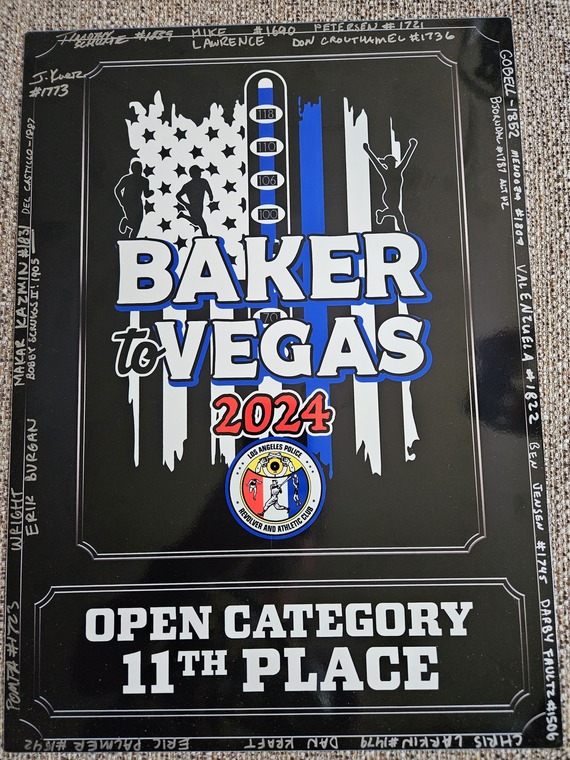 Team California State Parks' Baker to Vegas 11th place plaque. Photo from Bobby Scruggs, San Diego Coast District.
  Email photos to the WeeklyDigest@parks.ca.gov.
|