State Parks and Park Partners Celebrate Second Annual California State Parks Week
Story from: Jorge Moreno, Communications and Marketing Division
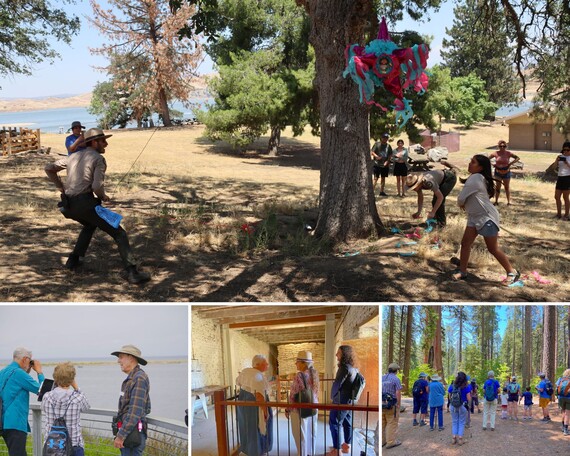 Top: Millerton Lake State Recreation Area (SRA) staff held a community event with Latino Outdoors, featuring various activities like hitting the piñata. Bottom left: Malibu Lagoon State Beach (SB) staff held a bird-watching event. Middle: Petaluma Adobe State Historic Park Docent Kit Foster provided tours. Right: Visitors enjoy a guided hike at Calaveras Big Trees State Park (SP). Photos from staff at Central Valley, Angeles and Bay Area Districts.
With 182 community in-person events and virtual programming, California State Parks, Save the Redwoods League, Parks California and California State Parks Foundation celebrated California’s 280 state parks during the second annual California State Parks Week. Held June 14-18, State Parks staff and partners welcomed new and returning visitors to explore new adventures and activities and discover ways to deepen their relationships with parks and the landscapes they protect.
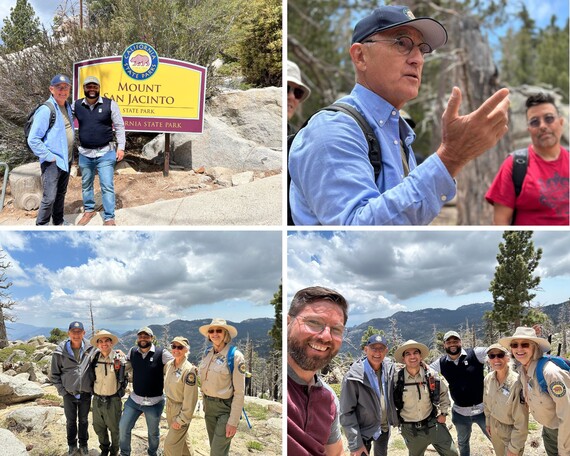
Each day had a unique theme, including "Explore New Experiences," "Nourish Your Health and Well-Being," "Support Climate Change," "Celebrate Community and Culture" and "Care for Our Shared Lands." Parks such as Malibu Lagoon State Beach held bird-watching activities; Oceano Dunes District held a Junior Ranger Program to discuss the importance of pollinators; Petaluma Adobe State Historic Park provided guided docent tours; Calaveras Big Trees State Park (SP) hosted a children’s career fair; Mount San Jacinto SP staff guided visitors on a hike in the wilderness, discussing climate change; and Millerton Lake State Recreation Area hosted a community event with Latino Outdoors.
Various media outlets covered a variety of events throughout the week. First Partner Jennifer Siebel Newsom promoted State Parks Week via social media messages, and the Governor’s Press Office issued a resolution.
A HUGE THANK YOU to staff and partners for your dedication and hard work, not just during California State Parks Week, but all year-round. We look forward to seeing you all at next year’s State Parks Week events.
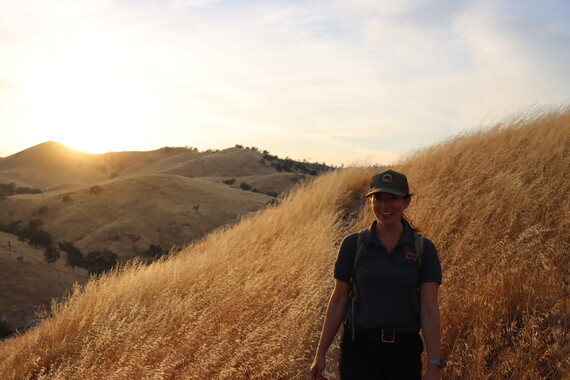
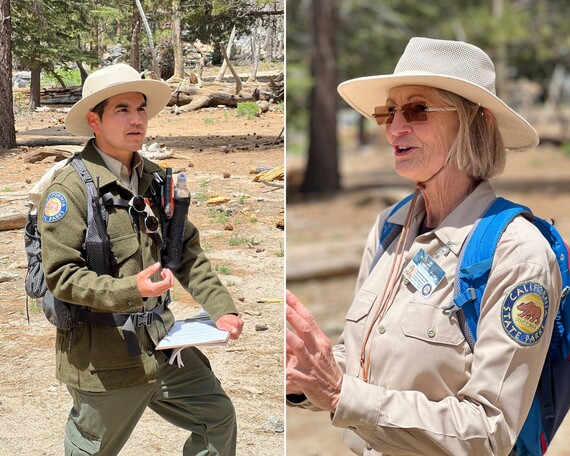
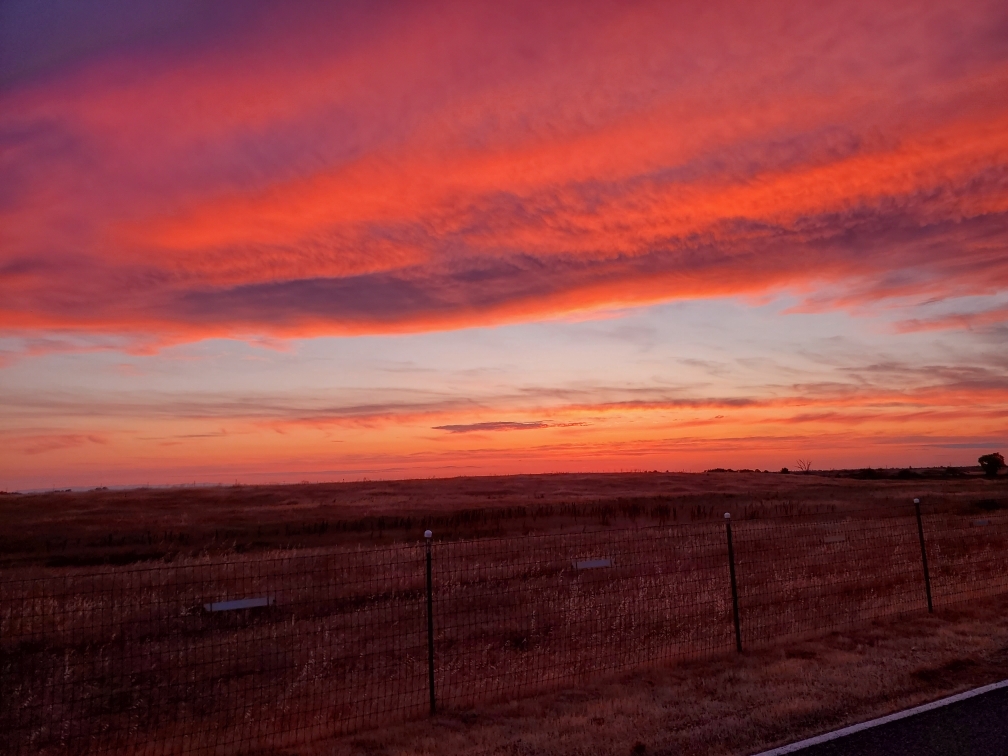
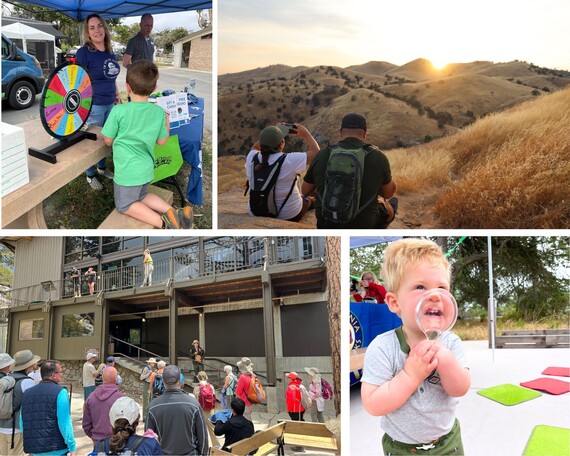 Top left: San Luis Obispo County Library had a van at the Oceano Dunes Visitor Center promoting the California State Library Parks Pass. Top right: Visitors on a guided hike take in the beautiful sunset at Millerton Lake SRA. Bottom left: Mount San Jacinto SP Interpreter I Nick Garduno gives a brief introduction before heading on a hike in the park's wilderness area. Bottom right: A young visitor having some fun with a magnifying glass during a Junior Ranger Program at the Oceano Dunes Visitor Center. Photos from staff at Central Valley and Oceano Dunes Districts, and Communications and Marketing Division.
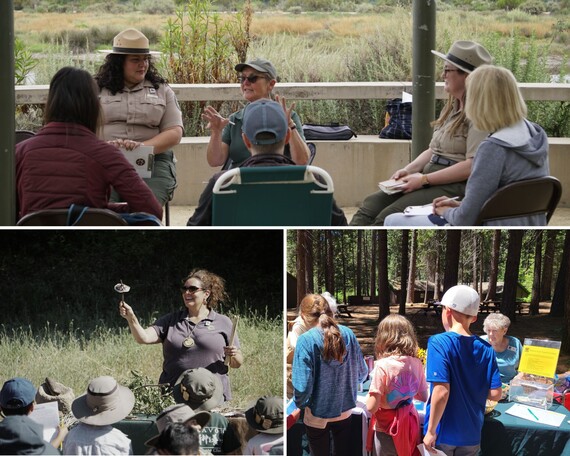 Top: Malibu Lagoon SB staff speak with visitors on how to start nature journaling. Bottom left: Malibu Creek SP staff hosted a Junior Ranger Program event. Bottom right: Calaveras Big Trees Association Volunteer Sue Hoffman welcomes youth during the career fair event. Photos from Angeles and Central Valley Districts.
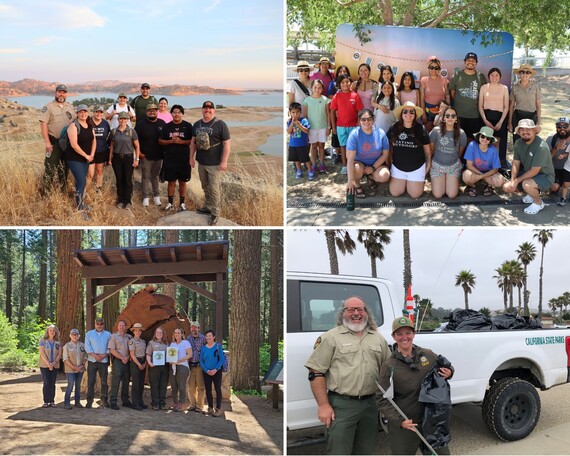 Top: Group photos of staff and visitors who attended State Parks Week at Millerton Lake SRA. Bottom left: Central Valley District staff at the Old Growth network dedication at Calaveras Big Trees SP. Bottom right: Oceano Dunes District staff Ronnie Glick and Laurel Rodger at the boardwalk and beach cleanup event. Photos from staff at Central Valley and Oceano Dunes Districts.
Volunteer Events Abound in Monterey District During California State Parks Week
Story from Sam Winter, Monterey District
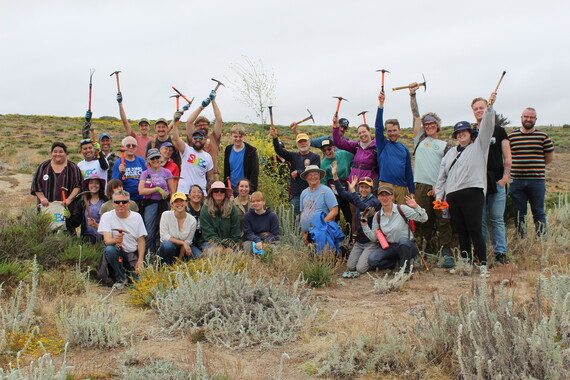 Volunteers pose triumphantly after the LGBTQ+ Volunteer Day at Fort Ord Dunes State Park on Saturday, June 17. Photo from Keira Silver, volunteer.
For California State Parks Week, the Monterey District’s Natural Resources Volunteer Program (NRVP) hosted a week of volunteer events in parks across the district. 85 volunteers contributed an astounding 255 hours of work removing invasive plants. In addition, these events created unique access opportunities by allowing members of the public to get up close and personal with areas most visitors do not get to see.
On Monday, June 12, volunteers and district staff gathered for a “broom bash” at Ishxenta State Park (SP). Participants helped remove invasive French broom from the beautiful Monterey pine forest and visited a patch of endangered Yadon’s rein orchard (Piperia yadonii).
At Point Lobos State Natural Reserve on Wednesday, June 14, volunteers worked to remove invasive velvet grass from Carmelo Meadow and were interviewed by local news station KSBW.
On Thursday, June 15, volunteers were joined by Environmental Scientist Aidan Sarbeck, Monterey District’s Wildfire and Forest Resilience Program lead, for a tour of last fall’s 86-acre prescribed burn plot at Andrew Molera SP. After the tour, volunteers and staff from the Office of County Supervisor Mary Adams removed invasive hemlock and thistle to protect the rebounding coastal prairie.
Friday, June 16, brought volunteers out to Asilomar State Beach for a morning of weeding along the storm-battered coastal trail.
Volunteers finished off the week with our largest-ever public volunteer day at Fort Ord Dunes SP. On Saturday, June 17, the NRVP teamed up with Salinas Valley Pride Celebrations and the California State Parks Foundation for our third biannual LGBTQ+ Volunteer Day. California State Senator John Laird and 47 volunteers teamed up to tackle invasive in the dunes, helping to improve habitat for the endangered Smith’s blue butterfly (Euphilotes enoptes smithi).
A big thank you to the volunteers, our partner organizations and Monterey District staff for making these California State Parks Week events a big success!
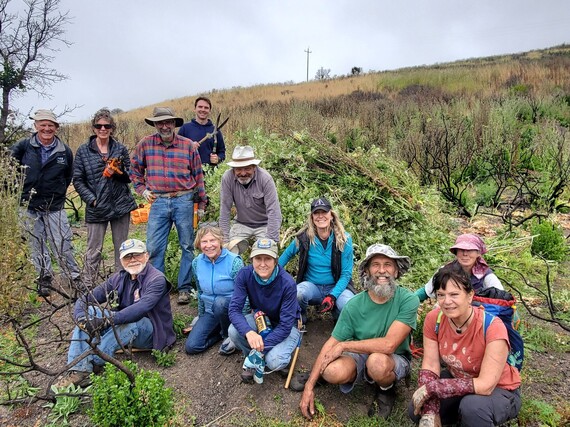 Volunteers and district staff pose with their pile of invasive hemlock at Andrew Molera SP on Thursday, June 15. Photo from Sam Winter, Monterey District.
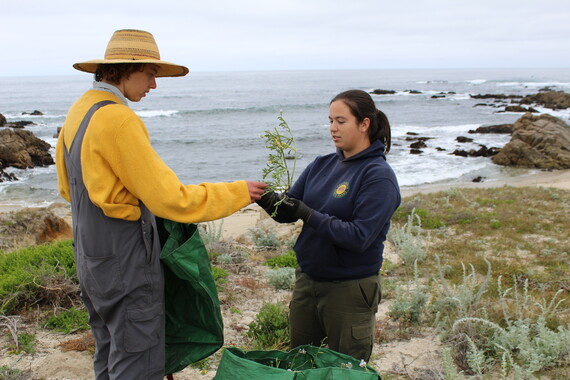 Forestry Aide Kylie Koestner (right) introduces volunteer Lainey Chatham to invasive European searocket (Cakile maritima) at Asilomar State Beach on Friday, June 16. Photo from Keira Silver, volunteer.
Leo Carrillo State Park Reopens for Camping After Storm Damage
Story and photos from: Lori Harrod and Brian Hisel, Angeles District
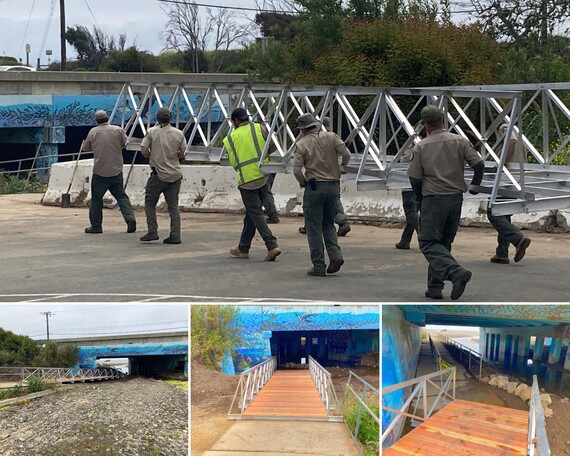 Angeles District staff installed a temporary bridge to provide beach access at the south beach area of Leo Carrillo State Park. The creek under that overpass is the Arroyo Sequit.
Angeles District is excited to announce that Leo Carrillo State Park (SP) is officially open again for camping and day use. Thank you to all the staff who worked tirelessly to repair and create safe access to the beach and campground. Some of the park’s features look a little different and are still in the process of being repaired. The park had been closed due to storm damage from the winter season.
The work was completely done with State Parks staff, consisting of the visitor services, maintenance and public safety staff, with the assistance of the Colorado Desert District Heavy Equipment Operator Adam Asche.
The silt and mud that covered the bottom portion of the campground about 6- to 8-feet deep was removed. The destroyed campsites were regraded, and new fire rings and picnic tables were purchased and replaced in about 40 campsites. Staff also removed several damaged trees, tree limbs and debris from the damaged areas of the campground. A new entry road was created to allow access while the damaged road awaits further repair. We also installed barricades along the damaged road, reconfigured the South Beach parking lot to allow ingress and egress, and installed a new pedestrian bridge to allow access to the beach.
The underpass to North Beach is still impassable and in need of repair, which is ongoing.
For those wishing to camp at Leo Carrillo SP, reservations can be made through ReserveCalifornia.com, although the campgrounds are almost nearly booked for the rest of the summer.
Angeles District thanks visitors for their patience as we continue to make improvements to the park.
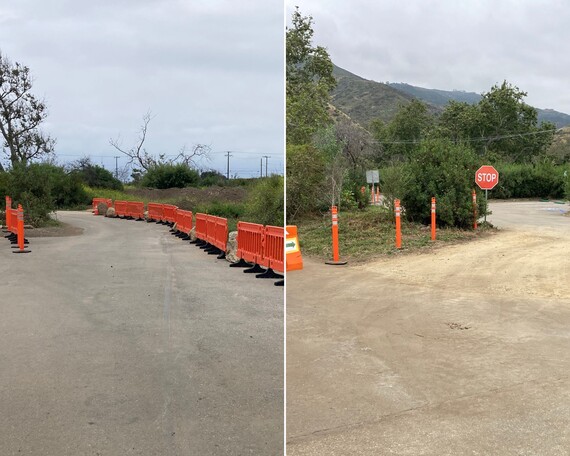 Left: New campground exit. Right: New campground entrance from day-use lots.
Sierra No. 3 at Railtown 1897 State Historic Park Readies for Federally Mandated Service Day Inspection
Story and photos from: Michael Ninneman, Central Valley District
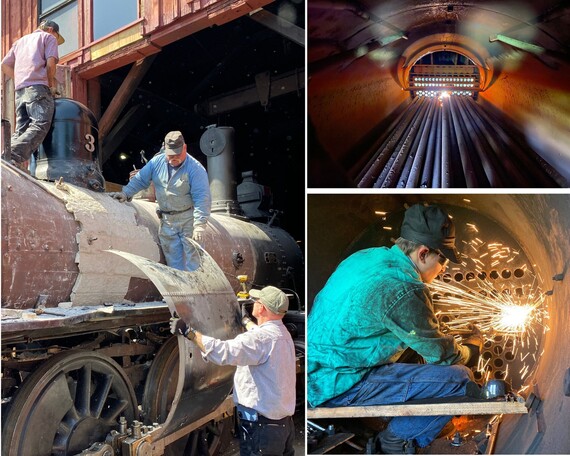 Left: Garrett Franklin, chief operations officer for Railtown 1897 SHP and with the California State Railroad Museum Foundation, assisting volunteer Paul Huston and Restoration Work Specialist Matt Sagaser to remove the boiler jacket. Top right: Inside the boiler. Bottom right: Senior Maintenance Aide Sean Berry-Kelly uses a torch to cut the old tubes out of the boiler.
Over the past few weeks, our mechanical team at Railtown 1897 State Historic Park (SHP) has been hard at work getting Sierra No. 3 ready for its federally mandated 1472 Service Day inspection.
This is necessary to certify the locomotive for operation under the U.S. federal code; the number “1472” refers to the number of service days that the locomotive can operate in total before receiving a comprehensive inspection on the locomotive’s boiler, as is being done now. The work included removing the fire brick from the firebox, fire tubes, boiler jacket, calcium silicate lagging (insulation), as well as various appliances and related plumbing.
Between 1996 and 2010, locomotive No. 3 went through an extensive overhaul and received a brand-new, all-welded steel boiler to replace the original riveted boiler from 1891. From its public debut in July 2010 to October of 2020, the locomotive operated reliably and has been Railtown 1897 SHP’s star attraction. The hope is to have the locomotive running before the end of the year.
Special thanks to the California State Railroad Museum Foundation for providing financial support for this project.
Division of Boating and Waterways Partners With San Joaquin County Sheriff's Office to Encourage Safe Boating Practices
Story and photos from: Joanna Andrade, Division of Boating and Waterways
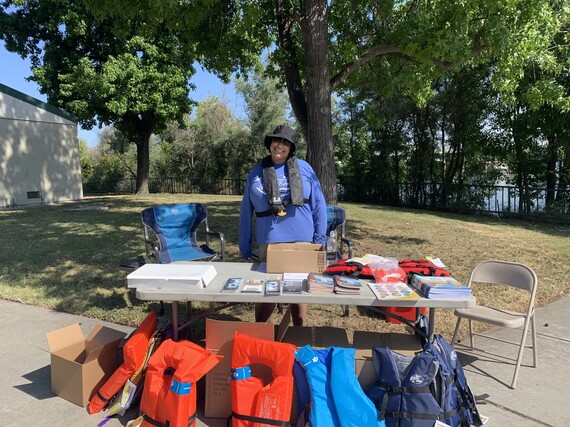 Division of Boating and Waterways Boating Safety Unit Analyst Monique Cabral.
On Memorial Day weekend, the Division of Boating and Waterways’ (DBW) Boating Safety Unit and the Quagga/Zebra Mussel Unit supervisor participated in an outreach event hosted by the San Joaquin County Sheriff's Office (SJCSO). The event took place at the Buckley Cove launch ramp and Morelli Park in Stockton, California, and Tower Park in Lodi, California. The purpose of the event was to educate the public on the proper safety equipment to have on board a vessel, such as wearing a life jacket and having a fire extinguisher, as well as the requirement to have a current Mussel Fee Sticker (aka Quagga mussel sticker) and a California Boater Card.
SJCSO also partnered with its Sheriff's Team of Active Retired Seniors, which is a group of volunteers ages 50 and up, who lend their time to serve the Sheriff's Office and the community for the promotion of crime prevention. Additional teammates supporting this event included the United States Coast Guard Auxiliary and Mothers Against Drunk Drivers. During this event, the teams were stationed at three different launch ramps throughout the county to talk with boaters as they headed out on the water.
After spending time on the ramp, the DBW team took to the water to observe SJCSO making vessel stops and see firsthand the impact of DBW’s programs and laws on boaters. During our ride-along, the team stopped boaters for not having a current Mussel Fee Sticker, which is required for all registered vessels boating in fresh water, as well as for riding on the transom of the vessel. After a boater was stopped, the SJCSO conducted vessel inspections to ensure 1) all carriage requirements were on board; 2) the operator had their California Boater Card, if required (as of Jan. 1, 2023, boaters 50 years of age or younger are required to have a Boater Card); and 3) the operator was not impaired. During one of the vessel stops, it was apparent that the boat operator was under the influence of alcohol. The operator was brought on board, and a Standard Field Sobriety Test was conducted. The operator was ultimately arrested for boating under the influence.
SJCSO continued to conduct enforcement stops and educate the public about safe boating practices throughout the holiday weekend. Ultimately, their goal was to ensure every boater who came out had fun and got home safely.
DBW appreciates the hard work of the San Joaquin County Sheriff's Office and thanks them for their continued partnership and dedication to safe boating.
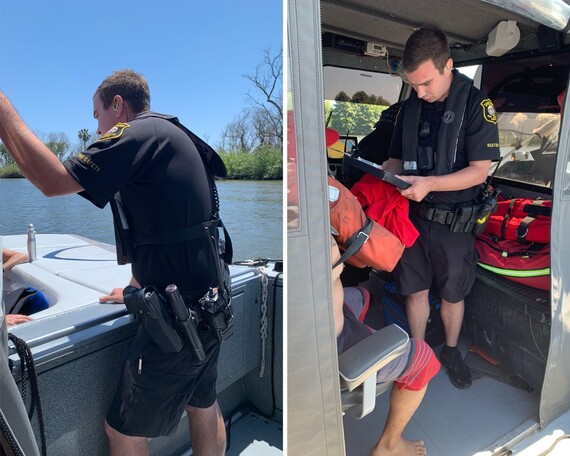 Left: Deputy J. Canepa from the San Joaquin County Sheriff’s Office (SJCSO) showing his California Boater Card to the public during an enforcement stop. Right: Deputy Canepa conducting a boating under the influence (BUI) stop.
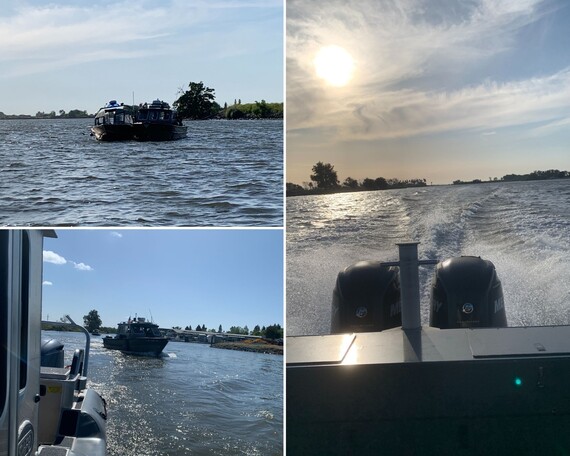 Top left: California Department of Fish and Wildlife and SJCSO conducting a joint stop for a BUI. Right: Riding into the sunset. Bottom left: San Joaquin County Sheriff headed out to ensure all boaters have a safe recreational experience.
Lost Coast Trail Maintenance Done at Sinkyone Wilderness State Park
Story from: Kevin Magallanes, Facilities Management Division
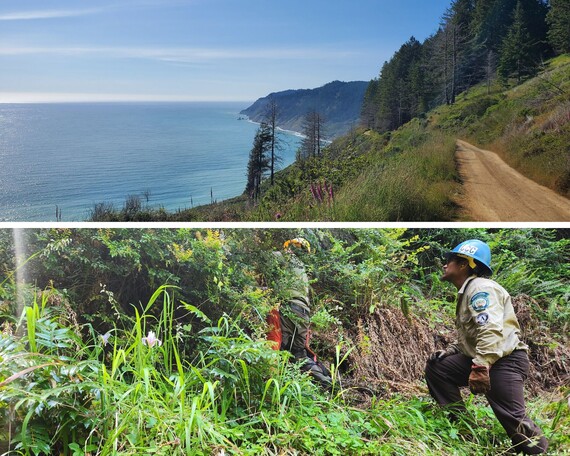 Top: Sinkyone Wilderness State Park coastline. Photo from Gardner Cline-James, Cannabis Watershed Protection Program. Bottom: CCC Backcountry Trails Program members stashing brush. Photo from Sam Tully, Cannabis Watershed Protection Program.
For the last seven weeks, the southern portion of the Lost Coast Trail located within Sinkyone Wilderness State Park (SP) has received much-needed maintenance. Since Sinkyone has not seen trail maintenance for an extended amount of time, the California Conservation Corps (CCC) Backcountry Trails Program partnered with the Cannabis Watershed Protection Program (CWPP) Roads and Trails team and the North Coast Redwoods District trails program to start efforts to brush and clear the roughly 22.1 miles of trail. The work provides better access for improved patrol, response, safe public recreation, facilities, natural and cultural resource management activities, and increased resource protection. The ongoing efforts will provide a more sustainable trail for the visitors to experience.
Over the years, downed trees and rockslides have diverted hikers off the original trail alignment and have forced visitors into taking alternative routes, causing accelerated erosion and user-created trails leading to increased resource damage. Starting at Usal Beach and working north toward the Needle Rock visitor center, the crews completed approximately 6.5 miles of trail brushing, ending the work near Anderson Gulch, a large campground that grants hikers a place to rest and filter water on their way to or from Usal Beach.
The 17-person interagency/district crew brushing and clearing the trail to department standards managed to average around 1,250 feet a day, while also navigating thick brush, downed trees, ticks, poison oak and many other obstacles.
The partnership between CCC and State Parks came from the inability of the CCC crew to enter the backcountry after the California mountain ranges experienced heavy snowfall this season. The last-minute decision to work in Sinkyone proved to be beneficial for both agencies.
This work is part of a larger maintenance effort that will occur over the next several years if CCC crews can be secured, allowing for additional improvements to make the Lost Coast Trail more sustainable in Sinkyone Wilderness SP.
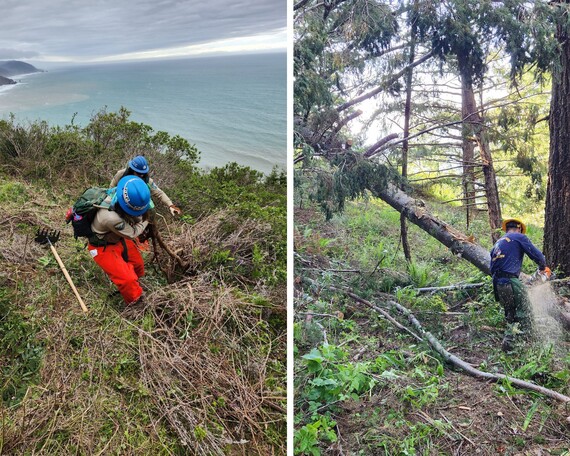 Left: CCC members working together to haul and stash brush on the Lost Coast Trail. Right: Park Maintenance Worker I Kevin Magallanes performing a log-out on trail. Photos from Sam Tully, Cannabis Watershed Protection Program.
'Get Out There!' With California State Parks and San Diego County Fair Now Through July 4
Story from: Alexandra Latona, San Diego Coast District
 After seven months of planning between three State Parks districts, San Diego County Parks and Recreation, and the San Diego County Fair, the 20,000-square-foot custom theme exhibition “Get Out There!” at the San Diego County Fair is complete. This year’s fair theme “Get Out There!” inspired San Diego County Fair planners to reach out to state and county parks to showcase the many opportunities for San Diegans to recreate.
San Diego County is home to 16 California state parks covering three districts: San Diego Coast, Colorado Desert and Ocotillo Wells. The three districts worked together with the county to create five distinct areas within the exhibit for fairgoers to explore and highlight the unique features of our parks: deserts and dunes; mountains and forests; rivers, lakes and lagoons; beaches and oceans; and historic parks. Each section also includes smell discovery stations to evoke the smell of the desert after a rain, the sulfur fumes of the deep sea and the smell of the blacksmith forge heating up.
District tribal liaisons invited Tribes to contribute content to the exhibition culminating in a section of the exhibit dedicated to sharing how to respectfully visit native lands. Stan Rodriguez, member of the Kumeyaay Nation, led a demonstration on the exhibit stage Sunday, June 18, on the construction of traditional tule boats.
In addition to the exhibit, fairgoers can pull up a seat at the Campfire Center to enjoy some traditional campfire programs presented by State Parks interpreters from Palomar Mountain State Park, Anza-Borrego Desert State Park and Silver Strand State Beach.
The theme exhibit is open from 11 a.m. to 10 p.m. through Tuesday, July 4. Learn more here.
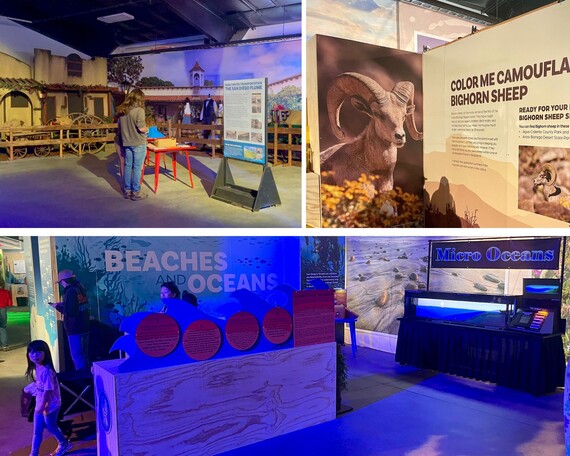 Top left: Visitors enjoy the recreated sights and smells of Old Town San Diego State Historic Park in the “Get Out There!” exhibition. Top right: Exhibits were written and designed by a team from California State Parks and San Diego County of Parks and Recreation. Bottom: Fairgoers explore the beaches and oceans of the San Diego coastline, including the importance of Marine Protected Areas. Photos from Alexandra Latona, San Diego Coast District.
Carrier Pigeon Day at Pigeon Point Light Station State Historic Park
Story from: Julie Barrow, Santa Cruz District
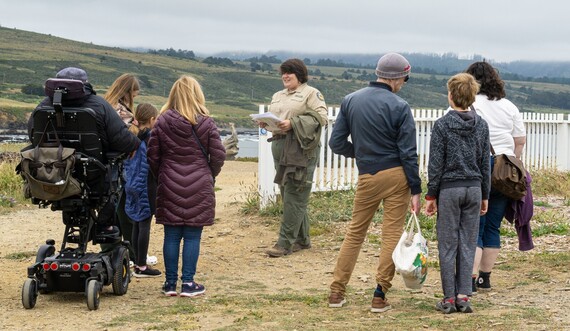 Interpreter Elizabeth Crowley shares stories of the shipwrecks at Pigeon Point.
Pigeon Point Light Station State Historic Park staff hosted Carrier Pigeon Day to honor the 170th anniversary of the wreck of the Carrier Pigeon for which the site is named on Saturday, June 10. Having sailed from Boston around Cape Horn, the ship was a day from its destination of San Francisco, when it crashed into the rocks off what was then called Punta de Ballenas, or Whale Point.
Throughout the afternoon, visitors could learn about knot tying and other nautical activities from members of the Santa Cruz Sea Scouts Ship 669 (SSS Pearls). Children and adults could make signal flags to spell out their name, sing along as sea shanties played in the background, go on a scavenger hunt to learn more about the lighthouse or take a guided shipwreck history tour around the park. Participants had a good time and left smiling!
Empowering Our Future Stewards at Plumas-Eureka State Park Through Partnerships and Collaborations
Story and photos from: Genomé Rodriguez, Sierra District
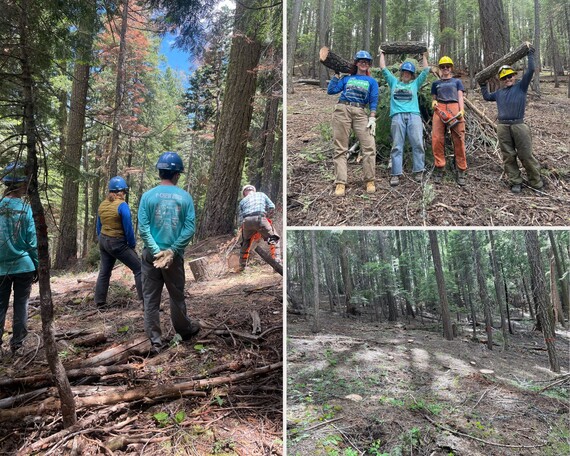 Left (left to right): Plumas Conservation, Restoration and Education in Watersheds Program (P-CREW) youth member, P-CREW Lead Gilian Meyers, P-CREW youth member and Feather River RCD Fuels Crew Lead Mike Berardino. P-CREW members and Gilian watching sawyer Mike cut slash that will be added to the burn piles. Top right (left to right): Sylvia Seay, P-CREW assistant crew lead; Lilith Eve Martin, P-CREW crew member; Hayden Lampe, Feather River RCD fuels technician; and Casey Porter, Sierra District FMC forestry aide. P-CREW, Feather River and Sierra District’s FMC crew members pose in front of a recently created burn pile. Bottom right: Thinning work completed on the foreground with marked trees and work to be done in the background.
This week, Plumas-Eureka State Park received much-needed support on the fuel-reduction work on the east side of the park. This collaboration is between Sierra District’s Fire Management Crew (FMC), Sierra Institute’s Plumas Conservation, Restoration and Education in Watersheds Program (P-CREW) youth crew, and the Feather River Resource Conservation District (RCD) crew. The goal is to implement a thinning treatment on a section of the park that has not had any documented forest management since the logging era. Sierra District’s FMC and the RCD crew are the sawyers implementing the thinning while providing learning and working opportunities for the P-CREW to practice forest management application by building burn piles.
The P-CREW program is developing the next generation of natural resource stewards through work experience, field-based education, personal growth and professional development. These youth are uniquely connected through the Feather River watershed and come from local rural towns near the park and downstream into the East Bay. The Feather River RCD provides the youth with scientific and technical assistance to develop and strengthen their work experience with action-based learning opportunities.
This landscape-scale restoration work requires building partnerships, collaboration and stewards across generations.
  Email photos to the WeeklyDigest@parks.ca.gov.
|