U.S. Fish and Wildlife Service Spends Day in Delta With Division of Boating and Waterways
Story from: Ethan Tratner, Division of Boating and Waterways
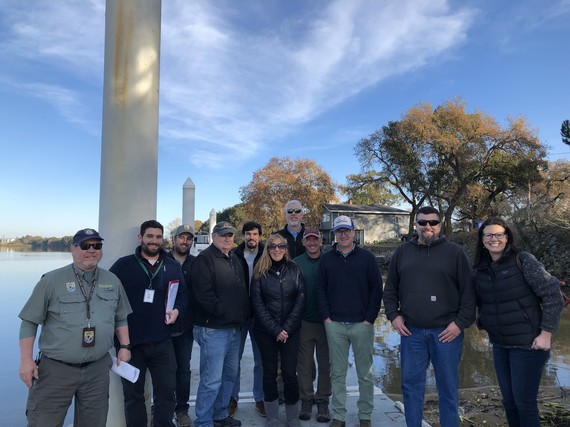 Boating Infrastructure Grant Merit Review Team with State Parks and Division of Boating and Waterways staff at Isleton Waterfront Public Dock. Photo from Division of Boating and Waterways.
The Division of Boating and Waterways (DBW) hosted the United States Fish and Wildlife Service (USFWS) Boating Infrastructure Grant Merit Review Team last month from December 12-15.
The Boating Infrastructure Grant (BIG) is a national grant program that funds improvements for recreational boaters with vessels 26 feet or more that stay no more than 15 days at a location. The intent of the program is to provide safe mooring and shoreside access for recreational boaters with nontrailerable vessels that tour our beautiful waterways, either on short day trips or multiday excursions. Fundable improvements can also include boater showers and laundry facilities, fuel and pumpout docks, and navigational aids.
The program is managed by USFWS, and California State Parks’ Division of Boating and Waterways is the designated state entity that administers the grant program in California. Since the program’s inception in 2000, California has been awarded over $18 million for 37 boating infrastructure projects, partnering with 27 public and private entities. Currently, DBW is administering six projects, which are in various stages of the design and construction process.
The Merit Review Team is comprised of USFWS headquarters program staff, boating program staff from USFWS regional offices, representatives from the States’ Organization for Boating Access, and the Sport Fishing and Boating Partnership Council. This team scores the nationally competitive BIG Tier 2 applications, which can fund up to $1.5 million per project, and selects the projects to be awarded. This year, the team chose Sacramento as their meeting location for the in-person scoring process. Capital District provided the Stanford Gallery meeting room for this event, and the team stayed in Old Sacramento State Historic Park onboard the Delta King Hotel.
With the scoring process completed on Wednesday, Dec. 14, 2022, the team was available to take a site visit the next day. DBW staff led the team on tours of three previously awarded BIG project site locations. Local partners met us and provided the USFWS an update on the grant, design, permitting and construction process, and the unique challenges of completing their BIG-funded infrastructure projects. They also provided an update of how those completed facilities are being used by boaters today.
We visited the Etenesh Zelenke Public Dock built in partnership with the City of West Sacramento, the Rio Vista Guest Dock at the Waterfront Promenade built in partnership with the City of Rio Vista, and the site of the proposed Isleton Waterfront Marina Dock, partnering with the City of Isleton.
While in Rio Vista, California, the team was also able to tour the Rio Vista Boat Launching Facility public access site, which completed a renovation in 2021 using a Boat Launching Facility grant issued and administered by DBW and funded from the Harbors and Watercraft Revolving Fund.
The BIG program provides resources for thousands of California’s recreational transient boaters, and DBW looks forward to a continuing partnership with USFWS and other local partners to provide access and resources for this important user group. DBW accepts BIG grant applications annually in July.
For more information on the BIG program, click here to visit DBW’s Grants and Loans webpage.
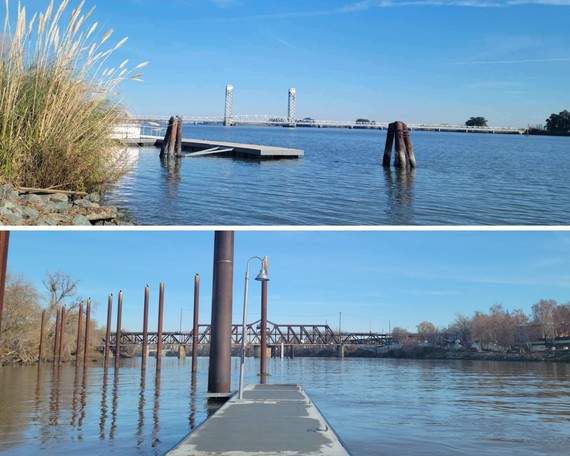 Boating Infrastructure Grant (BIG) national grant recipients. Top: Rio Vista Guest Dock. Bottom: Etenesh Zelenke Public Dock. Photos from Division of Boating and Waterways.
Historic 1920s Snowplow and 'Snowbound in the Sierra' Exhibit Return to California State Railroad Museum
Story and photos from: California State Railroad Museum Foundation
 The 1920s rotary snowplow now on display at the California State Railroad Museum.
Visitors to the California State Railroad Museum once again have the opportunity to see, back by popular demand, an impressive 251,000-pound rotary snowplow from the museum’s collection, along with exhibit "Snowbound in the Sierra."
With the historic snowplow as an eye-catching centerpiece, the exhibit highlights the dramatic story of 226 passengers and crew members who were rescued—with the help of crews working around the clock and seven rotary snowplows—after being trapped on a luxury streamliner locomotive during a massive snowstorm in the Sierra Nevada in 1952. The exhibit includes riveting narrative from passengers and crew.
On display in the museum's roundhouse, the historic rotary snowplow was built in 1920, converted to electric in 1958, retired by Union Pacific in 2004 and donated to the Railroad Museum in 2008. Since then, the historic snowplow has been housed in the Shops in the Sacramento Railyards.
The rotary snowplow and the companion "Snowbound in the Sierra" exhibit will remain on display in the museum’s roundhouse at least through spring 2023 and are included with the museum admission: $12 for adults, $6 for youths ages 6-17 and free for children ages 5 and under.
For more information about the snowplow, exhibit or the California State Railroad Museum, please visit www.californiarailroad.club.
Dive Team Commemorates 50 Years of Collaboration With Scripps Institution of Oceanography
Story from: Kenneth Kramer, Training Section
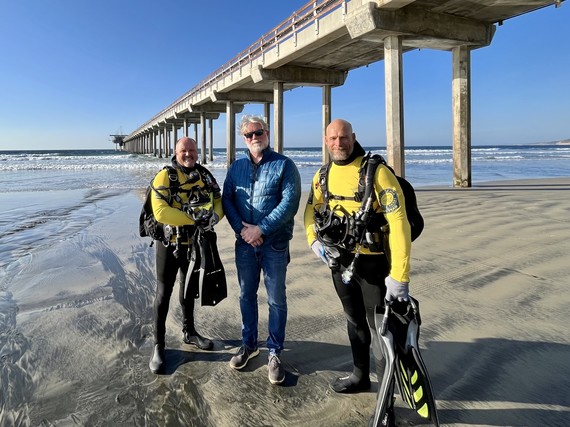 Left to right: Department Diving Safety Officer Ken Kramer (Training Section), UCSD-Scripps Diving Officer Christian McDonald and SPPO (Lifeguard) Tim Gunther (San Diego Coast District) at Scripps Pier in La Jolla, California. Photo from Training Section.
Fifty years ago in December 1972, department scuba divers James Barry (Natural Resources), Casey Buchter (Director's Office) and Lifeguard Garry Harvey were among the first State Parks employees to complete an intensive 100-hour scientific diver training course at the renowned Scripps Institution of Oceanography (Scripps) instructed by legendary Diving Officer and scientific diving pioneer James R. Stewart.
The Scripps training guidelines, originally created by Stewart and others in the 1950s, form the basis for the American Academy of Underwater Sciences diving manual, still considered the bible for the scientific diving community. Several generations of State Parks divers attended the Scripps course until the late 1990s when the training transitioned in-house and is now provided by department diving instructors.
For the past half-century, Scripps has provided invaluable support to the department by helping to promote safe diving practices, assisting with program management and advising on training development and technology innovations.
To commemorate the 50-year milestone, State Park divers suited up and jumped into the water from the end of the Scripps Pier, navigated underwater back to shore and then treated current Scripps Diving Officer Christian McDonald to lunch while reminiscing about the evolution of scientific diving.
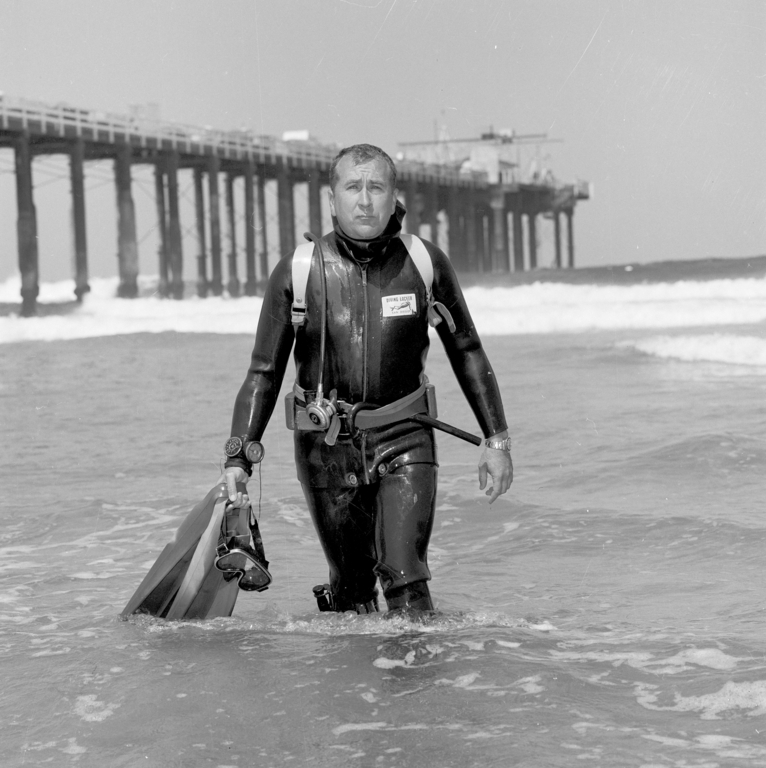 UCSD-Scripps Diving Officer James R. Stewart at Scripps Pier, circa 1970. Stewart served as the diving safety officer and scientific diving instructor for State Parks from the early 1970s to the late 1990s. Photo from Scripps Institution of Oceanography.
Annual Victorian Christmas Crafts Workshop Returns to Sonoma State Historic Park
Story and photos from: Tyler Barkley, Bay Area District, and Yvonne Bowers, Sonoma Petaluma Parks
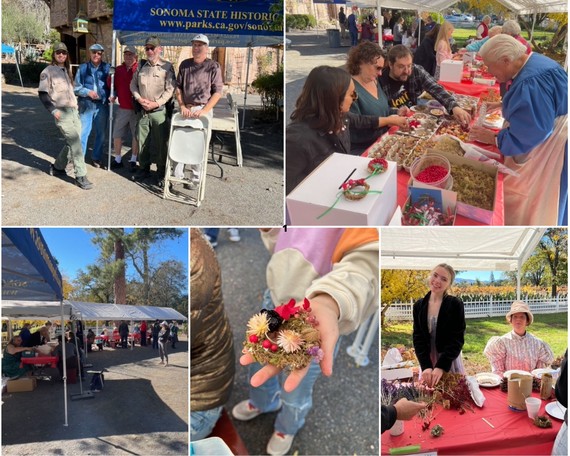 Top left (left to right): Setup crew: Frank Silva, Sonoma Petaluma Parks President Jim Danaher, volunteer Mike Cox, Supervising Ranger Rob Pickett and volunteer Jay Haney. Top right: State Parks volunteer Kit Foster helping attendees make wreaths. Bottom left and middle: Crafts workshop. Bottom right: State Park Groundskeeper Erin Mitchell (seated) and her daughter, Shiloh, in period attire, making pine cone bird feeders and dried flower crafts.
On a picture-perfect fall day and after a two-year hiatus due to the pandemic, Sonoma Petaluma Parks Inc. held its 31st Annual Victorian Christmas Crafts Workshop at the General Vallejo Home, which is part of Sonoma State Historic Park.
Over 30 volunteers and State Parks staff hosted the many children and adults, who created memorable Victorian ornaments at 11 craft tables. Santa Claus was on hand to hear holiday wishes and pass out candy canes. A wonderful time was had by all.
Teaming Up to Restore Native Habitat at Great Valley Grasslands State Park
Story and photo from: Amber Stegner, Central Valley District
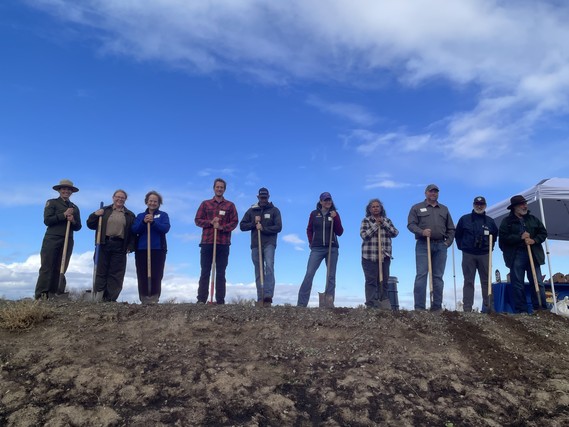 Left to right: Central Valley District Superintendent Danielle Gerhart, Natural Resources Program Manager Heather Reith, U.S. Fish and Wildlife Service (retired) Refuge Manager Kim Forrest, Project Manager for American Rivers Daniel Nylon, Mark Thompson with Flow West, Amy Merrill with American Rivers, Kathy Perez with North Valley Yokuts, Matt Kaminski with Ducks Unlimited, John Cain with River Partners and Daniel Burmester with California Department of Fish and Wildlife.
State Parks’ partners in the Floodplain Restoration project gathered for a groundbreaking ceremony on Monday, Dec. 5, 2022, at Great Valley Grasslands State Park. These partners include American Rivers, River Partners, Ducks Unlimited, U.S. Fish and Wildlife Service, The Levee District and Indigenous representatives from the local tribe.
This restoration effort will use a combination of hand-pulling non-native weeds, burning and flooding through the demolition of levees surrounding the 224-acre inundation area. The project consists of a total of 400 acres at Great Valley Grasslands and will once again support the native California grasslands and the species reliant on this habitat.
This project showcases what can be accomplished when private and public agencies work together to create change in the landscape and reimagine land use.
Whale Tail Art Debuts at Fort Ord Dunes State Park
Story from: Lisa Bradford, Monterey District
 Left: Whale tail panel. Photo from Lisa Bradford, Monterey District. Right: Lisa Bradford and Era Glasby in front of panel. Photo from JuJu Kim, Era’s mother.
In the months of December and January, a great collaborative effort happens between California State Parks and the Coastal Commission via the “King Tides” programs carried out at many coastal state parks. The Coastal Commission also sponsors an Annual Art and Poetry Contest; another collaboration that many State Parks interpreters get involved in with their local communities.
Working in the expansive coastal Monterey District, the legacy of ocean-inspired art—beginning with our first Indigenous tribal communities, to the bohemian artists and poets of the late 1800s, to the numerous present-day artists who call the Monterey Peninsula home—has a spiritual connection for visitors and residents alike. Over the years, there has been ample opportunity to encourage numerous teachers and students to participate in the Annual Art and Poetry Contest.
In updating a series of interpretive panels at Fort Ord Dunes State Park in 2021, I wanted to include artwork for one of the new panels and remembered student artwork previously seen on the Coastal Commission’s website. I clicked over to peruse the gallery of artwork submitted for the 2021 Annual Art and Poetry Contest winners and honorable mentions. To my delight, I came across a wonderful painting done by a local student Era Glasby, then a kindergartener at Big Sur Charter School. Era’s teacher had encouraged her students to participate in the Art and Poetry Contest. Era submitted his work, “Sunset Whale Tail,” which was awarded an honorable mention.
The powerful imagery of the whale’s flukes painted against a backdrop of the blazing setting sun and ocean stretching into infinity immediately conjures up the feeling of walking the coastal trail at Fort Ord Dunes State Park on a late afternoon during whale migration season. The Coastal Commission graciously forwarded contact information for Era’s parents, and I worked on getting permissions and visual media releases in place. The “Sunset Whale Tail” panel was installed in May 2022.
In August last year, I had the opportunity to interview Era alongside his beautiful artwork to get a little more information from this young artist. I asked him, "How did you get interested in doing this artwork?" Era replied, "My teacher let students know about this art contest. I was at the beach with my dad, and we kept seeing whale tails and spouts, which led to the idea of me painting what we were seeing."
There is still time to participate in the current contest—the deadline is Saturday, January 31. Follow this link for the full guidelines and details.
Christmas Bird Count at Carpinteria State Beach
Story from: Christina Furio, Channel Coast District
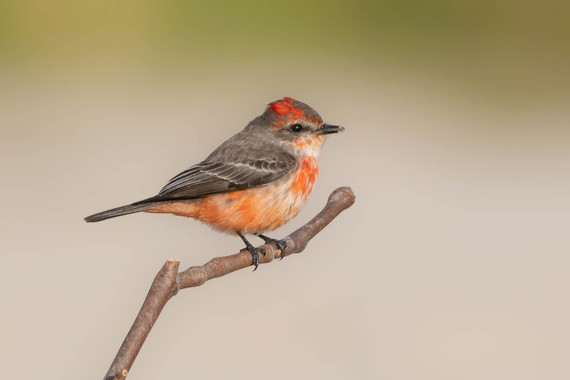 Immature male vermillion flycatcher. Photo from Sophie Cameron, Carpinteria Bird Watchers.
On Saturday, Dec. 17, 2022, Environmental Scientist April Randol and I participated in the annual Carpinteria Christmas Bird Count at Carpinteria State Beach. The birding event was led by Sophie Cameron of the Carpinteria Bird Watchers. Birding enthusiasts participated in the event to provide scientists with critical data on bird populations in Santa Barbara County via the eBird database.
Diverse species of birds were spotted on the beach and in the campground. Favorites included the Heermann's gull, northern pintail, spotted sandpiper, red-breasted merganser, horned grebe, say's phoebe and red-tailed hawk. An appearance by the vermillion flycatcher, native to Mexico and rarely found in this part of North America, was a highlight of the outing.
Later, I joined Park Interpretive Specialist Karen Griffin for an event on the beach to educate visitors about common birds found at Carpinteria. Park guests could participate in making a seagull craft, explore literature about Carpinteria’s migrant and resident avian species, or check out binoculars and field guides for birding opportunities along the shore and near Carpinteria Creek.
This event was informative and fun and, most importantly, allowed participants to learn more about birding and the different bird species found at Carpinteria State Beach. Park employees hope to continue this annual tradition to help deepen an appreciation and respect for diverse avian species found along the California Coast.
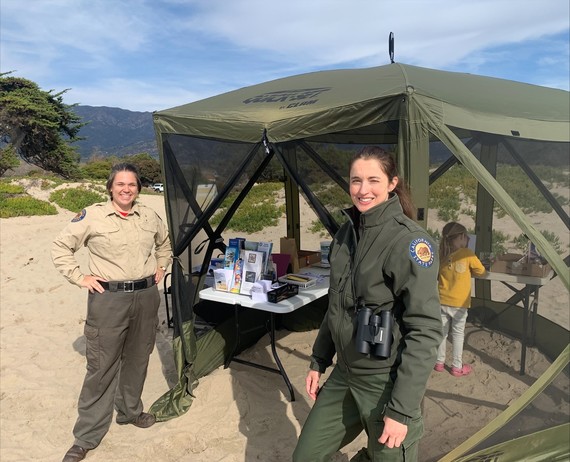 Park Interpreters Karen Griffin (left) and Christina Furio at the Carpinteria Christmas Bird Count event. Photo from Dave Wilson, Channel Coast District.
Benicia Capitol State Historic Park Celebrates Holiday Season
Story and photos from: Julio Ortiz, Diablo Range District
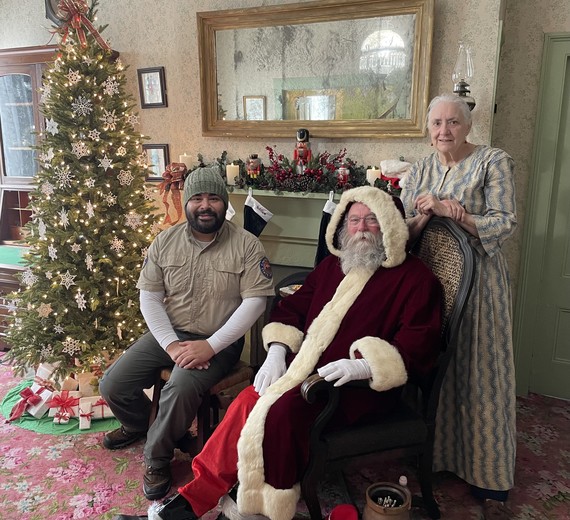 Left to right: State Park Interpreter I Julio Ortiz, Santa portrayed by volunteer David Brown and volunteer Diana King.
Following a three-year break, Benicia Capitol State Historic Park (SHP) brought some Victorian holiday cheer over the Dec. 10 and 11, 2022, weekend. Families had the opportunity to make memories that will hopefully last a lifetime, as sweet treats of cookies, spiced cider and hot chocolate were available to visitors in the Fisher-Hanlon house kitchen, and Jolly Old St. Nicholas paid a visit in the dining room to the delight of many children.
Our Santa Claus was portrayed by first-time volunteer David Brown from Martinez, California. Brown, a veteran and semi-retired real estate agent, had been out to dinner one evening when our longtime volunteer Diana King bumped into him and asked, “Would you like to be Santa Claus?” King saw the well-groomed natural beard Brown had and thought it wouldn’t hurt to ask. Brown agreed and did a wonderful job, exceeding our expectations. He enjoyed this experience so much, he is looking forward to doing it again next year.
In addition to Santa, children were also able to make Victorian-inspired ornaments at the historic Benicia Capitol, an activity in part organized and overseen by the local Girl Scout troop. Volunteering Girl Scouts dressed up in period clothing and helped the young children make a variety of easy, yet period-appropriate, ornaments. Any money collected from this activity is donated to the Benicia State Parks Association, which helps us fund various elements of the festivities that occur over the weekend.
Although the rain and slight Santa saturation that occurred did affect our projected attendance, those families who attended the jolly weekend event had a great time. The introduction of a preregistration option, which allowed families to reserve a dedicated time slot, made the planning and coordination much easier. Children were given a six-minute timeslot, with an 18-minute cap for families with three or more children.
Benicia Capitol SHP was happy to finally be able to join the December 2022 festivities and once again host our own weekend event. We look forward to providing these opportunities for more family memories next year.
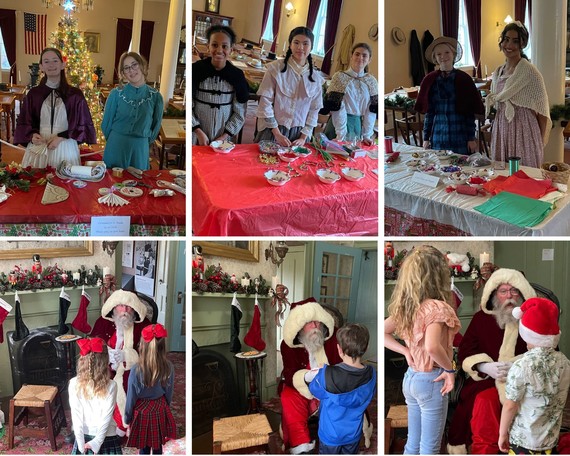 Top photos: Local Girl Scouts help run the ornament-making activity. Bottom photos: Volunteer David Brown takes on the role of Santa at the holiday event at Benicia Capitol State Historic Park.
38th Annual Christmas in the Adobes Event Shines Despite Foul Weather
Story from: Richard Fletcher, Monterey District
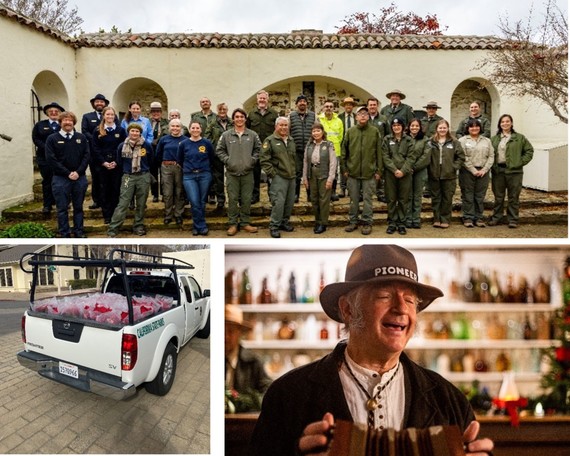 Top: The intrepid staff of the Monterey District who made Christmas in the Adobes possible. Photo from Brian Baer, Communications and Marketing Division. Bottom left: Event prep included a truckload of poinsettias being delivered to various historic buildings. Photo from Richard Fletcher, Monterey District. Bottom right: Volunteer Kevin Hanstick portraying local larger-than-life figure Jack Swan in California's First Theater. Photo from Brian Baer, Communications and Marketing Division.
The employees of the United States Postal Service are not the only ones who deliver in inclement weather. On Dec. 9 and 10, 2022, Monterey State Historic Park’s annual Christmas in the Adobes event kicked off just in time for the storm of the year to hit the central coast.
For those not familiar with the event, it’s a large annual fundraiser. Think of it as a historic building block party that spans much of downtown Monterey and raises money for building restoration and educational programs. Visitors have the opportunity to explore historic buildings, many of which are normally closed to the public, all festively decorated and offering entertainment such as music, dancing and caroling. This year, a brand-new portraiture exhibit was installed for the event and was greatly enjoyed by visitors.
Friday night was beautiful, and the event was busy! Rain began falling just as the event was winding down that night. The rain became heavier and strong winds began picking up, but the event wasn’t over yet. As State Parks staff began prepping for the event Saturday afternoon, a few surprises were in store. After 2 inches of rain, a particularly heavy downpour caused the walkway outside of the Pacific House Museum to start flooding. Thankfully, State Parks maintenance staff were able to clear a blocked drain just in time for the event to start.
Luckily for the visitors, the rain mostly paused for the evening. Eventgoers brave enough to challenge the elements were treated to a more personal experience in the adobes due to the lack of crowds. Although attendance was low, people’s spirits seemed high as they enjoyed the festivities. If anything, the brightly lit, warm adobes were all the more welcoming for visitors to come and escape from the winter weather and find some holiday cheer.
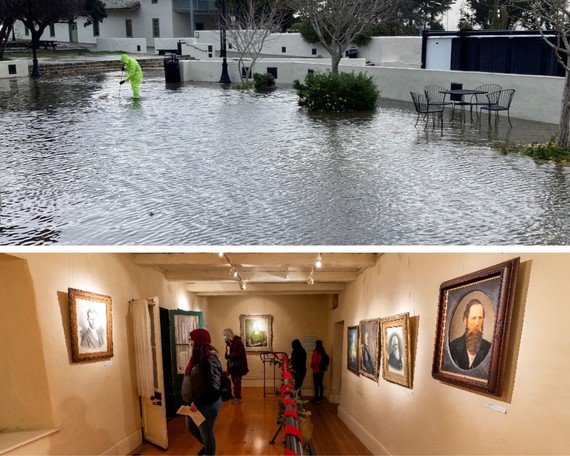 Top: Moments before the event was due to begin, the park was suddenly underwater. Park Maintenance Worker II Alex Franck (pictured here) and the maintenance crew saved the day by draining the water. Photo from Richard Fletcher, Monterey District. Bottom: Eventgoers learn about how people in the past communicated using personal adornment at the popular new portraiture exhibit. Photo from Brian Baer, Communications and Marketing Division.
Empire Mine State Historic Park Docents Give Tours of North Star Mining Museum
Story and photos from: Jean Rhyne, Sierra District
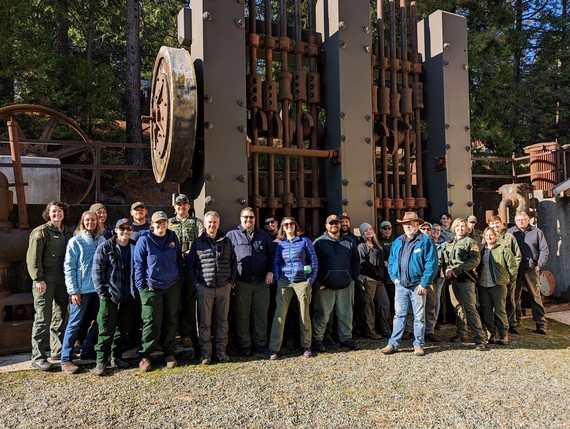 Sierra Gold Sector staff in front of a stamp mill.
Empire Mine State Historic Park docents Steve Ruble and George Sanford recently led tours for park staff and docents through the neighboring North Star Mining Museum in Grass Valley, California, where they also serve as docents. In addition, Mining Museum docents Issac Johnson and Gary Smith assisted with the tours.
The museum features working exhibits and hundreds of examples of the hard-rock mining equipment used during the heyday of Empire Mine, such as a stamp mill, which was used to crush rock in the gold extraction process; a Cornish pump to remove groundwater from the mines; and a dynamite-packing machine.
The museum tour guides turned on the equipment to demonstrate how they worked, including the largest known Pelton waterwheel ever made. The 30-foot wheel had been abandoned in a field, where generations of locals played on it like a Ferris wheel until it was restored to its original place in the North Star Mine powerhouse, which is now the museum. The Pelton wheel powered the mining operation by catching flowing water in cups around its edge, which drove the compressors that powered the mining equipment.
Outside the museum, a Cornish water pump had been restored to demonstrate how technology brought by miners from Cornwall, England, allowed hard-rock mining to continue in shafts below the water table: A smaller Pelton wheel turned a reciprocating rod, which pulled water from the shafts up past a one-way valve, and then deposited it away from the mine.
Empire Mine State Historic Park staff and docents were thrilled to see the mining equipment moving and developed a much deeper understanding of how the operation would have looked a century ago. Thank you to Steve for organizing the tour and to all the docents from North Star Mining Museum for the educational experience.
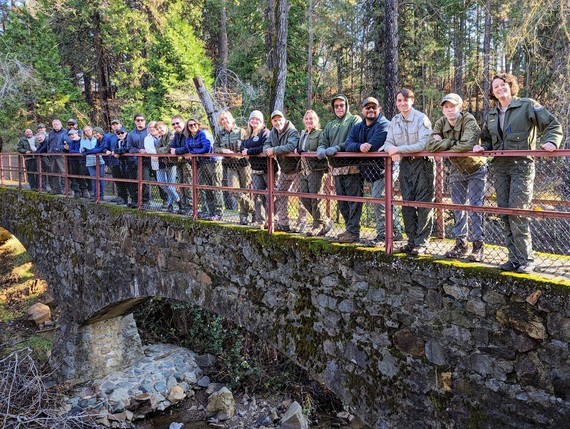 Sierra Gold Sector staff on the powerhouse aqueduct bridge that has been converted into a footbridge.
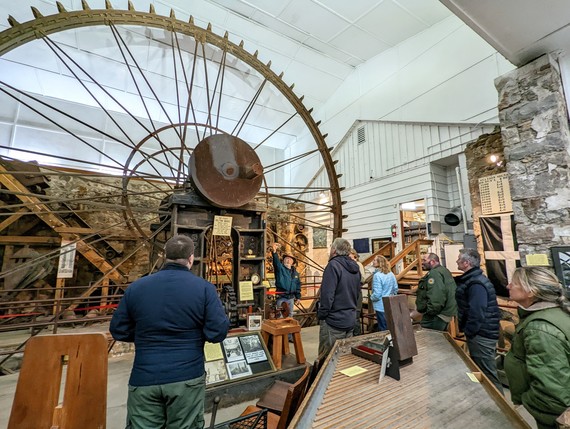 Docent Steve Ruble demonstrates the largest known Pelton wheel for peace officer, maintenance and administrative staff.
 Email photos to the WeeklyDigest@parks.ca.gov.
|