Off-Highway Motor Vehicle Recreation Division Encourages ‘Train for the Trail’ During OHV Safety Awareness Week, October 15-23
Story from: Jorge Moreno, Communications and Marketing Division
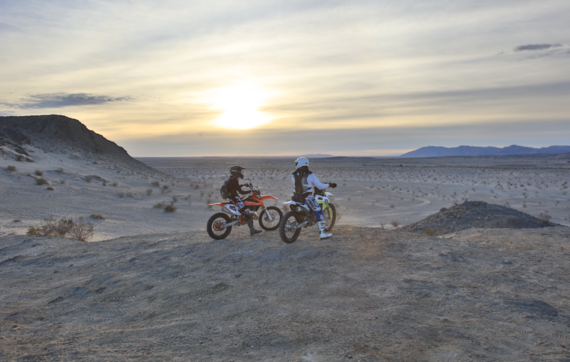 The Off-Highway Motor Vehicle Recreation (OHMVR) Division and partners kick off and welcome the return of the second OHV Safety Awareness Week this year, beginning Saturday, October 15, through Sunday, October 23, with the theme “Train for the Trail.” As part of the safety awareness week, the OHMVR Division and partners will hold several FREE safety training courses and events throughout California’s state vehicular recreation areas (SVRAs). New and experienced off-highway vehicle (OHV) recreation enthusiasts can learn something new by taking classes while riding in all-terrain vehicles (ATVs), dirt bikes and recreational off-highway vehicles or side-by-side vehicles (ROVs).
Additionally, as part of the weeklong celebration, Prairie City SVRA will hold a visitor appreciation and safety day this Saturday, October 15, starting at 10 a.m. Visitors can—for free—spend the weekend enjoying overnight camping in the main staging and day-use areas. Local OHV businesses will be on-site to talk about customizations, do-it-yourself remedies and safety tips. On Saturday, October 22, visitors can help keep Hollister Hills SVRA spotless with its annual Clean Wheeling trash pick-up event. Starting at 8 a.m., this free, family-friendly four-wheeling event is held in the Upper Ranch and Hudner Ranch. A free day-use pass and lunch will be provided by the Hollister Hills Off-Road Association. Participants are advised to bring gloves, water, sunblock and a hat.
Practicing responsible OHV recreation safety measures such as taking a safety course, learning the rules of riding, planning travel routes in advance, using required equipment and treading lightly help promote safety in the SVRAs and protect the natural resources that make these public outdoor spaces special.
Below are some important safety tips for new and experienced riders:
-
Take a Safety Course: Learn the fundamentals of operating off-highway vehicles by taking a training course, which can help you become a more experienced rider. Become familiar with the laws governing off-highway recreation on public lands and safety courses by visiting the webpage of your outdoor destination prior to leaving home.
-
Buckle It Up: Know which gear is required for your type of recreation to prevent injury. Secure all harnesses and safety equipment. Helmets and restraint devices are most effective when following the manufacturer’s instructions. Make sure they are securely and always buckled. Always wear protective gear, including a safe, well-fitting helmet.
-
Ride Respectfully: Community is the foundation for maintaining off-highway recreation. Respecting natural resources, wildlife and other off-highway recreators, and following off-highway regulations help preserve the natural landscapes for generations to come.
-
Be Prepared: Know which supplies you need for a successful ride. Be prepared with a first aid kit, extra water and food, maps, a tool kit and extra fuel.
-
Tread Lightly: Know where to ride, and ride only on designated routes and trails. Be sure to check ahead for open trails. Remember, wildlife has the right-of-way.
For more safety tips and to read the full press release, click here.
Ocotillo Wells and Hungry Valley State Vehicular Recreation Areas Team Up for Desert Lifeguard Training
Story from: Derek Donaldson, Ocotillo Wells District
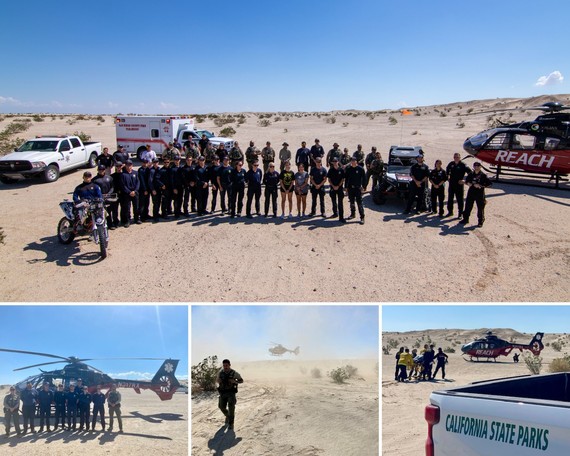 Top: Group photo of the Desert Lifeguard Training at Ocotillo Wells State Vehicular Recreation Area. Bottom left: State Park Peace Officer (SPPO) Haley Lubben; Desert Lifeguards Rafael Saldana, Daniel Lazar, Joe Waxtein, Christian Boewe, Eli Lapidus, Emma Sainbury-Carter, Maddie McCaw; and SPPO Joseph Kurtz. Middle: Ranger Chris Mendoza. Right: Desert Lifeguards and CAL FIRE Station 54 load patient on Reach 9. Photos from Desert Lifeguard Training staff.
Over the September 30 through October 2 weekend, staff from Ocotillo Wells State Vehicular Recreation Area (SVRA) and Hungry Valley SVRA teamed up to put on the annual Desert Lifeguard Training Weekend. For over 25 years, the Desert Lifeguard Program has been bringing experienced seasonal lifeguards from coastal and inland waterways to Ocotillo Wells SVRA to assist with the increase in medical aids during the off-highway vehicle riding season. Over time, the program later expanded to other SVRAs like Hungry Valley. The training provides a chance for new and returning guards to sharpen their skills and gain valuable experience working with the traumatic injuries and difficult terrain typically found in SVRAs. This was the first year both Ocotillo Wells and Hungry Valley SVRAs brought their respective crews together to participate in this training.
On Saturday, the day was led by the Training Section, which included EMT and PSFA (Public Safety First Aid) skills rotations for desert lifeguards and state park peace officers (SPPO). Participants also carried out a “Med Bag Dump” to check all medical equipment and increase familiarity with the tools and gear carried. After sunset, seven mini-scenarios were set up to simulate various types of injuries often found in the SVRA environment. The desert lifeguards worked in teams with SPPOs to give appropriate treatment to each patient. Training environments do not typically include the unique challenges brought on by nighttime operations, making this aspect of the training extremely valuable.
Sunday’s training consisted of park-familiarity exercises and an introduction to off-road navigating, ultimately leading to the main event: a large-scale mass casualty incident (MCI) scenario. Two groups of 12 desert lifeguards and SPPOs each took their turn handling a mock off-highway vehicle collision scene, which included multiple victims. MCIs require high levels of coordination between responders to manage priorities and ensure optimal patient care. Using the Incident Command System, responding units were able to quickly establish a structure to delegate tasks, including administering patient care, requesting adequate resources, establishing helicopter landing zones and conducting collision investigations. Thanks to help from CAL FIRE Station 54, and medical helicopters Mercy 8 and Reach 9, the desert lifeguards were able to participate in the scenario from initial callout through patient transport.
Ocotillo Wells and Hungry Valley staff wish to send a special thanks to all the role players who were willing to brave the hot weather and make the training as realistic as possible.
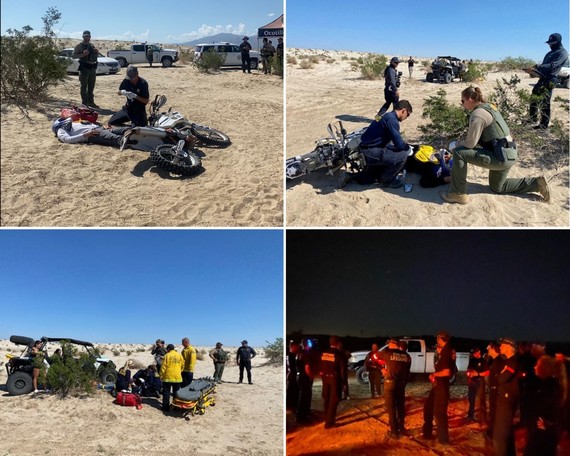 Top left: Ranger Joseph Kurtz and Lifeguards Eli Lapidus and Corey Vaughn with role player Robert Davis. Top right: Lifeguard Clayton Norian, Ranger Amber Nelson and Instructors Drasko Bogdanovich and Jack Valdez with role player Robert Davis. Bottom left: Desert Lifeguard Training staff work with CAL FIRE Station 54. Bottom right: Staff debrief from a nighttime operation. Photos from Desert Lifeguard Training staff.
Wildfire and Forest Resilience Work on Angel Island State Park
Story from: Naftali Moed and Rosa Schneider, Bay Area District
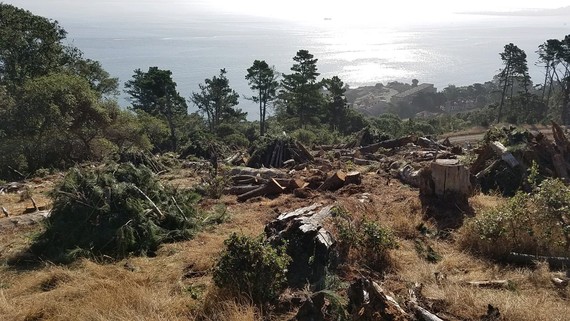 Wildfire and Forest Resilience Program work on Angel Island State Park. Photo from Rosa Schneider, Bay Area District.
The Bay Area District recently completed the first phase of Monterey pine (Pinus radiata) removal work on Angel Island State Park, funded by State Park’s Wildfire and Forest Resilience Program. Contrary to what one may think given the relative geographic proximity inferred by their name, Monterey pine is not native to Angel Island or the Bay Area and occupied an incredibly limited range for much of the past 10,000 years on the Monterey Peninsula and in the Southern Santa Cruz Mountains.
Fast growing and well adapted to our Mediterranean climate, cultivars of Monterey pine were developed and planted all over the world by European settlers for timber production and landscaping and are now incredibly abundant around the world, including in many of the parks in the Bay Area District.
Monterey pine poses threats to the biodiversity of the island, in particular the potential to outcompete native plants in grasslands and oak woodlands, converting areas to pine forests. They also pose the potential to change the expected fire behavior from lower intensity in grasslands/oak woodlands to higher-intensity burns, which could damage natural resources and threaten significant historic buildings on the island.
The pine trees were cut and piled by contractors under the direction of natural resource staff. The piles built as part of this first phase are now curing and will be burned by the Marin County Fire Department and State Parks in the coming year, when it is safe to do so. This project was developed in close coordination with staff from a variety of disciplines and is designed to avoid impacting cultural resources, including historic trees.
It’s hard to tell from the “after” photo below, but there are a considerable number of small oaks within the project area that should slowly fill in this site in the coming years. The district is planning to manage regrowth of pines and other invasive plants in the area. Future work will occur throughout the island in the coming years to address the remaining dense stands of pines in other locations, and to remove small pines throughout the island that are not associated with the historic landscape or cultural resources.
Thanks to all the island staff for the significant help with all the logistics required to make this a successful effort!
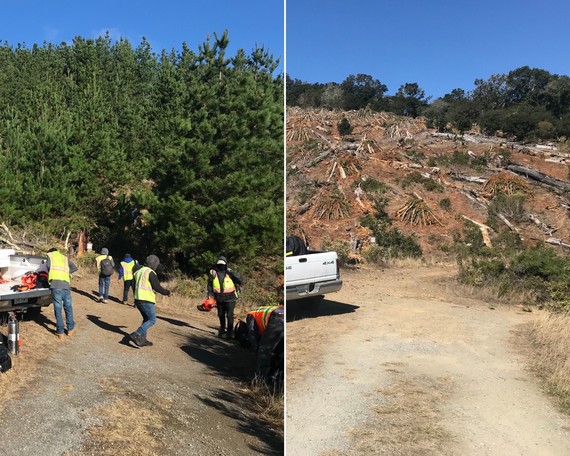 Left: Monterey pine before removal work. Right: After removal work. Photos from Naftali Moed, Bay Area District.
Local Educators Convene for Point Lobos State Natural Reserve Symposium
Story from: Alec Knapp, Monterey District
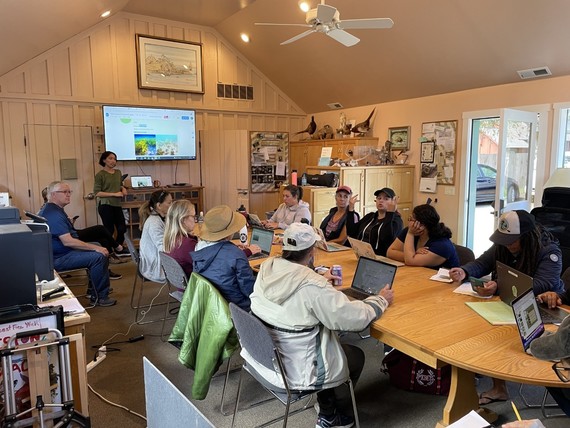 Led by State Parks staff, educators collaborate at the Point Lobos Docent Center. Photo from Alec Knapp, Monterey District.
Think back to your favorite field trip as a child. Was it because you were with your friends or you were exposed to a new environment? Or maybe it was because of a teacher who went the extra mile to make your experience the best it could be?
The California State Parks' Parks Online Resources for Teachers and Students (PORTS) program has been reimagining school field trips for the last few years. Local teacher collaborations called "Symposiums" connect students to their local state parks.
So how does a symposium work? For Central Coast teachers on Saturday, October 1, a symposium meant hiking, kayaking and burritos at Point Lobos State Natural Reserve (SNR). Suffice it to say it was one of the better ways to spend some professional development hours. After all, it is the least we could do for a few teachers who have gone through the wringer of this pandemic. Educators flocked from locations like Monterey, Salinas, Santa Cruz, Watsonville and the Central Valley.
It wasn’t just fun in the sun, of course. The Point Lobos Teacher Symposium was an in-depth discussion and planning session for how teachers will design their curriculums around Point Lobos SNR, connecting their students to an incredible resource while hitting the marks of their required standards. Teachers inspired teachers through stories and sharing techniques, with State Parks staff facilitating it all.
The Point Lobos Teacher Symposium featured 12 brilliant educators along with four PORTS interpreters, one lifeguard, a few senior park aides to coordinate logistics and a whole backstage crew of California State Parks personnel to tie up loose ends to make an event like this happen. Also, CUE (Computer-Using Educators), our rock star partner, sponsored the event with food and kayak rentals!
Our hope is that in 20 years, a few California kids will grow up and be able to reminisce with each other about their favorite field trip at their local California state park.
For more information on the PORTS program and Teacher Symposiums, visit ports-ca.us.
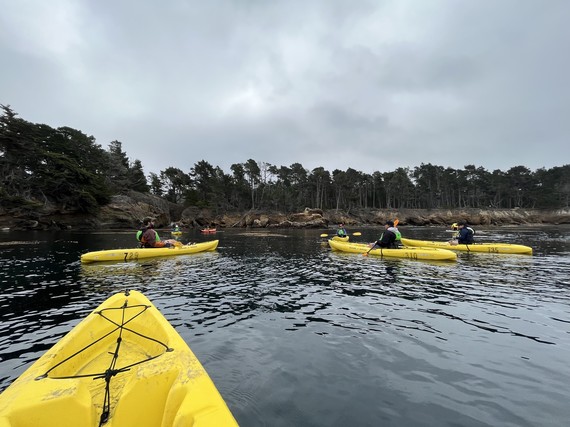 Educators enjoying the sights and sounds while paddling at Whaler's Cove. Photo from Lydia Stinson, Parks Online Resources for Teachers and Students.
Northern Buttes District Moves to New Offices at Bidwell Mansion
Story and photos from: Sam Ruttenburg and Ursula Filice, Northern Buttes District
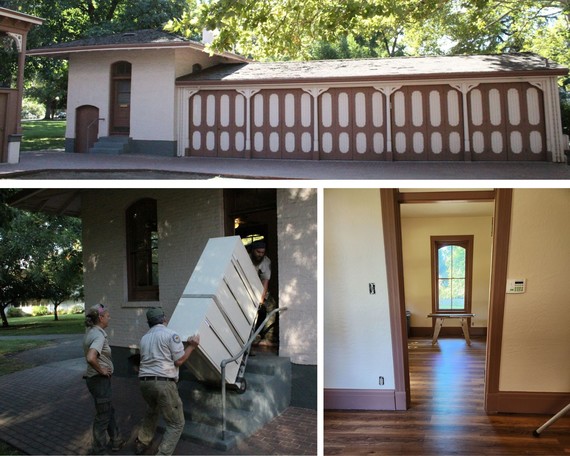 Top: The Architect’s House, built in the early 1860s, was once the residence of famed architect Henry Cleaveland as he oversaw construction of the Bidwell Mansion. Bottom left: Park Maintenance Aide Kelly Haywood (left) oversees Park Maintenance Assistants Jim Chiavola (center) and Cole Fierks (right) as they maneuver heavy furniture into the building. Bottom right: The new floor replicates the feel of the original wood. We think it looks great!
Last Thursday, October 6, was moving day in the Northern Buttes District. After months of planning, the Museum Collections team was finally able to relocate their offices from the Bidwell Mansion Visitor Center to the newly restored Architect’s House.
The Museum Collections team, which consists of Museum Technician Heather Lee and us, are thrilled to be occupying such a unique building. It is sure to serve as an inspiration to them in their work of preserving California’s treasured cultural resources.
Many thanks to our incredible Maintenance staff for all of their hard work in bringing the interior of this beautiful historic building back to life. It feels like home already!
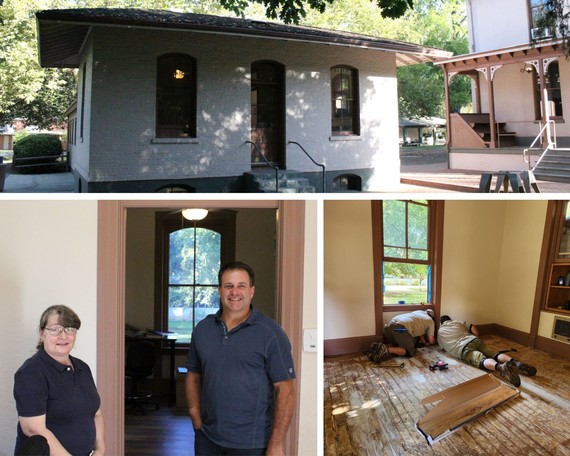 Top: The Architect’s House. Bottom left: Museum Curator I Ursula Filice (left) welcoming District Superintendent Matt Teague (right) as he stops by for a stroll down memory lane. The building used to be Matt’s office back in the mid-2000s. Bottom right: Parks Maintenance Workers I's Robbie Hunzeker (left) and Juan Lopez (right) laying out new laminate panels on top of the original wood flooring.
Visitors ‘Discover Their Adventure’ During Coloma Gold Rush Live! at Marshall Gold Discovery State Historic Park
Story from: Jerrie Beard, Gold Fields District
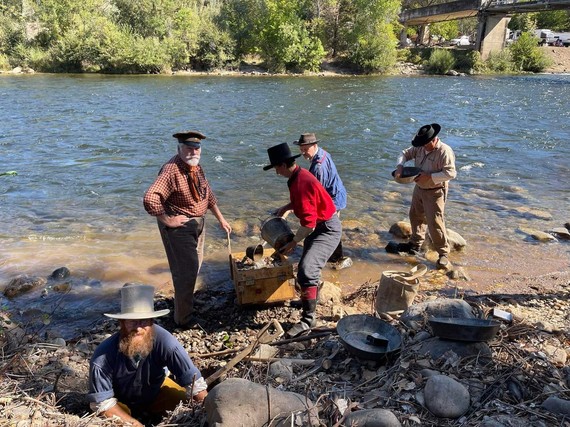 Miners Ethan Phillips, Chuck Graf, Jen Roger, Keenan Bird and Nelson Snook work their claim and a rocker box along the South Fork of the American River. Photo from Jen Roger, Gold Fields District.
Marshall Gold Discovery State Historic Park (SHP) in Coloma, California, invited the public to “Discover Their Adventure” last weekend at the Coloma Gold Rush Live! event over the weekend of October 7-9.
Marshall Gold Discovery SHP is the site of Sutter’s Mill, where in 1848 James W. Marshall found shining flecks of gold in the tailrace of the mill. This discovery changed the course of California’s and the nation’s history and led to the greatest voluntary mass migration of people in the Western Hemisphere.
“Coloma Gold Rush Live! is our biggest event of the year,” said Acting District Superintendent Barry Smith. “Park staff and volunteers transform the park into an 1850s tent town populated by over 150 volunteers portraying characters from the past and providing hands-on demonstrations. As visitors wander through, they get a taste of what life was like in Coloma during the Gold Rush.”
This year, visitors were encouraged to “Discover Their Adventure” and asked to identify where their family would have come from in 1850. The locations were marked on a map at the welcome table, and visitors were given a brief description of how their ancestors might have traveled to the California Gold Rush.
Upon arriving at the goldfields, guests could visit the general store to stock up on provisions before heading out to the mines or drop by the mining camp along the river for information on the latest mining techniques. For those who had been prospecting the hills and ravines, the claims office was the go-to spot to register a claim or talk with the assayer to determine the worth of a recent gold strike.
A trip to the laundry for a clean shirt and the tonsorial for a shave and a bath may have been in order before heading over to the saloon for a little liquid refreshment. However, guests were advised to keep their gold dust close, as wily gamblers were known to frequent the saloon!
“This event just keeps getting bigger and better every year,” continued Smith. “Our interpretive staff works throughout the year to develop venues for the event and to train volunteers in interpretive techniques and appropriate period attire.”
Before heading back out to the mines, visitors could stop at the blacksmith to pick up repaired tools or a new pair of shoes for their horse. The carpenter had rocker boxes ready for the new arrivals, and there were plenty of hands-on activities to keep the kids, young and old, entertained, including gold panning, tin punching, journaling and a plethora of children’s games.
“Our maintenance team spends countless hours preparing the grounds for this event—from leaf and debris cleanup, to mowing and tree trimming, to milling lumber for tent poles, benches, tables and other items needed for the event,” said Smith. “With a modern sawmill on-site and a fully outfitted carpentry shop, the maintenance staff can now fulfill most lumber needs in house.”
Coloma Gold Rush Live! is made possible thanks to our partnership with the Gold Discovery Park Association, the cooperating association at Marshall Gold Discovery SHP. Proceeds from the event will help fund future educational programs at the park. Over 6,000 people attended the three-day event.
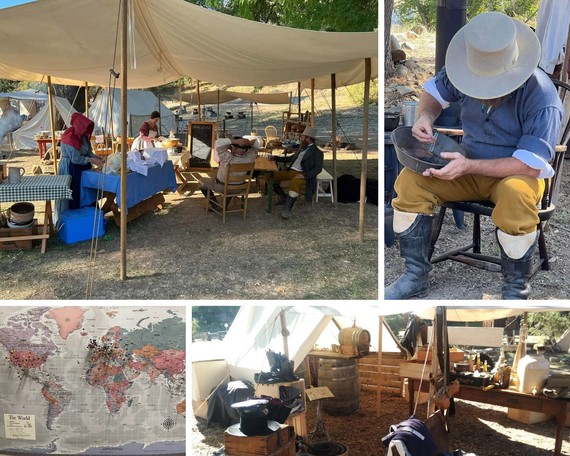 Top left: Restaurateurs Sharon Dennis and Stephanie Baltz prepare a meal for a pair of well-off miners. Photo from Jen Roger, Gold Fields District. Top right: Miner Ethan Phillips pans out black sand from the rocker box. Photo from Jen Roger, Gold Fields District. Bottom right: The general store provided a plethora of provisions to new arrivals as well as established miners in the gold fields. Photo from Jen Roger, Gold Fields District. Bottom left: Visitors to the event were encouraged to "Discover Their Adventure" and asked to identify where their family would have come from in 1850. The locations were marked on a map at the welcome table, and visitors were given a brief description of how their ancestors might have traveled to the California Gold Rush. Photo from Jerrie Beard, Gold Fields District.
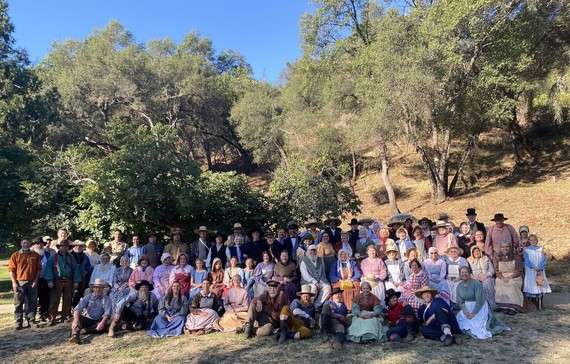 Group photo of State Parks staff, docents and volunteers at Marshall Gold Discovery State Historic Park for Coloma Gold Rush Live! 2022. Photo from Holly Thane, Gold Fields District.
  Email photos to the WeeklyDigest@parks.ca.gov.
|