Big Basin Redwoods State Park Reopens for Day-Use by Reservation
Story from: Will Fourt, Santa Cruz District
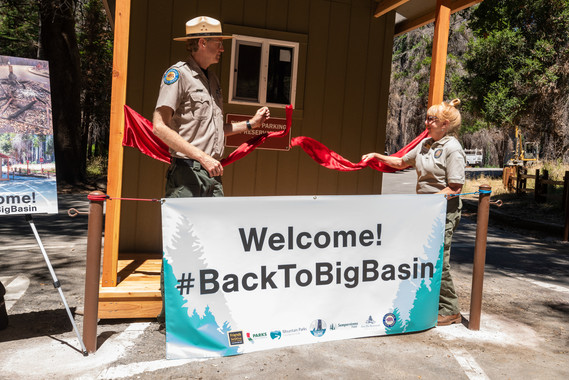
Superintendent Chris Spohrer (left) and Senior Visitor Services Aide Debbie Martwick of Friends of Big Basin Redwoods are at the ceremonial ribbon cutting for the reopening of Big Basin Redwoods State Park. Photo from Brian Baer, Communications and Marketing Division.
Big Basin Redwoods State Park has been closed to the public since the CZU Lightning Complex Fire burned most of the park in August 2020. Flames destroyed nearly every structure, including the park headquarters, housing for park employees and campgrounds.
After substantial fire recovery work was completed at the end of 2021, district staff, the Northern Service Center, contractors and partners have been working hard to prepare a portion of the park for limited day-use access through a reservation system. The day-use-only reservation system will provide public access to the Redwood Loop and access about 18 miles of fire roads near the historic park core. Services will be limited. The park is still without electricity, water, flush toilets, phone service or buildings.
To prepare for the day-use public access, work has included trail work, repair of roads and culverts, hazardous tree work, preparation of temporary park operation facilities and installation of temporary public facilities. These facilities include a temporary small visitor center area, portable restrooms within an enclosure, interpretive signage, three small parking areas with an entrance area for staff to check in visitors, a public bus stop and a welcome panel and park map. The Redwood Loop Trail and Dool Trail have been repaired and are open for hiking. Split rail fencing, a small deck and wood for the visitor center exterior and restroom exterior have been constructed from lumber that was milled from trees that fell during the fire.
The reservation system is being managed by Friends of Santa Cruz State Parks through their position as co-management partner with State Parks. Reservations are available online or by phone (831) 338-8867. Most spaces will be available by up to 60 days in advance, while a limited number of reservations will be released three days before the visit date. Initially, 45 spots will be offered daily. Preregistration is required. No day-of, drive-up entry will be available. Entry is $6, plus a $2 reservation fee, and will provide daylong access to the park. State Parks' day-use passes, and other park entry programs will be honored, including the recently expanded Golden Bear Park Pass, which provides free access to State Parks for families receiving CalWORKS benefits and others.
Public access to Big Basin coincides with the reopening of Highway 236, the main thoroughfare through the park. Once open, drivers may go through the park on Highway 236 without stopping. All parking within the park will be by reservation only. Visitors can also access the park by bicycle or METRO bus route 35, which runs on weekends only, without a reservation.
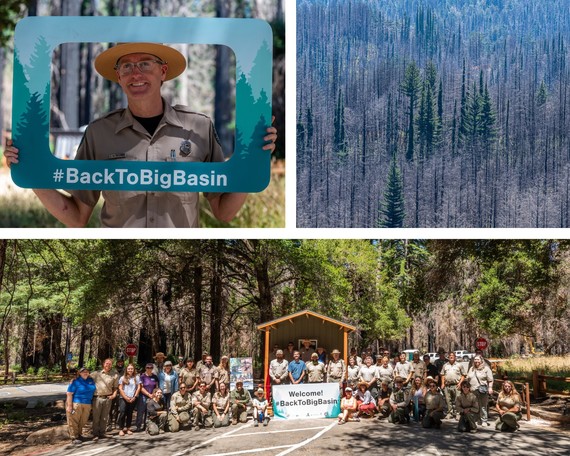 Top left: Superintendent Chris Spohrer poses with sign at the ceremonial ribbon cutting for the reopening of Big Basin Redwoods State Park. Top right: The forest makes a small recovery. Bottom: Parks employees and others gather at the ceremonial ribbon cutting for the reopening of Big Basin Redwoods State Park. Photos from Brian Baer, Communications and Marketing Division.
Fire-Trained Employees Learn New Skills on Wildfire Suppression Through Portable Pumps Class
Story and photos from: Brooke Sheridan, Natural Resources Division
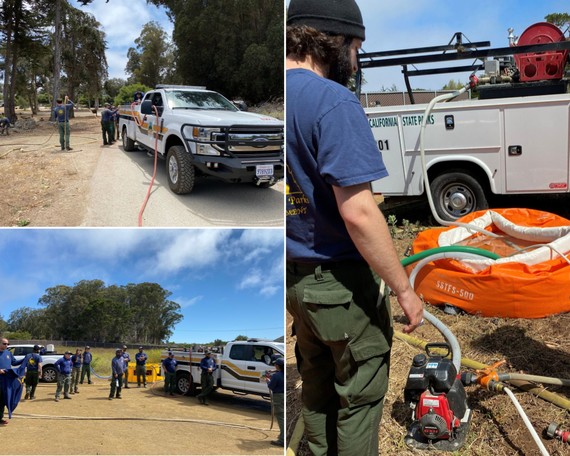 Top left: Students practice mobile attack and patrol using portable pumps on an engine. Bottom left: Students learning how to work a different nozzle type during the Portable Pump course. Right: Students practiced with various pumps and learned drafting and pump priming techniques.
State Parks fire-trained employees who are qualified to respond to wildfire and prescribed burns attended S-211 Portable Pumps class in early July. The course was held at the Morro Bay Fire Department, with field exercises hosted by San Luis Obispo (SLO) Coast District.
The Portable Pumps class was instructed by Firestorm, which was contracted through the Wildfire and Forest Resiliency Program, and SLO Coast District provided additional instruction assistance during field exercises to achieve course objectives. The S-211 Portable Pumps course objective is to demonstrate knowledge and skill needed to design, set up, operate, troubleshoot and shut down portable water delivery systems.
During the field exercises, State Parks staff from all over the state put lecture to practice by working with fellow department colleagues to become familiar with priming and starting techniques on various pump designs, as well as hands-on practice with patrol and mobile attack with engine pumps, pump troubleshooting, progressive hose lays with portable pumps, hydraulic feasibility and more.
Students were also given the opportunity to discuss and brainstorm initial attack tactics utilizing portable pumps for wildfire suppression and structure protection and defense, as well as prefire planning to include mapping out hose lay around structures, sprinkler systems, nozzle types and fittings, and understanding hydraulic feasibility for various site conditions based on topography, fuel type, weather, pump capabilities, personnel and more.
Thank you to Firestorm and SLO Coast District for instructing and hosting the 2022 Portable Pumps class, and an enormous thank you to all the class attendees and instructors for your unwavering passion for the work you do!
Staff Attends Prescribed Fire Monitoring Training at Calaveras Big Trees State Park
Story and photos from: Jim Suero, Natural Resources Division
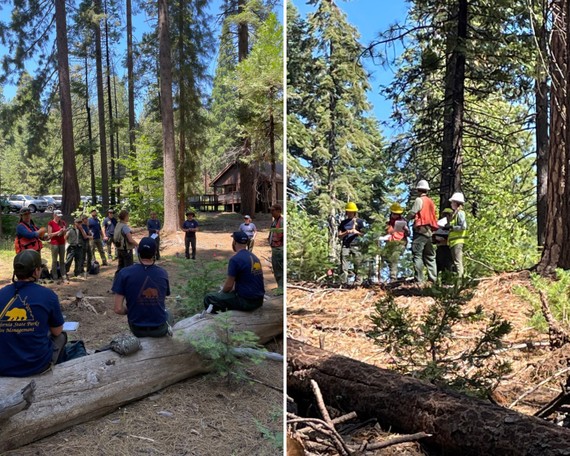 Left: Students review the monitoring protocols before implementing a plot in the field. Right: Training attendees learn the protocols of the California Prescribed Fire Monitoring Program.
Hosted by the Central Valley District, Wildfire and Forest Resilience staff from eight districts on July 12 and 13 attended the first training for the California State Parks Prescribed Fire Monitoring Program at Calaveras Big Trees State Park. With instruction by University of California (UC), Davis-Safford Lab, and the Fire and Resource Assessment Program (FRAP-CAL FIRE), attendees learned the survey protocols of the California Prescribed Fire Monitoring Program, a joint statewide monitoring collaboration between the UC Davis-Safford Lab and FRAP, the scientific arm of California Department of Forestry and Fire Protection (CAL FIRE).
Taking both pre- and post-vegetation treatment data, the objective of the monitoring program is to provide State Parks forest and fire managers with a better understanding of management actions and prescribed fire effects to inform future wildfire and forest resilience management, as well as provide important data to the larger statewide monitoring effort. Based on the U.S. Forest Service’s Common Stand Exam, attendees learned to establish 400-square-meter plots and Brown’s transects, capturing important data such as species composition, species cover, species regeneration, tree basal area, coarse woody debris, forest litter depth and other important vegetation and fuels data.
From all accounts, it was a successful training, and we are now better prepared to implement our wildfire and forest resilience, prescribed fire monitoring program, which is an important component to adaptive forest and fire management under a changing and challenging climate.
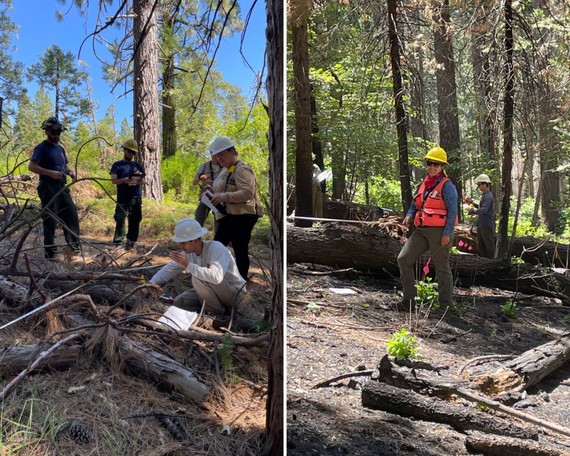 Left: Northern Buttes District Environmental Services Intern Chad Mackie (kneeling) takes fuels data as Northern Buttes Environmental Scientist Trish Ladd and other staff from Northern Buttes and Central Valley Districts record data and learn the protocols. Right: Sierra District Senior Environmental Scientist Courtney Rowe assists in implementing a monitoring plot in the recent North Grove Burn.
Horses 101 at Cuyamaca Rancho State Park
Story and photos from: Michele Hernandez, Colorado Desert District
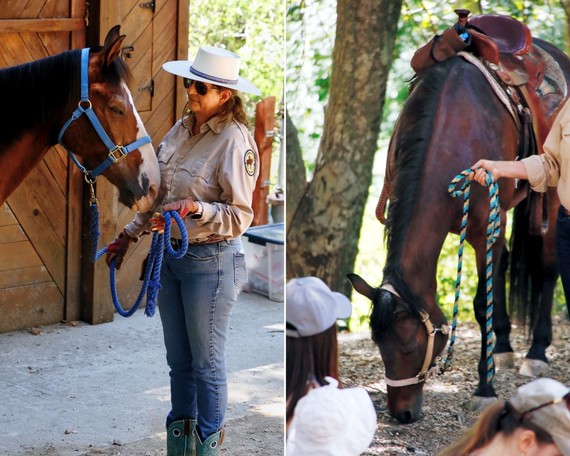 Left: Volunteer Laurie Luitweiler and her horse, Diego, teach visitors all about horses during Horses 101 at Cuyamaca Rancho State Park. Right: Volunteer Shelley Cyganik’s horse, Em. Shelley said that Em is an experienced camper and knows to look for s’mores around fire rings when camping.
In Cuyamaca Rancho State Park (SP), we are lucky to have mounted volunteers who love helping in the park. One of the ways they are helping is with the program Horses 101. Cuyamaca Rancho SP is a busy, recreation-heavy park where hikers, mountain bikers and equestrians come together to enjoy its natural beauty. This means that a lot of people who have never seen horses in person may not know what our equine friends are all about.
That’s where Horses 101 comes in. The program is done at the Green Valley Campground, where the family horse camp is located. The purpose is to make campers aware of the best way to interact with horses in camp and on the trails. It starts with mounted volunteers explaining a horse’s basic nature as a prey animal and then proceeds on to what to do when the horses are encountered on the trail and when they are in camp. There is usually a spirited Q&A session during the presentation.
The highlight of the program is when park visitors are allowed to come up and meet the horses, applying what they have just learned. It is always exciting to watch children and adults, some who a wary of horses, approach and eventually pat the horses.
Horses 101 is a fun, informative program that brings volunteers and park visitors together in a positive way and is popular with park visitors and volunteers. That is a winning combination.
Construction Begins on Mount Diablo State Park's Bike Turnout Project
Story and photos from: Elise E. McFarland, Diablo Range District
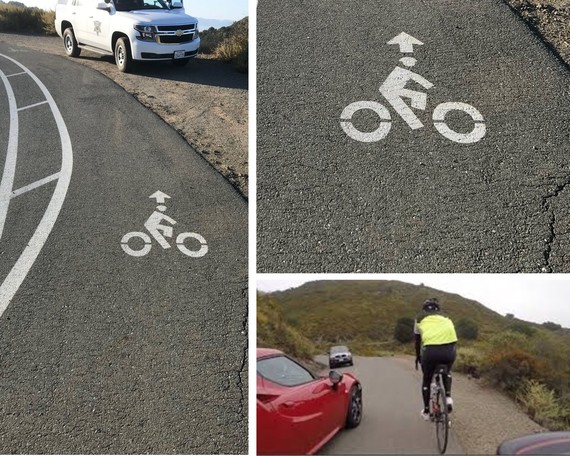 Before (bottom right) and after (left and top right) photos of the bicycle turnouts on Southgate Road.
Mount Diablo State Park is excited to announce the beginning of construction on new bike turnouts. This project, which makes travel on the mountain safer for both bicyclists and drivers, is a high priority for California State Parks and was funded by the State Legislature.
Construction of the first phase of the project began on Monday, July 18, and necessitated the closure of Southgate Road to all traffic. Work on the first phase will continue through August, with Southgate Road closed Monday through Friday. Roads and campgrounds will be open on weekends. If you’re entering the park on Northgate Road, please be prepared for large trucks on the road and drive carefully.
For more information on the closures at Mount Diablo State Park, please visit the park's webpage or Facebook page.
Gold Discovery Days at Plumas-Eureka State Park Strikes Gold
Story and photos from: Jeremy Lin, Sierra District
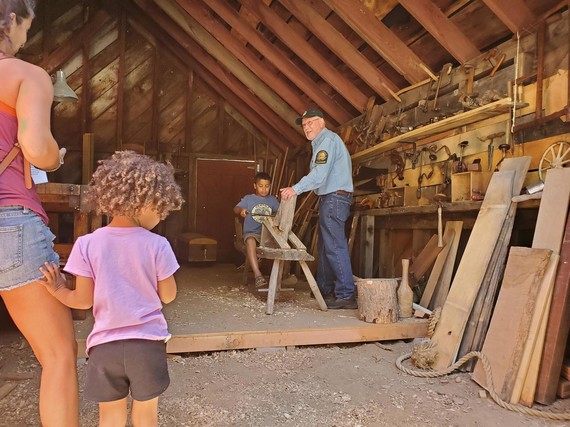 Event participant Noah Williams learns to use a draw knife tool from Volunteer Richard Clemens in the woodworking shop.
Park guests panned for gold, watched blacksmith demonstrations and rode on an authentic hay wagon pulled by draft horses at this year's Gold Discovery Days event on July 16 and 17 at Plumas-Eureka State Park. Plumas-Eureka State Parks Association, Plumas Ski Club and other visiting community exhibitors inspire visitors to venture into the past to experience the lifestyle and hard work of mid-19th-century gold miners.
Guests were invited to take guided tours of the historic assay office, discover “hidden artifacts” at the archaeology table and enjoy live folk music. Park volunteers dressed from head to toe in old-time garb while leading tours of the old Moriarty House, where guests marveled at the old furniture and listened to the docent’s description of the daily lives of the former Johnsville residents before the days of cars and electricity.
The local Graeagle Lions Club served burgers, chips and drinks, with all fundraised money to be reinvested into community projects.
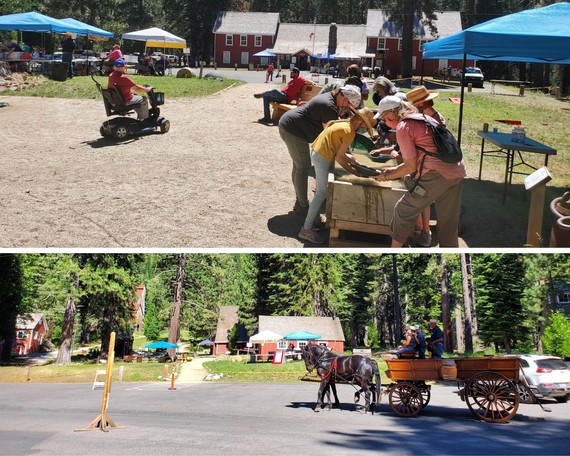
Top: Park guests strike it rich in the gold panning station. Bottom: Horse-drawn wagon rides brought visitors into the past for a unique tour of the park and historic gold mining area.
Interpretive Exhibit About Famed 'Tunnel Tree' to open in Calaveras Big Trees State Park
Story from: Communications and Marketing Division
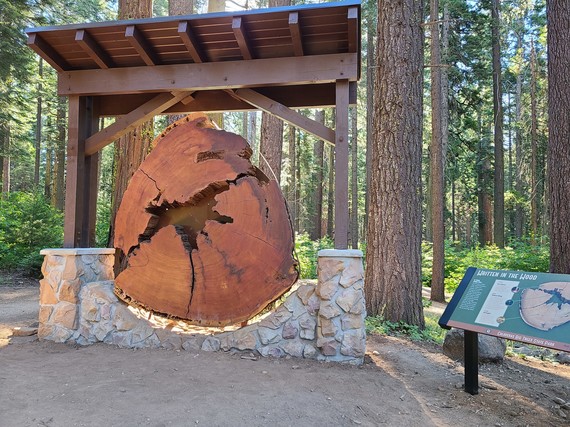 A look at the new exhibit on famed "Tunnel Tree," opening Saturday, July 23, at Calaveras Big Trees State Park. Photo from Amber Sprock, Central Valley District.
State Parks, the Calaveras Big Trees Association (CBTA) and Save the Redwoods League announce the opening of the Pioneer Cabin Tree interpretive exhibit in the North Grove at Calaveras Big Trees State Park (SP) on Saturday, July 23. The display includes an enormous “tree cookie” extracted from the 1,223-year-old fallen giant, which toppled in 2017, revealing a fascinating history of fires, drought and injuries, but also telling a story of healing and resilience.
“The new giant sequoia exhibit at Calaveras Big Trees will truly enhance the entrance to the North Grove Trail and provide a chance for visitors to connect with one of the most famous trees in the park—the Pioneer’s Cabin Tree,” said Mike Merritt, California State Parks district interpretive manager. “With this exhibit, visitors will have a new way to identify where the trail is and learn more about giant sequoia trees."
Standing 205-feet tall and more than 19 feet in diameter, the Pioneer’s Cabin Tree was one of about 150 ancient giant sequoias within the North Grove. The tree was distinguished by its crown, most of which had been shorn off by lightning, and by the distinctive fire scar at its wide base. In the 1880s, the former owners of the North Grove squared off the opening, creating a “tunnel tree” extremely popular with tourists. Thousands of park visitors passed through the Pioneer’s Cabin Tree on foot and horseback and by carriage and car. But the famous sequoia toppled five years ago, after a period of heavy rain and high winds.
After the tree fell, Save the Redwoods League worked with State Parks and the CBTA to extract and dry a cross section, or “tree cookie,” so they could learn more about the tree’s long history. Allyson Carroll, a dendrochronology with California State Polytechnic University, Humboldt, has analyzed the section, identifying key events in the tree’s life and matching years with specific tree rings. The information will help State Parks better understand the dynamic changes these ancient trees have experienced and will inform the management of existing groves of giant sequoias—a task made more urgent in the face of climate change.
“Save the Redwoods League, in collaboration with several agencies and organizations, is actively working to reintroduce fire to these forests and protect the giant sequoia on a landscape scale,” said Deborah Zierten, education and interpretation manager for Save the Redwoods League. “The preservation and interpretation of a cross section from this iconic tree helps showcase the importance of giant sequoias, especially at a time when they are under such threat from wildfire and climate change.”
The "cookie” and two interpretive panels are displayed at a kiosk next to the visitors center at Calaveras Big Trees SP, at the North Grove trailhead. A third interpretive panel is displayed next to the Pioneer’s Cabin Tree itself, which, though fallen, remains an important part of the forest ecosystem. The work was funded by Save the Redwoods League, the Calaveras Big Trees Association and private donations.
“CBTA is grateful to Save the Redwoods League and California State Parks for studying the fallen Pioneer’s Cabin Tree and preparing this display,” says Paul Prescott, president of the Calaveras Big Trees Association. “When the beloved monarch fell in 2017, we heard from hundreds of people all around the world. Their letters and pictures told stories about how the Pioneer’s Cabin Tree had been part of their life experience. Thanks to our partners, thousands more will now learn about this friend that is fallen, but not forgotten.”
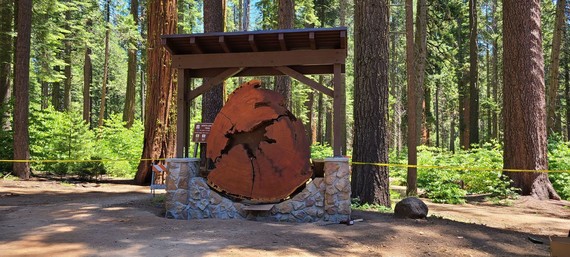 Installation of the new exhibit on famed "Tunnel Tree." Photo from Amber Sprock, Central Valley District.
  Email photos to the WeeklyDigest@parks.ca.gov.
|